(Some) Space Weather Forecasts are Less Certain during Solar Minimum than Solar Maximum

Dechen Gyeltschen (d.l.gyeltshen@pgr.reading.ac.uk)

Summary of Gyeltshen, D. L., et al. (2026) 

What is space weather?

Space weather refers to the short-term changes in the space environment of our solar system. We tend to focus on near-Earth space due to its direct impact on human life and infrastructure. Extreme space weather events can cause disruptions to satellite operations, navigation systems, radio communication, power grids, and rail networks. Additionally, they expose humans in space or on high-altitude flights to harmful radiation and energetic particles. Although mitigation procedures are being developed and refined, their efficacy relies on the accuracy of extreme space weather forecasts. As such, understanding causal phenomena such as solar eruptive processes and high-speed solar wind remains a high priority for improving prediction accuracy. 

Coronal Mass Ejections (CMEs) are drivers of the most severe space weather. They consist of a large structure of plasma and an accompanying magnetic field that have a typical Sun-Earth transit time of 1-5 days. This range exists because a) CMEs are ejected at different speeds and b) CMEs interact with the background ‘ambient’ solar wind and can be accelerated/decelerated due to drag forces. Current CME transit time predictions possess errors on the order ± 10 hours.

How are forecasts made?

Identifying sources of these errors requires an understanding of how CME transit time forecasts are made. The forecast process is outlined as follows, with a visual summary provided in Figure 1: 

  • Information about the Sun’s magnetic field structure in the form of magnetograms is used as initial data. 
  • These are fed into coronal models to generate ambient solar wind speed profiles at 0.1 Astronomical Units from the Sun (1 AU ~ 150 million kilometers). 
  • CME parameters are derived from white light coronagraph images and extrapolated to 0.1 AU. 
  • Together they serve as initial conditions for heliospheric models that simulate CME propagation to Earth and other planetary bodies.  
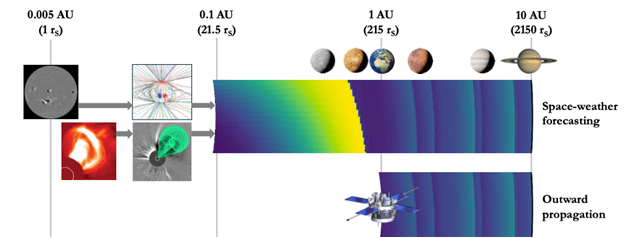
Figure 1: Schematic of standard space weather forecasting method. From top left to bottom right: A magnetogram, a coronagraph, coronal modelling, derivation of CME parameters, heliospheric modelling to Earth and to outer planets (Owens, M. J., et al. (2026)).

While the models used are imperfect, transit time errors largely stem from initial uncertainties in observations of CME parameters and ambient solar wind conditions.  

What did we do?

Though the sources of transit time errors are identified, the extents of their contributions vary, and isolating individual error contributions for observed events is difficult. In particular, the ambient solar wind properties exhibit substantial variability over the solar cycle. Observations show that during solar minimum, Earth intercepts interchangeable fast and slow winds over the course of a month. On the other hand, the solar wind during solar maximum is less stark in its longitudinal gradients. Does this structural difference between solar cycle phases change the ambient solar wind influence on CME propagation? If yes, by how much?  

We performed simulations of CME propagation using the Heliospheric Upwind eXtrapolation with time-dependence (HUXt) solar wind model to answer these questions. HUXt approximates the solar wind as a one-dimensional and hydrodynamic flow, which allows for low computational cost. We used realistic solar wind data to simulate a statistically average CME and a fast CME every day between 1975 – 2024 (4.5 solar cycles). This is 18,000 runs and 126,000 simulation days (for each CME)! This gave us a dataset of daily CME transit times to Earth that was later used for the analyses. An example of two such simulations is provided in Figure 2. 
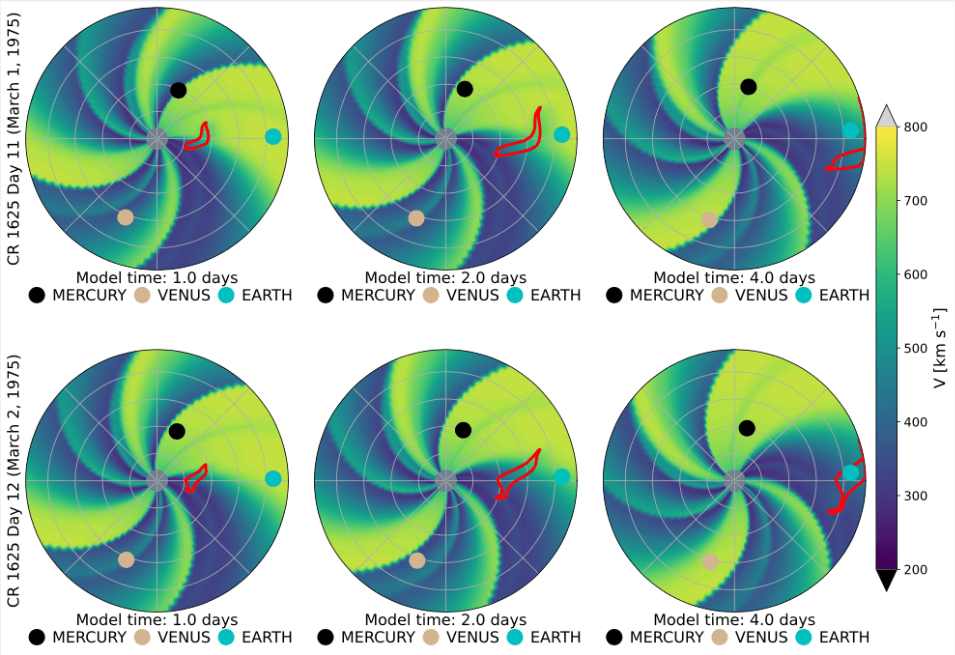
Figure 2: Snapshots of solar wind speed in the solar equatorial plane at three different times (from left to right, shown times are 1, 2, and 4 days after CME launch) from two HUXt simulations. The CME is shown by the red outline. Date labels on the left denote initiation time: the top plots were initialized just 1 day before the lower plots, but the arrival times vary a lot! 

What did we find out?

From the dataset of daily transit times, we calculated the monthly medians and interquartile ranges. We used the median to characterise the typical transit time, and the interquartile range to represent short-term variability of transit time. The distributions for these metrics are shown in Figure 3 for both types of CMEs. 
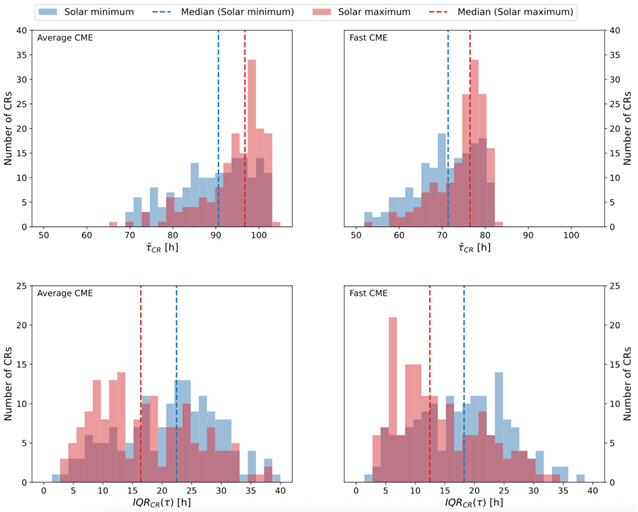
Figure 3: Top: Distributions of monthly transit time medians, during solar minimum and maximum solar phases for average and fast CMEs. Dotted lines represent median values for the distributions. Bottom: The same for distributions of the monthly interquartile range. 

Figure 3 tells us three things: 

  • CMEs arrive faster during solar minimum: the median values show that average CMEs arrive about 5 hours earlier during solar minimum. This is because CMEs encounter either slow or fast wind during solar minimum, but solar maximum presents mostly slow wind that does not accelerate any CME to the same degree. 
  • Transit times are more variable (~6h more variable for an average CME) during solar minimum. The design of our experiment dictates that this effect purely arises from the change in ambient solar wind structure over a solar cycle. 
  • These results are true for both CME types.  

In other words, even identical CMEs can exhibit a range of transit times due to changes in the ambient solar wind structure. Moreover, the magnitude of this variability peaks during solar minimum. It implies that in the absence of accurate ambient solar wind conditions, CME arrivals are intrinsically less predictable during solar minimum than solar maximum. Additionally, the penalty for incorrectly modelling the ambient solar wind—for example, small errors in speed gradients or the position of high-speed streams—is greater during solar minimum. 

Main Takeaways

  • During solar minimum, the arrival time of coronal mass ejections at Earth is roughly twice as uncertain due to the influence of the ambient solar wind compared to solar maximum. 
  • Importance of ambient solar wind representation during solar minimum is emphasised.  
Chasing Rain in a Tropical Archipelago: When Do Storms Really Occur?

By Dony Christianto (d.christianto@pgr.reading.ac.uk)

“When do storms really happen?”

It sounds like a simple question—but in the tropics, there is rarely a simple answer.

We often learn this simple process: daytime heating drives peak afternoon rainfall. It is a useful idea—and in many cases, it works. But as we looked more closely at rainfall in Papua, it became clear that the atmosphere was telling a more complex story.

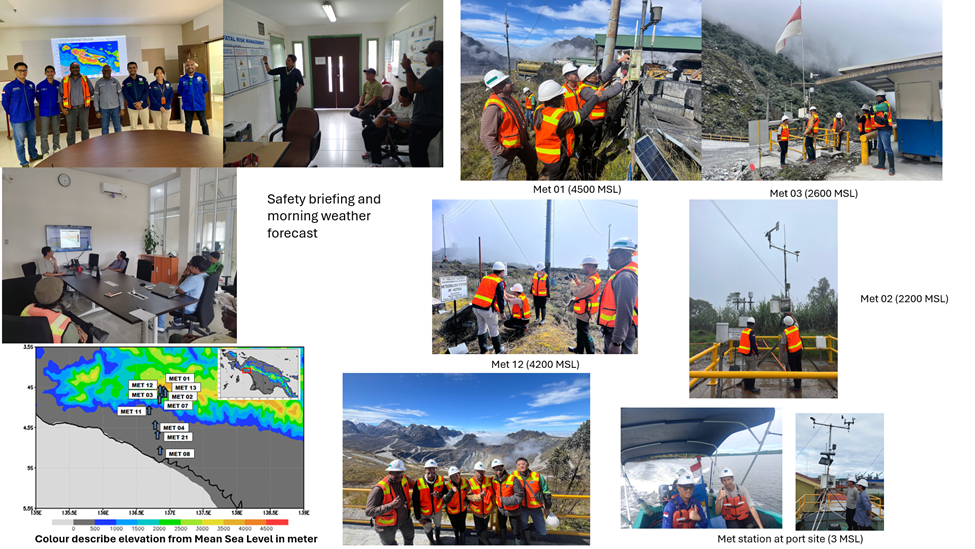
This work began in the field, in southern Papua near Timika. We worked with a network of Automatic Weather Stations (AWS) located across the extraordinary landscape of southern Papua (Figure 1). Across roughly 100 km, the terrain rises from sea level to mountain peaks exceeding 4,700 m. Along this steep transition, particularly in the foothill regions, rainfall reaches some of the highest values in the world, with annual totals of around 12,500 mm.

Figure 1: Automatic Weather Station network across Papua, spanning coast to high mountains, providing critical observations in a complex tropical environment.

This combination of coastline, lowland, and steep mountains creates a highly dynamic environment. Papua is not just another tropical region—it is a natural laboratory where local and large-scale atmospheric processes interact in complex ways.

The AWS data used in this study comes from a collaboration between PT Freeport Indonesia and BMKG (the Indonesian Agency for Meteorology, Climatology, and Geophysics). Maintaining these observations requires field visits, safety briefings, and working in remote areas where conditions can change rapidly. It is a reminder that every dataset has a story behind it—and that reliable ground observations remain essential, especially in regions as complex as Papua. This becomes particularly important when we consider how rainfall is commonly studied today.

Satellite products such as GPM-IMERG are widely used because they provide global coverage. In many studies, they are treated as a reference for understanding rainfall behaviour. But before relying on them, it is important to ask: how well do they represent what actually happens at the surface?

To address this, we compared satellite rainfall estimates with AWS observations in Papua (Figure 2).

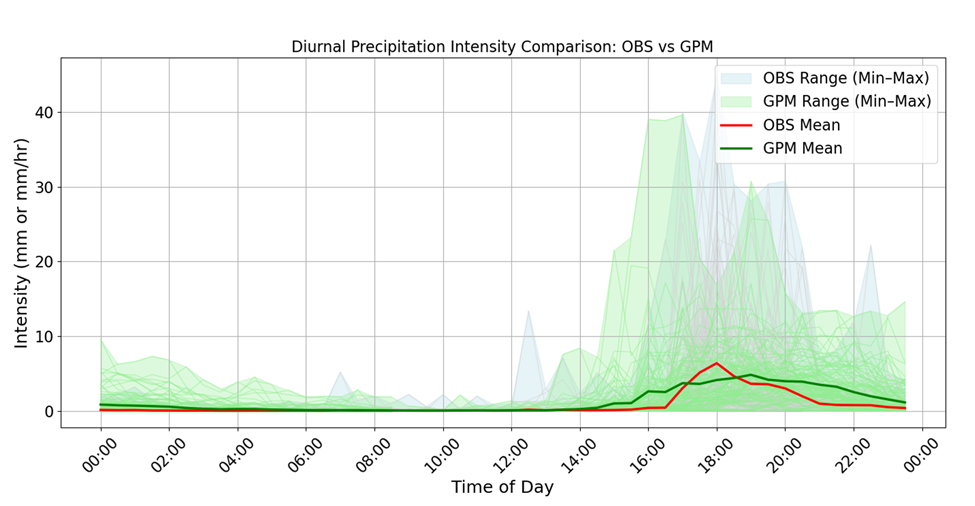
Figure 2: Comparison of diurnal rainfall intensity between ground observations (AWS) and satellite estimates (GPM-IMERG), showing a consistent delay in satellite peak timing, with observed rainfall peaking around 16:00 local time and GPM-IMERG peaking later.

What we found was consistent across the dataset: satellite rainfall peaks tend to occur later than those observed at the ground, typically by around one to three hours. This delay reflects that satellites are more sensitive to mature convective systems and therefore detect rainfall after storms have already developed.

At first glance, a difference of a few hours may not seem significant. However, in meteorology, timing is critical.

Satellite datasets are often used to evaluate weather and climate models. If rainfall timing is systematically shifted, models that appear to perform well against satellite data may not accurately represent real surface processes. This also has implications for applications such as early warning systems, where even small timing differences can influence how rainfall events are detected.

Having established this, we then turned to a more fundamental question: when does rainfall actually occur?

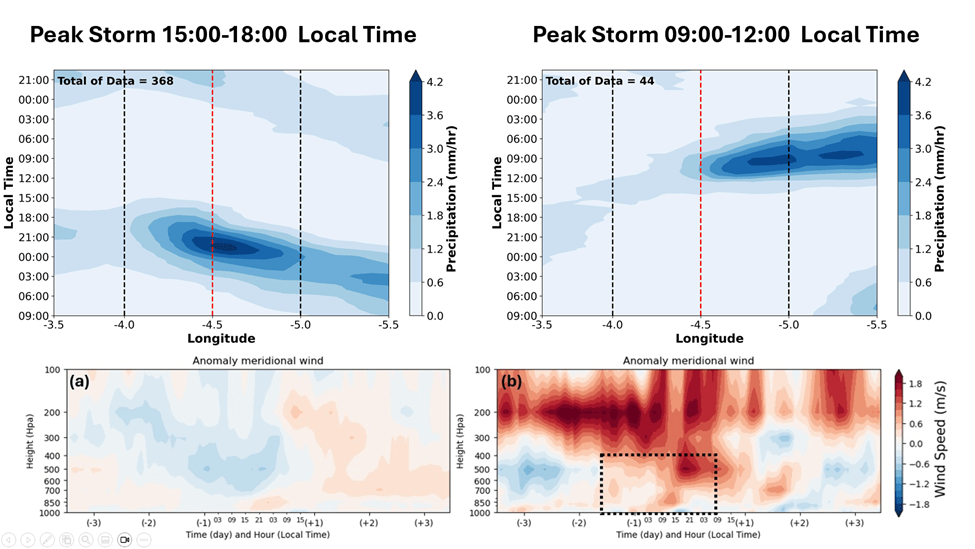
While rainfall in Papua often peaks in the late afternoon (around 15:00–18:00 local time), our analysis revealed a second important rainfall regime in the early morning, typically between 03:00 and 09:00 (Figure 3).

Figure 3: Contrasting rainfall regimes in Papua: afternoon storms (15:00–18:00 LT) are associated with offshore propagation from inland regions, while morning storms (09:00–12:00 LT) are linked to onshore flow bringing precipitation inland. The lower panels show meridional wind anomalies, with blue indicating southward (offshore) flow and red indicating northward (onshore) flow.

These two rainfall peaks are not simply different in timing; they are produced by different atmospheric processes.

Afternoon rainfall is largely driven by local processes. Solar heating during the day warms the land surface, causing air to rise, consequently triggering convection. In Papua, this process is strongly enhanced by the presence of mountains, which help initiate and organise storm development. These systems typically form over land and propagate towards the coast.

Morning rainfall, in contrast, often originates over the ocean. During the night, convective systems develop offshore and are transported inland by low-level winds. In this case, rainfall is not initiated locally but carried from the sea.

This leads to a key insight: rainfall timing is closely linked to wind direction.

When winds are directed offshore (from land towards the sea), they favour afternoon and evening rainfall over land. Conversely, when winds are onshore (from sea towards land), they transport moisture inland and are associated with morning rainfall. These alternating wind regimes create distinct “windows” for storm development throughout the day.

The next question is: what controls these wind patterns? The answer lies in larger-scale atmospheric processes.

Phenomena such as the Madden–Julian Oscillation (MJO), equatorial Rossby waves, and seasonal monsoon circulations influence the background wind environment over Papua. For example, different phases of the MJO are associated with shifts in wind direction and moisture transport. Some phases favour onshore flow, increasing the likelihood of morning rainfall, while others favour conditions more conducive to afternoon convection.

This highlights an important point: rainfall in Papua is not controlled by a single mechanism, but by interactions across multiple scales.

This is where the role of local characteristics becomes critical.

Every region has its own unique combination of topography, coastline, and atmospheric conditions. These factors shape local circulation patterns, which determine how that region responds to larger-scale climate phenomena. This is particularly important in the tropical Maritime Continent, where thousands of islands differ in size, shape, elevation, and land–sea distribution. These differences influence surface properties such as albedo, heat capacity, and moisture availability, which in turn affect how energy is distributed within the atmosphere.

As a result, each island develops its own local circulation system. Even under the same large-scale forcing—such as the MJO or monsoon—different regions can exhibit very different rainfall behaviour. The interaction between local geography and atmospheric processes creates a wide range of responses across the region.

Papua, with its steep topography and strong land–sea contrasts, provides a clear example of this complexity.

From field observations to large-scale atmospheric dynamics, this study highlights a simple but important message: understanding rainfall in the tropics requires considering both the local environment and the broader climate system.

Because in regions like Papua, rainfall is determined not by a single process, but by the interaction of many.