COP27 – An oasis in the heat of the climate change emergency, or a deserting of hope?

Rosie Mammatt – r.m.mammatt@pgr.reading.ac.uk

Thea Stevens – thea.stevens@pgr.reading.ac.uk

Sitting in the COPCAS studio in the University of Reading we were able to watch the numerous talks and panels taking place each day. This allowed us to tune into the different discussions surrounding topics from the role of civil society to the importance of biodiversity, giving us a unique insight into the proceedings of the conference. Through our team of people attending the conference, we were able to interview those who were participating in the negotiations, such as Robert Muthami, a climate and social justice advocate from Kenya. This gave us a gauge of what the atmosphere was like within the discussion and negotiation rooms. This left us with mixed emotions nearly 4000 miles away in Reading…
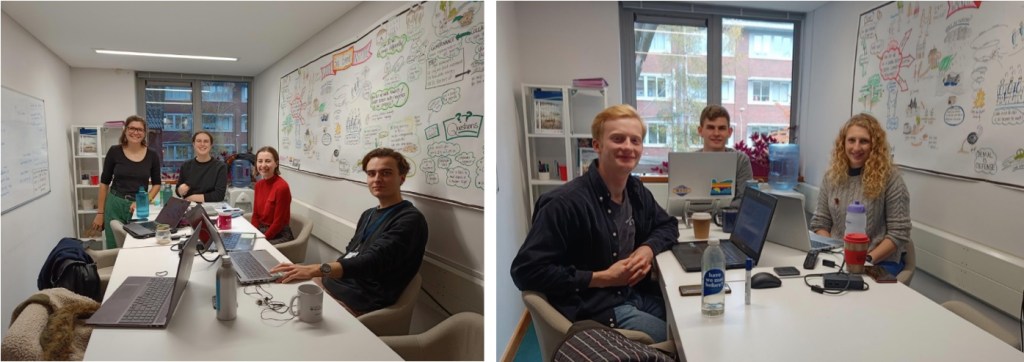
Left: Thea with her team in the Climate Action Studio on Energy and Civil Society Day. Right: Rosie with her team in the Climate Action Studio on the opening day of COP27.

“Human actions are the cause of this problem, so human actions must be the solution”. These were the words spoken passionately by UN Secretary-General António Guterres during the World Leaders Summit on the opening day at COP27. Similarly rousing speeches followed from world leaders and delegates who highlighted the challenges their countries are facing due to the climate emergency. The tone was set as one of desperation.

A large focus this year was on loss and damage. Talking to some of the negotiators towards the middle of COP showed us the struggle which was occurring behind the scenes. However, this ended up as one of the more positive outcomes of COP27 as an agreement on the creation of a global “loss and damage” fund. This is a historic milestone, and something that the most vulnerable nations have been seeking for decades. This is great progress. However, it is the beginning of a long process which is going to have to unpick who puts money into the fund and who is eligible to get money out. So, there is progress, but it is predictably slow meaning the hopes of the most vulnerable nations should not be pinned on this shaky agreement.

There have also been some critical backwards steps from Glasgow, with a number of important statements being removed from the final text. Alok Sharma put it clearly in his closing remarks:

‘Emissions peaking before 2025, as the science tells us is necessary.

Not in this text.

Clear follow-through on the phase down of coal.

Not in this text.

A clear commitment to phase out all fossil fuels.

Not in this text.

And the energy text, weakened, in the final minutes.’

This shows a clear and frustrating reduction in ambition that was fought over in the last COP.

Boosting low emission energy was also agreed upon in the final text. Unfortunately, there is some ambiguity around what “low emission energy” refers too. One would hope that this means renewable energy sources such as wind, solar, hydroelectric, tidal or wave power, or even nuclear power. However, it could also mean coal power stations with carbon capture capabilities or gas power. The “dash for gas” is something that should not be encouraged, as it must not be forgotten that gas is still a fossil fuel. Many gas-rich countries, however, sent officials to COP27 hoping to strike lucrative gas deals. Ultimately, this is not a viable solution for these nations and certainly not the right solution for the climate.

The whole event was overshadowed by an issue surrounding the lack of freedom to speak or peacefully protest. People on the ground in Sharm El-Sheikh said that this ominous feeling permeated the event as a whole. News after the arrest of hundreds of peaceful protesters and the misconduct by the Egyptian police showed the extent of the human rights crisis. Protesters will hope for fairer treatment next year, but due to its location are likely to be left disappointed.

COPCAS has allowed us to understand the mechanisms behind the negotiations and has shown how long and hard they are to achieve. However, the lasting feelings of COP27 are mixed. Progress has been made but it is slow and some key victories from previous COPs have been watered down. It feels like this might be the end of the 1.5oC dream. These talks are critical for our future and we should be seeing ambition, and more importantly, action at this time.

See all the bogs written during COPCAS:
https://walker.ac.uk/about-walker/news-events/

European Space Weather Week and exploring Zagreb

Harriet Turner – h.turner3@pgr.reading.ac.uk

This trip contained several firsts for me – first flight, first international conference and first in-person conference presentation. The 18th annual European Space Weather Week was held in Zagreb, Croatia from 24th to 28th October 2022, with delegates from Europe, the US and Australia present. The week was full of interesting talks and lively socials, culminating with the Reading lot (plus a postdoc from Imperial) completing the “secret social” lunar themed escape room in the second fastest time of the week.

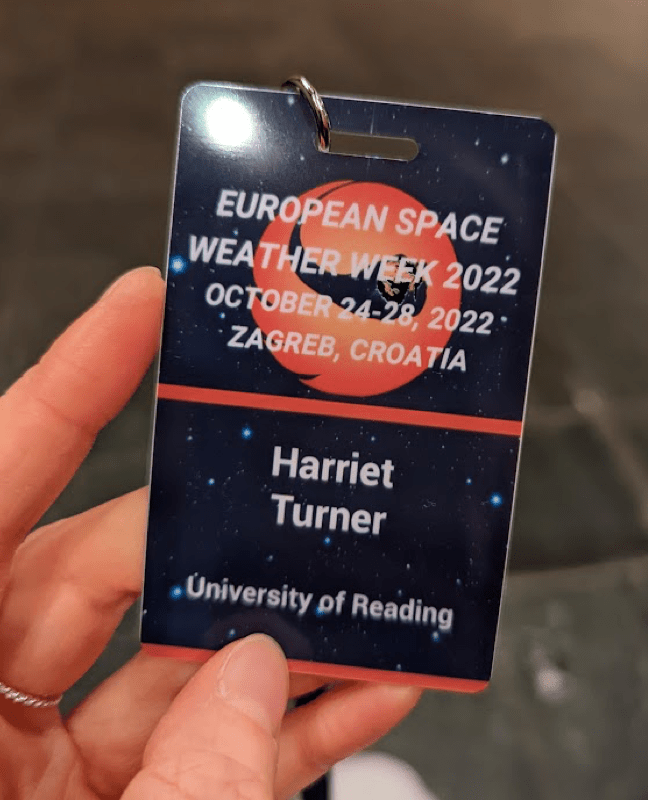
It always feels more official when your name is on a lanyard!

The week started with the standard conference registration followed by some tutorials and a live space weather forecast. Space weather refers to the changing plasma conditions in near-Earth space, which can pose a threat to modern life. It can lead to communication failures, damage to satellites, blackouts, and harm the health of humans in space. For this reason, it is important to forecast space weather so that these impacts can be mitigated against. The afternoon of the first day consisted of two parallel sessions and a poster session, with a reception buffet in the evening. The parallel sessions ran throughout the week, covering a wide range of topics from ways to improve our space weather forecasting capabilities to measuring and modelling geoelectric fields.

Tuesday was filled with more parallel sessions containing a wide range of talks, including my first in-person conference presentation of my PhD. I was rather nervous to present my work in front of a (quite large) room full of experts in the field, however I think it was well received and I had some interesting questions.

I study the solar wind, which is a constant stream of charged particles that flows off the Sun and is an important component of space weather. I have been using data assimilation (DA) to forecast the solar wind, which combines model output and observations to form an optimum estimation of reality. For DA to work in an operational context, it needs to work with real time data. This often contains more data gaps and erroneous observations when compared with the cleaned-up science level data, which has been used for previous analysis of solar wind DA. To cut a long story short, my work has shown that the real time data does not significantly worsen the forecasts, meaning that DA could be used for operational solar wind forecasting. Which is what we wanted to hear! I celebrated the presentation being over with a big pizza, followed by the conference music night hosted in a local bar. Turns out there are some talented musicians in the space weather community!

On the stage presenting the slide on the data assimilation scheme I have been analysing.

The rest of the week went by in a blur of parallel and poster sessions, with the conference dinner on the Thursday evening and everything wrapping up on Friday lunchtime. With flights back to the UK not until Monday evening, we had plenty of time to explore what Zagreb had to offer. Saturday was spent exploring the Mushroom Museum (spoiler alert, it was full of mushrooms) and the Museum of Broken Relationships. The latter of the two was filled with donated items that were special in some way or another and symbolised the end of a meaningful relationship. There were certainly some quirky exhibits, but a good attraction for sure.

There was not mushroom for anything else… (I’ll show myself out).

We filled Sunday with a tram ride to the north of Zagreb to the Sljeme cable car. The cable car took us from 267m up to the mountain summit at 1030m, which, for context, is 55m lower than Snowdon. One thing that will remain with me is just how foggy it was in Zagreb, so rising out of the fog in the cable car provided some great views. We could see the cloud hanging low in the valley and it was glorious sunshine at the top. The mountains were covered in trees that were turning into their autumn colours, which certainly was a beautiful sight.

With most of Monday to spare, we explored another museum. This time it was the Museum of Illusions, which was a lot of fun. There were a lot of interactive exhibits, including ones where you can make a kaleidoscope of your own face and play poker with 7 versions of yourself. It led to some truly horrifying photos.

View from the cable car over the mountains.

Overall, it was a tiring yet productive and enjoyable trip. I enjoyed networking with many scientists in my field, many of whom I had only seen as a name on a paper or on Twitter. It was great to see how work in the field is advancing and I look forward to being a part of that in the future.

Finally, a tip if you are visiting Croatia, try Čoksa salted peanut chocolate, it’s great. The forest fruits flavour is also great, but the banana has received mixed reviews!