A hackathon, from the words hack (meaning exploratory programming, not the alternate meaning of breaching computer security) and marathon, is usually a sprint-like event where programmers collaborate intensively with the goal of creating functioning software by the end of the event. From 2 to 4 June 2021, more than a hundred early career climate scientists and enthusiasts (mostly PhDs and Postdocs) from UK universities took part in a climate hackathon organised jointly by Universities of Bristol, Exeter and Leeds, and the Met Office. The common goal was to quickly analyse certain aspects of Climate Model Intercomparison Project 6 (CMIP6) data to output cutting-edge research that could be worked into a published material and shown in this year’s COP26.
Before the event, attendees signed up to their preferred project from a choice of ten. Topics ranged from how climate change will affect migration of arctic terns to the effects of geoengineering by stratospheric sulfate injections and more… Senior academics from a range of disciplines and institutions led each project.
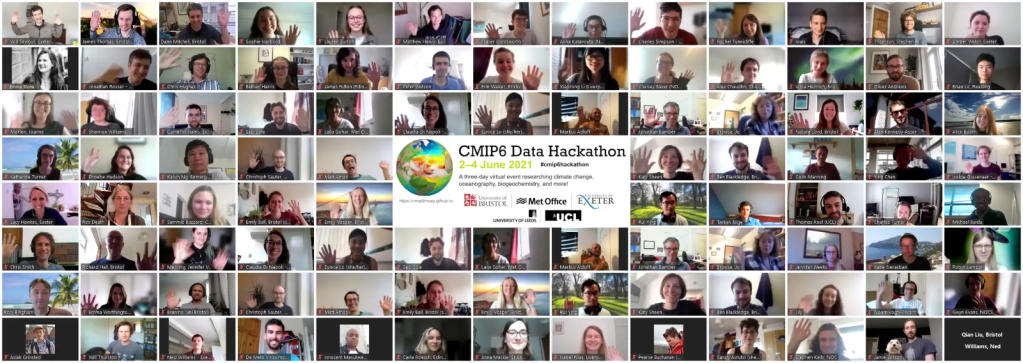
Group photo of participants at the CMIP6 Data Hackathon
How is this virtual hackathon different to a usual hackathon?
Like many other events this year, the hackathon took place virtually, using a combination of video conferencing (Zoom) for seminars and teamwork, and discussion forums (Slack).
Brian:
Compared to two 24-hour non-climate related hackathons I previously attended, this one was spread out for three days, so I managed not to disrupt my usual sleep schedules! The experience of pair programming with one or two other team members was as easy, since I shared one of my screens on Zoom breakout rooms throughout the event. What I really missed were the free meals, plenty of snacks and drinks usually on offer at normal hackathons to keep me energised while I programmed.
Chloe:
I’ve been to a climate campaign hackathon before, and I did a hackathon style event to end a group project during the computer science part of my undergraduate; we made the boardgame buccaneer in java. But this was set out completely differently. And, it was not as time intensive as those which was nice. I missed not being in a room with those you are on a project with and still missing out on free food – hopefully not for too much longer. But we made use of Zoom and Slack for communication. And Jasmin and the version control that git offers with individuals working on branches and then these were merged at the end of the hackathon.
What did we do?
Brian:
Project 2: How well do the CMIP6 models represent the tropical rainfall belt over Africa?
Using Gaussian parameters in Nikulin & Hewitson 2019 to describe the intensity, mean meridional position and width of the tropical rainfall belt (TRB), the team I was in investigated three aspects of CMIP6 models for capturing the Africa TRB, namely the model biases, projections and whether there was any useful forecast information in CMIP6 decadal hindcasts. These retrospective forecasts were generated under the Decadal Climate Prediction Project (DCPP), with an aim of investigating the skill of CMIP models in predicting climate variations from a year to a decade ahead. Our larger group of around ten split ourselves amongst these three key aspects. I focused on aspect of CMIP6 decadal hindcasts, where I compared different decadal models at different model lead times with three observation sources.
Chloe:
Project 10: Human heat stress in a warming world
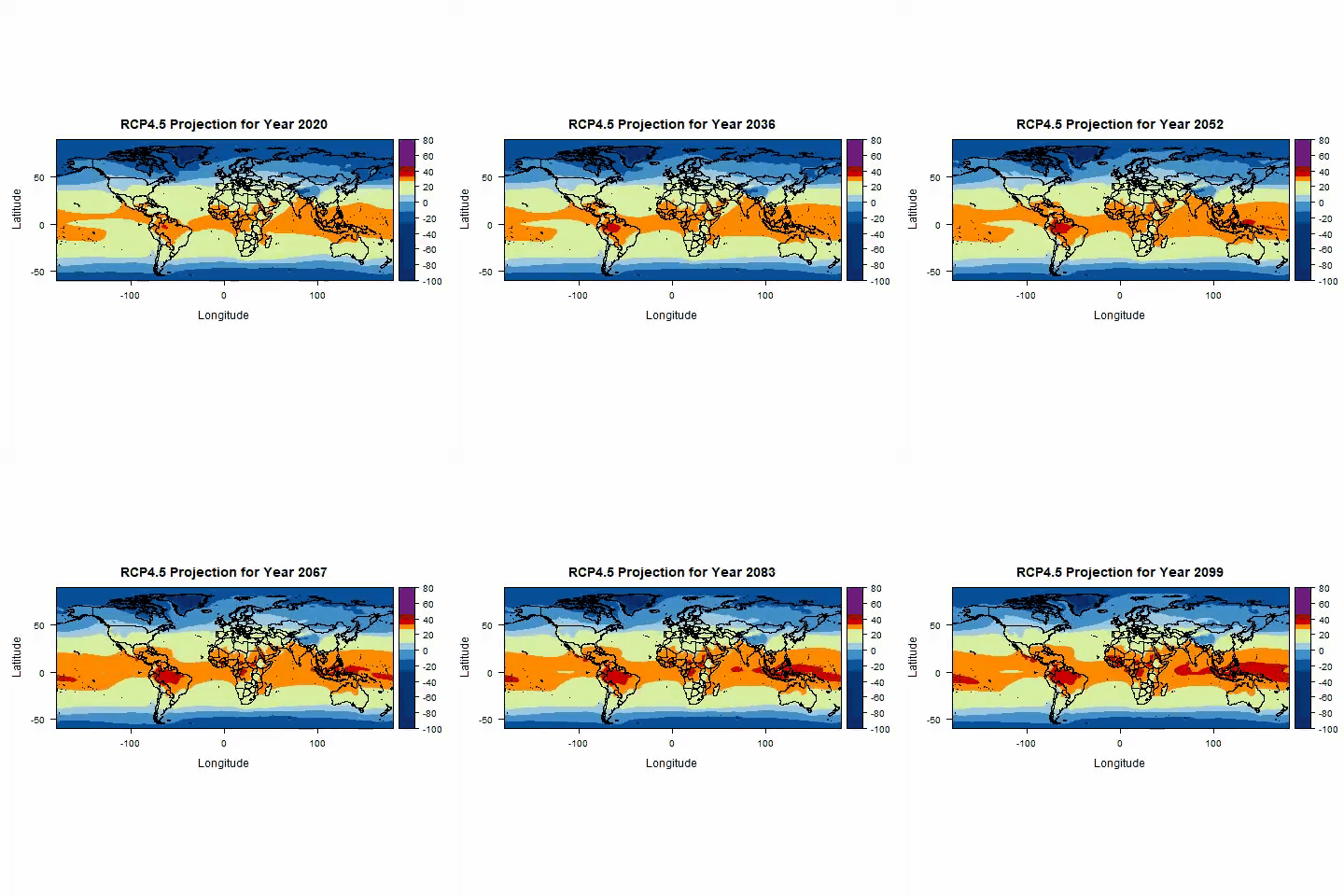
Our team leader Chris had calculated the universal thermal climate index (UTCI) – a heat stress index for a bunch of the CMIP6 climate models. He was looking into bias correction against the ERA5 HEAT reanalysis dataset whilst we split into smaller groups. We looked at a range of different things from how the intensity of heat stress changed to how the UTCI compared to mortality. I ended up coding with one of my (5) PhD supervisors Claudia Di Napoli and we made amongst other things the gif below.
See the Annual Means of the UTCI for RCP4.5 (medium emissions) projection from 2020 to 2099. Notice Brazil having a particularly tough time with heat stress 🥵🌿.
Would we recommend meteorology/climate-related hackathon?
Brian:
Yes! The three days was a nice break from my own radar research work. The event was nevertheless good training for thinking quickly and creatively to approach research questions other than those in my own PhD project. The experience also sharpened my coding and data exploration skills, while also getting the chance to quickly learn advanced methods for certain software packages (such as xarray and iris). I was amazed at the amount of scientific output achieved in only three short days!
Chloe:
Yes, but also make sure if it’s online you block out the time and dedicate all your focus to the hackathon. Don’t be like me. The hackathon taught me more about python handling of netcdfs, but I am not yet a python plotting convert, there are some things R is just nicer for. And I still love researching heat stress and heatwaves, so that’s good!
We hope that the CMIP hackathon runs again next year to give more people the opportunity to get involved.
Completing a PhD is a momentous task at the best of times, let alone in combination with a year-long global pandemic. Every PhD researcher is different, and as such, everyone has had different circumstantial struggles throughout Covid-19. The lack of human interaction that comes with working in a vibrant academic environment such as the Meteorology Department can make working from home a real struggle. Sometimes it is difficult to find the motivation to get anything useful done; whereas at other times you could squeeze five hours’ worth of work into one. Trying to stay organised is key to getting it done, therefore the following are some of the things that helped me get to the end of my PhD thesis – and it has not been easy. If you are still out there writing and finishing up experiments: read on! Maybe the result is that you might feel a little less alone. The PhD experience can be truly isolating at the best of times, so literally being instructed to isolate from the world is not ideal. The points are numbered for convenience of structuring this post, rather than any order of importance.
Communicate with your supervisor(s)
It is tempting to “disappear off the radar” when things are not going well. You could wake up in the morning of the day of your regular weekly meeting, filled with dread that you have not prepared anything for it. Your brain recoils into the depths of your skull as your body recoils back under the safety of the duvet. What are your options? Some of them might be: take a deep gulp and force yourself out of bed with the prospect of coffee before the meeting (where you steer the conversation onto the things you did manage to do); or to postpone the meeting because you need to finish XYZ and thus a later meeting may be more productive; or ignore the meeting altogether. The first one is probably the best option, but it requires mental strength where there might be none. The second one is OK, but you still need to do the work. The last one is a big no. Don’t do it.
Anxiety will make you believe that ignoring the world and all responsibilities is the most comfortable option in the moment, but the consequences of acting on it could be worse. Supervisors value honesty, and they know well that it is not always possible to complete all the scheduled tasks. Of course, if this happens every week then you might need to introspectively address the reasons for this, and – again, talking with your supervisor is usually a useful thing to do. You might not want them to know your entire life story, but it is helpful for everybody involved if they are aware that you struggle with anxiety / depression / ADHD / *insert any condition here*, which could affect your capacity to complete even the simplest, daily tasks. Being on the same page and having matching expectations is key to any student – supervisor partnership.
Reward yourself for the things you have already accomplished.
Whether that’s mid-week, mid-to-do-list, weekend — whenever. List all the things you have done regularly (either work- or life-related) and recognise that you are trying to survive a pandemic. And trying to complete the monstrous task of writing a PhD thesis. Those are big asks, and the only way to get through them is to break them down into smaller chunks. Putting down “Write thesis” on your to-do list is more likely to intimidate than motivate you. How about breaking it down further: “Re-create plot 4.21”, or “Consolidate supervisor comments on pages 21 – 25” — these are achievable things in a specified length of time. It also means you could tick them off more easily, hopefully resulting in feeling accomplished. Each time this happens, reward yourself in whatever way makes you feel nice. Even just giving yourself a literal pat on the shoulder could feel great – try it!
Compile supervisor feedback / comments into a spreadsheet
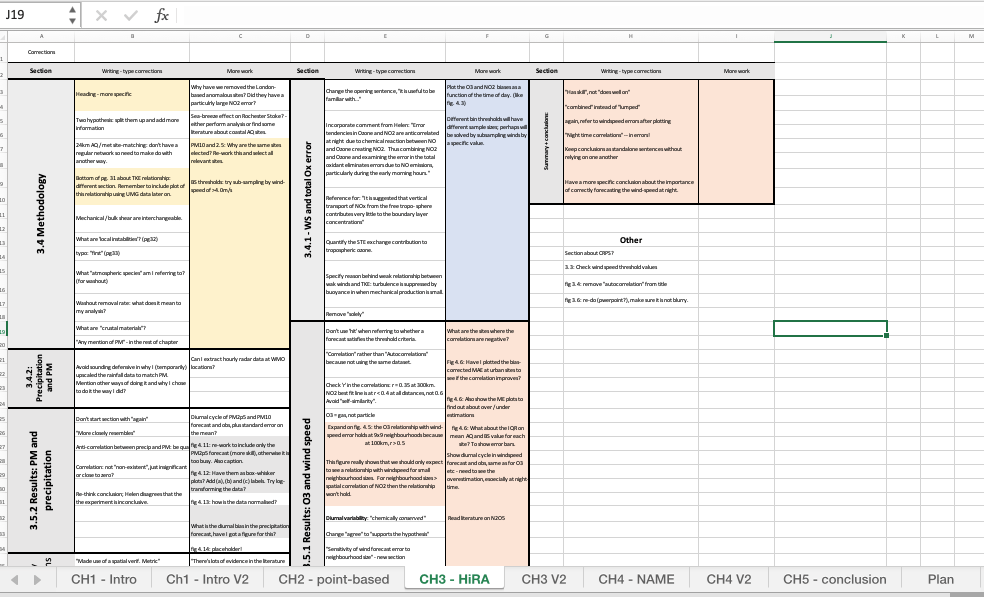
An Excel spreadsheet – or any other suitable system – will enable you to keep track of what still needs addressing and what has been completed. The beauty of using a colour-coded spreadsheet for feedback comments is that once the required corrections are completed, you have concrete evidence of how much you have already achieved – something to consult if you start feeling inadequate at any point (see previous section!). I found this a much easier system than writing it down in my workbook, although of course this does work for some people, too. Anytime you receive feedback on your work – written or otherwise – note them down. I used brief reminders, such as “See supervisor’s comment on page X” but it was useful to have them all compiled together. Also, I found it useful to classify the comments into ‘writing-type’ corrections and ‘more work required’ corrections. The first one is self-explanatory: these were typos, wrong terminologies, mistakes in equations and minor structural changes. The ‘more work required’ was anything that required me to find citations / literature, major structural changes, issues with my scientific arguments or anything else that required more thought. This meant that if my motivation was lacking, I could turn to the “writing-type” comments and work on them without needing too much brain power. It also meant that I could prioritise the major comments first, which made working to a deadline a little bit easier.
Break down how long specific things will take
This is most useful when you are a few weeks away from submission date. With only 5 weeks left, my colour-coded charts were full of outstanding comments; neither my ‘Conclusions’ chapter nor my Abstract had been written; plots needed re-plotting and I still did not know the title of my thesis. Naturally, I was panicking. I knew that the only way I could get through this was to set a schedule — and stick to it. At the time, there were 5 major things to do: complete a final version of each of my 5 thesis chapters. A natural split was to allow each chapter only one week for completion. If I was near to running over my self-prescribed deadline, I would prioritise only the major corrections. If still not done by the end of the allowed week: that’s it! Move on. This can be difficult for any perfectionists out there, but by this point the PhD has definitely taught me that “done” is better than perfect. I also found that some chapters took less time to finish than others, so I had time to return to the things I left not quite finished. Trust yourself, and give it your best. By all means, push through the hardest bit to the end, but remember that there (probably) does not exist a single PhD thesis without any mistakes.
5. Follow useful Twitter threads
There exist two groups of people: those who turn off or deactivate all social media when they need to focus on a deadline, and those who get even more absorbed by its ability to divert your attention away from the discomfort of the dreaded task at hand. Some might call it “productive procrastination”. I actually found that social media helped me a little – but only when my state of mind was such that I could resist the urge to fall down a scrolling rabbit hole. If you are on Twitter, you might find hashtags like #phdchat and accounts such as @AcademicChatter , @phdforum @phdvoice useful.
6. Join a virtual “writing room”
On the back of the last tip, I have found a virtual writing room helpful for focus. The idea is that you join an organised Zoom meeting full of other PhDs, all of whom are writing at the same time. All microphones are muted, but the chat is active so it is nice to say ‘hello!’ to someone else writing at the same time, anywhere else in the world. The meetings have scheduled breaks, with the organiser announcing when they occur. I found that because I actively chose to be up and start writing at the very early hour of 6am by attending the virtual writing room, I was not going to allow myself to procrastinate. The commitment to being up so early and being in a room full of people also doing the same thing (but virtually, obviously) meant that those were the times that I was probably the most focused. These kinds of rooms are often hosted by @PhDForum on Twitter; there could also be others. An alternative idea could be to set up a “writing meeting” with your group of peers and agree to keep chatter to a minimum (although this is not something I tried myself).
7. Don’t look at the news
Or at least, minimise your exposure to them. It is generally a good thing to stay on top of current events, but the final stages of writing a PhD thesis are probably unlike any other time in your life. You need the space and energy to think deeply about your own work right now. Unfortunately, I learnt this the hard way and found that there were days where I could do very little work because my brain was preoccupied with awful events happening around the world. It made me feel pathetic, routinely resulting in staying up late to try and finish whatever I failed to finish during the day. This only deteriorated my wellbeing further with shortened sleep and a constant sense of playing “catch-up”. If this sounds like you, then try switching off your news notifications on your phone or computer, or limit yourself to only checking the news homepage once a day at a designated time.
8. Be honest when asked about how you are feeling
Many of us tend to downplay or dismiss our emotions. It can be appealing to keep your feelings to yourself, saving yourself the energy involved in explaining the situation to whomever asked. You might also think that you are saving someone else the hassle of worrying about you. The trouble is that if we continuously paper over the cracks in our mental wellbeing within the handful of conversations we are having (which are especially limited during the pandemic), we could stop acknowledging how we truly feel. This does not necessarily mean spilling all the beans to whomever asked the innocent question, “How are you?”. But the catharsis from opening up to someone and acknowledging that things are not quite right could really offload some weight off your shoulders. If the person on the other end is your PhD supervisor, it can also be helpful for them to know that you are having a terrible time and are therefore unable to complete tasks to your best ability. Submission anxiety can be crippling for some people in the final few weeks, and your supervisor just won’t be able to (and shouldn’t) blindly assume how your mental health is being affected by it, because everyone experiences things differently. This goes back to bullet no.1.
Hopefully it goes without saying that the above are simply some things that helped me through to the end of the thesis, but everybody is different. I am no counsellor or wellbeing guru; just a recently-finished PhD! Hopefully the above points might offer a little bit of light for anyone else struggling through the storm of that final write-up. Keep your chin up and, as Dory says: just keep swimming. Good luck!
 The Social Metwork