The Role of the Cloud Radiative Effect in the Sensitivity of the Intertropical Convergence Zone to Convective Mixing

Email: j.f.talib@pgr.reading.ac.uk

Talib, J., S.J. Woolnough, N.P. Klingaman, and C.E. Holloway, 2018: The Role of the Cloud Radiative Effect in the Sensitivity of the Intertropical Convergence Zone to Convective Mixing. J. Climate, 31, 6821–6838, https://doi.org/10.1175/JCLI-D-17-0794.1

Rainfall in the tropics is commonly associated with the Intertropical Convergence Zone (ITCZ), a discontinuous line of convergence collocated at the ascending branch of the Hadley circulation, where strong moist convection leads to high rainfall. What controls the location and intensity of the ITCZ remains a fundamental question in climate science.
ensemble_precip_neat_thesis
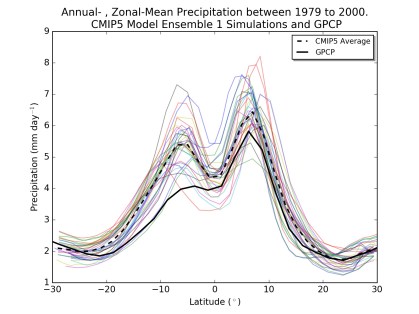
Figure 1: Annual-mean, zonal-mean tropical precipitation (mm day-1) from Global Precipitation Climatology Project (GPCP, observations, solid black line) and CMIP5 (current coupled models) output. Dashed line indicates CMIP5 ensemble mean.

In current and previous generations of climate models, the ITCZ is too intense in the Southern Hemisphere, resulting in two annual-mean, zonal-mean tropical precipitation maxima, one in each hemisphere (Figure 1).  Even if we take the same atmospheric models and couple them to a world with only an ocean surface (aquaplanets) with prescribed sea surface temperatues (SSTs), different models simulate different ITCZs (Blackburn et al., 2013).

Within a climate model parameterisations are used to replace processes that are too small-scale or complex to be physically represented in the model. Parameterisation schemes are used to simulate a variety of processes including processes within the boundary layer, radiative fluxes and atmospheric chemistry. However my work, along with a plethora of others, shows that the representation of the ITCZ is sensitive to the convective parameterisation scheme (Figure 2a). The convective parameterisation scheme simulates the life cycle of clouds within a model grid-box.

Our method of showing that the simulated ITCZ is sensitive to the convective parameterisation scheme is by altering the convective mixing rate in prescribed-SST aquaplanet simulations. The convective mixing rate determines the amount of mixing a convective parcel has with the environmental air, therefore the greater the convective mixing rate, the quicker a convective parcel will become similar to the environmental air, given fixed convective parcel properties.

AEIprecipCREon
Figure 2: Zonal-mean, time-mean (a) precipitation rates (mm day-1}$) and (b) AEI (W m-2) in simulations where the convective mixing rate is varied.

In our study, the structure of the simulated ITCZ is sensitive to the convective mixing rate. Low convective mixing rates simulate a double ITCZ (two precipitation maxima, orange and red lines in Figure 2a), and high convective mixing rates simulate a single ITCZ (blue and black lines).

We then associate these ITCZ structures to the atmospheric energy input (AEI). The AEI is the amount of energy left in the atmosphere once considering the top of the atmosphere and surface energy budgets. We conclude, similar to Bischoff and Schneider, 2016, that when the AEI is positive (negative) at the equator, a single (double) ITCZ is simulated (Figure 2b). When the AEI is negative at the equator, energy is needed to be transported towards the equator for equilibrium. From a mean circulation perspective, this take place in a double ITCZ scenario (Figure 3). A positive AEI at the equator, is associated with poleward energy transport and a single ITCZ.

blog_figure_ITCZ_simulation
Figure 3: Schematic of a single (left) and double ITCZ (right). Blue arrows denote energy transport. In a single ITCZ scenario more energy is transported in the upper branches of the Hadley circulation, resulting in a net-poleward energy transport. In a double ITCZ scenario, more energy is transport equatorward than poleward at low latitudes, leading to an equatorward energy transport.

In our paper, we use this association between the AEI and ITCZ to hypothesize that without the cloud radiative effect (CRE), atmospheric heating due to cloud-radiation interactions, a double ITCZ will be simulated. We also hypothesize that prescribing the CRE will reduce the sensitivity of the ITCZ to convective mixing, as simulated AEI changes are predominately due to CRE changes.

In the rest of the paper we perform simulations with the CRE removed and prescribed to explore further the role of the CRE in the sensitivity of the ITCZ. We conclude that when removing the CRE a double ITCZ becomes more favourable and in both sets of simulations the ITCZ is less sensitive to convective mixing. The remaining sensitivity is associated with latent heat flux alterations.

My future work following this publication explores the role of coupling in the sensitivity of the ITCZ to the convective parameterisation scheme. Prescribing the SSTs implies an arbitary ocean heat transport, however in the real world the ocean heat transport is sensitive to the atmospheric circulation. Does this sensitivity between the ocean heat transport and atmospheric circulation affect the sensitivity of the ITCZ to convective mixing?

Thanks to my funders, SCENARIO NERC DTP, and supervisors for their support for this project.

References:

Blackburn, M. et al., (2013). The Aqua-planet Experiment (APE): Control SST simulation. J. Meteo. Soc. Japan. Ser. II, 91, 17–56.

Bischoff, T. and Schneider, T. (2016). The Equatorial Energy Balance, ITCZ Position, and Double-ITCZ Bifurcations. J. Climate., 29(8), 2997–3013, and Corrigendum, 29(19), 7167–7167.


It’s a #GlobalHeatwave

Email: s.h.lee@pgr.reading.ac.uk 

Sometimes a simple tweet on a Sunday evening can go a long way.

This summer’s persistent dry and warm weather in the UK has led to many comparisons to the summer of 1976, which saw a lethal combination of the warmest June-August mean maximum temperatures (per the Met Office record stretching back to 1910) and a record-breaking lack of rainfall (a measly 104.6 mm – since bested by 1995’s 103.0 mm –  compared with the record-wettest 384.4 mm in 1912). When combined with a hot summer the year before and a dry winter, water shortages were historic and the summer has become a benchmark to which all UK heatwaves are compared. So far, 2018 has set a new record for the driest first half of summer for the UK (a record stretching back to 1961) but it remains to be seen whether it will truly rival ’76.

All these comparisons made me wonder: what did global temperatures look like during the heatwave of 1976? Headlines have been filled with news of other heatwaves across the Northern Hemisphere, including in AfricaFinland and Japan. Was the UK heatwave in 1976 also part of a generally warm pattern?

So I had a look at the data using the plotting tool available on NASA’s Goddard Institute for Space Studies (GISS) site, and composed a relatively simple tweet which took off in a manner only fitting for a planet undergoing rapid warming:

At the time of writing, it’s been retweeted over 8,800 times in under 48 hours and featured as part of a Twitter Moment. Even Héctor Bellerín, a footballer for Arsenal, retweeted it!

Once the tweet had taken on a life of its own, I was also well aware of so-called “climate change deniers” (I don’t like the term, but it’s the best I can do) lurking out there, and I was somewhat apprehensive of what might get said. I’ve seen Paul Williams have many not-so-pleasant Twitter encounters on the subject of climate change. However, I was actually quite surprised. Aside from a few comments here and there from ‘deniers’ (usually focusing on fundamental misunderstandings of averaging periods and the interpolation used by NASA to deal with areas of low data coverage), the response was generally positive. People were shocked, frightened, moved…and thankful to have perhaps finally grasped what global warming meant.

I endeavoured to keep it cordial and scientific, as the issue is too big to make enemies over – we all need to work together to tackle the problem.

So, maybe now I have some idea how Ed Hawkins felt when his global warming spiral went viral and eventually ended up in the 2016 Olympics opening ceremony. I guess the biggest realisation for me is that, as a scientist, I’m familiar with graphics such as these showing the extent of global warming, but the wider public clearly aren’t – and that’s part of the reason I believe the tweet became so popular.

I can’t say that the 2018 UK heatwave is due to global warming. However, with unusually high temperatures present across the globe, it takes less significant weather patterns to produce significant heatwaves in the UK (and elsewhere). And with the jet streams that guide our weather systems already feeling the effects of climate change (something which I researched as an undergraduate), we can only expect more extremes in the future.

Royal Meteorology Conferences

From 3rd-6th July 2018 the Royal Meteorological Society (RMetS) held two national conferences at the University of York. The Atmospheric Science Conference, joint with NCAS, started off the week and brought together scientists to present and discuss the latest research findings in weather, climate and atmospheric chemistry. The following two days brought the RMetS Student Conference. Both events were well attended by PhD students from Reading and provided a great opportunity to share our work with the wider scientific community.

For a summary of the work presented by Reading students, stick around until the end of the blog!

Atmospheric Science Conference 2018

Weather, Climate and Air Quality

Many of the presentations focused on seasonal forecasting with Adam Scaife (Met Office) giving a keynote address on “Skilful Long Range Forecasts for Europe”. He presented an interesting analysis on the current progress of predicting the North Atlantic Oscillation showing that there is skill in current predictions which could be improved even further by increasing ensemble size. Adam was also awarded the prestigious Copernicus Medal at the conference dinner. Another notable talk was by Reading’s own Ed Hawkins, who presented the benefits of using citizen scientists to rescue weather records. A summary of Ed’s presentation can be accessed below, and you can read more about research involving Citizen Science in Shannon Jones’ blog.

The poster sessions at the conference also gave a great opportunity to look at the breadth of work going on in institutions around the UK. It was also a great time to catch up with colleagues and forge new academic connections.

One of the highlights of the conference was having the conference dinner in the National Railway Museum. This was a fantastic yet surreal location with dining tables set up in the station hall overlooking a suite of old steam trains . The event was made even better by watching England‘s quarter-final world cup game!

conference_dinner

Evolution of Science: Past, Present and Future

Students & Early Career Scientist Conference

The student conference is open to all students with an interest in meteorology, from undergraduate to PhD and early career scientists. The conference aimed to give students the opportunity to meet each other and present their work at an early stage in their career before attending other academic conferences. For many of those attending from Reading this was their first time presenting research at an event outside of the department and provided a great experience to communicate their work with others. Work presented varied from radiative forcing to normal empirical modes (summaries of talks are below). There were also a number of keynote speakers and workshops aimed at addressing the current challenges in atmospheric sciences and skills that are important for researchers.

student_workshop_1
Rory Fitzpatrick, presenting on skills for writing as an academic. “I have the Best Words” – How to write articles that impact bigly”

https://twitter.com/jominicdones/status/1015191296334548993

Of course there was also time for socialising with an ice-breaker dinner and pub quiz  and a formal Conference dinner on the Thursday. This was the second student conference I have attended and it was a really great place to discuss my work and meet other students from around the country. I have also attended other academic events with several people that I met at the conference last year, it’s always great to see a friendly face!

The student conference is organised by a committee of students from around the UK. Being on the committee was a great opportunity to learn more about how conferences work and to practice skills such as chairing sessions. It has also been great to get to know lots of different people working within meteorology. If you’re interested in helping organise next year’s conference please do get in touch with Victoria Dickinson at RMetS (Victoria.Dickinson@rmets.org) or if you’re thinking about attending then you can start by joining the society where you’ll hear about all the other great events they host.

Highlights of the work presented by Reading students:

Godwin Ayesiga presented work on the convective activity that connects Western and Eastern equatorial Africa. Investigating how intraseasonal modes of variability influence intense rainfall.

Matt Priestley presented an assessment of the importance of windstorm clustering on European wintertime insurance losses. More details of this work can be found here.

Lewis Blunn presented his work looking into the ‘grey zone’ of turbulence at model grid scale lengths of 100 m – 1 km. At these scales turbulence is partially resolved by the grid but still needs to be partially parameterised. Lewis finds that spurious grid scale features emerge at scales where turbulence is partially resolved. Model results are poorer in this ‘grey zone’ than when turbulence is fully resolved or fully parameterised.

Alec Vessey presented his work evaluating the representation of Arctic storms in different reanalysis products. He found that there is a difference between different reanlysis and so care should be taken when using these products to analyse Arctic storms.

Dominic Jones presented a technique for extracting modes of variability from atmospheric data, and a test dataset that has been developed to use this technique to examine the relationship of modes of variability associated with the jet-latitude.

Rachael Byrom presented a motivation for quantifying methane’s shortwave radiative forcing. Her work demonstrated a need to use a high resolution narrow-band radiation model to accurately calculate forcings in atmospheric models.

Andrea Marcheggiani presented a poster on the role of resolution in predicting the North Atlantic storm track. An energy budget of the winter climatology (DJF 1979-2018) was presented.

Sally Woodhouse presented her work on the impact of resolution on energy transports into the Arctic. She has found that increasing atmospheric resolution increases the energy transport in the ocean to better agree with observations.

Kaja Milczewska presented work on evaluating the inaccuracies of predicting air quality in the UK.

Having recently passed her viva, Caroline Dunning’s presentation was on precipitation seasonality over Africa under present and future climates. Caroline has developed a new methodology for determining the beginning and end of the wet season across Africa. This has been applied to CMIP5 model output to look at future changes in wet seasons across Africa under climate change.

How the Earth ‘breathes’ on a daily timescale

Email: J.Gristey@pgr.reading.ac.uk
Web: http://www.met.reading.ac.uk/~fn008822/

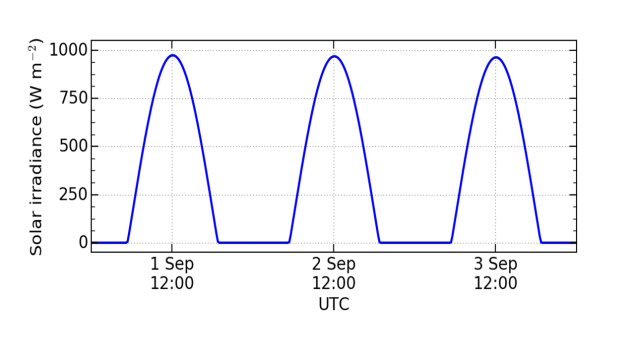
As the Earth rotates, each location on its surface is periodically exposed to incoming sunlight. For example, over London at the beginning of September, the intensity of incoming sunlight ranges from zero overnight, when the sun is below the horizon, to almost 1000 W m–2 at noon, when the sun is highest in the sky (Fig. 1).

Slide2
Fig. 1. Top-of-atmosphere incoming sunlight over London (51.5° N, 0° E) for the first three days in September 2010. Data is from the Met Office numerical weather prediction model.

Earth’s atmosphere and surface respond to this repeating daily cycle of incoming sunlight in ways that can change the amount of energy that is emitted or reflected back to space. For example, the increased amount of sunlight in the afternoon can heat up the surface and cause more thermal energy to be emitted to space. Meanwhile, the surface heating can also cause the air near the surface to warm up and rise to form clouds that will, in turn, reflect sunlight back to space. The resulting daily cycle of the top-of-atmosphere outgoing energy flows is therefore intricate and represents one of the most fundamental cycles of our weather and climate. It is essential that we can properly represent the physical processes controlling this daily variability to obtain accurate weather and climate forecasts. However, the daily variability in Earth’s outgoing energy flows is not currently well observed across the entire globe, and current weather and climate models can struggle to reproduce realistic daily variability, highlighting a lack of understanding.

To improve understanding, dominant patterns of the daily cycle in outgoing energy flows are extracted from Met Office model output using a mathematical technique known as “principal component analysis”.

The daily cycle of reflected sunlight is found to be dominated by the height of the sun in the sky, or the “solar zenith” angle, because the atmosphere and surface are more reflective when the sun is low in the sky. There is a lesser importance from low-level clouds over the ocean, known as “marine stratocumulus” clouds, which burn off during the afternoon, reducing the amount of reflected sunlight, and tall and thick clouds, known as “deep convective” clouds, which develop later in the afternoon over land and increase the amount of reflected sunlight. On the other hand, the daily cycle of emitted thermal energy is dominated by surface heating, which increases the emitted energy at noon, but also by deep convective clouds that have very high and cold tops, reducing the emitted energy later in the afternoon. These dominant processes controlling the daily cycle of Earth’s outgoing energy flows and their relative importance (summarised in Fig. 2) have not been revealed previously at the global scale.

Slide1
Fig. 2. A schematic diagram showing the first (top) and second (bottom) most important processes controlling the daily cycle in emitted thermal energy (left) and reflected sunlight (right).

The physical processes discussed above are consistent with the daily cycle in other relevant model variables such as the surface temperature and cloud amount, further supporting the findings. Interestingly, a time lag is identified in the response of the emitted thermal energy to cloud variations, which is thought to be related to changes in the humidity of the upper atmosphere once the clouds evaporate.

The new results highlight an important gap in the current observing system, which can be utilized to evaluate and improve deficiencies in weather and climate models.

Gristey, J. J., Chiu, J. C., Gurney, R. J., Morcrette, C. J., Hill, P. G., Russell, J. E., and Brindley, H. E.: Insights into the diurnal cycle of global Earth outgoing radiation using a numerical weather prediction model, Atmos. Chem. Phys., 18, 5129-5145, https://doi.org/10.5194/acp-18-5129-2018, 2018.