Honest Reviews of NCAS Training Courses

By Maia Arama (m.arama@pgr.reading.ac.uk), Molly Macrae(molly.macrae@pgr.reading.ac.uk) and Giacomo Giuliani (g.giuliani@pgr.reading.ac.uk)

A big part of doing a PhD at Reading is the opportunity to complete training courses that expand our skillsets and knowledge. Below, we summarise and review our experiences of different courses offered by the National Centre for Atmospheric Science (NCAS) that we completed at the beginning of our PhDs.

Introduction to Scientific Computing (ISC), Maia Arama

In November 2025, I completed the ISC course run by NCAS. The course consisted of three modules designed to provide students with essential skills and tools for data analysis. Module 1 introduced Linux commands, Module 2 covered an introduction to Python programming, and Module 3 focused on data analysis tools in Python (e.g. numpy, x-array, cf-python). Modules 1 and 2 were aimed at beginners, while Module 3 was aimed at those with some prior experience. After completing a short quiz, I was able to skip Module 2 and complete only Modules 1 and 3. Module 1 was delivered online while Modules 2 and 3 were taught at NCAS headquarters in Leeds.

The most valuable things I learned from Module 1 was how to combine commands using pipes and filters, as well as writing loops and shell scripts. I now regularly use these skills to process data for my PhD project! I did find that more time was spent on easier sections, while more challenging sections felt rushed at times. However, all material was made available to us on Software Carpentry enabling us to practice with the resources after the module. In Module 3, I found it particularly useful to learn how to use cf-python and cf-plot. We also completed a challenge using weather API data where we created NetCDF files, combined our data and produced a plot. The module also introduced version control with Git and the use of remote GitHub repositories. All teaching was done using Jupyter Notebooks on Jasmin.

Overall, I had a fantastic experience attending the course in Leeds. The staff were readily available to answer questions and help with debugging code. It was also great to meet other friendly and motivated PhD students, which created an inspiring working environment. Those with more experience in Python may find some of the material quite basic. However, if you have limited coding experience or want to increase your confidence coding in Python, I would highly recommend this course!

Links to the relevant NCAS ISC GitHub pages can be found here:

Module 1: https://ncasuk.github.io/ncas-isc-shell/06a-environment-variables/index.html

Module 3: https://github.com/ncasuk/ncas-isc/

Introduction to the UK Chemistry-Aerosol (UKCA) Model, Molly Macrae

UKCA is a community atmospheric chemistry–aerosol model used to study how atmospheric chemistry, aerosols, and climate interact within the Met Office Unified Model, supporting research on climate forcing, air quality, and ozone processes. The ‘Introduction to UK Chemistry Aerosol (UKCA) Model’ course aims to provide experience of running the model through a set of practical, self-paced tutorials. The course was free to attend and took place in-person in Leeds with accommodation, travel and food included.

Over the 3 days, you are provided with a login to Monsoon3 and work through online tutorials at your own pace with expert UKCA users on hand to answer any questions or help with technical issues. These tutorials covered how to use the main parts of the UKCA model, setting up and running experiments, and how to adapt the model to specific purposes. There were also pre-recorded walkthrough videos provided, which were incredibly useful if anything from the instructions was unclear. Additionally, the logins were made available for a couple of weeks beyond the course, and a Slack channel was set up for any queries that arose after the course.

Despite most of the training being individual, I really appreciated that the course was held in-person. It was a great opportunity to meet other people using UKCA and to get guidance and feedback from the experts about how I plan to use UKCA in my project.

Overall, I found the course very useful, and I still go back to the provided resources now as I run the model. As expected for a course introducing the running of a climate model, there is a lot of information to take in, and after a few months, the elements of the course that have stayed with me are the parts I am actually using the model for now. Furthermore, the resources provided are clear and available for returning to at a later date. The self-paced format also allows you to tailor the course by spending longer on tutorials most relevant to your research. I would strongly recommend this course to anyone considering using UKCA in their work.

Course webpage with tutorials: UKCA Chemistry and Aerosol Tutorials at UMvn13.9 – UKCA

Introduction to the Unified Model, Giacomo Giuliani

The ‘Introduction to the Unified Model (UM)’ course is a 3-day course organised by NCAS at its headquarters in Leeds. It consists of two complementary parts: a series of lectures on the UM components and their applications, and tutorial sessions focused on working with suites and model outputs.

The UM is the atmospheric model for numerical weather prediction and climate projections. It can be run using different configurations, also called suites. The “how to use it” part mainly focuses on becoming familiar with the (un)intuitive, and sometimes quixotic, architecture of the workflow, as well as how to run simulations. Much of the tutorials involved working on the terminal interface of Archer2 and the UM graphic user interface, in other words, a good refresher for Shell and Bash scripting.

At the end of the course, I proudly scrolled my notebook page of “Commands, Tips and Common Errors when running the UM” noticing how long – and hopefully comprehensive – it was. I think the main takeaway of the course was: to be able to troubleshoot any issues, to create your own model configurations, and to understand the overall process behind a simulation within the UM framework.

The practical part for the UM course can be found on GitHub. Thus, in principle, one could just “learn from home”. However, the lectures are not the only aspect that makes this course extremely valuable. I rapidly assessed in thirty days and several hours between yawns and desperation the amount of time it would take me to complete this course on my own. It was really valuable and helpful to be able to talk to people who develop and use this model every day.  On the other hand, this course may be too high-level for a person only interested in using the UM for numerical simulations. It provides a general overview of the architecture of the UM workflow, but it lacks the use of a testbed simulation to simulate a common research situation.

Overall, I would definitely recommend the course to anyone frequently working with the UM, as soon as they have a solid base in Linux.

Here is the link to the GitHub page: https://ncas-cms.github.io/um-training/index.html
The Mystery of Coarse Dust Transport in Observations and Models​

Natalie Ratcliffe – n.ratcliffe@pgr.reading.ac.uk

On Tuesday 23rd April 2024, I presented my PhD work at the lunchtime seminar to the department.  The work I presented incorporated a lot of the work I have achieved during the 3 and a half years of my PhD. This blog post will be a brief overview of the work discussed.

Every year, between 300 and 4000 million tons of mineral dust are lofted from the Earth’s surface (Huneeus et al., 2011; Shao et al., 2011). This dust can travel vast distances, affecting the Earth’s radiative budget, water and carbon cycles, fertilization of land and ocean surfaces, as well as aviation, among other impacts. Observations from recent field campaigns have revealed that we underestimate the amount of coarse particles (>5 um diameter) which are transported long distances (Ryder et al., 2019). Based on our understanding of gravitational settling, some of these particles should not physically be able to travel as far as they do. This results in an underestimation of these particles in climate models, as well as a bias towards modelling finer particles (Kok et al., 2023). Furthermore, fine particles have different impacts on the Earth than coarse particles, for example with the radiative budget at the top of the atmosphere; including more coarse particles in a model reduces the cooling effect that dust has on the Earth.

Thus, my PhD project was born! We wanted to try and peel back the layers of the dusty onion. How are these coarse particles travelling so far?

Comparing a Climate Model and Observations

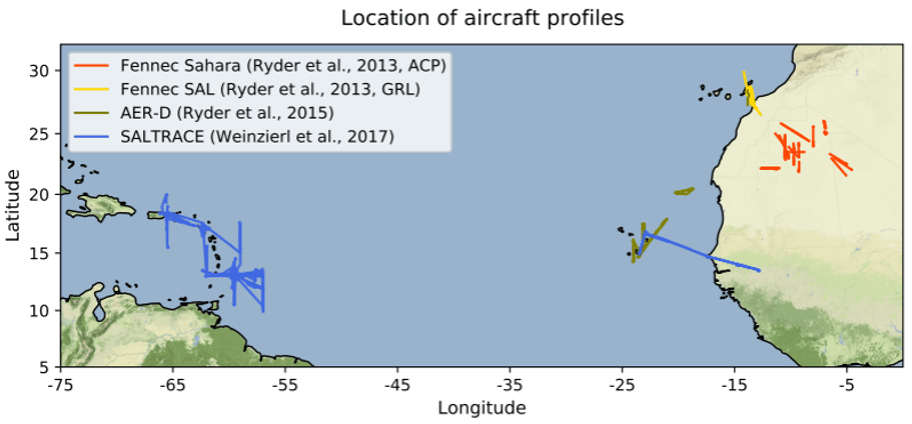
First, we compared in-situ aircraft observations to a climate model simulation to assess the degree to which the model was struggling to represent coarse particle transport from the Sahara across the Atlantic to the Caribbean. Measuring particles up to 300 um in diameter, the Fennec, AER-D and SALTRACE campaigns provide observations at three stages of transport throughout the lifetime of dust in the atmosphere (near emission, moving over the ocean and at distance from the Sahara; Figure 1). Using these observations, we assess a Met Office Unified Model HadGEM3 configuration. This model has six dust size bins, ranging from 0.063-63.2 um diameter. This is a much larger upper bound than most climate models, which tend to have an upper bound at 10-20 um.

Figure 1: Map showing the location of the flight tracks which were taken when the observations were measured.

We found that the model significantly underestimates the total mass of mineral dust in the atmosphere, as well as the fraction of dust mass made up of coarse particles. This happens at all locations, including at the Sahara: firstly, this suggests that the model is not emitting enough coarse particles to begin with and secondly, the growing model underestimation with distance suggests that the coarse particles are being deposited too quickly. By looking further into the model, we found that the coarsest particles (20-63.2 um) were lost from the atmosphere very quickly, barely surpassing Cape Verde in their westwards transport. Whereas in the observations, these coarsest particles were still present at the Caribbean, representing ~20% of the total dust mass. We also found that the distribution of coarse particles tended to have a stronger dependence on altitude than in the observations, with fewer particles observed at higher altitudes. This work has been written up into a paper which is currently undergoing review, but can be seen in preprint; Ratcliffe et al., (preprint).

Sensitivity Testing of the Model

Now that we have confirmed that the model is struggling to retain coarse particles for long- range transport, we want to work out if any of the model processes involved in transport and deposition could be over- or under-active in coarse particle transport. This involved turning off individual processes one at a time and seeing what impact it has on the dust transport. As we wanted to focus on the impact to coarse particle transport, we needed to start with an improved emission distribution at the Sahara, so we tuned the model to better match the observations from the Fennec campaign.

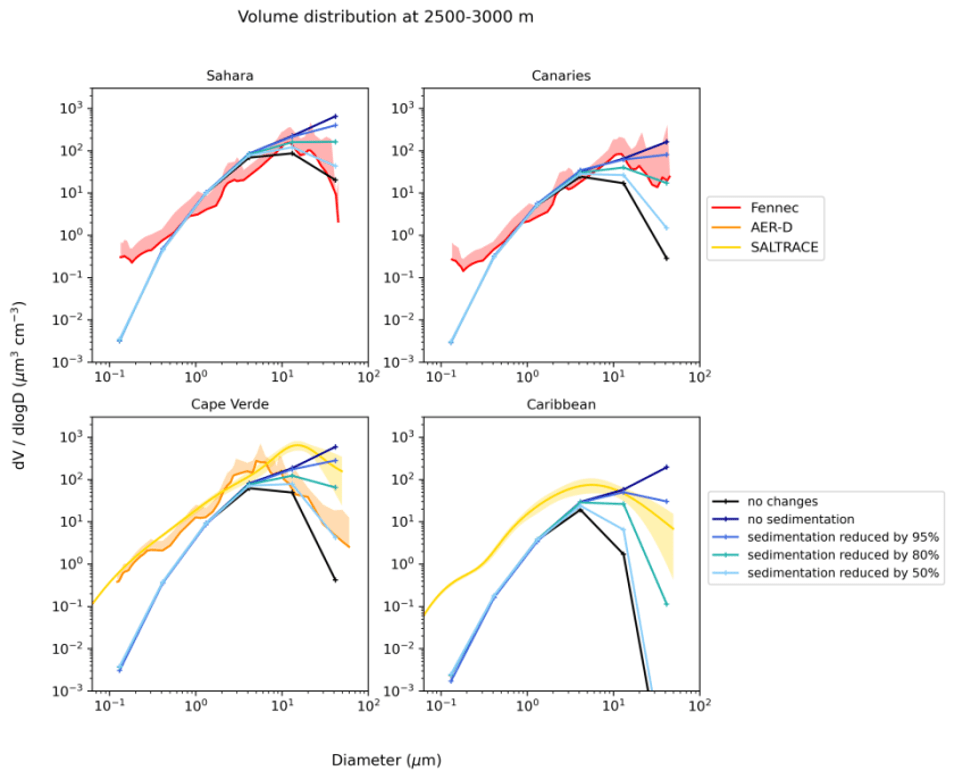
In our first tests we decided to ‘turn off’ or reduce gravitational settling of dust particles in the model to see what happens if we eliminate the greatest removal mechanism for coarse particles. Figure 2 shows the volume size distribution of these gravitational settling model experiments against the observations. We found that completely removing gravitational settling increased the mass of coarse particles too much, while having little to no effect on the fine particles. We found that to bring the model into better agreement with the observations, sedimentation needs to be reduced by ~50% at the Sahara and more than 80% at the Caribbean.

Figure 2: Mean volume size distribution between 2500-3000 m in the Fennec (red), AER-D (orange) and SALTRACE (yellow) observations, the control mode simulation (black) and the reduced dust sedimentation experiments (blue shades).

We also tested the sensitivity of turbulent mixing, convective mixing and wet deposition on coarse dust transport; however, these experiments did not have as great of an impact on coarse transport as the sedimentation. We found that removing the mixing mechanisms resulted in decreased vertical transport of dust which tended to reduce the horizontal transport. We also carried out an experiment where we doubled the convective mixing, and this did show improved vertical and horizontal transport. Finally, when we removed wet deposition of dust, we found that it had a greater impact on the fine particles, less so on the coarse particles, suggesting that wet deposition is the main removal mechanism for the four finest size bins in the model.

Final Experiment

Now that we know our coarse particles are settling out too quickly and sit a bit too low in the atmosphere, we come to our final set of experiments. Let’s say that our coarse particles in the model and our dust scheme are actually set up perfectly, then could it be the meteorology in the model which is wrong? If the coarse particles were mixed higher up at the Sahara, then would they reach faster horizontal winds to travel further across the Atlantic? To test this theory, I hacked the files which the model uses to start a simulation, and I put all the dust over the Sahara up to the top of the dusty layer (~5 km). We found this increased the lifetime of the coarsest particles so that it took twice as long to lose 50% of the starting mass. This unfortunately only slightly improved transport distance as the particles were still lost relatively quickly. After checking the vertical winds in the model, we found that they were an order of magnitude smaller at the Sahara, Canaries and Cape Verde than the observations made during the field campaigns. This suggests that if the vertical winds were stronger, they could initially raise the dust higher and keep the coarse particles raised higher for longer, extending their atmospheric lifetime.

Summarised Conclusions

To summarise what I’ve found during my PhD:

  1. The model underestimates coarse mass at emission and the underestimation is exacerbated with westwards transport.
  2. Altering the settling velocity of dust in the model brings the model into better agreement with the observations.
    • a. Turbulent mixing, convective mixing and wet deposition have minimal impact on coarse transport.
  3. Lofting the coarse particles higher initially improves transport minimally.
    • a. Vertical winds in the model are an order of magnitude too small.

So what’s next?

If we’ve found that the coarse particles are settling out the atmosphere too quickly (by potentially more than 80%), would that suggest that the deposition equations are wrong and are overestimating particle deposition? So, we change those and everything’s fixed, right? I wish. Unfortunately, the deposition equations are one of the things that we are more scientifically sure of, so our results mean that there’s something happening to the coarse particles that we aren’t modelling which is able to counteract their settling velocity by a very significant amount. Our finding that the vertical winds are too small could be a part of this. Other recent research suggests that processes such as particle asphericity, triboelectrification, vertical mixing and turbulent mixing (has been shown to help in a higher-resolution (not climate) model) in the atmosphere could enhance coarse particle transport.

Huneeus, N., Schulz, M., Balkanski, Y., Griesfeller, J., Prospero, J., Kinne, S., Bauer, S., Boucher, O., Chin, M., Dentener, F., Diehl, T., Easter, R., Fillmore, D., Ghan, S., Ginoux, P., Grini, A., Horowitz, L., Koch, D., Krol, M. C., Landing, W., Liu, X., Mahowald, N., Miller, R., Morcrette, J.-J., Myhre, G., Penner, J., Perlwitz, J., Stier, P., Takemura, T., and Zender, C. S. 2011. Global dust model intercomparison in AeroCom phase I. Atmospheric Chemistry and Physics. 11(15), pp. 7781-7816

Kok, J. F., Storelvmo, T., Karydis, V. A., Adebiyi, A. A., Mahowald, N. M., Evan, A. T., He, C., and Leung, D. M. Jan. 2023. Mineral dust aerosol impacts on global climate and climate change. Nature Reviews Earth Environment 2023, pp. 1–16. url: https://www.nature.com/articles/s43017-022-00379-5

RatcliLe, N. G., Ryder, C. L., Bellouin, N., Woodward, S., Jones, A., Johnson, B., Weinzierl, B., Wieland, L.-M., and Gasteiger, J.: Long range transport of coarse mineral dust: an evaluation of the Met Office Unified Model against aircraft observations, EGUsphere [preprint], https://doi.org/10.5194/egusphere-2024-806, 2024

Ryder, C. L., Highwood, E. J., Walser, A., Seibert, P., Philipp, A., and Weinzierl, B. 2019. Coarse and giant particles are ubiquitous in Saharan dust export regions and are radiatively significant over the Sahara. Atmospheric Chemistry and Physics. 19(24), pp. 15353–15376

Shao, Y., Wyrwoll, K.-H., Chappell, A., Huang, J., Lin, Z., McTainsh, G. H., Mikami, M., Tanaka, T. Y., Wang, X., and Yoon, S. 2011. Dust cycle: An emerging core theme in Earth system science. Aeolian Research. 2(4), pp. 181–204

Characterising the seasonal and geographical variability in tropospheric ozone, stratospheric influence and recent changes

Email: r.s.williams@pgr.reading.ac.uk

Williams, R. S., Hegglin, M. I., Kerridge, B. J., Jöckel, P., Latter, B. G., and Plummer, D. A.: Characterising the seasonal and geographical variability in tropospheric ozone, stratospheric influence and recent changes, Atmos. Chem. Phys., 19, 3589–3620, https://doi.org/10.5194/acp-19-3589-2019, 2019.


Approximately 90 % of atmospheric ozone (O3) today resides in the stratosphere, which we know as the ozone layer (extending from ~15-35 km), where it plays a critical role in filtering out most of the harmful ultraviolet (UV) rays from the sun. The gradual formation of the ozone layer from around 600 million years ago was key in Earth’s evolutionary history, as it enabled life to flourish on land. Lesser known is the importance of the remaining ~ 10 % of atmospheric ozone, which is found in the troposphere and has implications for air quality, radiative forcing and the oxidation capacity of the troposphere. Whilst ozone is a pollutant at ground level, contributing to an estimated 6 million premature deaths globally per year, it also acts to cleanse the troposphere by breaking down a large number of pollutants, along with some greenhouse gases. Ozone is however a greenhouse gas in itself – where it has a maximum radiative forcing in the upper troposphere. It is an example of a non-well mixed gas, owing to its spatially and temporally highly varying sources and sinks, as well as its relatively short global mean tropospheric lifetime of about 3 weeks.

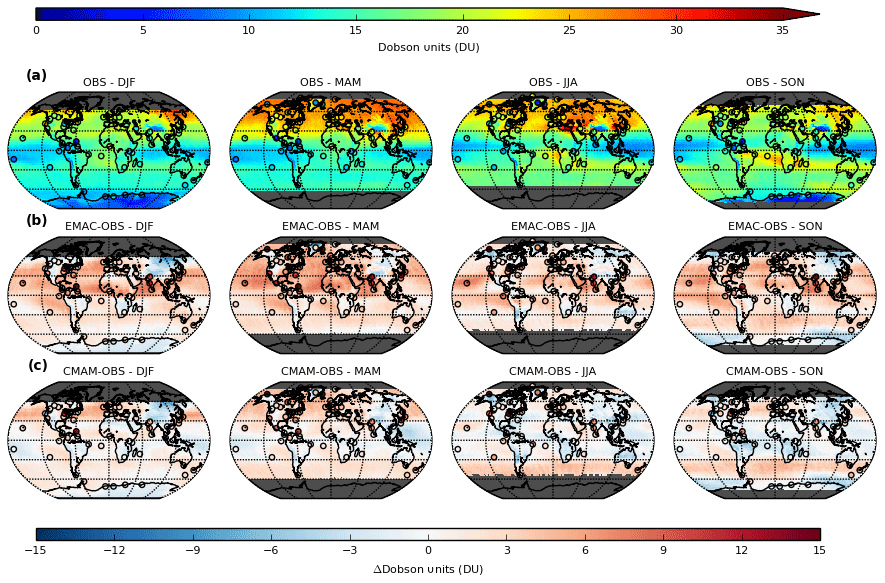
Figure 1 – Seasonal composites of monthly averaged 1000-450 hPa (0-5.5 km) subcolumn O3 (DU) for 2005-2010 (left to right) from (a) OMI, (b) EMAC minus OMI and (c) CMAM minus OMI. Circles denote (a) equivalent ozone-sonde derived subcolumn O3 (DU), (b) EMAC minus ozone-sonde differences and (c) CMAM minus ozone-sonde differences. All data were regridded to 2.5° resolution (~ 275 km). 1 Dobson Unit (DU) equates to a thickness of 0.01 mm if it were compressed at sea level.

A major source of tropospheric ozone is the photochemical reactions of emission precursors such as carbon monoxide (CO), nitrogen oxides (NOx) and volatile organic compounds (VOCs), which have both natural and anthropogenic sources, in addition to the natural influx of ozone-rich air from the stratosphere. The magnitude of these two competing influences has been poorly quantified until the recent advent of satellite observations and the development of comprehensive chemistry-climate models (CCMs), which simulate interactive chemistry and are stratospherically well-resolved.

Our study aimed to update and extend the knowledge of a previous key study (Lamarque et al., 1999), that investigated the role of stratosphere-troposphere exchange (STE) on tropospheric ozone, using two contemporary state-of-the-art CCMs (EMAC and CMAM) with stratospheric-tagged ozone tracers as a diagnostic. We first sought to validate the realism of the model ozone estimates with respect to satellite observations from the Ozone Monitoring Instrument (OMI), together with spatially and temporally limited vertical profile information provided from ozonesondes, which we resolved globally on a seasonal basis for the troposphere (1000-450 hPa) (Figure 1).

Whilst we found broad overall agreement with both sets of observations, an overall systematic bias in EMAC of + 2-8 DU (Dobson Units) and regionally and seasonally varying biases in CMAM (± 4 DU) can be seen in the respective difference panels (Figure 1b and 1c). A height-resolved comparison of the models with respect to regionally aggregated ozonesonde observations helped us to understand the origin of these model biases. We showed that apparent closer agreement in CMAM arises due to compensation of a low bias in photochemically produced ozone in the troposphere, resulting from the omission of a group of emission precursors in this model, by excessive smearing of ozone from the lower stratosphere due to an inherent high bias. This smearing is induced when accounting for the satellite observation geometry of OMI, necessary to ensure a direct comparison with vertically well-resolved models, which has limited vertical resolution due to its nadir field of view. The opposite was found to be the case in EMAC, with a high (low) bias in the troposphere (lower stratosphere) relative to ozonesondes. Given the similarity in the emission inventories used in both models, the high bias in this model indicates that excess in situ photochemical production from emission precursors is simulated within the interactive chemistry scheme. These findings emphasise the importance of understanding the origin of such biases, which can help prevent erroneous interpretations of subsequent model-based evaluations.

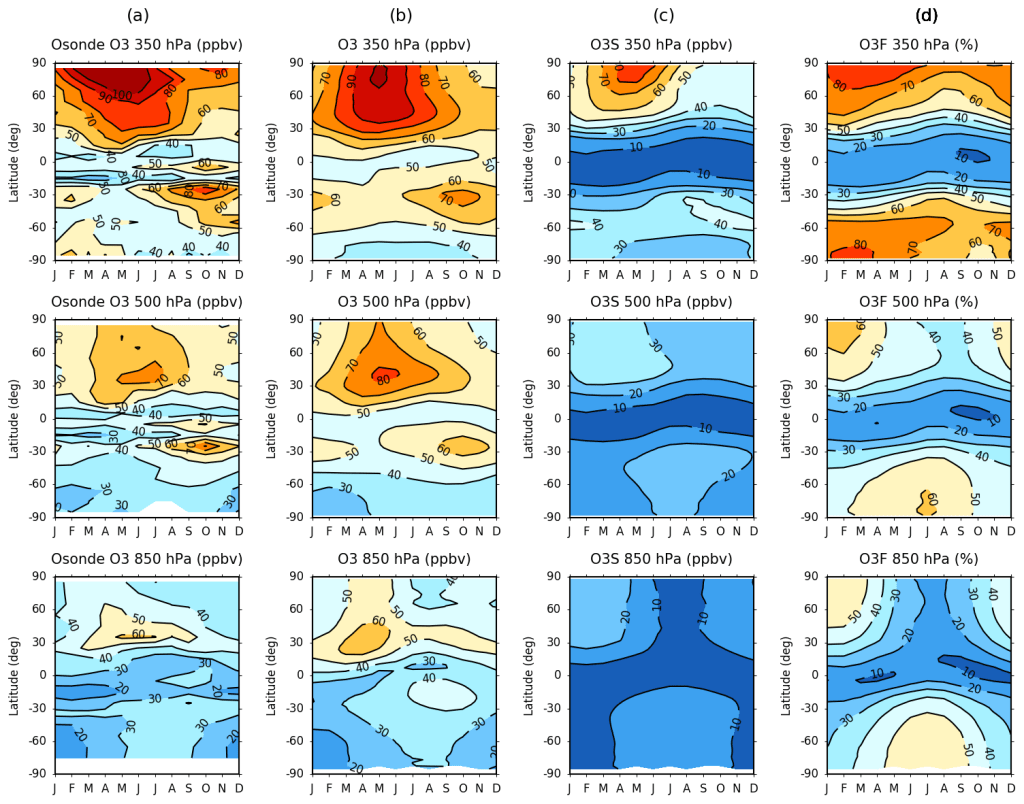
Noting these model biases, we next exploited the fine scale vertical resolution offered by the CCMs to investigate the regional and seasonal variability of the stratospheric influence. Analysis of the model stratospheric ozone (O3S) tracers revealed large differences in the burden of ozone in the extratropical upper troposphere-lower stratosphere (UTLS) region, with some 50-100 % more ozone in CMAM compared to EMAC. We postulated that CMAM must simulate a stronger lower branch of the Brewer-Dobson Circulation, the meridional stratospheric overturning circulation, since the stratospheric influence is isolated using these simulations. This has implications for the simulated magnitude and distribution of the downward flux of ozone from the stratosphere in each model. Shown in Figure 2 is the zonal-mean monthly evolution of ozone volume mixing ratio (ppbv) from ozonesondes and EMAC over the period 1980-2013 for the upper (350 hPa), middle (500 hPa) and lower (850 hPa) troposphere, together with the EMAC O3S and derived fraction of ozone of stratospheric origin (O3F) (%) evolution.

We found that the ozonesonde evolution closely resembles that of both EMAC and CMAM (not shown) throughout the troposphere. A clear correspondence in the seasonality of ozone is also evident for the EMAC O3S tracer, and in turn the O3F evolution, particularly towards the upper troposphere. Nonetheless, both models imply that over 50 % of near-surface ozone is derived from the stratosphere during wintertime in the extratropics, which is substantially greater than that estimated by Lamarque et al. (1999) (~ 10-20 %), and still considerably higher than more recent studies (~ 30-50 %) (e.g. Banarjee et al., 2016). This indicates that the stratospheric influence may indeed be larger than previously thought and is thus an important consideration when attempting to understand past, present and future trends in tropospheric ozone.

Figure 2 – Zonal-mean monthly mean evolution of ozone (O3) volume mixing ratio (ppbv) derived from (a) ozonesondes and (b) EMAC. The evolution of the (c) EMAC stratospheric ozone (O3S) tracer and (d) stratospheric fraction (O3F) (%) are additionally included over the period 1980-2010 for 350 hPa (top row), 500 hPa (middle row) and 850 hPa (bottom row).

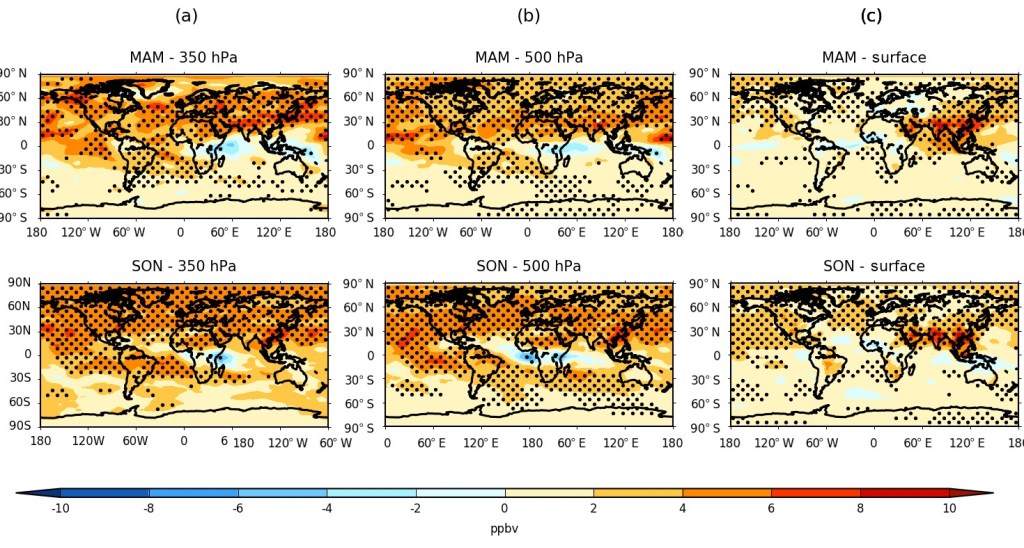
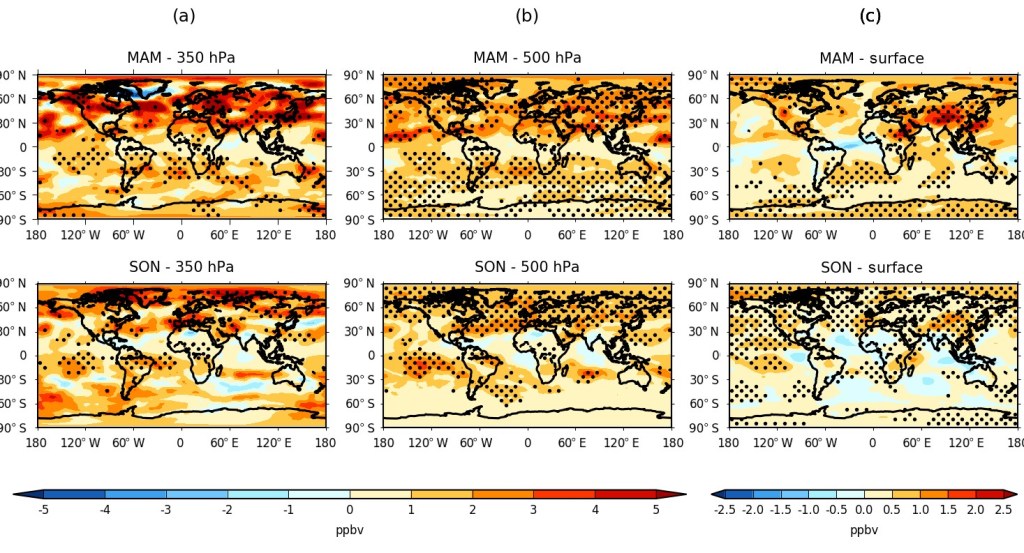
Finally, we analysed height-resolved seasonal changes in both the model O3 and O3S between 1980-89 and 2001-10. The calculated hemispheric springtime (MAM/SON) changes in ozone are shown in Figure 3, and equivalently for O3S in Figure 4, for the upper and middle troposphere (350 and 500 hPa), as well as for the surface model level. A general increase in tropospheric ozone was found worldwide in all seasons, which is maximised overall during spring in both the Northern Hemisphere (~ 4-6 ppbv) and the Southern Hemisphere subtropics (~ 2-6 ppbv), corresponding to a relative increase of about 5-10 %. Respectively, a significant stratospheric contribution to this change of ~ 3-5 ppbv and ~ 1-4 ppbv is estimated using the model O3S tracers (~ 50-80 % of the total change), although with substantial inter-model disagreement over the magnitude and sometimes the sign of the attributable change for any given region or season from the stratosphere.

Figure 3 – Seasonal change in EMAC ozone volume mixing ratio (O3) (ppbv) between 1980-89 and 2001-10 for MAM (top) and SON (bottom) at (a) 350 hPa, (b) 500 hPa and (c) the surface model level. Stippling denotes regions of statistical significance according to a paired two-sided t-test (p < 0.05).

Although surface ozone changes are dominated by regional changes in precursor emissions between the two periods – the largest, statistically significant increases (> 6 ppbv) being over south-east Asia – the changing influence from the stratosphere were estimated to be up to 1–2 ppbv between the two periods in the Northern Hemisphere, albeit with high regional, seasonal and inter-model variability. In relative terms, the stratosphere can be seen to typically explain 25-30 % of the surface change over regions such as the Himalayas, although locally it may represent the dominant driver (> 50 %) where changes in emission precursors are negligible or even declining due to the enforcement of more stringent air quality regulations over regions such as western Europe and eastern North America in recent years.

Figure 4 – Seasonal change in EMAC stratospheric ozone volume mixing ratio (O3S) (ppbv) between 1980-89 and 2001-10 for MAM (top) and SON (bottom) at (a) 350 hPa, (b) 500 hPa and (c) the surface model level. Stippling denotes regions of statistical significance according to a paired two-sided t-test (p < 0.05). Note the scale difference between (a-b) and (c).

To summarise, our paper highlights some of the shortcomings of the EMAC and CMAM CCMs with respect to observations and we emphasise the importance of understanding model bias origins when performing subsequent model-based evaluations. Additionally, our evaluations highlight the necessity of a well-resolved stratosphere in models for quantifying the stratospheric influence on tropospheric ozone. We find evidence that the stratospheric influence may be larger than previously thought, compared with previous model-based studies, which is a highly significant finding for understanding tropospheric ozone trends.

References:
Lamarque, J. F., Hess, P. G. and Tie, X. X.: Three‐dimensional model study of the influence of stratosphere‐troposphere exchange and its distribution on tropospheric chemistry., J. Geophys. Res. Atmos., 104(D21), 26363-26372, https://doi:10.1029/1999JD900762, 1999.

Banerjee, A., Maycock, A. C., Archibald, A. T., Abraham, N. L., Telford, P., Braesicke, P., and Pyle, J. A.: Drivers of changes in stratospheric and tropospheric ozone between year 2000 and 2100., Atmos. Chem. Phys., 16, 2727-2746, https://doi.org/10.5194/acp-16-2727-2016, 2016.