Models and Memories: Our NCAS CMSS 2025 Experience

Piyali Goswami: p.goswami@pgr.reading.ac.uk

Mehzooz Nizar: m.nizar@pgr.reading.ac.uk

This September, we attended the NCAS Climate Modelling Summer School (CMSS), held at the University of Cambridge from 8th to 19th September. Five of us from the University of Reading joined this two-week residential programme. It was an intense and inspiring experience, full of lectures, coding sessions, discussions, and social events. In this blog, we would like to share our experiences.
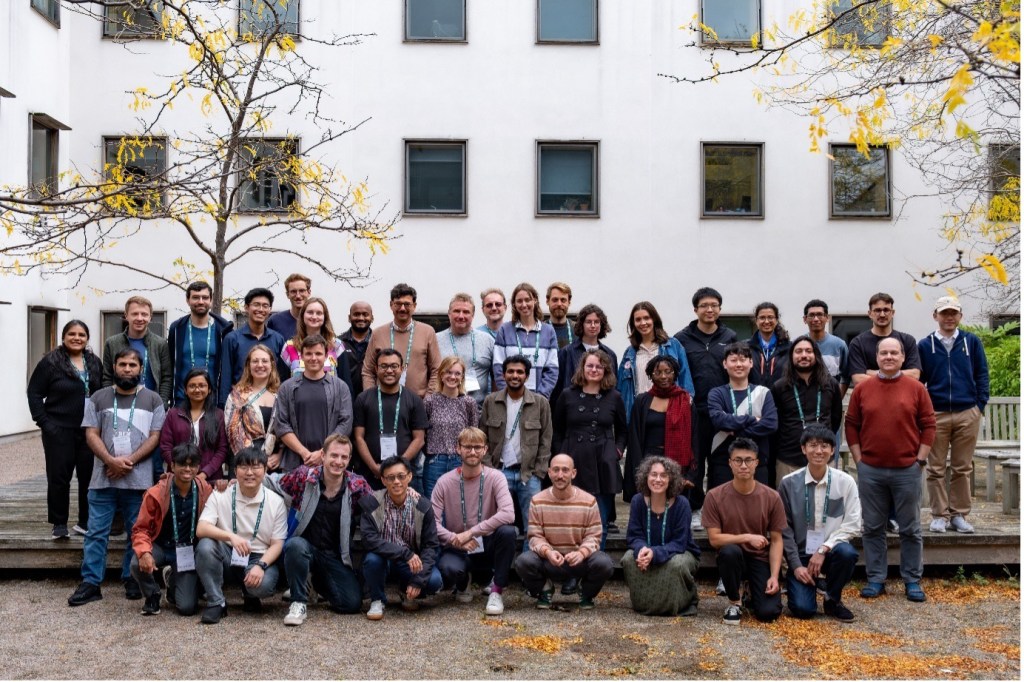
 Picture 1: Group Picture of Students and teaching staff. One cohort, many time zones, zero dull moments…

About NCAS CMSS

The NCAS Climate Modelling Summer School (CMSS) is a visionary program, launched in 2007 with funding originating from grant proposals led by Prof. Pier Luigi Vidale. Run by leading researchers from the National Centre for Atmospheric Science and the University of Reading, it’s an immersive, practice-driven program that equips early-career researchers and PhD students with deeper expertise in climate modelling, Earth system science, and state-of-the-art computing. Held biennially in Cambridge, CMSS has trained 350 students from roughly 40 countries worldwide.

The CMSS 2025 brought together around 30 participants, including PhD students and professionals interested in the field of Climate Modelling. 

Long Days, Big Ideas: Inside Our Schedule

The school was full of activity from morning to evening. We started around 9:00 AM and usually wrapped up by 8:30 PM, with a good mix of lectures, practical sessions, and discussions that made the long days fly by.

Week 1 was led by Dr Hilary Weller, who ran an excellent series on Numerical Methods for Atmospheric Models. Mornings were devoted to lectures covering core schemes; afternoons shifted to hands-on Python sessions to implement and test the methods. Between blocks, invited talks from leading researchers across universities highlighted key themes in weather and climate modelling. After dinner, each day closed with a thought-provoking discussion on climate modelling, chaired by Prof. Pier Luigi Vidale, where participants shared ideas on improving models and their societal impact. 

The week concluded with group presentations summarising the key takeaways from Hilary’s sessions and our first collaborative activity that set the tone for the rest of the school. It was followed by a relaxed barbecue evening, where everyone finally had a chance to unwind, chat freely, and celebrate surviving our first week together. 
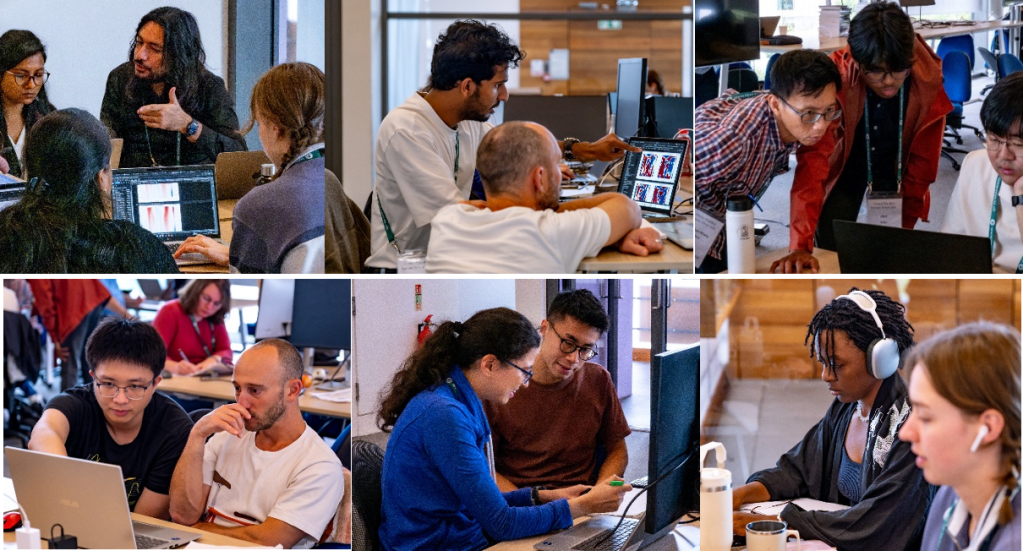
Picture 2 : Working on our group projects. Looks like NASA, feels like: ‘what’s our team name?’

Week 2 was all about getting hands-on with a climate model and learning how to analyse its output. We moved into group projects using SpeedyWeather.jl to design and run climate model experiments. It is a global atmospheric model with simplified physics, designed as a research playground. One of the developers of SpeedyWeather.jl, Milan Klöwer, was with us throughout the week to guide and support our work. Each team explored a different question, from sensitivity testing to analysing the model outputs, and spent the afternoons debugging, plotting, and comparing results. Evenings featured talks from leading scientists on topics such as the hydrological cycle, land and atmosphere interactions, and the carbon cycle. 

The week also included a formal dinner at Sidney Sussex, a welcomed pause before our final presentations. On Friday 19th of September, every group presented its findings before we all headed home. Some slides were finished only seconds before presenting, but the atmosphere was upbeat and supportive. It was a satisfying end to two weeks of hard work, shared learning, and plenty of laughter. A huge thank you to the teaching team for being there, from the “silly” questions to the stubborn bugs. Your patience, clarity, and genuine care made all the difference.
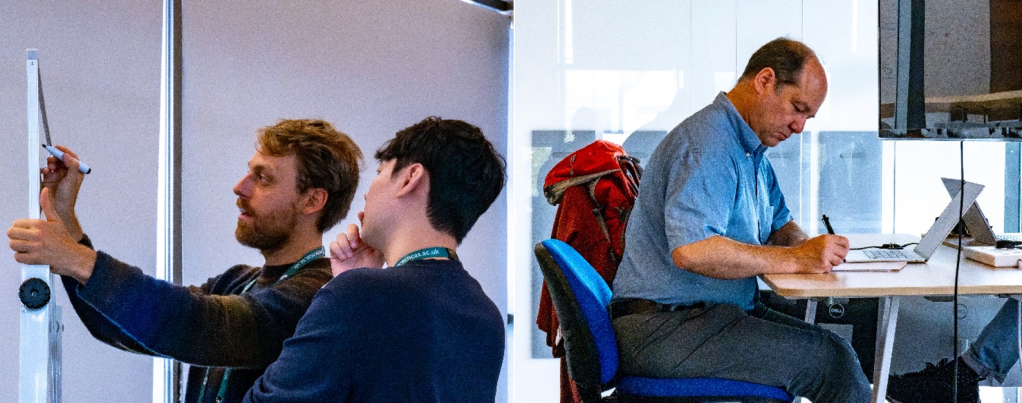
Picture 3: SpeedyWeather, as told by its favourite storyteller Milan, Picture 4: Pier Luigi probably preparing for the next summer school..

Coffee, Culture, and Climate Chat

The best part of the summer school was the people. The group was diverse: PhD students, and professionals from different countries and research areas. We spent nearly every moment together, from breakfast to evening socials, often ending the day with random games of “Would You Rather” or talking about pets. The summer school’s packed schedule brought us closer and sparked rich chats about science and life, everything from AI’s role in climate modelling to the policy levers behind climate action. We left with a lot to think about. Meeting people from around the world exposed us to rich cultural diversity and new perspectives on how science is practiced in different countries, insights that were both fresh and valuable. It went beyond training: we left with skills, new friends, and the seeds of future collaborations, arguably the most important part of research.
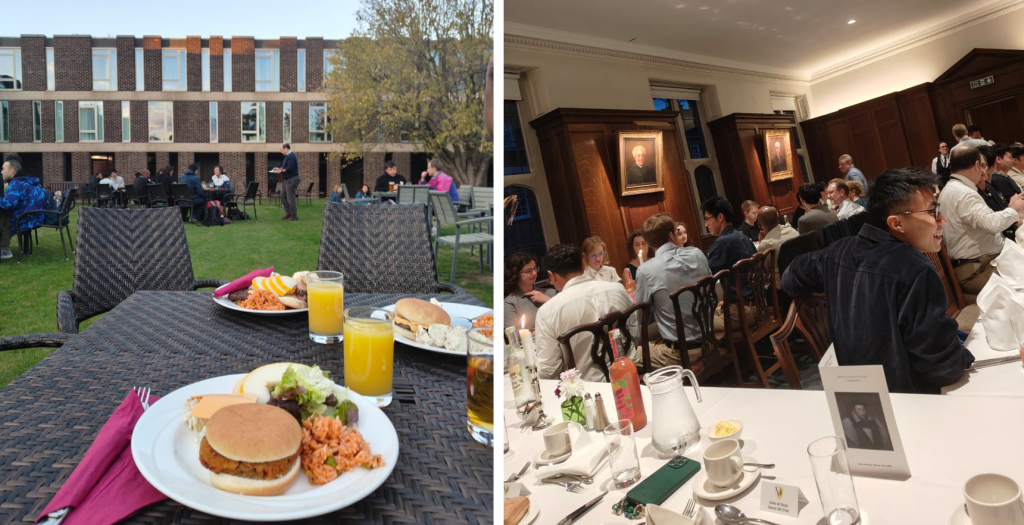
Picture 5: Barbecue evening after wrapping up the first week, Picture 6: Formal dinner at Sidney Sussex, one last evening together before the final presentations

Reflections and takeaways

We didn’t become expert modellers in two weeks, but we did get a glimpse of how complex and creative climate modelling can be. The group presentations were chaotic but fun. Different projects, different approaches, and a few slides that weren’t quite finished in time. Some of us improvised more than we planned, but the atmosphere was supportive and full of laughter. More than anything, we learned by doing and by doing it together. The long days, the discussions, and the teamwork made it all worthwhile.

If you ever get the chance to go, take it. You’ll come back with new ideas, good memories, and friends who make science feel a little more human.

For the future participants

The NCAS CMSS usually opens in early spring, with applications closing around June. With limited spots, selection is competitive and merit-based, evaluating both fit for the course and the expected benefit to the student.

Bring curiosity, enthusiasm, and a healthy dose of patience, you’ll need all three. But honestly, that’s what makes it fun. You learn quickly, laugh a lot, and somehow find time to celebrate when a script finally runs without error. By the end, you’ll be tired, happy, and probably a little proud of how much you managed to do (and probably a few new friends who helped you debug along the way).
Match report on the first Met Dept cricket match since 2019

Written by Elliot McKinnon-Gray

THERE HAD BEEN murmurings among the cricket lovers of the Meteorology department about resurrecting the Staff v Student cricket match each year when the darling buds of Spring give way to the lush green leaves of Summer and the drying out of the ground underfoot. It was time to get it going. It started with casual conversations over coffee about the logistics of resurrecting this beloved tradition, and then the feelers were sent out. Over 30 people signed up to be notified of developments, so I knew we would have enough players, and it was time to find a venue.

How foolish it was of me to assume that the University would have an on-campus cricket pitch – “a non-starter on campus” I was told by Sport@Reading: turns out they had turfed out their cricketers and exiled them to a far away land the other side of the M4. That would not do. Then came the excellent suggestion from one of the all-time cricketing greats of the department, Reg. Prof. Keith Shine who suggested we could ask over at Sol Joel Park about use of their facilities. A perfectly walkable distance away. But again I was met with an apologetic rebuttal – the facilities were fully booked out by regular-season teams. Looks like we were going to have to MacGyver this together ourselves. The plan was simple: plastic cones for a boundary and stumps on springs on a plain patch of grass near the SportsPark. But then came the revelation that PhD student Eme Dean-Lewis might be able to connect with the lovely folk over at Leighton Park School, just over the road at the Pepper Lane exit. It was all a little last minute, but it was done. The first Staff vs. Student match was to be held on the grounds of Leighton Park school on their beautifully kept ground in front of their adorable Victorian pavilion.

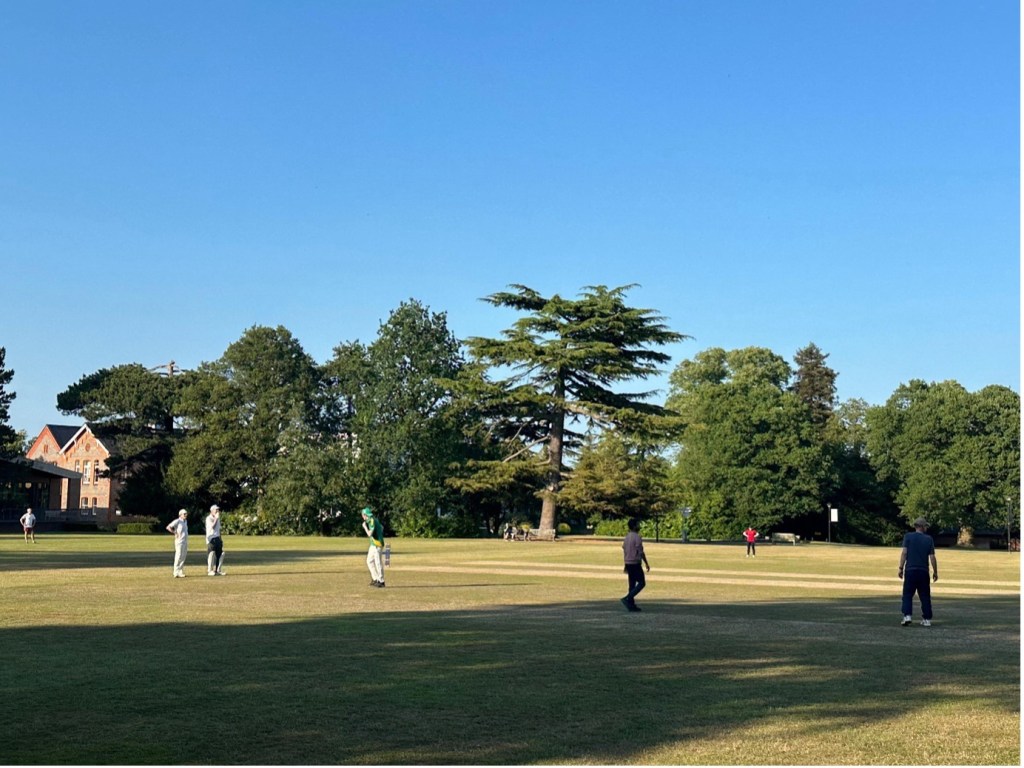
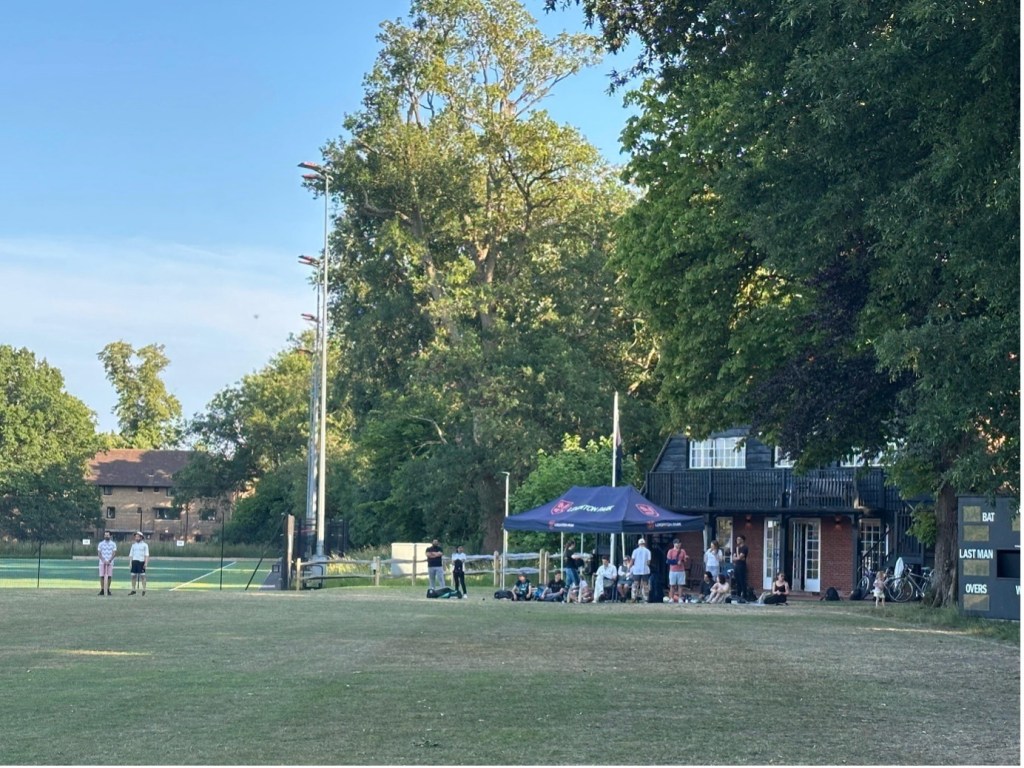
Students’ XI waiting their turn to bat in front the Leighton Park School pavilion. Image Credit: J. Williams

Gameday arrived. Tuesday 17th June 2025. Gloriously hot and dry: a perfect day for a game of cricket. We were to play a 22-over game so that everyone faced 12 balls but we had to be out of the ground by 20:45, so no hanging about! To speed things along, there were no re-bowls for wides or no balls, but a 2-run penalty. A 2 run penalty to the batting team for each wicket lost as well. The Students’ captain E. McKinnon-Gray and Staff captain K. M. R. Hunt went out to inspect the wicket and both had the same first impression. This looks like a subcontinental wicket – hard and dry with a few cracks. Not expecting a lot of bounce or seam movement but the spinners might have a field day…

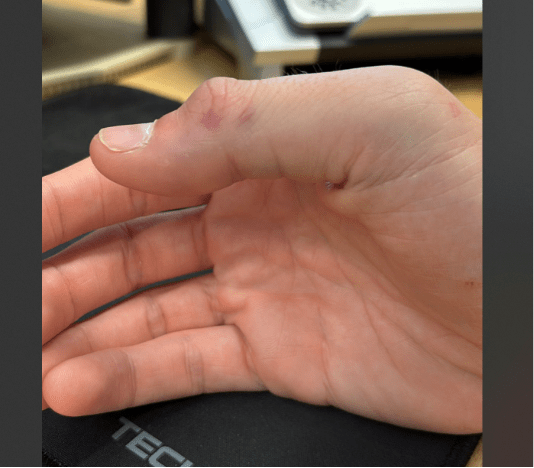
At the toss, both captains were happy with Students’ XI batting first. The first over was N. Reddy to E. McKinnon-Gray and provided some of the highest quality cricket of the evening. Reddy was bowling fast and straight, but McKinnon-Gray was making use of that pace and managed to score 10 off the first over with a bye for the team taking the opening over score to 11-0. It was looking like a good day to bat. Following that was Shipley to Mammatt with a modest 3 including a wicket. Reddy to McKinnon-Gray was the story of the 3rd over, and two stories of the game as a whole. To make up for his expensive first over, Reddy elected to come over the wicket this time, and first ball pitched up viciously into McKinnon-Gray’s thumb resulting in a painful swelling. Great deal of help those expensive Gray-Nicolls gloves were! The following ball, wicket keeper S. Woolnough suffered the same fate to a searing yorker-length ball just outside off stump that went for a bye. Two fractured thumbs in two balls, Reddy took the pace off a bit and decided to bowl some medium-fast spin. The result was just 2 runs off the 3rd over. McKinnon-Gray and Woolnough continued to play through the pain.

McKinnon-Gray’s smashed thumb

Mammatt followed up with a well earned 3 runs off the bowling of W. Tsai. Up next was the batting pair of S. K. Panda and C. Miller. Like the other pairs, this represents one more and one less experienced player. All the inexperienced players made a great case for themselves and had a good time according to conversations I have had with them today. And that is the most important thing – that people enjoyed playing a team sport with their colleagues (and bosses!).

In the four overs that followed there were a flurry of runs and wickets. Panda crashed a delicious four on the offside which almost got lost in the bushes off Reddy’s fast spin. Miller, after scoring a run off the spin of C. O’Reilly, was caught and bowled by O’Reilly twice in consecutive balls. The eventual player of the match was giving us his first hint that he came here to win this match for team Staff. 5 runs off the Hunt to Panda over, followed by A. Charlton-Perez to Miller which resulted in another wicket, this time a catch by Woolnough off the tall spinner’s bowling.

In at 5 and 6 were the experienced D. Wood and the flying Dutchwoman with 0 games under her belt A. Te Winkel. Wood played a classy innings scoring 4 runs with a variety of classic strokes off the bowling of R. Kandala. Te Winkel scored a steady 3 off Williams’s and Shipley’s bowling. Up next were R. S. Nemani and G. Ching-Johnson. Nemani scored 3 and lost two wickets to the bowling of B. Senapati, while Ching-Johnson scored 1 and weathered the storm against a barrage of spin from Thompson and G. Hu. The best was yet to come for the student batters however – out walked L. Blunn and N. Inatimi with the Students foundering at 62-6 off 16. 4 overs later, they stood at 97-7 after Blunn crashed 21 off his two overs against the bowling of P. M. Inness and N. Reddy. Inatimi endured an eventful two overs, scoring 7 runs including a boundary – the only inexperienced player to do so – and was the 3rd victim of another O’Reilly caught and bowled. Up at 11 to give the Students a boost at the end was J. Charlton-Perez with a beautifully struck 12 from 12 balls (and making his dad run around a fair bit in the field!).

The final student net score of 107 must be caveated here by the fact that the Staff XI was in fact a Staff XIII – two extra players flew under the radar until near the end. With this taken into account, Staff only won by 9 runs, but in their batting innings they certainly made sure that there was no doubt over the winner.

Staff captain Hunt corralling his 13 fielders. Photo: J. Williams

The bowling started well for the Students, with EMG, JCP, Nemani, and Blunn conceding just 16 runs off the opening 4 overs of Hunt and Hu. It was during the staff batting that some creative nominations for player of the match began to be suggested. A very successful chase was about to start, possibly thanks to a seagull roaming around the perimeter. Another suggestion was in the form of umpire K. Shine who, if all the extras were credited to him was the top scorer by 400%! He did however play the full 44 overs – a valiant effort.

In at 3 and 4 were Thompson and Reddy whose mission was to “take off the scoreboard pressure”. And they did exactly that – 36 runs off their stand and Staff were already nearly halfway to Students’ total. No wickets fell in the next pairing of Senapati and Shipley – adding 25 more (mostly extras). The following pairing was what ultimately won the match for the Staff and cemented O’Reilly’s place as player of the match. O’Reilly hit a thunderous 24 off the bowling of Panda and McKinnon-Gray with Tsai contributing 4 more, and extras taking the staff score to within 2 of the Students’. The bowling of Blunn to Tsai also brought up arguably the highest quality piece of bowling and fielding of the match, a beautiful outswinger from Blunn nicked offside straight to the raised hands of Panda at first slip high above his head. A proper test dismissal. JCP’s wicket-keeping debut was off to a flyer with a stumping to end the final over of Tsai’s batting.

Kandala and Inness followed up, and although wickets fell to Panda and Blunn with a great performance from stand-in keeper JCP with a catch to add to his tally, the pair contributed 24 to the Staff score taking the game all but out of reach of the Students. Finally, it was the turn of Williams to bat and perhaps the most village moment of the whole game. While running for his first single off the bowling of Blunn, his box fell out onto the middle of the pitch! We then all politely looked away while he readjusted…! Blunn and J. Charlton-Perez got a wicket each with no extras, but despite their tight bowling, Williams’s 4 runs was enough to make sure of the result.

All in all, a great departmental social event, and hopefully a few more people can count themselves as enjoyers of cricket. See you all at the next one – students, we’ve got revenge to seek!

The Making of STRATATOUILLE

By Elliot Mckinnon-Gray and Niamh Ocallaghan

The making of 2024’s departmental pantomime Stratatouille actually began all the way back in the summer of that year. There had been conversations on some stifling hot days (not that there were many!) around the theme for the current year’s panto. A film viewing had taken place and characters had begun to be assigned. However, come October, no one could have predicted the twist this tale would have taken leading to the majority of PhD students reluctantly(?) donning chef hats and rat ears for the best part of the coming December.

STRATATOUILLE Poster

Our story actually begins even earlier, mere days after the roaring success of sshRACC in December 2023 – as is apparently tradition – the fabled Panto Cupboard Key was foisted upon me by one of last year’s organisers. I won’t name and shame – but my fate was sealed; I was to become the organiser for the 2024 departmental pantomime. But who, pray, would heed my call for a co-organiser in this, my hour of need? It all came down to a rather conniving bit of deception, whereby I managed to trick my co-coordinator into accepting the key when they may have been expecting a tasty treat. Who says the pantomime is begrudgingly organised? But our destiny was well and truly decided and laid out in front of us. In nine to ten short months, we would be organising a corral of unruly PhD students and support staff to put on the world’s greatest annual university meteorology department pantomime.

Coming back to where we began, at the start of the academic year, we had an extremely strong candidate for what we thought was going to be the theme of the panto, but as always, the story for the panto is decided in the second(?) PhD Group Meeting of the year in a democratic process. This is where our original plan got unseated. The strongest proprietor (with many supporters) of the originally planned theme made the fatal mistake of prioritising career development over their wishes for a panto theme and could not make the deciding session. As Rabbie Burns reminds us, “The best laid plans of mice and men often go awry” – this was one such instance. With only half the organising committee present to propose the original idea, a plucky upstart with one good joke took the stage and captured the imagination of the PhD cohort, and so it was decided: Stratatouille would be the theme for this year’s panto. As fatefully predicted in last year’s panto blog post… 

Plot 

After innumerable lunchtime and evening writing sessions, the bulk of the panto story was baked and ready to consume. It is here where we have to give another massive thank you to Caleb Miller, who spent hours and hours essentially transposing the original story of the film Ratatouille to be based in our department following the terribly cobbled together idea of a story that we had. All we had to do now was pepper it with jokes and puns pertaining to food and/or meteorology and we had a script that even Patton Oswalt would be proud to perform. 

Audience review #1 

“The best panto I’ve seen for many years”

– Dr. Pete Inness 

The story begins with Remi the undergrat realising he feels unable to fulfil his ambition of doing serious research while surrounded by his decidedly unserious fellow undergrats. All they care about is getting drunk off snakebites, but Remi has a dream of becoming a great scientist and doing exceptional and interesting original research. While feeling dejected that he is too inferior to publish original research, he has an apparition of King Sir Professor Brian Hoskins* who gives him a message that anyone can be a scientist if they put their heart into it. 

Then we meet Linguini, a floundering PhD student who feels like he isn’t cut out for the work he is undertaking and expected to do. In a moment of serendipity, Linguini leaves his laptop open and unlocked in the BH coffee area where Remi is able to take a look at the work he is carrying out analysing some CheeseCDF files. Remi realises Linguini’s coding is terrible, fixes a few bugs and manages to greatly improve the code Linguini was working on. This leads to Linguini accepting help from Remi to write a paper as part of his PhD.

In the next scene, Linguini is showing Remi around his PhD office, when the WCD (Weekly Cuisine Discussion) bell goes, and all the PhD students diligently trudge down to GU01 to attend. Admittedly the WCD scene doesn’t further the story much apart from giving Remi an insight into the breadth of research done in this meteorology kitchen. But we got a lot of laughs, good jokes and puns, and silly costumes into this scene so it was an audience and cast favourite. It is later in this scene that we meet the terrifying supervisor, brilliantly played by our regular cartoon villain Catherine Toolan. The supervisor is very tough on Linguini with high expectations and little patience. But that is all too easy for Remi who manages to complete the task the supervisor asked for in no time at all. They (Linguini napping with his feet up) spend the next few hours “cooking up some actual research”. When the supervisor returns, she is amazed to see that ‘Linguini’ has disproved the entire concept of PV. Suspicious that he has managed to attain such a level of skill so quickly, she recommends that he first present the work at a conference before they crack on with publishing the work. 

At the conference, Linguini gives a great presentation (Remi is giving him slide-by-slide instructions) but makes a fatal error by taking nearly all of the credit and failing to mention he got any help from Remi. This alienates Remi who storms out of the conference to return to the department. Jumping forward in time, when Remi returns to and hatches a cunning plan to derail the entire department – stealing the tea and coffee money box (topical departmental news has appeared in the script!). Back at the conference, Remi is making a total fool of himself by not being able to answer even the simplest of questions from the audience, embarrassing his supervisor in the process. She interrogates him about this and finds out much to her dismay that an undergrat helped with the research. So disgusted is she at this that supervisor and the other staff members strike, leaving the department destitute of senior figures. 

This leads to a moment where Remi and Linguini make up thanks to an apology, and Remi recruits a team of undergrats to help finish writing the paper they started. The paper is submitted to the journal Nature: Valley Bar where it is eventually inspected by the feared Reviewer 2, who is so impressed by the work that he recommends it be published with no changes (apart from citing one of his own papers). The story ends with KSPBH* re-appearing and handing Remi the keys to the department and naming the building after him. 

Songs 

Please Stop Me Now – there was a running theme of ‘difficult to sing but possibly worth the effort since they are well loved tunes’ for most songs this year, and this one was no exception. A parody of Queen’s 1979 mega-hit of Don’t Stop Me Now, our extremely talented band carried our pretty rubbish singing – but that didn’t stop it being some attendees’ favourite part of the show. 

Audience review #2 

“How did you guys come up with all those song lyrics and make them work? So funny and so impressive!” 

– MSc Student 

Come on Remi – One of the more singable tunes based on Come on Eileen by Dexys Midnight Runners, all about how much work Remi was going to have to do to get Linguini through his PhD work. In practising this one, we had choir master Catherine bellowing at us to sing louder, a task we all found much easier after a few glasses of boxed wine from the Winnersh Sainsbury’s. The Middle – Jimmy Eat World was the third song which I don’t think we even came up with a spoof title for; a punk-pop particularly catchy tune about the trials and tribulations of poor Linguini the PhD first year who is letting his stress get in the way of enjoying the start of his PhD. Money, Money, Money – an ABBA classic we also didn’t need to change the title of about the rats stealing the money box. We made the bold decision this year to plant much of the songs mid-scene. A directorial choice that I think helped the coherent telling of the story. Special mention here to Nathan’s amazing piano playing skills here – the rendition of Erik Satie’s Gymnopedie during the John Meth-Coq-au-Vin monologue was only improvised in the final dress rehearsal earlier that day! 500 Lines – a version of the Proclaimers’ singalong classic 500 Miles about how many lines Remi has to write to get their paper done! H-O-S-K-I-N-S : I’m not sure how Sir Brian feels about being the subject of the panto or at least a song every year, and this one was a little on the nose; but you really couldn’t ask for a better fit for one of the songs of the summer – Chappell Roan’s Hot to Go had exactly the right mood for what we wanted to sing, and I think it made for a great outro wonderfully delivered by one of the best KSPBH performances we’ve seen in a while by our very own Douglas Mulangwa.

Casting 

It can be a bit like pulling teeth trying to cast the leading roles in the panto, and as one of the few first-year PhDs who have shown the extroversion to be able to tackle this and with great stage presence, the inimitable Jake Keller somewhat reluctantly agreed to be Remi with a fateful “if I have to” when asked repeatedly. I think he came around to really enjoying it, and the audience were also quite impressed –

Audience review #3 

[To Jake] “You were great!” 

– Regius Professor Keith Shine 

And Andrea Rivosecchi as Linguini – at first he accepted but then realised he would have to learn even more lines than the main character; so we looked around and found a great doppelganger for the second act – not sure if any of you noticed – but in the second act Linguini was played by a different Italian man in Riccardo Monfardini! Some veterans of the game came through and gave us some great performances with Catherine as Supervisor and Hette Houtman as Pete Dinners. Shout out to Hette as one of last year’s organisers for also helping us with timing and who to contact for various admin duties. The remaining roles had under 5 lines, but all were delivered hilariously and brilliantly, and you all appear to have agreed.

Audience Review #5 

“Catherine was quite scary as supervisor” 

– Dr Andy Apple Turnover Turner (Catherine’s PhD Supervisor) 

The Night (and Day) of the Panto 

So as many of you agreed, the Act 1 cameo from our antipodean friend Robbie Marks (the star of last year’s panto) was one of the best moment’s of the panto: 

Audience review #4 

“I can’t believe Robby came through and made that for us!” 

– Gabrielle Ching-Johnson (Undergrat #2) 

This is where I would like to make the point that he sent me those videos the morning of the show, and we had to hurriedly stitch together his several renditions of that speech in different locations with the cinematic walk off. Special thanks to Rosie (last year’s co-organiser) for helping with the video editing, and generally for being a great help to us organisers this year by giving advice and keeping us on time (mostly). Robby was sent a video of the mirthful reaction to his cameo with the reaction “F*** yeah, glad I could make an appearance”. The day went much more smoothly than last year, with us occupying the Madejski lecture theatre from 2pm onwards with no interruptions, we had plenty of time to set up the tech and instruments, as well as squeeze in a final full rehearsal. Set up the ticket booth, and we were ready to go! 150 people filed in for a great attendance to our show. Not to forget a great buffet beforehand to get everyone in the mood for the flagship event in the departmental calendar. 

Act 1 and Act 2 managed to run for about the same amount of time, 30 mins a piece for an hour-long panto, as we had planned – brilliant! The interval acts, however put paid to that. A mammoth 45-minute session full of controversy and some of the biggest laughs of the night. We saw Stroopwaffels crowned the winner of the big biscuit bracket, however this was vetoed by the head of department who quite rightly pointed out they are not a biscuit and so the runner up chocolate hobnobs was our true champion. Professor Coq-au-Vin was not the only one to take issue with this controversial result. The 3L68 team of Dan Shipley, Jake Bland and Brian Lo made the argument that Bourbons had been wrongfully expelled and would have won this year, and so Dan delivered a hilarious diatribe explaining how they came to decide which Bourbon was best, and therefore the true winner of the biscuit bracket. I don’t remember which one it was in the end (M&S?) – check the video recordings of the night to find out for yourselves. 

A pleasant break from the commotion of the biscuit brackets was brought around from some classical piano performed by Amber Te Winkel, and then some might say the only reason they attend the panto – Mr Mets. A blinder of an episode where Peter Clark was apologised to (again – and rejected on his behalf by Humphrey), and insinuated to have signed up to OnlyFans with the most innocent of intentions. The theme of the story was John Methven’s takeover as head of department, with him bumbling along and struggling to fulfil the role while eating copious amounts of ‘free’ food (it’s not free if you use department funds to pay for it, Prof. Methven!). Just to clarify that no one thinks John will struggle to fulfil the role, but as HOD I’m afraid you have to expect a fair bit of derision at these sorts of performances! 

Following that, another side-splittingly funny act followed with an after party led by DJ Shonk that included a rare slow number – all in aid of blossoming romance on the dancefloor. 

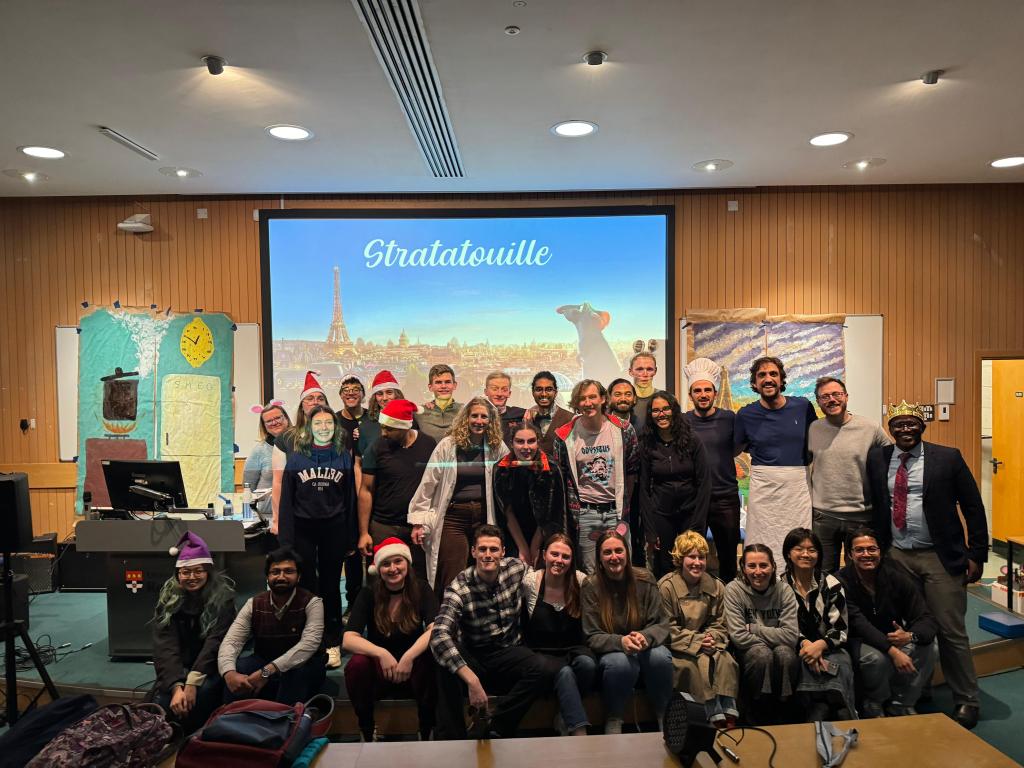
The amazing cast and crew who made STRATATOUILLE happen!

Reflections 

As always, the Panto is months of hard work to organise, and things only ever seem to come together in the eleventh hour. But we had a great team and cast and band that really made it come together beautifully. Acting on stage, playing in a live band, organising a production, generally being a thesp isn’t the kind of thing you expect to hear from a large majority of the PhD students of the world’s leading Meteorology department. But it is these experiences, very far outside most of our comfort zones that builds strong and adaptable characters. And I think this experience has probably given us, as organisers and performers alike, more useful skills than we might have realised. This will, however, probably be these director-producers’ debut and final production. 

A huge thank you to everyone who attended and contributed to the panto in any way, no matter how small. Your participation is what makes this a great bonding experience for the department, and you are all greatly appreciated! 

One last time, 

Your Panto Organisers 
Elliot and Niamh 

The 5th ICTP Summer School on Modelling of Climate Dynamics: Convection and Clouds, and Conference on Convective Organisation (WCO4)

By Juan Garcia Valencia

In the tropics, organised convective systems provide the majority of precipitation and are often responsible for extreme events. To understand these systems, researchers now use kilometre-resolution (k-scale) global and regional convection-permitting models, along with the latest satellite observations. Machine learning tools have also emerged as important supplements to our dynamical and thermodynamic understanding.

It’s crucial to understand these tools to address key questions such as:

  • How do deep and shallow convection organise in k-scale models?
  • Can energy budgets help explain their precipitation biases?
  • What are the recent advances in convective parameterisation?

These questions were the focus of the “5th Summer School on Theory, Mechanisms and Hierarchical Modelling of Climate Dynamics: Convection and Clouds,” which I had the privilege of attending from the 1st–19th of July 2024 at the International Centre for Theoretical Physics (ICTP) in Trieste, Italy.

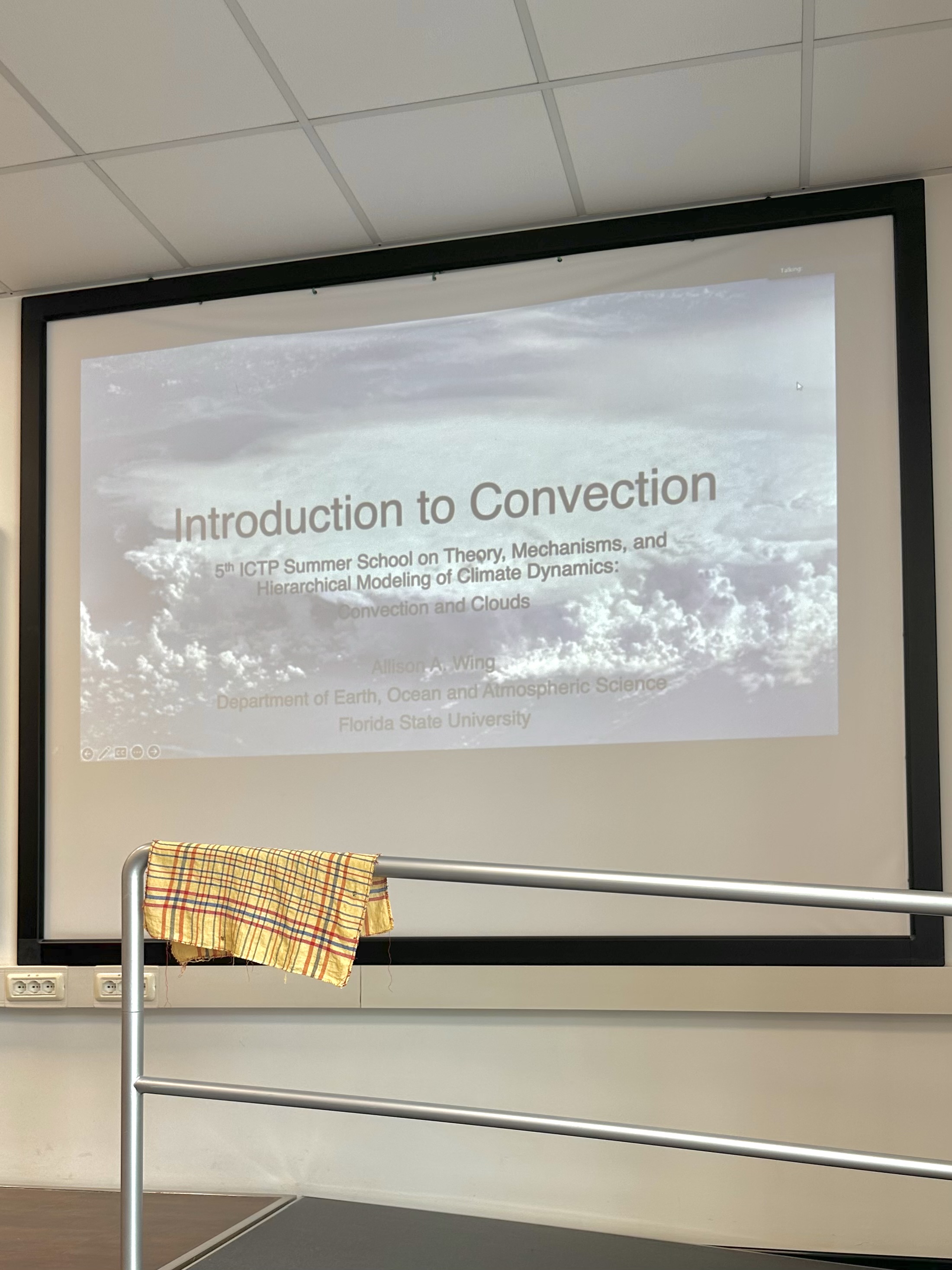
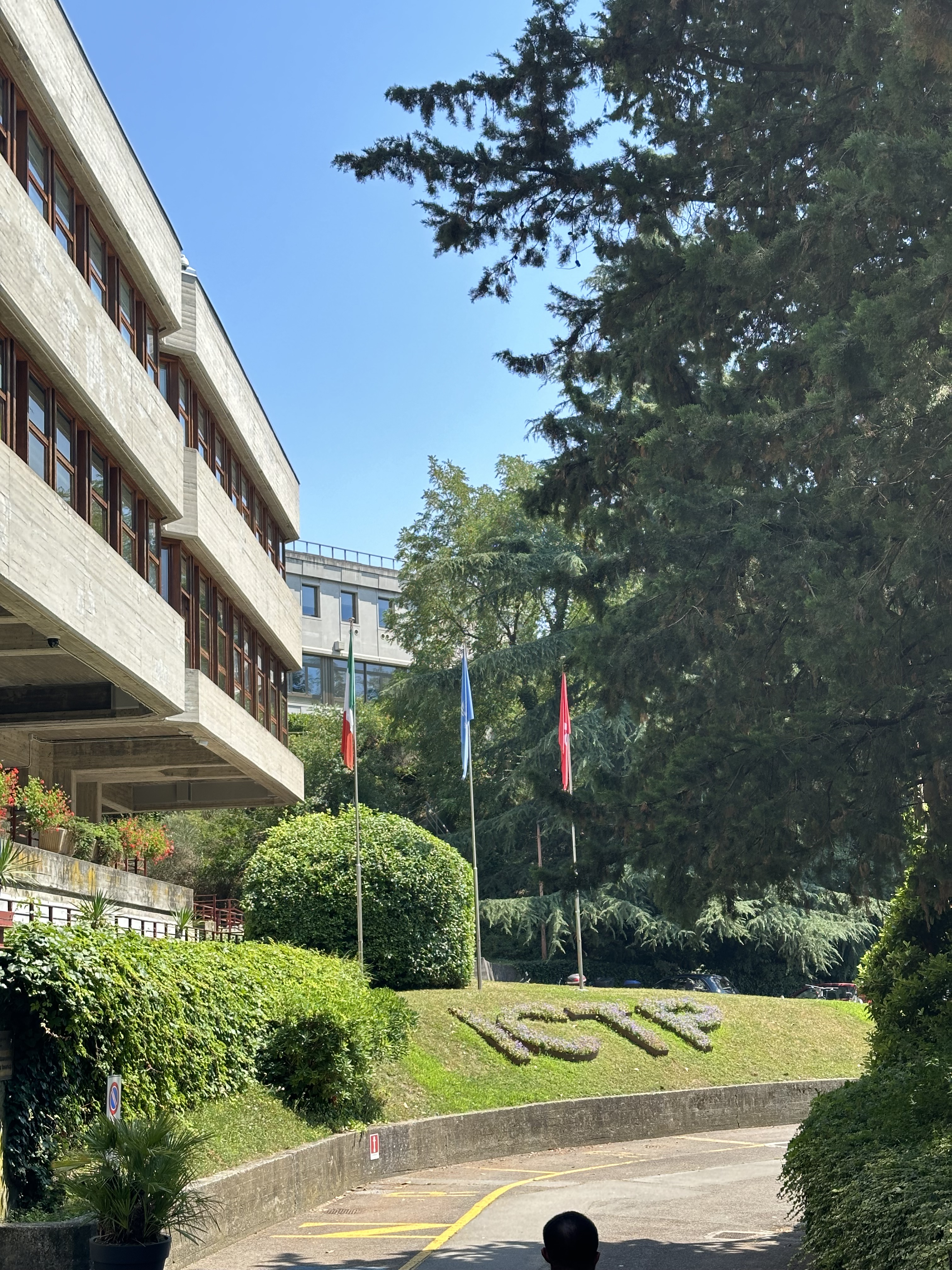
Picture 1 and 2. First lecture and campus. 

The program offered a mix of introductory and advanced lectures, hands-on data analysis through participant projects, and the chance to get involved in the “4th Workshop on Convective Organisation and Precipitation Extremes (WCO4).” The opportunity to attend arose because two of my supervisors, Chris Holloway and Lorenzo Tomassini, presented their work at the conference and taught some of the lectures in the course. As a PhD student researching monsoons using kilometre-scale simulations, I also felt like I had to attend! 

The three-week schedule was intense, with most days running from 9 AM to 6 PM (thankfully with plenty of coffee breaks and a long lunch). A typical day began with lectures from leading experts like Simona Bordoni, Robert Pincus, and Courtney Schumacher. Topics ranged from convection and radiation to RCE, stochastic parameterisation, and observations. Afternoons were usually dedicated to computer lab sessions or group project work.

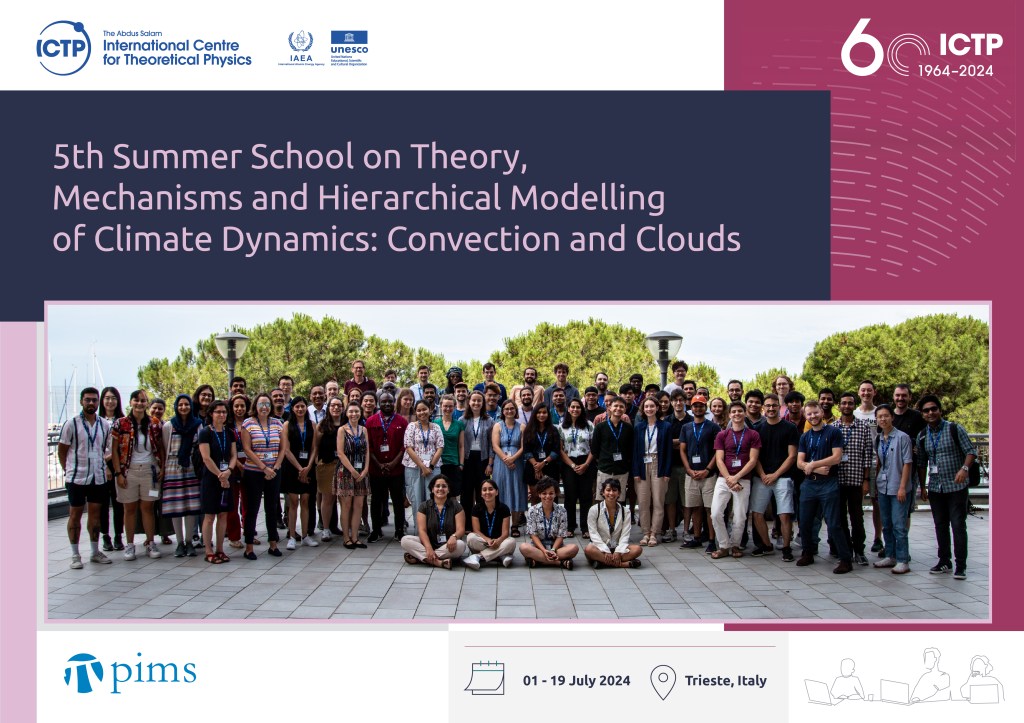
Picture 3. Attendees of the summer school. 

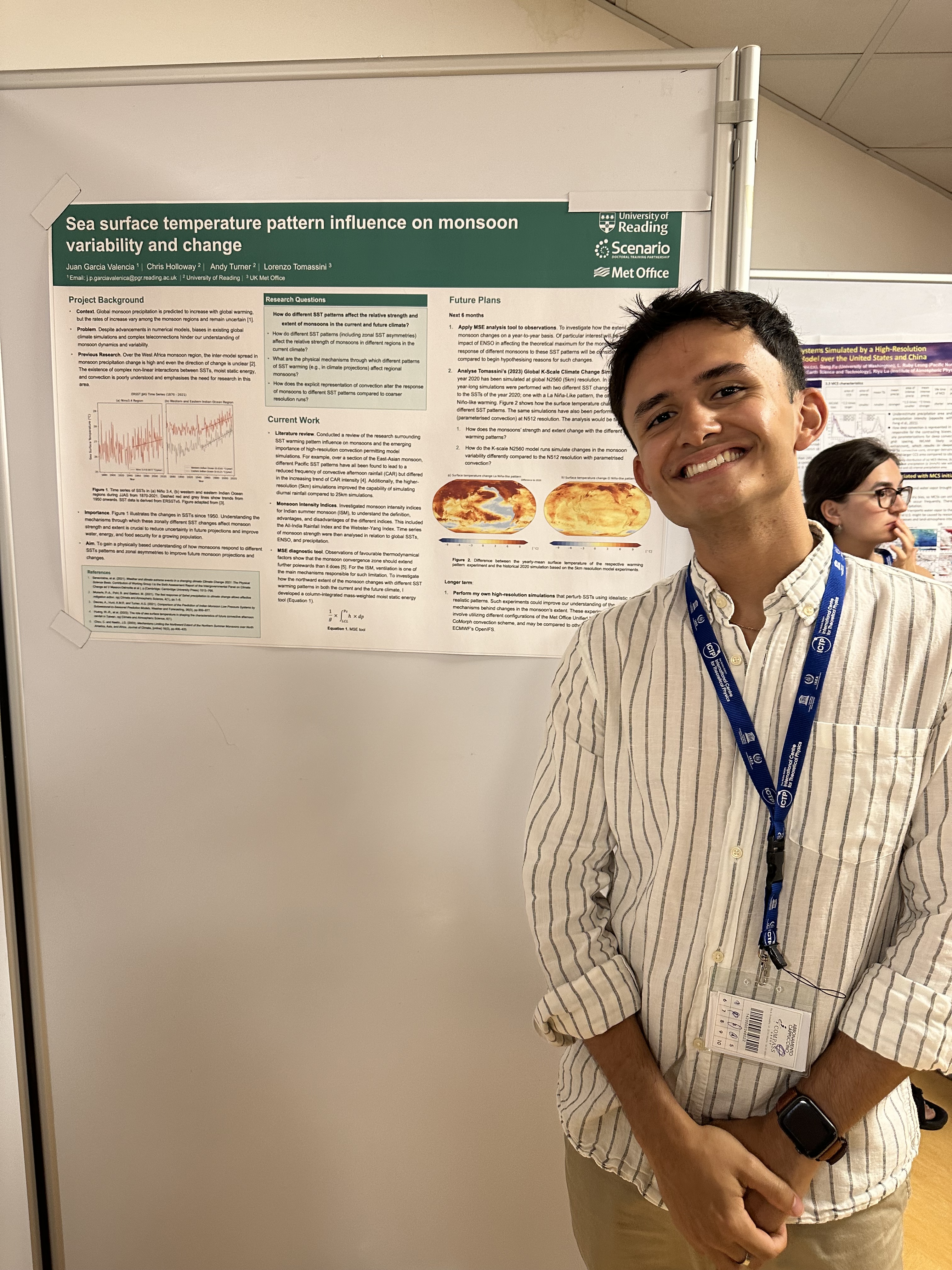
The second week centred on the WCO4 conference, covering topics from convective self-aggregation in idealized experiments to precipitation extremes associated with organized convection and optimizing our use of observational data. Students had the opportunity to present posters on their research—an incredibly valuable experience for me as I received loads of useful feedback about my ideas and goals. This was also my first time presenting research at an international event, so it was great to show what I’ve been working on in front of all the attendees and meet so many people genuinely interested in my work.

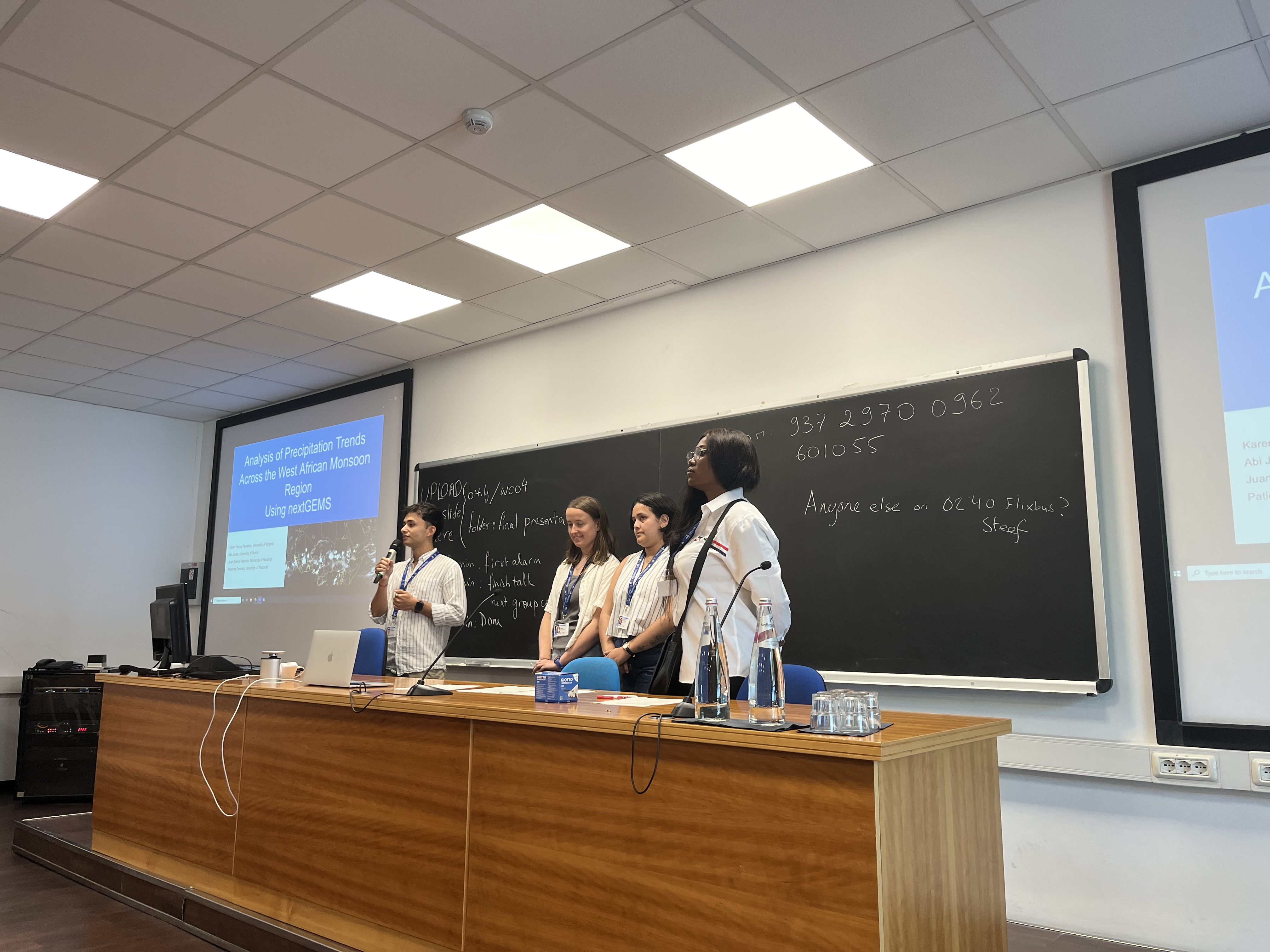
The final week focused on hands-on projects. In groups of 4–5, we analysed numerical model data and presented our results to everyone. My group examined how precipitation extremes change in a warming world using NextGEMS data, but every group had different topics that they had chosen according to their interest and expertise. Many of the tasks and analyses we did were similar to my first-year work, so I left with a plenty of new ideas for my research!

Picture 4. End of group project presentation and poster presentation. 

Being an international centre, the school and conference brought together staff and students from all corners of the globe—one of my favourite aspects of the course. Despite knowing no one beforehand, I quickly got to know other PhDs and post-docs from various institutions, all working on projects similar to mine. I felt at ease in this new environment, making friends and meeting potential future colleagues!

Another fantastic aspect of this summer school was its stunning location on Italy’s sunny, warm northern Adriatic coast. After each day’s activities, we were free to spend our evenings as we pleased. This was the perfect opportunity to relax by the sea, swim, and explore Trieste’s picturesque town centre. More often than not, we’d venture into town for pizza and, of course, gelato!

Starting Your PhD Journey: Tips for Success

So, you’ve officially embarked on the exciting journey that is a PhD—congrats! You’ve reached a major milestone, and whether you’re feeling excited, overwhelmed, or a mix of both, just know you’ve signed up for an adventure like no other. A PhD is an incredible opportunity to dive headfirst into a subject you’re passionate about, build a toolkit of valuable skills, and—who knows?—maybe even make history in your field.

But let’s be real: it’s not all rainbows and groundbreaking discoveries. The PhD life can be challenging, sometimes feeling like a marathon through an obstacle course. You’ll have moments that test your patience, confidence, and sometimes, your sanity. That’s why here at Social Metwork, we’ve gathered some golden advice from seasoned PhD students to help you navigate these waters. Our goal? To make this transition into PhD life a little smoother, maybe even a little fun.

We’ll break these tips down into three areas: navigating day-to-day life as a PhD student, getting organized like a pro, and growing into the great scholar you’re destined to be. Ready? Let’s dive in!

1. Navigating Day-to-day Life as a PhD Student

Work-life balance

The first year of your PhD can feel overwhelming as you try to juggle research, coursework, and life. One key piece of advice? Don’t overwork yourself. As Laura Risley puts it, “Sometimes if you’re struggling with work, an afternoon off is more useful than staying up late and not taking a break.” It’s easy to get absorbed in your work, but stepping away to recharge can actually help you return with fresh perspectives.

Getting involved in activities outside your PhD is another great way to maintain balance (L. Risley, 2024). Whether it’s exploring more of Reading, participating in a hobby, or just getting outside for some fresh air, your brain will thank you for the break. Remember, “Your PhD is important, but so is your health,” so make sure to take care of yourself and make time for things that bring you joy: exercise, good food, and sleep!

Lastly, don’t underestimate the power of routine. Building a consistent schedule can help bring some stability to PhD life. Most importantly, be kind to yourself. The weight of expectations can be heavy so give yourself permission to not have it all figured out yet. You won’t understand everything right away, and that’s completely normal!

Socialising and Building a Support System

Your cohort is your lifeline. The people you start with are going through the same experiences, and they will be your greatest support system. Whether you’re attending department events, organizing a BBQ, or just grabbing a coffee, socializing with your peers is a great way to get through everything. At the end of the day, we are all in this together! As Rhiannon Biddiscombe wisely says, “Go for coffee with people, go to Sappo, enjoy the pub crawls, waste a night out at PT, take part in the panto, spend time in the department in-person” — so make sure you get involved!

If what you want is to meet new people, you could even help organise social events, like research groups or casual hangouts – feeling connected within your department can make all the difference when you’re having a tough week. And hey, if you’re looking for a fun group activity, “Market House in town has darts boards, ping pong tables, and shuffleboard (you slide little discs to the end of the board, it’s good fun!)”.  

2. Getting Organised Like a Pro

Writing and Coding

Staying organised is critical for both your mental health and your research. Adam Gainford recommends you start by setting up a reference manager early on—trust us, you’ll thank yourself later. And if your research involves coding, learn version control tools like GitHub to keep your projects neat and manageable. As a fellow PhD student says “Keeping organised will help keep your future self sane (and it’s a good skill that will help you with employability and future group projects)”.

A golden rule for writing: write as you go. Don’t wait until the last minute to start putting your thoughts on paper. Whether it’s jotting down a few ideas, outlining a chapter, or even starting a draft, regular writing will save you from stress later on. Remember what Laura always says, “It’s never too early to start writing.”

Time Management

Managing your time as a PhD student is a balancing act. Plans will shift, deadlines will change, and real life will get in the way—it’s all part of the process. Instead of stressing over every slipped deadline, try to “go with the flow”. Your real deadlines are far down the road, and as long as you’re progressing steadily, you’re doing fine.

Being organised also doesn’t have to be complicated. Some find it helpful to create daily, weekly, or even monthly plans. Rhiannon recommends keeping a calendar is a great way to track meetings, seminars, and research group sessions – I myself could not agree more and find time-blocking is a great way to make sure everything gets done. Regarding your inbox, make sure you “stay on top of your emails but don’t look at them constantly. Set aside a few minutes a day to look at emails and sort them into folders, but don’t let them interrupt your work too much!”. Most importantly though, don’t forget to schedule breaks—even just five minutes of stepping away can help you reset (and of course, make sure you have some valuable holiday time off!).

3. Growing into the Scholar You’re Meant to Be

Asking for Help

This journey isn’t something you’re expected to do alone. Don’t be afraid to reach out for help from your friends, supervisors, or other PhD students. Asking questions is a sign of strength, not weakness. What’s great is that everyone has different backgrounds, and more often than not, someone will be able to help you navigate whatever you’re facing (trust me, as a geography graduate my office mates saved my life with atmospheric physics!). Whether you’re stuck on a tricky equation or need clarification on a concept, ask ask ask! 

“You’ve got a whole year to milk the ‘I’m a first year’ excuse, but in all seriousness, its never too late to ask when you’re unsure!” – a fellow PhD student.

Navigating Supervisor Meetings

Your supervisors are there to guide you, but communication is key. Be honest with them, especially when you’re struggling or need more support. If something doesn’t make sense, speak up—don’t nod along and hope for the best, “they should always have your back” (it will also be very embarrassing if you go along with it and are caught out with questions…). 

Also, “If you know some things you want to get out of your PhD, communicate that with your supervisors”. Open communication will help you build a stronger working relationship and ensure you get what you need from the process.

Dealing with Imposter Syndrome

Imposter syndrome can hit hard during a PhD, especially when you’re surrounded by brilliant people doing impressive work. But here’s the thing: don’t compare yourself to others. Everyone’s PhD is different—some projects lend themselves to quick results, while others take longer. Just because someone publishes early doesn’t mean your research is less valuable or that you’re behind – we are all on our own journeys. 

And remember, no one expects you to know everything right away. “There might be a pressure, knowing that you’ve been ‘handpicked’ for a project, that you should know things already; be able to learn things more quickly than you’re managing; be able to immediately understand what your supervisor is talking about when they bring up XYZ concept that they’ve been working on for 20+ years. In reality, no reasonable person expects you to know everything or even much at all yet. You were hand-picked for the project because of your potential to eventually become an independent researcher in your field – A PhD is simply training you for that, so you need to finish the PhD to finish that training.”

If you’d struggling with imposter syndrome, or want to learn about ways to deal with it, I highly recommend attending the imposter syndrome RRDP. 

A Few Final Words of Wisdom

The PhD rollercoaster is full of ups and downs, but remember, you’re doing fine. “If you’re supervisors are happy, then don’t worry! Everything works out in the end, even when it seems to not be working for a while! “– Laura Risley

It’s also super important to enjoy the process. You’ve chosen a topic you’re passionate about, and this is a rare opportunity to fully immerse yourself in it. Take advantage of that! Don’t shy away from opportunities to share your work. Whether it’s giving a talk, presenting a poster (or writing for the Social Metwork blog!!), practice makes perfect when it comes to communicating your research.

Embarking on a PhD is no small feat, but hopefully with these tips, you’ll have the tools to manage the challenges and enjoy the ride. And if all else fails, remember the most important advice of all: “Vote in the Big Biscuit Bracket—it’s the most important part of being a PhD student!”. 

From the department’s PhDs students to you! 

Written by Juan Garcia Valencia 

The Weather Game

Ieuan Higgs – i.higgs@pgr.reading.ac.uk

It’s a colder-than-usual, early October Friday afternoon in the PhD offices of Brian Hoskins. The week is tired, motivation is waning and most importantly – Sappo is only 30 minutes away. As the collective mind of each office meanders further and further from work, someone inevitably pipes up with:

“Has anyone done their weather game predictions this week?”

Some mutterings might move around the room – grumbling about the unpredictability of rainfall in Singapore, or a verbal jab at the cold front that decided to move across Reading about 6 hours too early – until, as predictably as ENSO, a first year cautiously asks,

“…What’s the weather game?”

Which is then met with a suitable response, such as:

“The Weather Game? It’s a bit like fantasy football, but for us weather nerds – you’re going to love it!”. 

At least, that’s how I like to describe it.

The game was hotly contested this Autumn, with huge sign-up and participation across the entire term.

A particular shoutout to the Undergraduates, who were out in force and took 50% of the top 10 spots!

Plotting the cumulative scores for the top 32 players of the term, we are treated to a blindingly colourful cascade (thanks excel?) of points totals:

From this, it is clear that our eventual winner had led the pack for a solid five weeks by the competition end – although I’m sure they were a little nervous in those final two weeks. We can also see the dreaded “flatline” – players who clearly got off to a good start but then, for whatever reason, never submitted another prediction for the remainder of the game. Another interesting feature of these plots is the occasional downward bump – a symptom of the dreaded negative score, which were (thankfully) relatively few and far between.

The illustrious awards ceremony was held in WCD on the 8th of December. Category winners were treated to a bar of tasty chocolate, and the overall winner was gifted a delightful little ThermoPro Bluetooth Thermometer & Hygrometer. This seemed an ideal prize for students who might want check if their flat-share thermostat is being undemocratically switched on while they are out at lectures. Of course, a wooden spoon was given to the last place that played at least 8 of the 10 weeks (and if you’re having that much fun with the weather – can you really ever lose?).

With all of that said, we now put our winners’ names in lights (or on the blog) – immortalising them in the records of Weather Game glory.

Wooden Spoon: Catherine Toolan

Oil and Gas – 66.8 points – 32nd place

Best Pseudonym: Meg Stretton

The SIF Lord

External: Thomas Hall

Noctilucent – 518.6 points – 2nd place

Postgraduate: Caleb Miller

I own a sphere – 414.4 points – 8th place

Staff: Patrick McGuire

WindyCrashLandingOnYou – 432.4 points – 7th place

Overall Winner: Nathan Ng

Come Rain or (Keith) Shine – 534.3 points – 1st place

The Weather Game will be back in Spring of 2024. We are excited to run it, and hope to see many new and familiar faces (well, pseudonyms) there.

Mr Weathers

Ieuan Higgs and Nathan Edward-Inatimi

EGU 2022 

Charlie Suitters – c.c.suitters@pgr.reading.ac.uk 

Isabel Smith – i.h.smith@pgr.reading.ac.uk 

Brian Lo – brian.lo@pgr.reading.ac.uk 

What is EGU22? 

With more events resuming as in-person, the European Geosciences Union General Assembly 2022 (EGU22) was no exception. The European Geoscience Union General Assembly is one of the big annual conferences for Earth sciences. For some of us, EGU22 was our first in-person conference overseas, which made it both an exciting and eye-opening experience! This year, 12,332 abstracts were presented with the participation of 7,315 colleagues from 89 countries on-site in Vienna, accompanied by 7,002 virtual attendees from 116 countries. 

Venue of EGU22 – Vienna International Centre

With 791 sessions running throughout the week, working out our personal schedule was a challenge. Luckily, EGU had an online tool we used to add talks to a personal programme, without having to distribute printed programmes. Due to COVID restrictions, all presentations at EGU22 had the same format as short orals. These presentations were delivered and viewed both in-person and online in a hybrid format. Most talks were limited to 5 minutes, which meant it was not the easiest to summarise our work and also deliver effective science to the audience. 

Isabel Smith giving her 5-minute talk at the High-resolution weather and climate simulation session

What is a typical day like at EGU22? 

If you planned to attend an 8.30am session in the morning, then you would have had to take the U-Bahn to the conference centre, crossing your fingers there would be no breakdowns. Most sessions lasted for one and a half hours, consisting of between 15 and 20 presentations with some time for questions and discussion. There were coffee breaks between sessions, where we could recharge with a free flow of coffee and tea.  

A variety of short courses were also on offer, such as “Writing the IPCC AR6 Report: Behind the Scenes” or “Thermodynamics and energetics of the oceans, atmosphere and climate” co-convened by Remi Tailleux from our department. If you are likely to attend this conference in the future, sign up to the EGU newsletter, here you could see further details about the short courses and the EGU staff’s top sessions of the day.  

There was also a large exhibition hall featuring publishing companies and geoscience companies, some of which offered freebies like pens and notebooks. Outside the main exhibition halls, there were picnic benches, usually filled with conference attendees enjoying lunch or an afternoon beer after a full day of conferencing. 

What did we do other than the conference? 

Although there was an impressive showcase of presentations and networking at the 5-day long EGU, we also went sightseeing in and around Vienna. Some of us would take the opportunity of having an extended lunch break to take the U-Bahn to the centre of the city, or an afternoon off to explore a museum, or visit the Donauturm (Danube Tower) for an amazing if windy view of the city. 

We also enjoyed the dinners after long conference days, especially on the night when we filled ourselves with schnitzel larger than the size of our face and had late-night gelato after a few drinks. A few of us stayed over the weekend and visited the outskirts of the city, such as the Schönbrunn Palace and a free panoramic view of Vienna at the top of Leopoldsberg! 

Having met many familiar faces and networked with others in our field, EGU22 was a “Wunderbar” experience we would definitely recommend, especially in person! It is also a great excuse to practise your GCSE German. Just remember the phrase “Können wir die/der Rechnung/Kassenzettel haben, bitte?” if you want to claim back your meals and other expenses from the trip! 

Dinner gathering of past and present members of the University of Reading at EGU22

MeteoXchange 

Supporting International Collaboration for Early Career Researchers 

James Fallon – j.fallon@pgr.reading.ac.uk 
 

What is it? 

Due to lockdowns and travel restrictions since 2020, networking opportunities in science have been transformed. We can expect to see a mix of virtual and hybrid elements persist into the future, offering both cost-saving and carbon-saving benefits. 

The MeteoXchange project aims to become a new platform for young atmospheric scientists from all over the world, providing networking opportunities and platforms for collaboration. The project is an initiative of German Federal Ministry of Education and Research, and research society Deutsche Forschungsgesellschaft. Events are conducted in English, and open to young scientists anywhere. 

ECS Conference 

This year marked the first ever MeteoXchange conference, which took place online in March 2022. The ECS (early career scientists) conference took place over two days, on gather.town. An optional pre-conference event gave the opportunity for new presenters to work on presentation skills and receive feedback at the end of the main conference. 

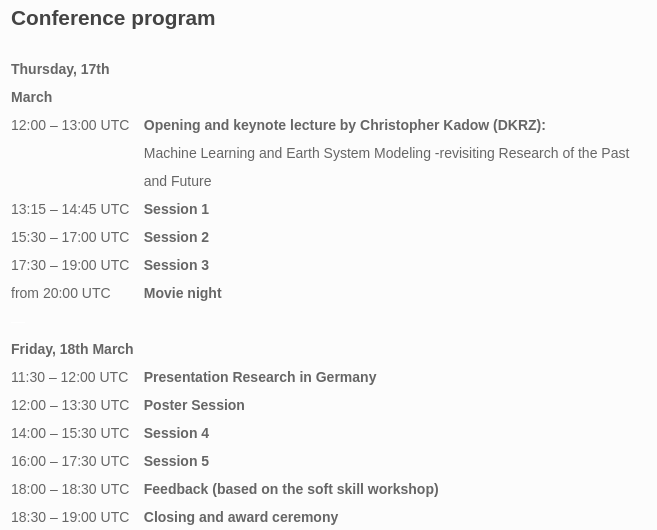
Figure 1: Conference Schedule, including a keynote on Machine Learning and Earth System Modelling, movie night, and presenter sessions. 

Five presenter sessions were split over two days, with young scientists sharing their research to a conference hall on the virtual platform gather.town. Topics ranged from lidar sensing and reanalysis datasets, to cloud micro-physics and UV radiation health impacts. I really enjoyed talks on the attribution of ‘fire weather’ to climate change, and machine learning techniques for thunderstorm forecasting! The first evening concluded with a screening of documentary Picture a Scientist

During the poster session on the second day, I presented my research poster to different scientists walking by my virtual poster board. Posters were designed to mimic the large A2 printouts seen at in-person events. Two posters that really stood out were a quantification of SO2 emissions from Kilauea volcano in Hawaii, and an evaluation of air quality in Cuba’s Mariel Bay using meteorological diagnostic models combined with air dispersion modelling. 

Anticipating that it might be hard to communicate on the day, I added a lot of text to my poster. However, I needn’t have worried as the virtual platform worked flawlessly for conducting poster Q&A – the next time I present on a similar platform I will try to avoid using as much text and instead focus on a more traditional layout! 

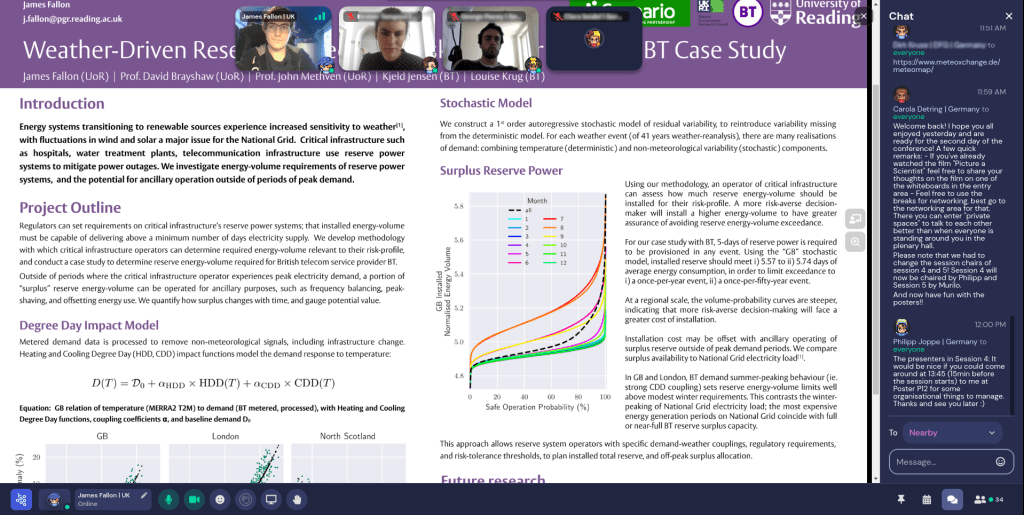
Figure 2: During the poster session, I presented my research on Reserve-Power systems – energy-volume requirements and surplus capacity set by weather events. 

By the conference end, I got the impression that everyone had really enjoyed the event! Awards were given for the winners of the best posters and talks. The ECS conference was fantastically well organised by Carola Detring (DWD) and Philipp Joppe (JGU Mainz), and a wonderful opportunity to meet researchers from around the world. 

MeteoMeets 

Since July 2021, MeteoXchange have held monthly meetups, predominantly featuring lecturers and professors who introduce research at their institute for early career scientists in search of opportunities! 

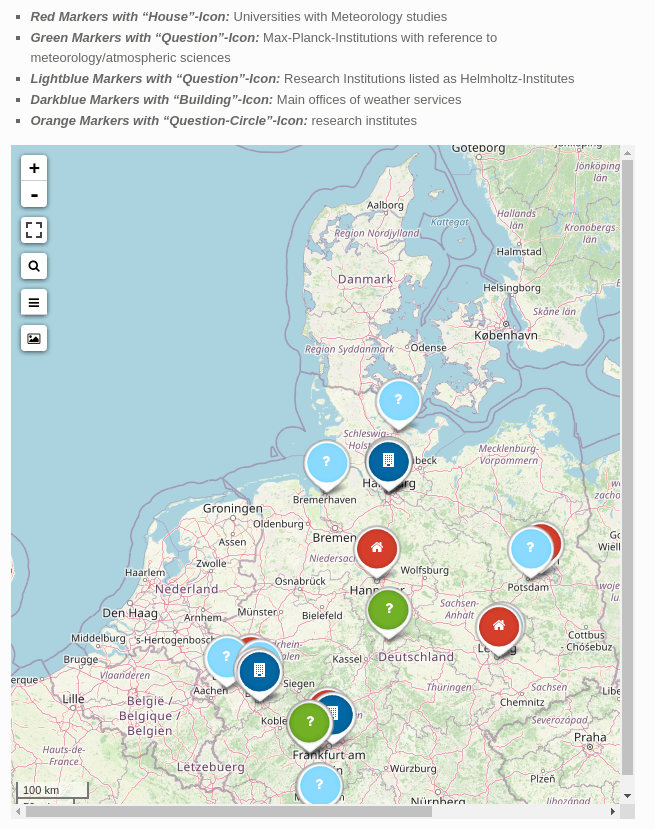
The opportunities shared at MeteoMeets are complemented by joblists and by the MeteoMap: https://www.meteoxchange.de/meteomap. The MeteoMap lists PhD and postdoc positions across Germany, neatly displayed with different markers depending on the type of institute. This resource is currently still under construction. 

Figure 3: The MeteoMap features research opportunities in Germany, available for early career researchers from across the world. 

Travel Grants 

One of the most exciting aspects of the MeteoXchange project is the opportunity for international collaboration with travel grants! 

The travel funds offered by MeteoXchange are for two or more early career scientists in the field of atmospheric sciences. Students must propose a collaborative project, which aims to spark future work and networking between their own institutions. If the application is successful, students have the opportunity to access 2,500€ for travel funds.  

Over the last two weeks of April, I will be collaborating with KIT student Fabian Mockert  on “Dunkelflauten” (periods of low-renewable energy production, or “dark wind lulls”). Dunkelflauten, especially cold ones, result in high electricity load on national transmission networks, leading to high costs and potentially cause a failure of a fully renewable power system doi.org/10.1038/nclimate3338. We are collaborating to use power system modelling to better understand how this stress manifests itself. Fabian will spend two weeks visiting the University of Reading campus, meeting with students and researchers from across the department. 

Get Involved 

The 2022 travel grant deadline has already closed; however, it is hoped that MeteoXchange will receive funding to continue this project into future years, supporting young researchers in collaboration and idea-exchange. 

To get involved with the MeteoMeets, and stay up to date on MeteoXchange related opportunities, signup to the mailing list