Mountains and the Atmospheric Circulation within Models

Email: a.vanniekerk@pgr.reading.ac.uk

Mountains come in many shapes and sizes and as a result their dynamic impact on the atmospheric circulation spans a continuous range of physical and temporal scales. For example, large-scale orographic features, such as the Himalayas and the Rockies, deflect the atmospheric flow and, as a result of the Earth’s rotation, generate waves downstream that can remain fixed in space for long periods of time. These are known as stationary waves (see Nigam and DeWeaver (2002) for overview). They have an impact not only on the regional hydro-climate but also on the location and strength of the mid-latitude westerlies. On smaller physical scales, orography can generate gravity waves that act to transport momentum from the surface to the upper parts of the atmosphere (see Teixeira 2014), playing a role in the mixing of chemical species within the stratosphere.

hims
Figure 1: The model resolved orography at different horizontal resolutions. From a low (climate model) resolution to a high (seasonal forecasting) resolution. Note how smooth the orography is at climate model resolution.

Figure 1 shows an example of the resolved orography at different horizontal resolutions over the Himalayas. The representation of orography within models is complicated by the fact that, unlike other parameterized processes, such as clouds and convection, that are typically totally unresolved by the model, its effects are partly resolved by the dynamics of the model and the rest is accounted for by parameterization schemes.However, many parameters within these schemes are not well constrained by observations, if at all. The World Meteorological Organisation (WMO) Working Group on Numerical Experimentation (WGNE) performed an inter-model comparison focusing on the treatment of unresolved drag processes within models (Zadra et al. 2013). They found that while modelling groups generally had the same total amount of drag from various different processes, their partitioning was vastly different, as a result of the uncertainty in their formulation.

Climate models with typically low horizontal resolutions, resolve less of the Earth’s orography and are therefore more dependent on parameterization schemes. They also have large model biases in their climatological circulations when compared with observations, as well as exhibiting a similarly large spread about these biases. What is more, their projected circulation response to climate change is highly uncertain. It is therefore worth investigating the processes that contribute towards the spread in their climatological circulations and circulation response to climate change. The representation of orographic processes seem vital for the accurate simulation of the atmospheric circulation and yet, as discussed above, we find that there is a lot of uncertainty in their treatment within models that may be contributing to model uncertainty. These uncertainties in the orographic treatment come from two main sources:

  1. Model Resolution: Models with different horizontal resolutions will have different resolved orography.
  2. Parameterization Formulation: Orographic drag parameterization formulation varies between models.

The issue of model resolution was investigated in our recent study, van Niekerk et al. (2016). We showed that, in the Met Office Unified Model (MetUM) at climate model resolutions, the decrease in parameterized orographic drag that occurs with increasing horizontal resolution was not balanced by an increase in resolved orographic drag. The inability of the model to maintain an equivalent total (resolved plus parameterized) orographic drag across resolutions resulted in an increase in systematic model biases at lower resolutions identifiable over short timescales. This shows not only that the modelled circulation is non-robust to changes in resolution but also that the parameterization scheme is not performing in the same way as the resolved orography. We have highlighted the impact of parameterized and resolved orographic drag on model fidelity and demonstrated that there is still a lot of uncertainty in the way we treat unresolved orography within models. This further motivates the need to constrain the theory and parameters within orographic drag parameterization schemes.

References

Nigam, S., and E. DeWeaver, 2002: Stationary Waves (Orographic and Thermally Forced). Academic Press, Elsevier Science, London, 2121–2137 pp., doi:10.1016/B978-0-12-382225-3. 00381-9.

Teixeira MAC, 2014: The physics of orographic gravity wave drag. Front. Phys. 2:43. doi:10.3389/fphy.2014.00043 http://journal.frontiersin.org/article/10.3389/fphy.2014.00043/full

Zadra, A., and Coauthors, 2013: WGNE Drag Project. URL:http://collaboration.cmc.ec.gc.ca/science/rpn/drag_project/

van Niekerk, A., T. G. Shepherd, S. B. Vosper, and S. Webster, 2016: Sensitivity of resolved and parametrized surface drag to changes in resolution and parametrization. Q. J. R. Meteorol. Soc., 142 (699), 2300–2313, doi:10.1002/qj.2821. 


The impact of Climate Variability on the GB power system.

Email: h.bloomfield@pgr.reading.ac.uk

Bloomfield et al., 2016. Quantifying the increasing sensitivity of power systems to climate variability. View published paper.

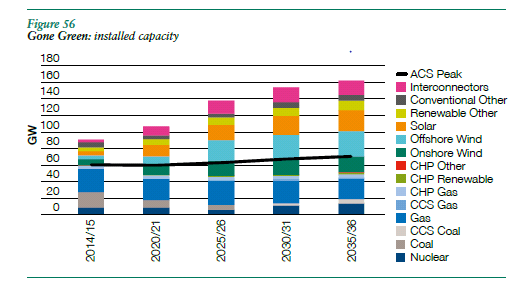
Within the power system of Great Britain (GB), there is a rapidly increasing amount of generation from renewables, such as wind and solar power which are weather-dependent. An increased proportion of weather-dependent generation will require increased understanding of the impact of climate variability on the power system.

blog1

Figure 1: Predicted installed capacity from the National Grid Gone Green Scenario. Source: National Grid Future Energy Scenarios (2015).

Current research on the impact of climate variability on the GB power system is ongoing by climate scientists and power system modellers. The focus of the climate research is on the weather-driven components of the power system, such as the impact of climate variability on wind power generation. These studies tend to include limited knowledge of the whole system impacts of climate variability. The research by power system modellers focuses on the accurate representation of the GB power system. A limited amount of weather data may be used in this type of study (usually 1-10 years) due to the complexity of the power system models.

The aim of this project is to bridge the gap between these two groups of research, by understanding the impact of climate variability on the whole GB power system.In this project, multi-decadal records from the MERRA reanalysis* are combined with a simple representation of the GB power system, of which the weather-dependent components are electricity demand and wind power production. Multiple scenarios are analysed for GB power systems, including 0GW, 15GW, 30GW, and 45GW of installed wind power capacity in the system.

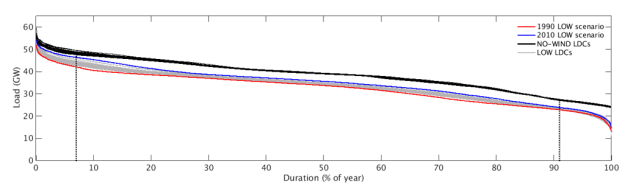
This study characterises the impact of inter-annual climate variability on multiple aspects of the GB power system (including coal, gas and nuclear generation) using a load duration curve framework. A load duration curve can be thought of as a cumulative frequency distribution of power system load. Load can be either power system demand (i.e. the NO-WIND scenario) or demand minus wind power (ie. the LOW, MED and HIGH scenarios).

The introduction of additional wind-power capacity greatly increases the year-year variability in operating opportunity for conventional generators, this is particularly evident for baseload plant (i.e. nuclear power plants). The impact of inter-annual climate variations across the power system due to present-day level of wind-farm installation has approximately doubled the exposure of the GB power sector to inter-annual climate variability. This is shown in Figure 2 as the spread between the red and blue curves (from the LOW scenario) is double that of the black curves (the NO-WIND scenario).

blog2

Figure 2: Load duration curves for the NO-WIND and LOW scenario in black and grey respectively. The two most extreme years from the LOW scenario are 1990 and 2010, plotted in red and blue respectively. Vertical dashed lines show the percentage of time that baseload-plant (91%) and peaking plant (7%) are required to operate

This work has shown that as the amount of installed wind power capacity on the power system is increased, the total amount of energy required from other generators (coal, gas, nuclear) is reduced. Wind therefore contributes to decarbonising the power system, however the reduction is particularly pronounced for plants which are operating as baseload rather than peaking plant (i.e. oil fired generation) where an increase in required production is seen.

This study adds to the literature which suggests that the power system modelling community should begin to take a more robust approach to its treatment of weather and climate data by incorporating a wider range of climate variability.

For more information contact the author for a copy of the paper with details of this work: Quantifying the increasing sensitivity of power system to climate variability (submitted to ERL).

* A reanalysis data set is a scientific method for developing a record of how weather and climate are changing over time. In it, observations are combined with a numerical model to generate a synthesised estimate of the state of the climate system.