(Some) Space Weather Forecasts are Less Certain during Solar Minimum than Solar Maximum

Dechen Gyeltschen (d.l.gyeltshen@pgr.reading.ac.uk)

Summary of Gyeltshen, D. L., et al. (2026) 

What is space weather?

Space weather refers to the short-term changes in the space environment of our solar system. We tend to focus on near-Earth space due to its direct impact on human life and infrastructure. Extreme space weather events can cause disruptions to satellite operations, navigation systems, radio communication, power grids, and rail networks. Additionally, they expose humans in space or on high-altitude flights to harmful radiation and energetic particles. Although mitigation procedures are being developed and refined, their efficacy relies on the accuracy of extreme space weather forecasts. As such, understanding causal phenomena such as solar eruptive processes and high-speed solar wind remains a high priority for improving prediction accuracy. 

Coronal Mass Ejections (CMEs) are drivers of the most severe space weather. They consist of a large structure of plasma and an accompanying magnetic field that have a typical Sun-Earth transit time of 1-5 days. This range exists because a) CMEs are ejected at different speeds and b) CMEs interact with the background ‘ambient’ solar wind and can be accelerated/decelerated due to drag forces. Current CME transit time predictions possess errors on the order ± 10 hours.

How are forecasts made?

Identifying sources of these errors requires an understanding of how CME transit time forecasts are made. The forecast process is outlined as follows, with a visual summary provided in Figure 1: 

  • Information about the Sun’s magnetic field structure in the form of magnetograms is used as initial data. 
  • These are fed into coronal models to generate ambient solar wind speed profiles at 0.1 Astronomical Units from the Sun (1 AU ~ 150 million kilometers). 
  • CME parameters are derived from white light coronagraph images and extrapolated to 0.1 AU. 
  • Together they serve as initial conditions for heliospheric models that simulate CME propagation to Earth and other planetary bodies.  
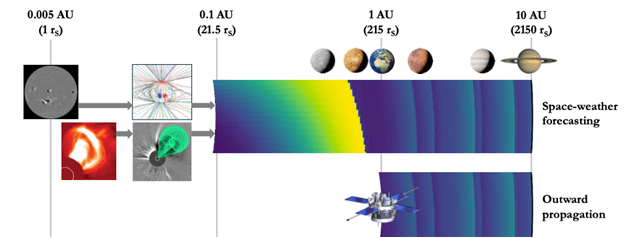
Figure 1: Schematic of standard space weather forecasting method. From top left to bottom right: A magnetogram, a coronagraph, coronal modelling, derivation of CME parameters, heliospheric modelling to Earth and to outer planets (Owens, M. J., et al. (2026)).

While the models used are imperfect, transit time errors largely stem from initial uncertainties in observations of CME parameters and ambient solar wind conditions.  

What did we do?

Though the sources of transit time errors are identified, the extents of their contributions vary, and isolating individual error contributions for observed events is difficult. In particular, the ambient solar wind properties exhibit substantial variability over the solar cycle. Observations show that during solar minimum, Earth intercepts interchangeable fast and slow winds over the course of a month. On the other hand, the solar wind during solar maximum is less stark in its longitudinal gradients. Does this structural difference between solar cycle phases change the ambient solar wind influence on CME propagation? If yes, by how much?  

We performed simulations of CME propagation using the Heliospheric Upwind eXtrapolation with time-dependence (HUXt) solar wind model to answer these questions. HUXt approximates the solar wind as a one-dimensional and hydrodynamic flow, which allows for low computational cost. We used realistic solar wind data to simulate a statistically average CME and a fast CME every day between 1975 – 2024 (4.5 solar cycles). This is 18,000 runs and 126,000 simulation days (for each CME)! This gave us a dataset of daily CME transit times to Earth that was later used for the analyses. An example of two such simulations is provided in Figure 2. 
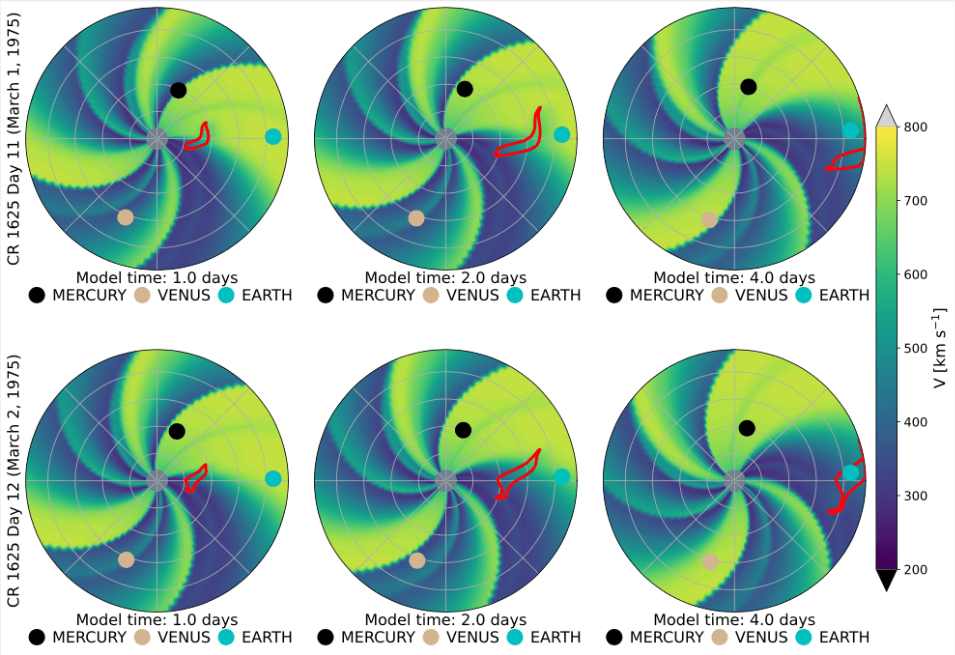
Figure 2: Snapshots of solar wind speed in the solar equatorial plane at three different times (from left to right, shown times are 1, 2, and 4 days after CME launch) from two HUXt simulations. The CME is shown by the red outline. Date labels on the left denote initiation time: the top plots were initialized just 1 day before the lower plots, but the arrival times vary a lot! 

What did we find out?

From the dataset of daily transit times, we calculated the monthly medians and interquartile ranges. We used the median to characterise the typical transit time, and the interquartile range to represent short-term variability of transit time. The distributions for these metrics are shown in Figure 3 for both types of CMEs. 
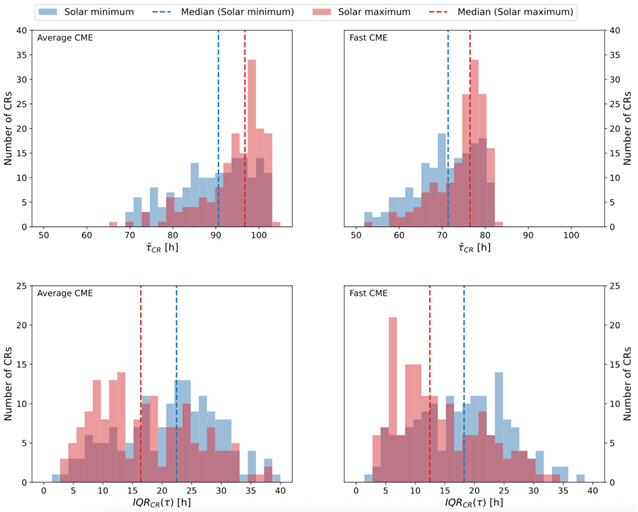
Figure 3: Top: Distributions of monthly transit time medians, during solar minimum and maximum solar phases for average and fast CMEs. Dotted lines represent median values for the distributions. Bottom: The same for distributions of the monthly interquartile range. 

Figure 3 tells us three things: 

  • CMEs arrive faster during solar minimum: the median values show that average CMEs arrive about 5 hours earlier during solar minimum. This is because CMEs encounter either slow or fast wind during solar minimum, but solar maximum presents mostly slow wind that does not accelerate any CME to the same degree. 
  • Transit times are more variable (~6h more variable for an average CME) during solar minimum. The design of our experiment dictates that this effect purely arises from the change in ambient solar wind structure over a solar cycle. 
  • These results are true for both CME types.  

In other words, even identical CMEs can exhibit a range of transit times due to changes in the ambient solar wind structure. Moreover, the magnitude of this variability peaks during solar minimum. It implies that in the absence of accurate ambient solar wind conditions, CME arrivals are intrinsically less predictable during solar minimum than solar maximum. Additionally, the penalty for incorrectly modelling the ambient solar wind—for example, small errors in speed gradients or the position of high-speed streams—is greater during solar minimum. 

Main Takeaways

  • During solar minimum, the arrival time of coronal mass ejections at Earth is roughly twice as uncertain due to the influence of the ambient solar wind compared to solar maximum. 
  • Importance of ambient solar wind representation during solar minimum is emphasised.  
How does plasma from the solar wind enter Earth’s magnetosphere?

Earth’s radiation belts are a hazardous environment for the satellites underpinning our everyday life. The behaviour of these high-energy particles, trapped by Earth’s magnetic field, is partly determined by the existence of plasma waves. These waves provide the mechanisms by which energy and momentum are transferred and particle populations physically moved around, and it’s some of these waves that I study in my PhD.

However, I’ve noticed that whenever I talk about my work, I rarely talk about where this plasma comes from. In schools it’s often taught that space is a vacuum, and while it is closer to a vacuum than anything we can make on Earth, there are enough particles to make it a dangerous environment. A significant amount of particles do escape from Earth’s ionosphere into the magnetosphere but in this post I’ll focus on material entering from the solar wind. This constant outflow of hot particles from the Sun is a plasma, a fluid where enough of the particles are ionised that the behaviour of the fluid is then dominated by electric and magnetic fields. Since the charged particles in a plasma interact with each other, with external electric and magnetic fields, and also generate more fields by moving and interacting, this makes for some weird and wonderful behaviour.

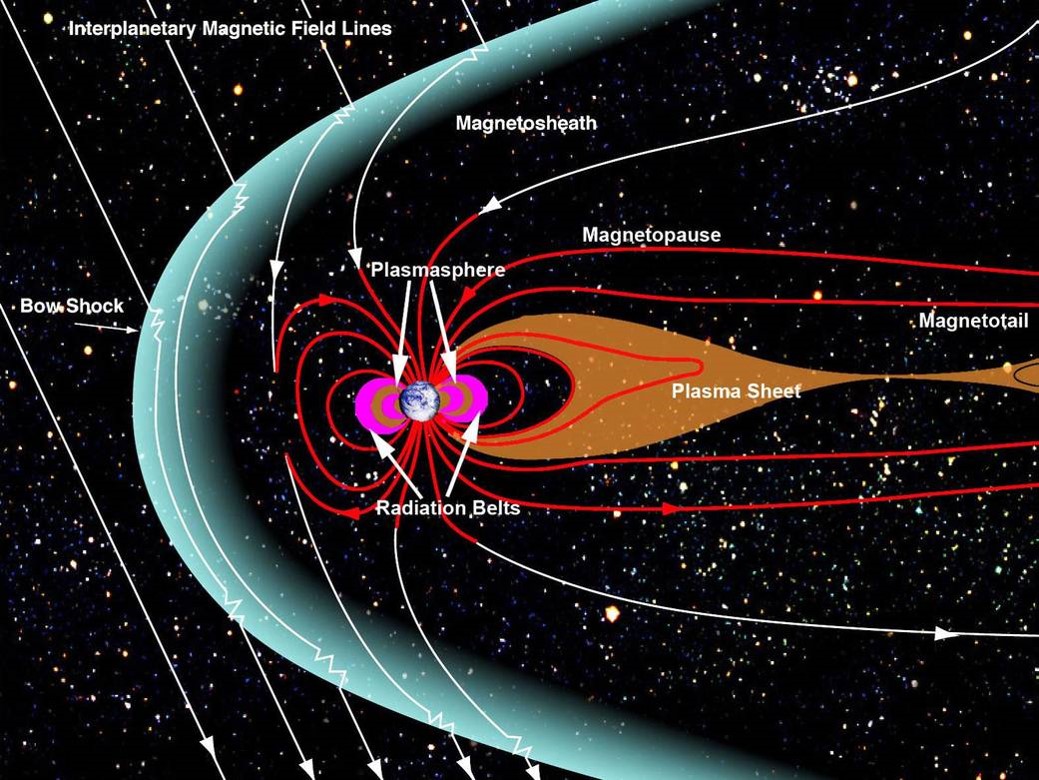
magnetosphere_diagram
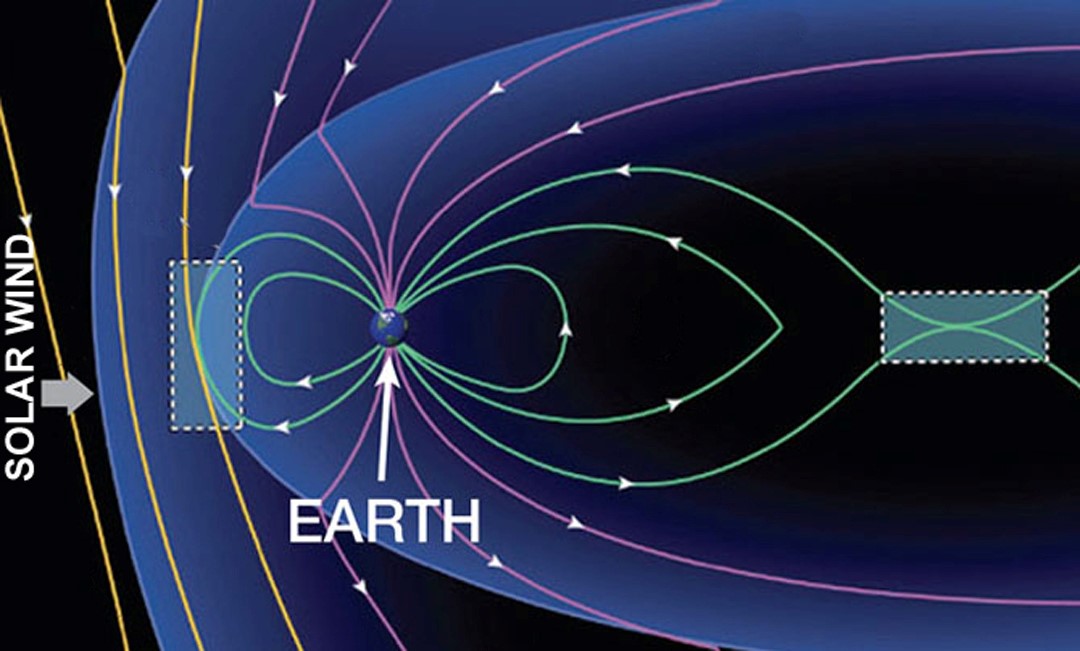
Figure 1: The area of space dominated by Earth’s magnetic field (the magnetosphere) is shaped by the constant flow of the solar wind (a plasma predominantly composed of protons, electrons and alpha particles). Plasma inside the magnetosphere collects in specific areas; the radiation belts are particularly of interest as particles there pose a danger to satellites. Credit: NASA/Goddard/Aaron Kaas

When explaining my work to family or friends, I often describe Earth’s magnetic field as a shield to the solar wind. Because the solar wind is well ionised, it is highly conductive, and this means that approximately, the magnetic field is “frozen in” to the plasma. If the magnetic field changes, the plasma follows this change. Similarly, if the plasma flows somewhere, the magnetic field is dragged along with it. (This is known as Alfvén’s frozen in theorem – the amount of plasma in a volume parallel to the magnetic field line remains constant). And this is why the magnetosphere acts as shield to all this energy streaming out of the Sun – while the magnetic field embedded in the solar wind is topologically distinct from the magnetic field of the Earth, there is no plasma transfer across magnetic field lines, and it streams past our planet (although this dynamic pressure still compresses the plasma of the magnetosphere, giving it that typical asymmetric shape in Figure 1).

Of course, the question still remains of how the solar wind plasma enters the Earth’s magnetic field if such a shielding effect exists. You may have noticed in Figure 1 that there are gaps in the shield that the Earth’s dipole magnetic field presents to the solar wind; these are called the cusps, and at these locations the magnetic field connects to the solar wind. Here, plasma can travel along magnetic field lines and impact us on Earth.

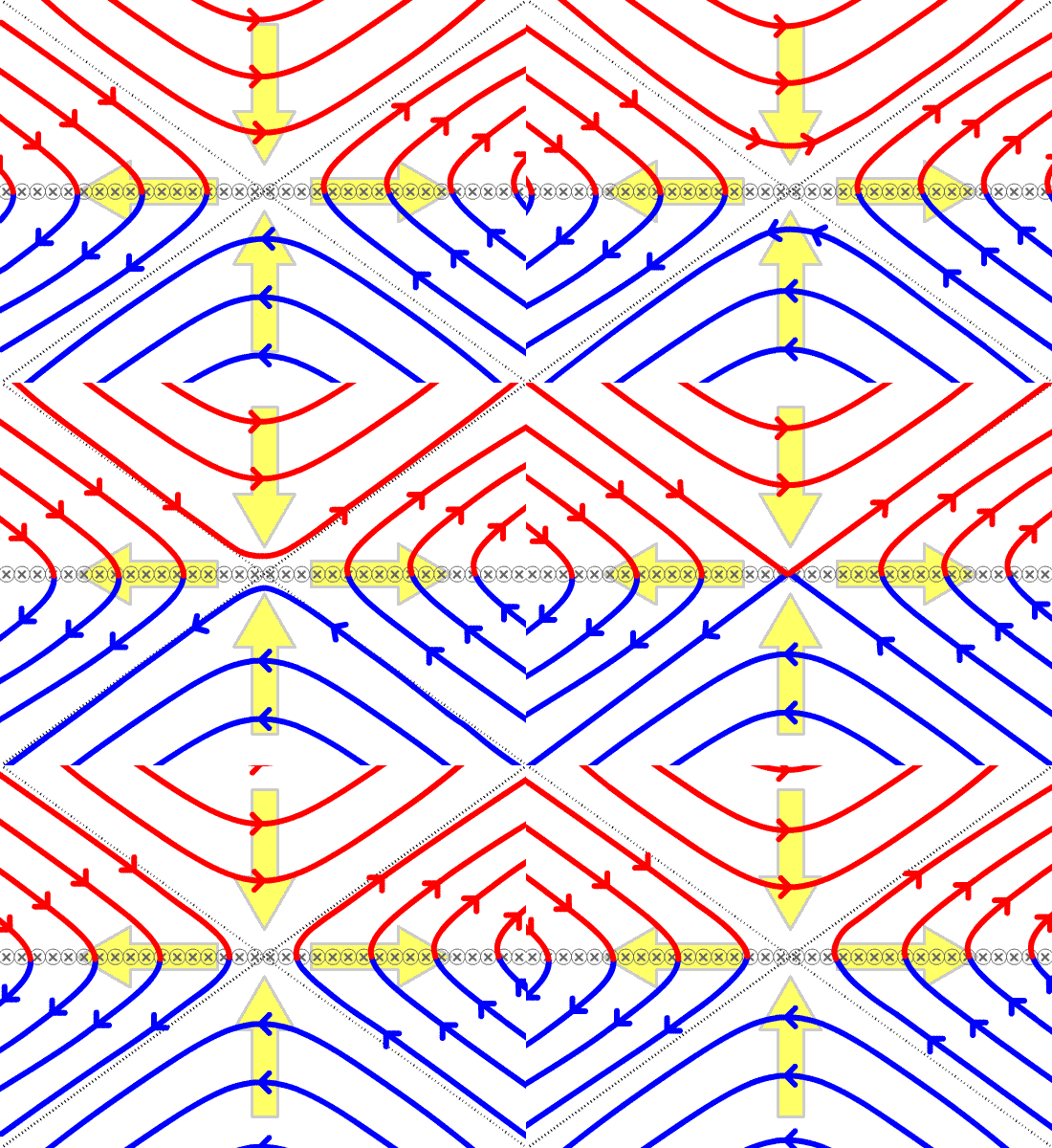
But there’s also a more interesting phenomenon occurring – on a small enough scale (i.e. the very thin boundaries between two magnetic domains) the assumptions behind the frozen-in theorem break down, and then we start to see one of the processes that make the magnetosphere such a complex, fascinating and dynamic system to study. Say we have two regions of plasma with opposing orientation of the magnetic field. Then in a middle area these opposing field lines will suddenly snap to a new configuration, allowing them to peel off and away from this tightly packed central region. Figure 2 illustrates this process – you can see that after pushing red and blue field lines together, they suddenly jump to a new configuration. As well as changing the topology of the magnetic field, the plasma at the centre is energised and accelerated, shooting off along the magnetic field lines. Of course even this is a simplification; the whole process is somewhat more messy in reality and I for one don’t really understand how the field can suddenly “snap” to a new configuration.

reconnection
Figure 2: Magnetic reconnection. Two magnetic domains of opposing orientation can undergo a process where the field line configuration suddenly resets. Instead of two distinct magnetic domains, some field lines are suddenly connected to both, and shoot outwards and away, as does the energised plasma.

In the Earth’s magnetosphere there are two main regions where this process is important (Figure 3). Firstly, at the nose of the magnetosphere. The dynamic pressure of the solar wind is compressing the solar wind plasma against the magnetospheric plasma, and when the interplanetary magnetic field is orientated downwards (i.e. opposite to the Earth’s dipole – about half the time) this reconnection can happen. At this point field lines that were solely connected to the Earth or in the solar wind are now connected to both, and plasma can flow along them.

magnetosphere_reconnection_sites
Figure 3: There are two main areas where reconnection happens in Earth’s magnetosphere. Opposing field lines can reconnect, allowing a continual dynamic cycle (the Dungey cycle) of field lines around the magnetosphere. Plasma can travel along these magnetic field lines freely. Credits: NASA/MMS (image) and NASA/Goddard Space Flight Center- Conceptual Image Lab (video)

Then, as the solar wind continues to rush outwards from the Sun, it drags these field lines along with it, past the Earth and into the tail of the magnetosphere. Eventually the build-up of these field lines reaches a critical point in the tail, and boom! Reconnection happens once more. You get a blast of energised plasma shooting along the magnetic field (this gives us the aurora) and the topology has rearranged to separate the magnetic fields of the Earth and solar wind; once more, they are distinct. These dipole field lines move around to the front of the Earth again, to begin this dramatic cycle once more.

Working out when and how these kind of processes take place is still an active area of research, let alone understanding exactly what we expect this new plasma to do when it arrives. If it doesn’t give us a beautiful show of the aurora, will it bounce around the radiation belts, trapped in the stronger magnetic fields near the Earth? Or if it’s not so high energy as that, will it settle in the cooler plasmasphere, to rotate with the Earth and be shaped as the magnetic field is distorted by solar wind variations? Right now I look out my window at a peaceful sunny day and find it incredible that such complicated and dynamic processes are continually happening so (relatively) nearby. It certainly makes space physics an interesting area of research.