Martina Frid – m.a.h.frid@pgr.reading.ac.uk
Beth Saunders – bethany.saunders@pgr.reading.ac.uk
Introduction
With a large (and growing) proportion of the global population living in cities, research undertaken in urban areas is important; especially in hazardous situations (heatwaves, flooding, etc), which become more severe and frequent due to climate change.
This post gives an overview of recent work done for The urbisphere; a Synergy Project funded by the European Research Council (urbisphere 2021), aiming to forecast feedbacks between weather, climate and cities.
Berlin Field Campaign
The project has included a year-long field campaign (Autumn 2021 – Autumn 2022) undertaken in Berlin (Fig. 1). A smart Urban Observation System was used to take measurements across the city. Sensors used include ceilometers, Doppler wind LIDARs, radiometers, thermal cameras, and large aperture scintillometers (LAS). These measurements were taken to provide new information about the impact of Berlin (and other cities) on the urban boundary layer. The unique observation network was able to provide dense, multi-scale measurements, which will be used to evaluate and inform weather and climate models.

Large Aperture Scintillometry in Berlin
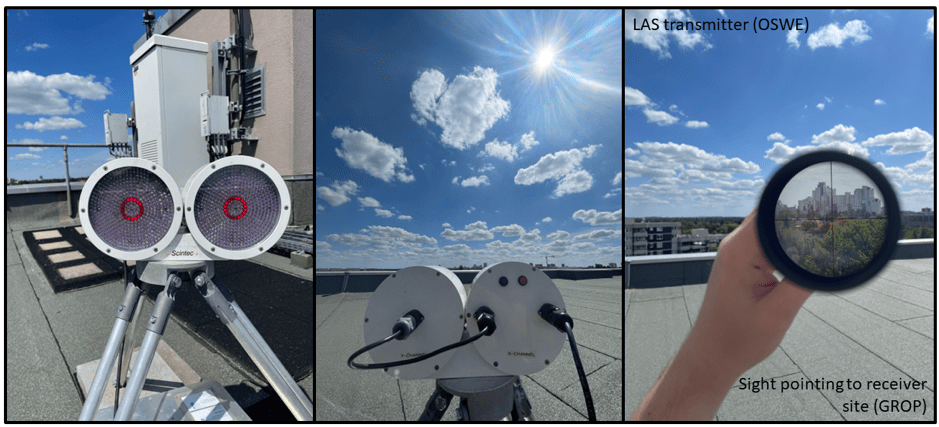
The Berlin field campaign has included 6 LAS paths (Fig. 1). LAS paths consist of a transmitter and receiver mounted in the free atmosphere (Fig. 2), 0.5 – 5 km apart (e.g. Ward et al. 2014).
A beam of near-infrared radiation (wavelength of ~ 850 nm) is passed from the transmitter to receiver, where the beam intensity is measured. Changes in the refractive index of air are used to derive turbulent sensible heat flux. As the received intensity is the result of fluctuations all along the beam, derived quantities are spatially-integrated, and are therefore at a larger-scale compared to other flux measurement techniques (e.g. eddy-covariance).

Our Visit to Berlin
During the first week of August, we travelled to Berlin for three days of fieldwork, to prepare for an intense observation period (IOP). This trip included us installing sensors, and testing they worked as expected. We visited three observation sites: GROP (123 m above sea level, Fig. 2), OSWE (63 m, Fig. 2) and NEUK (60 m).
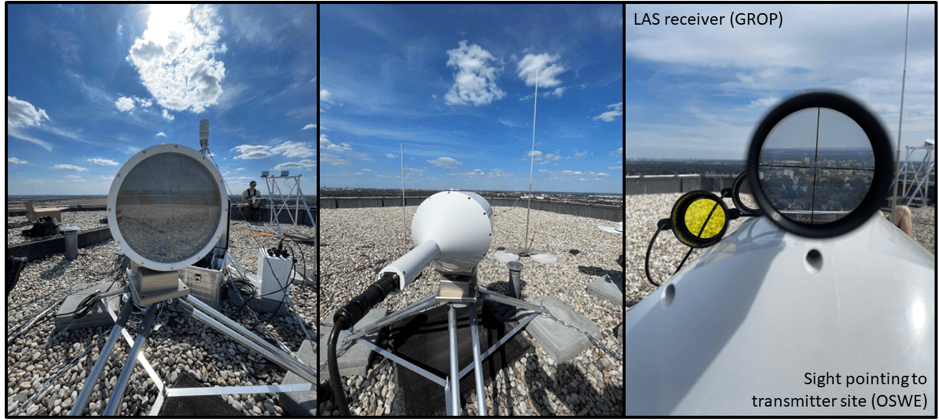
One of the main purposes of this visit was to align two of the LAS paths (including the one in Fig. 2). Initially, work is undertaken at the transmitter site (Fig. 3, top) to point the instrument in the approximate direction of the receiver using a sight (Fig. 3, right hand side photographs).
At the receiver site (Fig. 3, bottom), the instrument’s measurement of signal strength can be displayed on a monitor in real time. Using this output as a guide, small adjustments to the receiver’s alignment are made by loosening or tightening two bolts on the mount; one which adjusts the receiver’s pitch, and one with adjusts the yaw. This was carried out until we reached a peak reading in signal strength, indicating the path was aligned.
Our contribution to the IOP
Back in Reading, daily weather forecasts were carried out for the IOP, to determine when ground-based observations could be made. As the field campaign coincided with the central European heat wave, some of the highest temperatures were recorded during the IOP, and there was a need to forecast thunderstorm and the possibility of lightning strikes.
Ideal conditions for observations were clear skies and a consistent wind direction with height. A variety of different wind directions during the IOP was also preferable, to capture different transects of Berlin. For the selected days, group members in Berlin deployed multiple weather balloons simultaneously across multiple sites within the city and the outskirts. This was also timed with satellite overpasses. Observations of the mixing layer height (urban and suburban) were taken using a ceilometer mounted in a van, which drove along different transects of Berlin.
As the field campaign is wrapping up in Berlin, several instruments are now being moved to the new focus city: Paris. We are looking forward to this new period of interesting observations! Thank you and goodbye from us at the top of the GROP observation site!

References
urbisphere, 2021: Project Context and Objectives. http://urbisphere.eu/ (accessed 27/09/22)
Ward, H. C., J. G. Evans, and C. S. B. Grimmond, 2014: Multi-Scale Sensible Heat Fluxes in the Suburban Environment from Large-Aperture Scintillometry and Eddy Covariance. Boundary-Layer Meteorol., 152, 65–89.







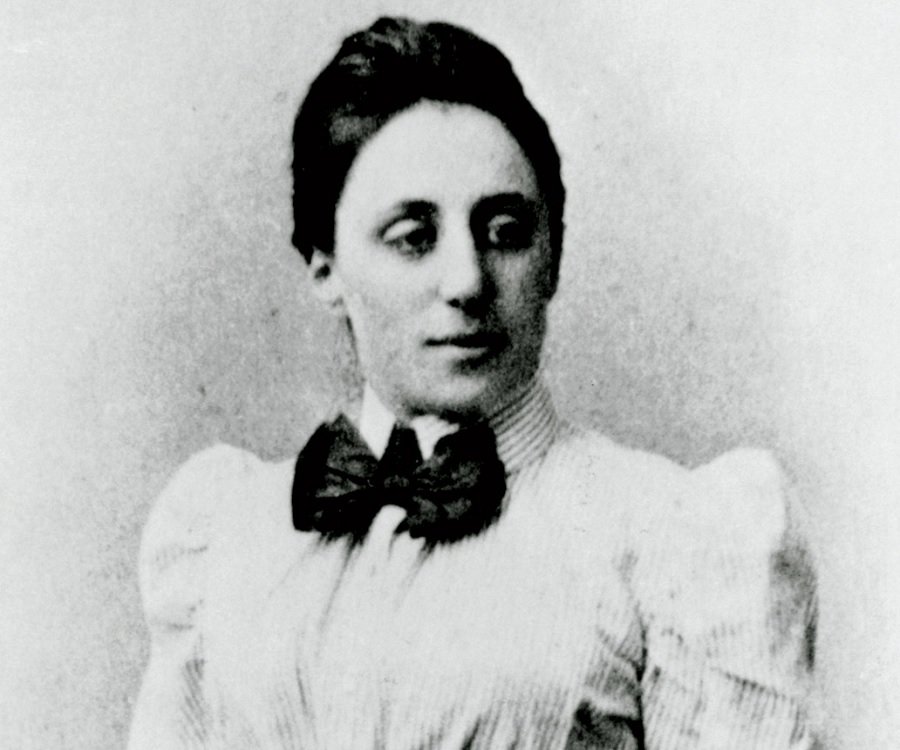 A true revolutionary in the field of theoretical physics and abstract algebra, Amelie Emmy Noether was a German-born inspiration thanks to her perseverance and passion for research. Instead of teaching French and English to schoolgirls, Emmy pursued the study of mathematics at the University of Erlangen. She then taught under a man’s name and without pay because she was a women. During her exploration of the mathematics behind Einstein’s general relativity alongside renowned scientists like Hilbert and Klein, she discovered the fundamentals of conserved quantities such as energy and momentum under symmetric invariance of their respective quantities: time and homogeneity of space. She built the bridge between conservation and symmetry in nature, and although Noether’s Theorem is fundamental to our understanding of nature’s conservation laws, Emmy has received undeservedly small recognition throughout the last century.
 Claudine Hermann is a French physicist and Emeritus Professor at the École Polytechnique in Paris. Her work, on physics of solids (mainly on photo-emission of polarized electrons and near-field optics), led to her becoming the first female professor at this prestigious school. Aside from her work in Physics, Claudine studied and wrote about female scientists’ situation in Europe and the influence of both parents’ works on their daughter’s professional choices. Claudine wishes to give girls “other examples than the unreachable Marie Curie”. She is the founder of the Women and Sciences association and represented it at the European Commission to promote gender equality in Science and to help women accessing scientific knowledge. Claudine is also the president of the European Platform of Women Scientists which represents hundreds of associations and more than 12,000 female scientists.
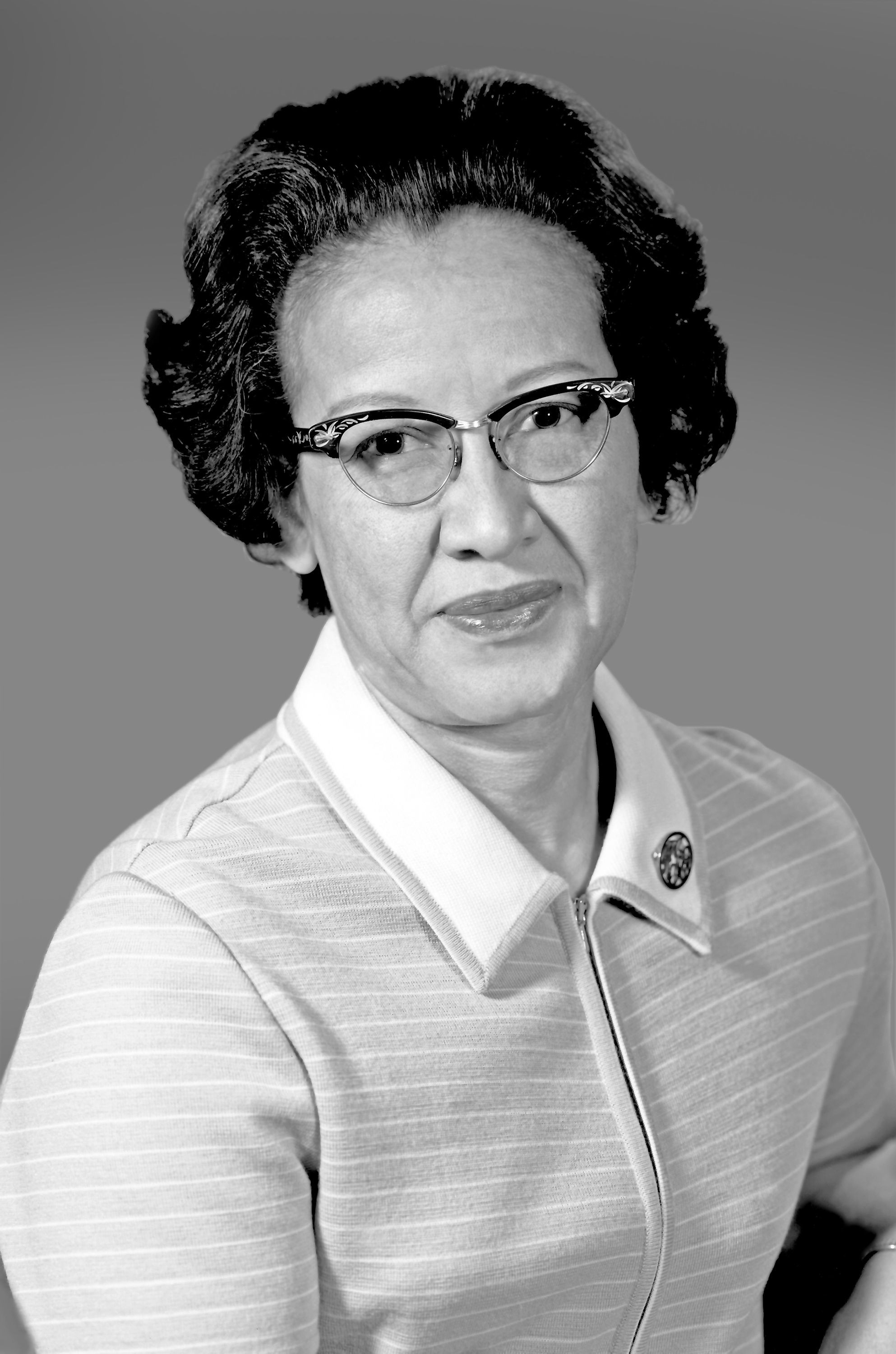 For most people being handpicked to be one of three students to integrate West Virginia’s graduate schools would probably be the most notable life achievements. However for Katherine Johnson’s this was just the start of a remarkable list of accomplishments. In 1952 Johnson joined the all-black West Area Computing section at NACA (to become NASA in 1958). Acting as a computer, Johnson analysed flight test data, provided maths for engineering lectures and worked on the trajectory for America’s first human space flight.
 Women however were not allowed on such ships, thus Marie Tharp was stationed in the lab, checking and plotting the data. Her drawings showed the presence of the North Atlantic Ridge, with a deep V-shaped notch that ran the length of the mountain range, indicating the presence of a rift valley, where magma emerges to form new crust. At this time the theory of plate tectonics was seen as ridiculous. Her supervisor initially dismissed her results as ‘girl talk’ and forced her to redo them. The same results were found. Her work led to the acceptance of the theory of plate tectonics and continental drift.
 Ada Lovelace was a 19th century Mathematician popularly referred to as the “first computer programmer”. She was the translator of “Sketch of the Analytical Engine, with Notes from the Translator”, (said “notes” tripling the length of the document and comprising its most striking insights) one of the documents critical to the development of modern computer programming. She was one of the few people to understand and even fewer who were able to develop for the machine. That she had such incredible insight into a machine which didn’t even exist yet, but which would go on to become so ubiquitous is amazing!

 As a student, being an RMetS member can lead to conversations that could develop your career and bring unexpected opportunities. This has been greatly enhanced with the RMetS mentoring scheme.
 For a student, the highlight in the RMetS calendar is the annual student conference. Every year, sixty to eighty students come together to present their work and develop professional relationships that continue for years to come. This year’s conference is hosted at the University of York on the 5th and 6th July 2018 (
 Other benefits to becoming an RMetS student member include eligibility to the
