When the Lakes Remember: Unravelling the Sudd Floods of 2022

By Douglas Mulangwa – d.mulangwa@pgr.reading.ac.uk

Between 2019 and 2024, East Africa experienced one of the most persistent high-water periods in modern history: a flood that simply would not recede. Lakes Victoria, Kyoga, and Albert all rose to exceptional levels, and the Sudd Wetland in South Sudan expanded to an unprecedented 163,000 square kilometres in 2022. More than two million people were affected across Uganda and South Sudan as settlements, roads, and farmland remained inundated for months.

At first, 2022 puzzled stakeholders, observers and scientists alike. Rainfall across much of the region was below average that year, yet flooding in the Sudd intensified. This prompted a closer look at the wider hydrological system. Conventional explanations based on local rainfall failed to account for why the water would not recede. The answer, it turned out, lay far upstream and more than a year earlier, hidden within the White Nile’s connected lakes and wetlands.

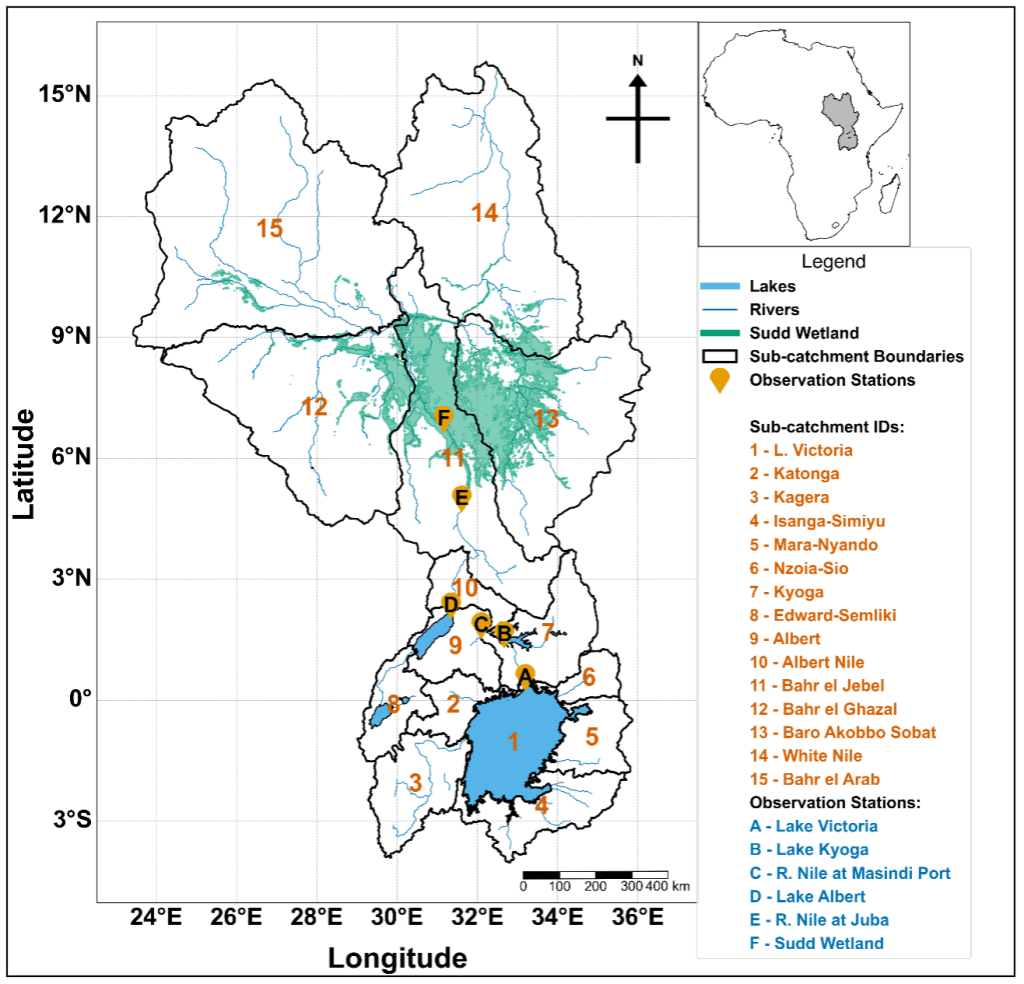
Figure 1: Map of the White Nile Basin showing delineated sub-catchments, lakes, major  rivers, and the Sudd Wetland extent. Sub-catchments are labelled numerically (1–15) with names listed in the legend. Observation stations (A–F) mark key hydrological data collection  locations used in this study: Lake Victoria (A), Lake Kyoga (B), River Nile at Masindi Port (C), Lake Albert (D), River Nile at Juba (E), and the Sudd Wetland (F). Background river networks and sub-catchment boundaries are derived from the HydroSHED dataset, and wetland extent is based on MODIS flood mask composites. The map is projected in geographic coordinates (EPSG:4326) with a graduated scale bar for accurate distance representation using UTM Zone 36N.

The White Nile: A Basin with Memory

The White Nile forms one of the world’s most complex lake, river, and wetland systems, extending from Lake Victoria through Lakes Kyoga and Albert into the Sudd. Hydrologically, it is a system of connected reservoirs that store, delay, and gradually release floodwaters downstream.

For decades, operational planning assumed that floodwaters take roughly five months to travel from Lake Victoria to the Sudd. That estimate was never actually tested with data; it originated as a rule of thumb based on Lake Victoria annual maxima in May and peak flooding in South Sudan in September/October.

Our recent study challenged that assumption. By combining daily lake-level and discharge data (1950–2024) with CHIRPS rainfall and MODIS flood-extent records (2002–2024), we tracked how flood peaks propagated through the system, segment by segment. Using an automated peak-matching algorithm, we quantified the lag between successive annual maxima peaks in Lake Victoria, Lake Kyoga, Lake Albert, and the Sudd Wetland.

The unprecedented high-water regime of 2019-2024

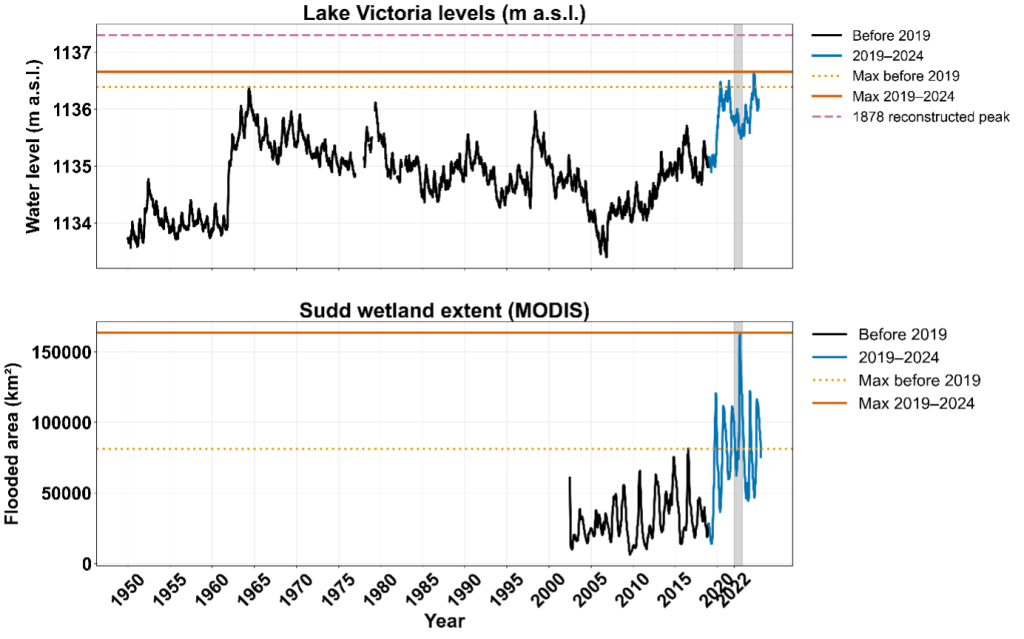
Figure 2: Lake Victoria water levels (1950–2024) and Sudd Wetland extents (2002–2024), with the 2019–2024 anomalous period shown in dark blue and earlier observations in black. The orange dotted line marks the pre-2019 maximum, while the solid vermillion line denotes the highest peak observed during 2019–2024. The dashed magenta line represents the reconstructed 1878 Lake Victoria peak (1137.3 m a.s.l.) from Nicholson & Yin (2001). The shaded grey band highlights the 2022 flood year, when the Sudd reached its largest extent in the MODIS record.

Between 2019 and 2024, both Lake Victoria and the Sudd reached record levels. Lake Victoria exceeded its historic 1964 peak in 2020, 2021, and 2024, while the Sudd expanded to more than twice its previous maximum extent. Each year from 2019 to 2024 stayed above any pre-2019 record, revealing that this was not a single flood season but a sustained multi-year regime.

The persistence of the 2019–2024 high-water regime mirrors earlier basin-wide episodes, including the 1961–64 and 1870s floods, when elevated lake levels and wetland extents were sustained across multiple years rather than confined to a single rainy season.  However, the 2020s stand out as the most extensive amongst all the episodes since the start of the 20th century. These data confirm that both the headwaters and terminal floodplain remained at record levels for several consecutive years during 2019–2024, highlighting the unprecedented nature of this sustained high-water phase in the modern observational era.

2019–2024: How Multi-Year Rainfall Triggers Propagated a Basin-Wide Flood

The sequence of flood events began with the exceptionally strong positive Indian Ocean Dipole of 2019, which brought extreme rainfall across the Lake Victoria basin. This marked the first in a series of four consecutive anomalous rainfall seasons that sustained elevated inflows into the lake system. The October–December 2019 short rains were among the wettest on record, followed by above-normal rainfall in the March–May 2020 long rains, another wet short-rains season in late 2020, and continued high rainfall through early 2021. Together, these back-to-back wet seasons kept catchments saturated and prevented any significant drawdown of lake levels between seasons. Lake Victoria rose by more than 1.4 metres between September 2019 and May 2020, the highest increase since the 1960s, and remained near the 1960s historical maximum for consecutive years. As that excess water propagated downstream, Lakes Kyoga and Albert filled and stayed high through 2021. Even when regional rainfall weakened in 2022, these upstream lakes continued releasing stored water into the White Nile. The flood peak that reached the Sudd in 2022 corresponded closely to the 2021 Lake Victoria high-water phase.

This sequence shows that the 2022 disaster was not driven by a single rainfall event but by cumulative wetness over multiple seasons. Each lake acted as a slow reservoir that buffered and then released the 2019 to 2021 excess water, resulting in multi-year flooding that persisted long after rainfall had returned to near-normal levels.

Transit Time and Floodwave Propagation

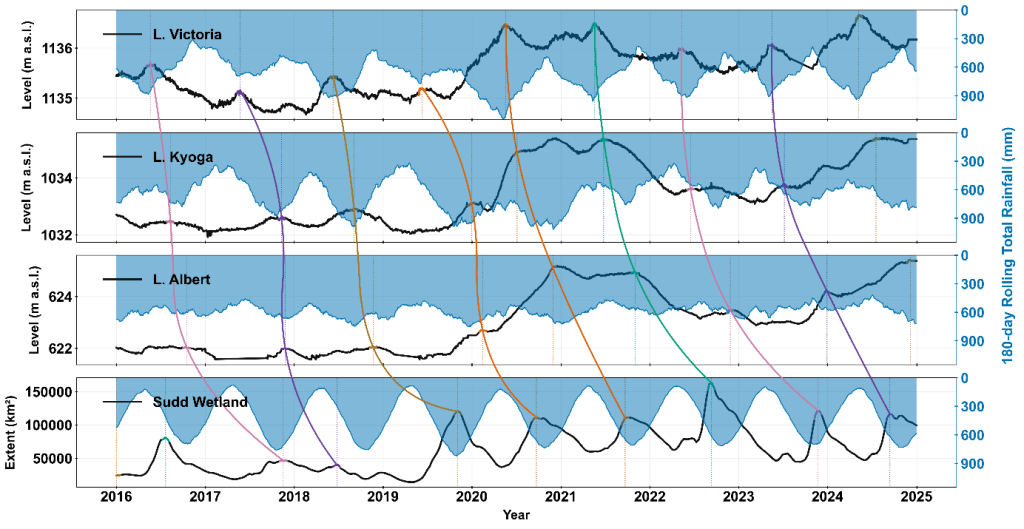
Quantitative tracking showed that it takes an average of 16.8 months for a floodwave to travel from Lake Victoria to the Sudd. The fastest transmission occurs between Victoria and Kyoga (around 4 months), while the slowest and most attenuated segment lies between Albert and the Sudd (around 9 months).

This overturns the long-held assumption of a five-month travel time and reveals a system dominated by floodplain storage and delayed release. The 2019–2021 period showed relatively faster propagation because of high upstream storage, while 2022 exhibited the longest lag as the Sudd absorbed and held vast volumes of water. By establishing this timing empirically, the study offers a more realistic foundation for early-warning systems.

Figure 3: Lake Victoria, Lake Kyoga, and Lake Albert water levels, and Sudd Wetland inundated extent, from 2016 to 2024. Coloured spline curves indicate annual flood-wave trajectories traced from the timing of Lake Victoria annual maxima through the downstream of the White Nile system. Blue shading on the secondary (right) axis shows 180-day rolling rainfall totals over each basin. The panel sequence (Victoria–Kyoga, Kyoga–Albert, Albert–Sudd) highlights the progressive translation of flood waves through the connected lake–river–wetland network.

Wetland Activation and Flood Persistence

Satellite flood-extent maps reveal how the Sudd responded once the inflow arrived. The wetland expanded through multiple activation arms that progressively connected different sub-catchments:

  • 2019: rainfall-fed expansion on the east (Baro–Akobo–Sobat and White Nile sub-basins)
  • 2020–2021: a central-western arm from Bahr el Jebel extending into Bahr el Ghazal and a north-western connection from Bahr el Jebel to Bahr el Arab connected around Bentiu in Unity State.
  • 2022: The two activated arms persisted so the JJAS seasonal rainfall in South Sudan and the inflow from the upstream lakes just compounded the activation leading to the massive flooding in Bentiu, turning the town into an island surrounded by water.

This geometry confirms that the Sudd functions not as a single floodplain but as a network of hydraulically linked basins. Once activated, these wetlands store and recycle water through backwater effects, evaporation, and lateral flow between channels. That internal connectivity explains why flooding persisted long after rainfall declined.

The Bigger Picture

Understanding these long lags is vital for effective flood forecasting and anticipatory humanitarian action. Current early-warning systems in South Sudan and Uganda mainly rely on short-term rainfall forecasts, which cannot capture the multi-season cumulative storage and delayed release that drive multi-year flooding.

By the time floodwaters reach the Sudd Wetland, the hydrological signature of releases from Lake Victoria has been substantially transformed by storage, delay, and attenuation within the intermediate lakes and wetlands. This means that downstream flood conditions are not a direct reflection of upstream releases but the result of cumulative interactions across the basin’s interconnected reservoirs.

The results suggest that antecedent storage conditions in Lakes Victoria, Kyoga, and Albert should be incorporated into regional flood outlooks. When upstream lake levels are exceptionally high, downstream alerts should remain elevated even if rainfall forecasts appear moderate. This approach aligns with impact-based forecasting, where decisions are informed not only by rainfall predictions but also by hydrological memory, system connectivity and potential impact of the floods.

The 2019–2024 high-water regime joins earlier basin-wide flood episodes in the 1870s, 1910s, and 1960s, each linked to multi-year wet phases across the equatorial lakes. The 1961–64 event raised Lake Victoria by about 2.5 metres and reshaped the Nile’s flow for several years. The 1870s flood appears even more extensive, showing that compound, persistent flooding is part of the White Nile’s natural variability.

Climate-change attribution studies indicate that the 2019–2020 rainfall anomaly was intensified by anthropogenic warming, increasing both its magnitude and probability. If such events become more frequent, the basin’s long-memory behaviour could convert short bursts of rainfall into multi-year high-water regimes.

This work reframes how we view the White Nile. It is not a fast, responsive river system but a slow-moving memory corridor in which floodwaves propagate, store, and echo over many months. Recognising this behaviour opens practical opportunities: it enables longer forecast lead times based on upstream indicators, supports coordinated management of lake releases, and strengthens early-action planning for humanitarian agencies across the basin.

It also highlights the need for continued monitoring and data sharing across national borders. Sparse observations remain a major limitation: station gaps, satellite blind spots, and non-public lake-release data all reduce our ability to model the system in real time. Improving this observational backbone is essential if we are to translate scientific insight into effective flood preparedness.

By Douglas Mulangwa (PhD researcher, Department of Meteorology, University of Reading), with contributions from Evet Naturinda, Charles Koboji, Benon T. Zaake, Emily Black, Hannah Cloke, and Elisabeth M. Stephens.

Acknowledgements

This research was conducted under the INFLOW project, funded through the CLARE programme (FCDO and IDRC), with collaboration from the Uganda Ministry of Water and Environment, the South Sudan Ministry of Water Resources and Irrigation, the World Food Programme(WFP), IGAD Climate Prediction and Application Centre  (ICPAC), Médecins Sans Frontières (MSF), the Red Cross Red Crescent Climate Centre, Uganda Red Cross Society (URCS), the South Sudan Red Cross Red Crescent Society (SSRCS) and the Red Cross Red Crescent Climate Centre (RCCC).

The Mystery of Coarse Dust Transport in Observations and Models​

Natalie Ratcliffe – n.ratcliffe@pgr.reading.ac.uk

On Tuesday 23rd April 2024, I presented my PhD work at the lunchtime seminar to the department.  The work I presented incorporated a lot of the work I have achieved during the 3 and a half years of my PhD. This blog post will be a brief overview of the work discussed.

Every year, between 300 and 4000 million tons of mineral dust are lofted from the Earth’s surface (Huneeus et al., 2011; Shao et al., 2011). This dust can travel vast distances, affecting the Earth’s radiative budget, water and carbon cycles, fertilization of land and ocean surfaces, as well as aviation, among other impacts. Observations from recent field campaigns have revealed that we underestimate the amount of coarse particles (>5 um diameter) which are transported long distances (Ryder et al., 2019). Based on our understanding of gravitational settling, some of these particles should not physically be able to travel as far as they do. This results in an underestimation of these particles in climate models, as well as a bias towards modelling finer particles (Kok et al., 2023). Furthermore, fine particles have different impacts on the Earth than coarse particles, for example with the radiative budget at the top of the atmosphere; including more coarse particles in a model reduces the cooling effect that dust has on the Earth.

Thus, my PhD project was born! We wanted to try and peel back the layers of the dusty onion. How are these coarse particles travelling so far?

Comparing a Climate Model and Observations

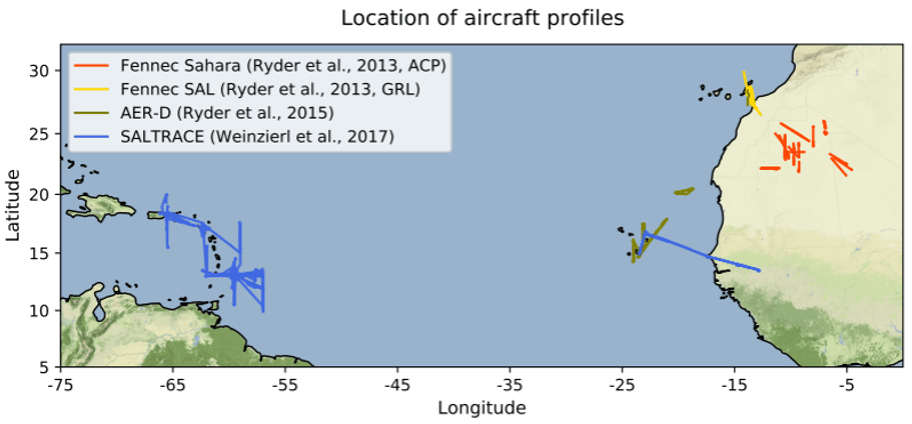
First, we compared in-situ aircraft observations to a climate model simulation to assess the degree to which the model was struggling to represent coarse particle transport from the Sahara across the Atlantic to the Caribbean. Measuring particles up to 300 um in diameter, the Fennec, AER-D and SALTRACE campaigns provide observations at three stages of transport throughout the lifetime of dust in the atmosphere (near emission, moving over the ocean and at distance from the Sahara; Figure 1). Using these observations, we assess a Met Office Unified Model HadGEM3 configuration. This model has six dust size bins, ranging from 0.063-63.2 um diameter. This is a much larger upper bound than most climate models, which tend to have an upper bound at 10-20 um.

Figure 1: Map showing the location of the flight tracks which were taken when the observations were measured.

We found that the model significantly underestimates the total mass of mineral dust in the atmosphere, as well as the fraction of dust mass made up of coarse particles. This happens at all locations, including at the Sahara: firstly, this suggests that the model is not emitting enough coarse particles to begin with and secondly, the growing model underestimation with distance suggests that the coarse particles are being deposited too quickly. By looking further into the model, we found that the coarsest particles (20-63.2 um) were lost from the atmosphere very quickly, barely surpassing Cape Verde in their westwards transport. Whereas in the observations, these coarsest particles were still present at the Caribbean, representing ~20% of the total dust mass. We also found that the distribution of coarse particles tended to have a stronger dependence on altitude than in the observations, with fewer particles observed at higher altitudes. This work has been written up into a paper which is currently undergoing review, but can be seen in preprint; Ratcliffe et al., (preprint).

Sensitivity Testing of the Model

Now that we have confirmed that the model is struggling to retain coarse particles for long- range transport, we want to work out if any of the model processes involved in transport and deposition could be over- or under-active in coarse particle transport. This involved turning off individual processes one at a time and seeing what impact it has on the dust transport. As we wanted to focus on the impact to coarse particle transport, we needed to start with an improved emission distribution at the Sahara, so we tuned the model to better match the observations from the Fennec campaign.

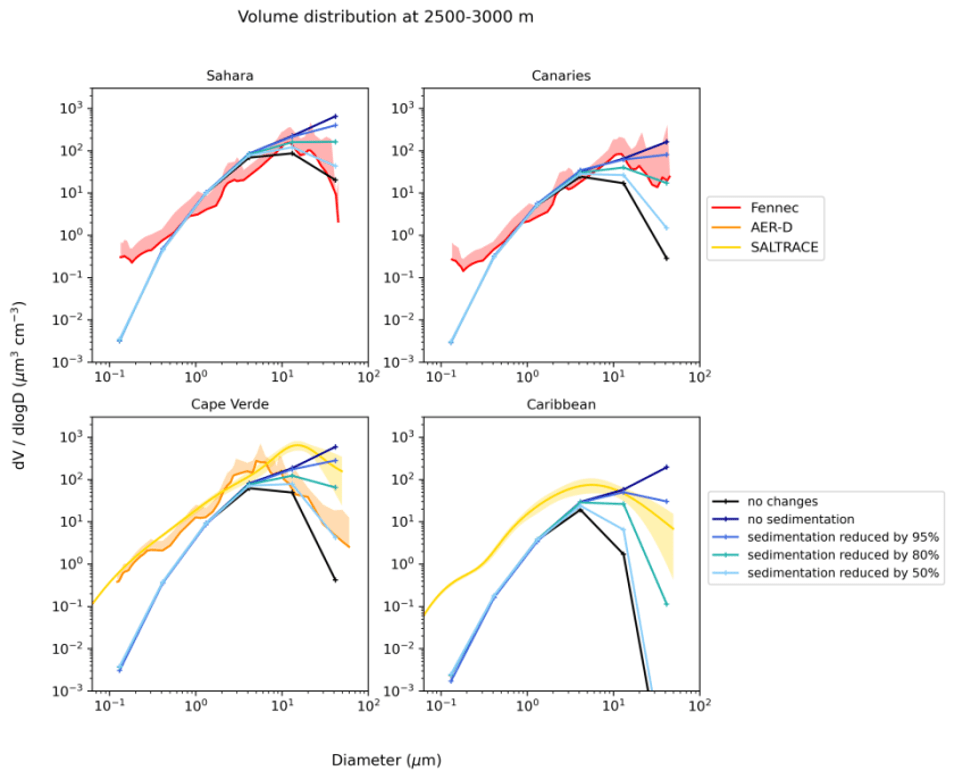
In our first tests we decided to ‘turn off’ or reduce gravitational settling of dust particles in the model to see what happens if we eliminate the greatest removal mechanism for coarse particles. Figure 2 shows the volume size distribution of these gravitational settling model experiments against the observations. We found that completely removing gravitational settling increased the mass of coarse particles too much, while having little to no effect on the fine particles. We found that to bring the model into better agreement with the observations, sedimentation needs to be reduced by ~50% at the Sahara and more than 80% at the Caribbean.

Figure 2: Mean volume size distribution between 2500-3000 m in the Fennec (red), AER-D (orange) and SALTRACE (yellow) observations, the control mode simulation (black) and the reduced dust sedimentation experiments (blue shades).

We also tested the sensitivity of turbulent mixing, convective mixing and wet deposition on coarse dust transport; however, these experiments did not have as great of an impact on coarse transport as the sedimentation. We found that removing the mixing mechanisms resulted in decreased vertical transport of dust which tended to reduce the horizontal transport. We also carried out an experiment where we doubled the convective mixing, and this did show improved vertical and horizontal transport. Finally, when we removed wet deposition of dust, we found that it had a greater impact on the fine particles, less so on the coarse particles, suggesting that wet deposition is the main removal mechanism for the four finest size bins in the model.

Final Experiment

Now that we know our coarse particles are settling out too quickly and sit a bit too low in the atmosphere, we come to our final set of experiments. Let’s say that our coarse particles in the model and our dust scheme are actually set up perfectly, then could it be the meteorology in the model which is wrong? If the coarse particles were mixed higher up at the Sahara, then would they reach faster horizontal winds to travel further across the Atlantic? To test this theory, I hacked the files which the model uses to start a simulation, and I put all the dust over the Sahara up to the top of the dusty layer (~5 km). We found this increased the lifetime of the coarsest particles so that it took twice as long to lose 50% of the starting mass. This unfortunately only slightly improved transport distance as the particles were still lost relatively quickly. After checking the vertical winds in the model, we found that they were an order of magnitude smaller at the Sahara, Canaries and Cape Verde than the observations made during the field campaigns. This suggests that if the vertical winds were stronger, they could initially raise the dust higher and keep the coarse particles raised higher for longer, extending their atmospheric lifetime.

Summarised Conclusions

To summarise what I’ve found during my PhD:

  1. The model underestimates coarse mass at emission and the underestimation is exacerbated with westwards transport.
  2. Altering the settling velocity of dust in the model brings the model into better agreement with the observations.
    • a. Turbulent mixing, convective mixing and wet deposition have minimal impact on coarse transport.
  3. Lofting the coarse particles higher initially improves transport minimally.
    • a. Vertical winds in the model are an order of magnitude too small.

So what’s next?

If we’ve found that the coarse particles are settling out the atmosphere too quickly (by potentially more than 80%), would that suggest that the deposition equations are wrong and are overestimating particle deposition? So, we change those and everything’s fixed, right? I wish. Unfortunately, the deposition equations are one of the things that we are more scientifically sure of, so our results mean that there’s something happening to the coarse particles that we aren’t modelling which is able to counteract their settling velocity by a very significant amount. Our finding that the vertical winds are too small could be a part of this. Other recent research suggests that processes such as particle asphericity, triboelectrification, vertical mixing and turbulent mixing (has been shown to help in a higher-resolution (not climate) model) in the atmosphere could enhance coarse particle transport.

Huneeus, N., Schulz, M., Balkanski, Y., Griesfeller, J., Prospero, J., Kinne, S., Bauer, S., Boucher, O., Chin, M., Dentener, F., Diehl, T., Easter, R., Fillmore, D., Ghan, S., Ginoux, P., Grini, A., Horowitz, L., Koch, D., Krol, M. C., Landing, W., Liu, X., Mahowald, N., Miller, R., Morcrette, J.-J., Myhre, G., Penner, J., Perlwitz, J., Stier, P., Takemura, T., and Zender, C. S. 2011. Global dust model intercomparison in AeroCom phase I. Atmospheric Chemistry and Physics. 11(15), pp. 7781-7816

Kok, J. F., Storelvmo, T., Karydis, V. A., Adebiyi, A. A., Mahowald, N. M., Evan, A. T., He, C., and Leung, D. M. Jan. 2023. Mineral dust aerosol impacts on global climate and climate change. Nature Reviews Earth Environment 2023, pp. 1–16. url: https://www.nature.com/articles/s43017-022-00379-5

RatcliLe, N. G., Ryder, C. L., Bellouin, N., Woodward, S., Jones, A., Johnson, B., Weinzierl, B., Wieland, L.-M., and Gasteiger, J.: Long range transport of coarse mineral dust: an evaluation of the Met Office Unified Model against aircraft observations, EGUsphere [preprint], https://doi.org/10.5194/egusphere-2024-806, 2024

Ryder, C. L., Highwood, E. J., Walser, A., Seibert, P., Philipp, A., and Weinzierl, B. 2019. Coarse and giant particles are ubiquitous in Saharan dust export regions and are radiatively significant over the Sahara. Atmospheric Chemistry and Physics. 19(24), pp. 15353–15376

Shao, Y., Wyrwoll, K.-H., Chappell, A., Huang, J., Lin, Z., McTainsh, G. H., Mikami, M., Tanaka, T. Y., Wang, X., and Yoon, S. 2011. Dust cycle: An emerging core theme in Earth system science. Aeolian Research. 2(4), pp. 181–204

Cape Verde with a Chance of Dust Storms

Natalie Ratcliffe – n.ratcliffe@pgr.reading.ac.uk

My PhD project was could have been done entirely from behind a computer screen, but I ended up in Cape Verde for 3 weeks in June 2022 on a field campaign.

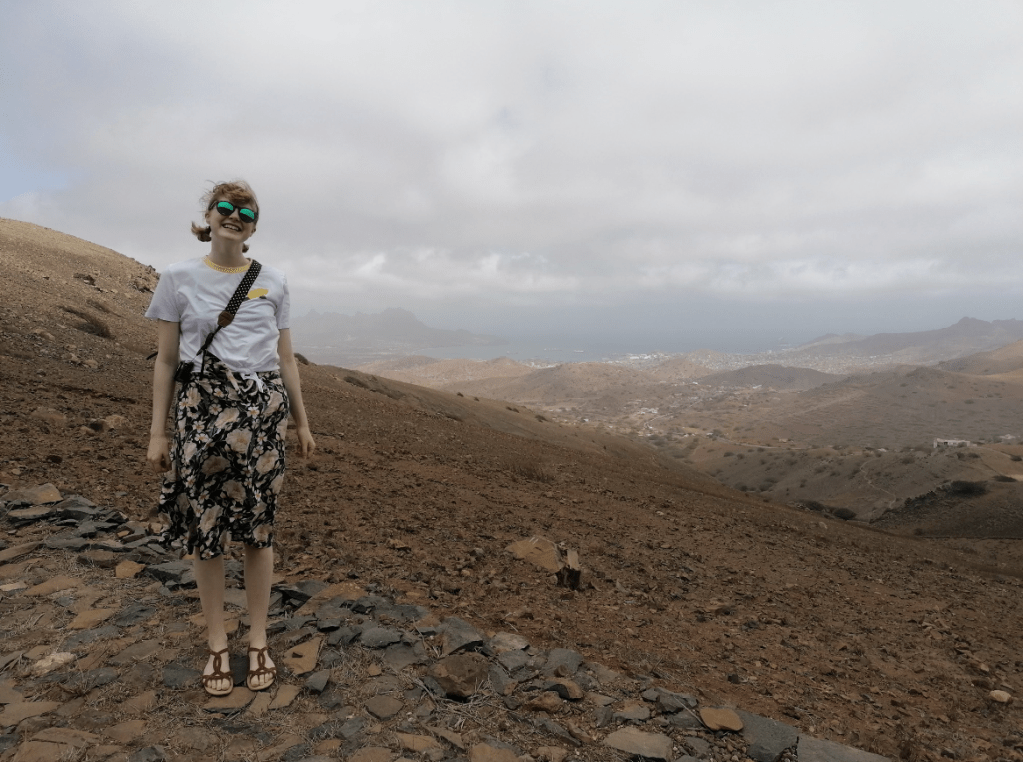
Though the island of Sao Vicente is one of the Cape Verde (= green cape) islands, it wasn’t particularly green…

Working with Dr Franco Marenco from The Cyprus Institute (CyI) and my supervisor at Reading, Dr Claire Ryder, I managed to get some funding to spend 3 weeks in Cape Verde alongside an organised campaign. The ASKOS campaign was created to calibrate and validate aerosol, wind and cloud products from the Aeolus satellite, launched in 2018. They planned on using a combination of ground-based instruments and drones supplied by the Unmanned Systems Research Laboratory (USRL) with CyI to profile dust above Cape Verde to compare with the Aeolus aerosol products.

My PhD project is based around trying to understand how some large dust particles (diameter > 20 um) are travelling much further from the Sahara than expected based on their deposition velocity. One theory about how these particles are transported so far is that they are vertically mixed throughout the depth of the Saharan Air Layer (SAL, dry dusty air layer transported from the Sahara, typically up to ~6 km altitude) during convective mixing in the daytime. At night, with the removal of this convection, these large particles begin to settle through the SAL at a faster rate than other fine particles, before being mixed up again to the top of the SAL during the convective day. This is hypothesised to increase the time taken for the particles to reach the surface, encouraging long-range transport of these coarse particles. We proposed to fly drones with optical particle counters attached up through the SAL during the day and night to see if this theory has any standing.

Before I could go to Cape Verde came all the admin and preamble for going on a field campaign. Before booking flights and accommodation, the wonderfully long health and safety risk assessment form must be completed and approved. Reading through that form really makes it feel like you’re going to face every single threat known to humankind while you’re off campus; hurricanes, volcanoes, Covid-19, getting bitten by ticks (other animals/insects are available), sunburn (to be fair, a very real concern for me) and even getting hacked and bribed. I suppose being prepared for all these eventualities is meant to make it less scary

I had three virtual meetings with everyone involved in the campaign before we travelled, so I had a little bit of an idea what I was supposed to be doing when we were out there. Though to be honest, I still wasn’t entirely sure until a couple of weeks before we left! Claire and I had to introduce our work and what we wanted to achieve from this campaign. I was a little apprehensive as we were going to be requesting to collect data in the very early morning (3-6am ish) meaning we’d have to ask some of the other scientists to be up very early (or late depending on your opinion).

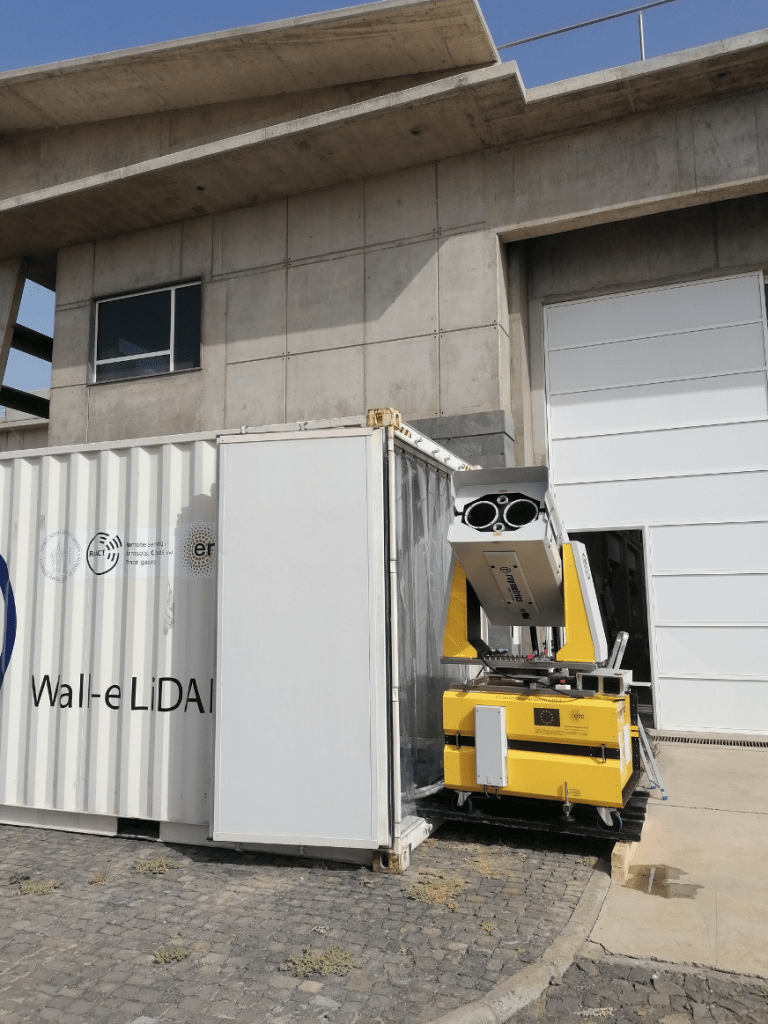
The Wall-e LiDAR. Wall-e was looking at the orientation of the dust particles. eVe was there too but she was basically just an all-white version of Wall-e (disappointing).

Now we get to the fun part where I actually go on the campaign (or on holiday as some people kept insisting. FYI, this was absolutely not the case). Most days would start with a few of us looking at the forecast to work out when we should aim to fly the drones. We would decide on a plan for the day, a suggested plan for the next day, briefly looking at data from the day before and then collating this all into a newsletter which was sent out to everyone on the campaign. These forecasts were useful for those collecting in-situ observations as well as those working on the ground-based remote sensing equipment. It also became very clear in these meetings that each scientist had a preferred forecasting model. We had so many options for forecasts (SKIRON, Met Office, CAMS, IAASARS, ECMWF etc), as well as varying satellite retrievals (EUMETSAT Dust RGB, MODIS NASA AOD, NOAA GOES-East visible images etc) and near-real-time observations from the ground instruments (PollyXT LIDAR, HALO Doppler wind lidar, CIMEL Sunphotometer etc) that there was occasionally some jostling to work out which forecast and measurements to trust and focus our planning based on! I was then able to go to the airport to help the flight team. I would refer to the most recent reading from the lidar and suggest which layers in the dust should be sampled with filters, as well as checking the wind lidar to make sure it wasn’t getting windier.

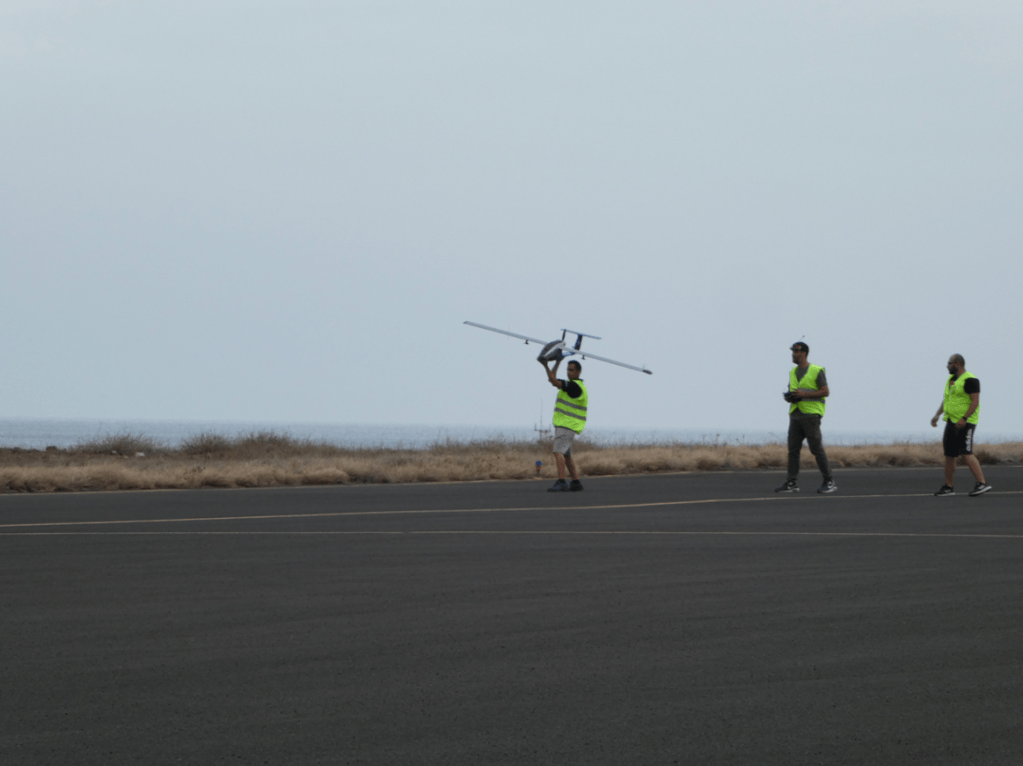
The USRL team getting ready for launch. The drones were thrown rather than taking off from the ground. The pilot is in the middle; he has a controller and a headset which he can use to pilot the drone.
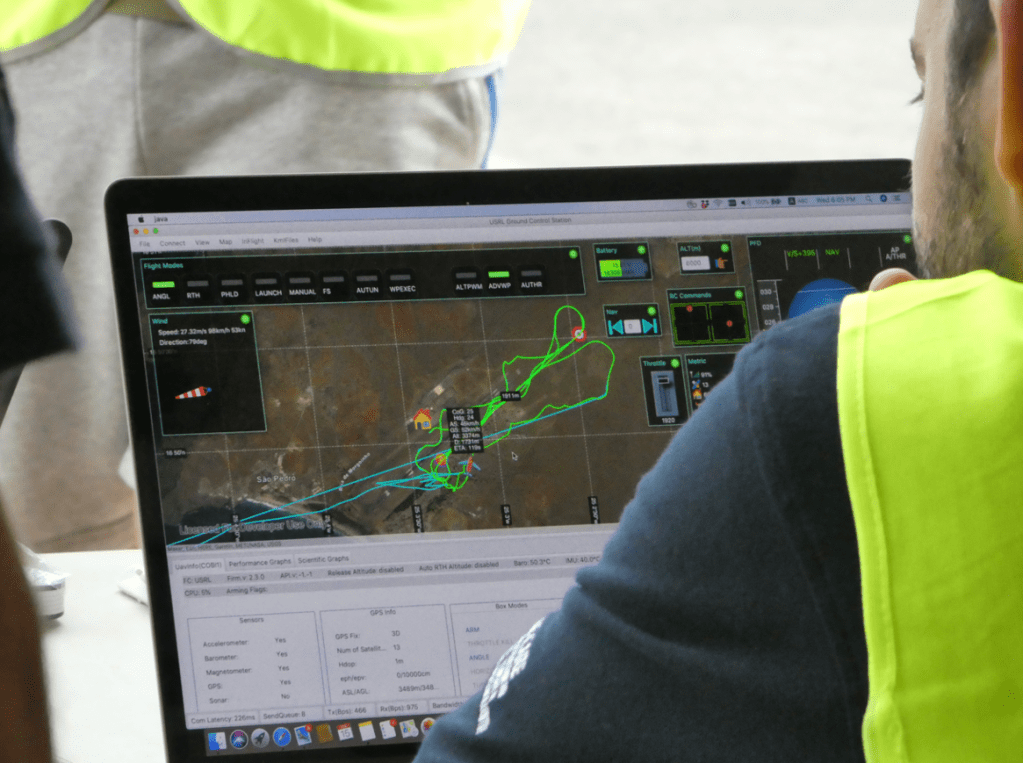
The drone path, windspeed, ground speed and altitude can be watched from the ground.

Looking back, we should have focused our forecasting on the wind and cloud more than the dust concentration. Initially, we were planning to measure when there was an interesting or high concentration dust event over the island. However, we eventually realised that the wind and cloud cover were the most limiting factors for measuring in terms of the in-situ and ground-based measurements, respectively. This unfortunately meant that, on a few occasions, the flight team were stuck at the airport waiting for the winds to drop before they could launch the drones. Or that the remote sensing teams couldn’t take results at the same time as the drones because there was too much cloud. It was a learning experience for everyone involved!

I’ve taken away four things from this campaign that it seems will probably happen on any field campaign, so take note if you ever get the opportunity!

  • You’ll get to meet some really cool people
  • Probably get food poisoning
  • Your equipment will break at some point
  • And many things will go wrong… It’s an inevitability

Some of the issues we faced were: instruments taking longer to calibrate and setup than expected, helium arriving two weeks late, missing weather balloons, two got covid, five got food poisoning, one drone crash-landed, too windy to fly the drones, not dusty enough, too cloudy for the lidars… It was definitely an exercise in contingency planning. I did say that this was a fun experience and I do mean it! Though there were many tense moments where things went completely opposite to the plan, I got to meet a lot of cool scientists, learn about new instruments, go to Africa for the first time and get hands on with some dust at last!

Feel free to check out this blog post which I wrote for ESA’s Campaign Earth blog page: (https://blogs.esa.int/campaignearth/2022/08/03/delving-deep-into-dusty-skies-on-the-askos-aeolus-field-campaign/).

This blog article is part of the DAZSAL project that is supported by the European Commission under the Horizon 2020 – Research and Innovation Framework Programme, H2020-INFRAIA-2020-1, Grant Agreement number: 101008004, Transnational Access by ATMO-ACCESS.

Main challenges for extreme heat risk communication

Chloe Brimicombe – c.r.brimicombe@pgr.reading.ac.uk, @ChloBrim

For my PhD, I research heatwaves and heat stress, with a focus on the African continent. Here I show what the main challenges are for communicating heatwave impacts inspired by a presentation given by Roop Singh of the Red Cross Climate Center at Understanding Risk Forum 2020.  

There is no universal definition of heatwaves 

Having no agreed definition of a heatwave (also known as extreme heat events) is a huge challenge in communicating risk. However, there is a guideline definition by the World Meteorological Organisation and for the UK an agreed definition as of 2019. In simple terms a heatwave is: 

“A period of above average temperatures of 3 or more days in a region’s warm season (i.e. all year in the tropics and in the summer season elsewhere)”  

We then have heat stress which is an impact of heatwaves, and is the killer aspect of heat. Heat stress is: 

“Build-up of body heat as a result of exertion or external environment”(McGregor, 2018) 

Attention Deficit 

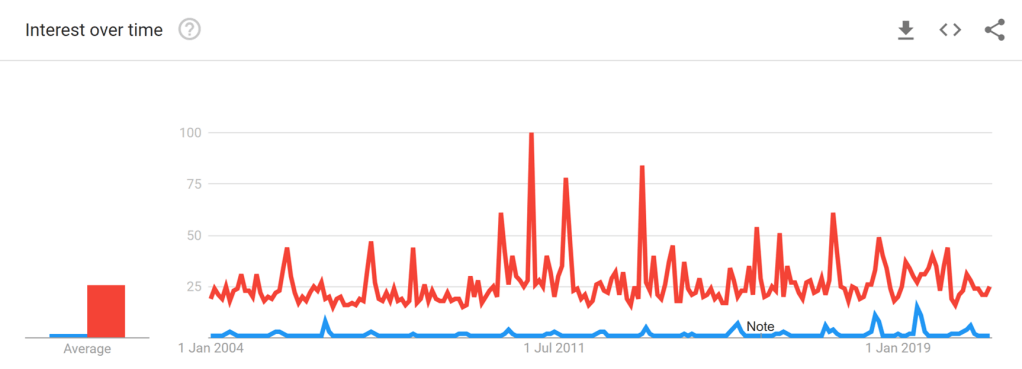
Heatwaves receive low attention in comparison to other natural hazards I.e., Flooding, one of the easiest ways to appreciate this attention deficit is through Google search trends. If we compare ‘heat wave’ to ‘flood’ both designated as disaster search types, you can see that a larger proportion of searches over time are for ‘flood’ in comparison to ‘heat wave’.  

Figure 1: Showing ‘Heat waves’ (blue)  vs ‘Flood’ (red) Disaster Search Types interest over time taken from: https://trends.google.com/trends/explore?date=all&q=%2Fm%2F01qw8g,%2Fm%2F0dbtv 

On average flood has 28% search interest which is over 10 times the amount of interest for heat wave. And this is despite Heatwaves being named the deadliest hydro-meteorological hazard from 2015-2019 by the World Meteorological Organization. Attention is important if someone can remember an event and its impacts easily, they can associate this with the likelihood of it happening. This is known as the availability bias and plays a key role in risk perception. 

Lack of Research and Funding 

One impact of the attention deficit on extreme heat risk, is there is not ample research and funding on the topic – it’s very patchy. Let’s consider a keyword search of academic papers for ‘heatwave*’ and ‘flood*’ from Scopus an academic database.  

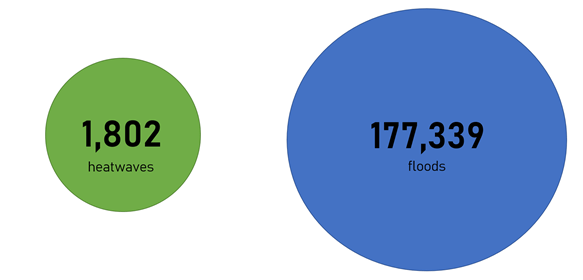
Figure 2: Number of ‘heatwave*’ vs number of ‘flood*’ academic papers from Scopus. 

Research on floods is over 100 times bigger in quantity than heatwaves. This is like what we find for google searches and the attention deficit, and reveals a research bias amongst these hydro-meteorological hazards. And is mirrored by what my research finds for the UK, much more research on floods in comparison to heatwaves (https://doi.org/10.1016/j.envsci.2020.10.021). Our paper is the first for the UK to assess the barriers, causes and solutions for providing adequate research and policy for heatwaves. The motivation behind the paper came from an assignment I did during my masters focusing on UK heatwave policy, where I began to realise how little we in the UK are prepared for these events, which links up nicely with my PhD. For more information you can see my article and press release on the same topic. 

Heat is an invisible risk 

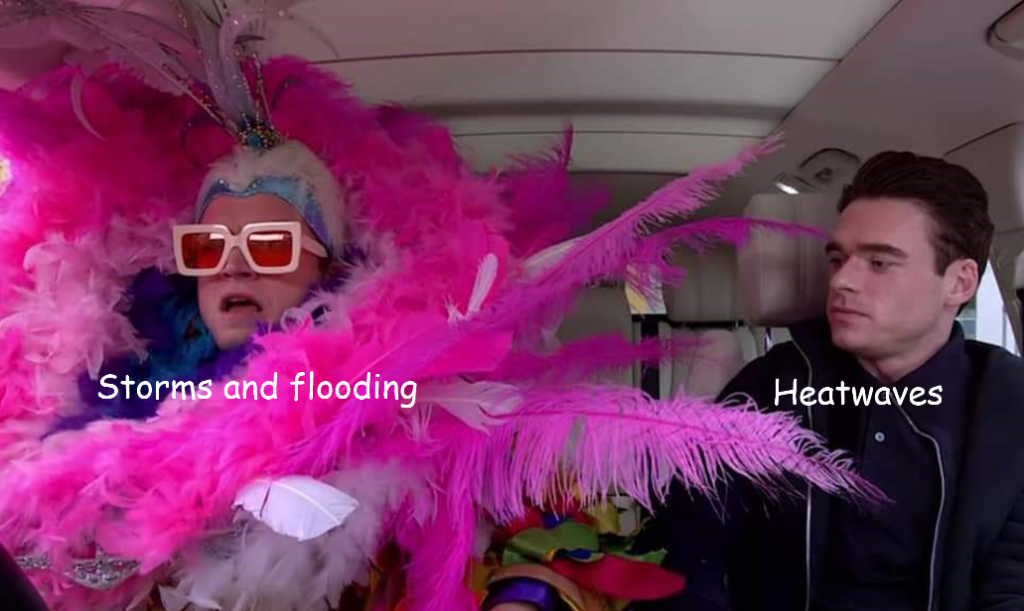
Figure 3: Meme that sums up not perceiving heat as a risk, in comparison, to storms and flooding.

Heatwaves are not something we can touch and like Climate Change, they are not ‘lickable’ or visible. This makes it incredibly difficult for us to perceive them as a risk. And this is compounded by the attention deficit; in the UK most people see heatwaves as a ‘BBQ summer’ or an opportunity to go wild swimming or go to the beach.  

And that’s really nice, but someone’s granny could be experiencing hospitalising heat stress in a top floor flat as a result of overheating that could result in their death. Or for example signal failures on your railway line as a result of heat could prevent you from getting into work, meaning you lose out on pay. I even know someone who got air lifted from the Lake District in their youth as a result of heat stress.  

 A quote from a BBC one program on wild weather in 2020 sums up overheating in homes nicely:

“It is illegal to leave your dog in a car to overheat in these temperatures in the UK, why is it legal for people to overheat in homes at these temperatures

For Africa the perception amongst many is ‘Africa is hot’ so heatwaves are not a risk, because they are ‘used to exposure’ to high temperatures. First, not all of Africa is always hot, that is in the same realm of thinking as the lyrics of the 1984 Band Aid Single. Second, there is not a lot of evidence, with many global papers missing out Africa due to a lack of data. But, there is research on heatwaves and we have evidence they do raise death rates in Africa (research mostly for the West Sahel, for example Burkina Faso) amongst other impacts including decreased crop yields.  

What’s the solution? 

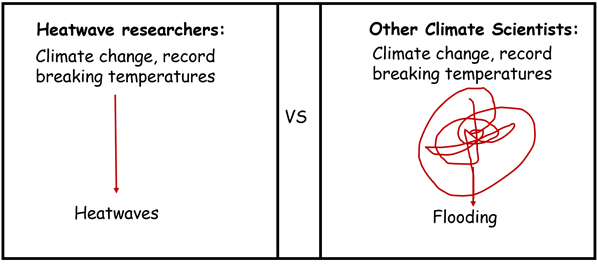
Talk about heatwaves and their impacts. This sounds really simple, but I’ve noticed a tendency of a proportion of climate scientists to talk about record breaking temperatures and never mention land heatwaves (For example the Royal Institute Christmas Lectures 2020). Some even make a wild leap from temperature straight to flooding, which is just painful for me as a heatwave researcher. 

Figure 4: A schematic of heatwaves researchers and other climate scientists talking about climate change. 

So let’s start by talking about heatwaves, heat stress and their impacts.  

The onset and end of wet seasons over Africa

Email: c.m.dunning@pgr.reading.ac.uk

For many Africans, the timing of the wet season is of crucial importance, especially for those reliant upon subsistence agriculture, who depend on the seasonal rains for crop irrigation. In addition, the wet season recharges lakes, rivers and water storage tanks which constitute the domestic water supply in some areas. The timing of the wet season also affects the availability of energy from hydroelectric schemes, and has impacts upon the prevalence of certain disease carrying vectors, such as mosquitoes.

Climate change is already threatening many vulnerable populations, and changes in the timing or intensity of the wet season, or increasing uncertainty in the timing of the onset, may lead to significant socio-economic impacts. But before we consider future projections or past changes in the seasonality, we need to go back a few steps.

The first step is to find a method for determining when the wet season starts and ends (its ‘onset’ and ‘cessation’). In order to look at large-scale shifts in the timing of the wet season and relate this to wider-scale drivers, this method needs to be applicable across the entirety of continental Africa. Most previous methods for determining the onset focus on the national to regional scale, and are dependent on the exceedance of a certain threshold e.g. the first week with at least 20mm of rainfall, with one rainfall event of more than 10mm, and no dry spell of more than 10 days after the rain event for the next month. While such definitions work well at a national scale they are not applicable at a continental scale where rainfall amounts vary substantially. A threshold suitable for the dry countries at the fringes of the Sahara would not be suitable in the wetter East African highlands.

In addition to a vast range of rainfall amounts, the African continent also spans multiple climatic regimes. The seasonal cycle of precipitation over continental Africa is largely driven by the seasonal progression of the ITCZ and associated rain belts, which follows the maximum incoming solar radiation. In the boreal summer, when the thermal equator sits between the equator and the Tropic of Cancer, the ITCZ sits north of the equator and West Africa and the Sahel experience a wet season. During the boreal autumn the ITCZ moves south, and southern Africa experiences a wet season during the austral summer, followed by the northward return of the ITCZ during the boreal spring. As a consequence of this, central African regions and the Horn of Africa experience two wet seasons per year – one as the ITCZ travels north, and a second as the ITCZ travels south. A method for determining the onset and cessation at the continental scale thus needs to account for regions with multiple wet seasons per year.

In our paper (available here) we propose such a method, based on the method of Liebmann et al (2012). The method has three steps:

  • Firstly, determine the number of seasons experienced per year at the location (or grid point) of interest. This is achieved using harmonic analysis – the amplitude of the first and second harmonic were computed, using the entire timeseries and their ratio compared. If the ratio was greater than 1.0, i.e. the amplitude of the second harmonic was greater than the amplitude of the first harmonic then the grid point was defined as having two wet seasons per year (biannual), if the ratio was less than one then it was defined as having an annual regime. Figure 1 shows the ratio for one African rainfall dataset (TARCATv2). Three regions are identified as biannual regions; the Horn of Africa, an equatorial strip extending from Gabon to Uganda and a small region on the southern West African coastline.

    blog_fig1
    Figure 1: Location of regions with one and two seasons per year, determined using harmonic analysis. Yellow indicates two seasons per year, while pink/purple indicates one season per year. Computed from TARCATv2 data.
  • Secondly the period of the year when the wet season occurs was determined. This was achieved by looking for minima and maxima in the climatological cumulative daily rainfall anomaly to identify one or two seasons.
  • The third and final stage is to calculate the onset and cessation dates for each year. This is done by looking for the minima and maxima in the cumulative daily rainfall anomaly, calculated for each season.

Figure 2 shows the seasonal progression of the onset and cessation, with the patterns observed in agreement with those expected from the driving physical mechanisms, and continuous progression across the annual/biannual boundaries. Over West Africa and the Sahel, Figure 2a-b shows zonally-contiguous progression patterns with onset following the onset of the long rains and moving north, and cessation moving southward, preceding the end of the short rains. Over southern Africa Figure 2c-d shows the onset over southern Africa starting in the north-west and south-east, following the onset of the short rains, reaching the East African coast last, and cessation starting at the Zimbabwe, Mozambique, South Africa border and spreading out radially into the cessation of the long rains.

As well as testing the method for compatibility with known physical drivers of African rainfall, agreement across multiple satellite-based rainfall estimates was also examined. In general, good agreement was found across the datasets, particularly for regions with an annual regime and over the biannual region of East Africa.

blog_fig2
Figure 2: Southward and northward progression of the onset and cessation across the annual/biannual boundaries, computed using GPCP daily rainfall data 1998-2013.

The advantage of having a method that works at the continental scale is the ability to look at the impact of large-scale oscillations on wider-scale variability. One application of this method was to investigate the impact of El Niño upon both the annual rains and short rains (Figure 3). In Figure 3 we see the well-documented dipole in rainfall anomaly, with higher rainfall totals over 0–15°S and the Horn of Africa in El Niño years and the opposite between 15°S and 30°S.  This anomaly is stronger when we use this method compared with using standard meteorological seasons. We can also see that while the lower rainfall to the south is colocated with later onset dates and a consequentially shorter season, the higher rainfall over the Horn of Africa is associated with later cessation of the short rains, with only small differences in onset date.

blog_fig3
Figure 3: a-c) Composite of onset, cessation and wet season rainfall in El Niño years for annual rains and short rains, minus the mean over 1982-2013, computed using CHIRPS data d) Oct-Feb rainfall anomaly in  years (CHIRPS).

In addition to using this method for research purposes, its application within an operational setting is also being explored. Hopefully, the method will be included within the Rainwatch platform, which will be able to provide users with a probabilistic estimate of whether or not the season has started, based on the rainfall experienced so far that year, and historical rainfall data.

For more details, please see the paper detailing this work:

Dunning, C.M., E Black, and R.P. Allan (2016) The onset and cessation of seasonal rainfall over Africa, Journal of Geophysical Research: Atmospheres, 121 11,405-11,424, doi: 10.1002/2016JD025428

References:

Liebmann, B., I. Bladé, G. N. Kiladis, L. M. Carvalho, G. B. Senay, D. Allured, S. Leroux, and C. Funk (2012), Seasonality of African precipitation from 1996 to 2009, J. Clim.25(12), 4304–4322.