The Making of STRATATOUILLE

By Elliot Mckinnon-Gray and Niamh Ocallaghan

The making of 2024’s departmental pantomime Stratatouille actually began all the way back in the summer of that year. There had been conversations on some stifling hot days (not that there were many!) around the theme for the current year’s panto. A film viewing had taken place and characters had begun to be assigned. However, come October, no one could have predicted the twist this tale would have taken leading to the majority of PhD students reluctantly(?) donning chef hats and rat ears for the best part of the coming December.

STRATATOUILLE Poster

Our story actually begins even earlier, mere days after the roaring success of sshRACC in December 2023 – as is apparently tradition – the fabled Panto Cupboard Key was foisted upon me by one of last year’s organisers. I won’t name and shame – but my fate was sealed; I was to become the organiser for the 2024 departmental pantomime. But who, pray, would heed my call for a co-organiser in this, my hour of need? It all came down to a rather conniving bit of deception, whereby I managed to trick my co-coordinator into accepting the key when they may have been expecting a tasty treat. Who says the pantomime is begrudgingly organised? But our destiny was well and truly decided and laid out in front of us. In nine to ten short months, we would be organising a corral of unruly PhD students and support staff to put on the world’s greatest annual university meteorology department pantomime.

Coming back to where we began, at the start of the academic year, we had an extremely strong candidate for what we thought was going to be the theme of the panto, but as always, the story for the panto is decided in the second(?) PhD Group Meeting of the year in a democratic process. This is where our original plan got unseated. The strongest proprietor (with many supporters) of the originally planned theme made the fatal mistake of prioritising career development over their wishes for a panto theme and could not make the deciding session. As Rabbie Burns reminds us, “The best laid plans of mice and men often go awry” – this was one such instance. With only half the organising committee present to propose the original idea, a plucky upstart with one good joke took the stage and captured the imagination of the PhD cohort, and so it was decided: Stratatouille would be the theme for this year’s panto. As fatefully predicted in last year’s panto blog post… 

Plot 

After innumerable lunchtime and evening writing sessions, the bulk of the panto story was baked and ready to consume. It is here where we have to give another massive thank you to Caleb Miller, who spent hours and hours essentially transposing the original story of the film Ratatouille to be based in our department following the terribly cobbled together idea of a story that we had. All we had to do now was pepper it with jokes and puns pertaining to food and/or meteorology and we had a script that even Patton Oswalt would be proud to perform. 

Audience review #1 

“The best panto I’ve seen for many years”

– Dr. Pete Inness 

The story begins with Remi the undergrat realising he feels unable to fulfil his ambition of doing serious research while surrounded by his decidedly unserious fellow undergrats. All they care about is getting drunk off snakebites, but Remi has a dream of becoming a great scientist and doing exceptional and interesting original research. While feeling dejected that he is too inferior to publish original research, he has an apparition of King Sir Professor Brian Hoskins* who gives him a message that anyone can be a scientist if they put their heart into it. 

Then we meet Linguini, a floundering PhD student who feels like he isn’t cut out for the work he is undertaking and expected to do. In a moment of serendipity, Linguini leaves his laptop open and unlocked in the BH coffee area where Remi is able to take a look at the work he is carrying out analysing some CheeseCDF files. Remi realises Linguini’s coding is terrible, fixes a few bugs and manages to greatly improve the code Linguini was working on. This leads to Linguini accepting help from Remi to write a paper as part of his PhD.

In the next scene, Linguini is showing Remi around his PhD office, when the WCD (Weekly Cuisine Discussion) bell goes, and all the PhD students diligently trudge down to GU01 to attend. Admittedly the WCD scene doesn’t further the story much apart from giving Remi an insight into the breadth of research done in this meteorology kitchen. But we got a lot of laughs, good jokes and puns, and silly costumes into this scene so it was an audience and cast favourite. It is later in this scene that we meet the terrifying supervisor, brilliantly played by our regular cartoon villain Catherine Toolan. The supervisor is very tough on Linguini with high expectations and little patience. But that is all too easy for Remi who manages to complete the task the supervisor asked for in no time at all. They (Linguini napping with his feet up) spend the next few hours “cooking up some actual research”. When the supervisor returns, she is amazed to see that ‘Linguini’ has disproved the entire concept of PV. Suspicious that he has managed to attain such a level of skill so quickly, she recommends that he first present the work at a conference before they crack on with publishing the work. 

At the conference, Linguini gives a great presentation (Remi is giving him slide-by-slide instructions) but makes a fatal error by taking nearly all of the credit and failing to mention he got any help from Remi. This alienates Remi who storms out of the conference to return to the department. Jumping forward in time, when Remi returns to and hatches a cunning plan to derail the entire department – stealing the tea and coffee money box (topical departmental news has appeared in the script!). Back at the conference, Remi is making a total fool of himself by not being able to answer even the simplest of questions from the audience, embarrassing his supervisor in the process. She interrogates him about this and finds out much to her dismay that an undergrat helped with the research. So disgusted is she at this that supervisor and the other staff members strike, leaving the department destitute of senior figures. 

This leads to a moment where Remi and Linguini make up thanks to an apology, and Remi recruits a team of undergrats to help finish writing the paper they started. The paper is submitted to the journal Nature: Valley Bar where it is eventually inspected by the feared Reviewer 2, who is so impressed by the work that he recommends it be published with no changes (apart from citing one of his own papers). The story ends with KSPBH* re-appearing and handing Remi the keys to the department and naming the building after him. 

Songs 

Please Stop Me Now – there was a running theme of ‘difficult to sing but possibly worth the effort since they are well loved tunes’ for most songs this year, and this one was no exception. A parody of Queen’s 1979 mega-hit of Don’t Stop Me Now, our extremely talented band carried our pretty rubbish singing – but that didn’t stop it being some attendees’ favourite part of the show. 

Audience review #2 

“How did you guys come up with all those song lyrics and make them work? So funny and so impressive!” 

– MSc Student 

Come on Remi – One of the more singable tunes based on Come on Eileen by Dexys Midnight Runners, all about how much work Remi was going to have to do to get Linguini through his PhD work. In practising this one, we had choir master Catherine bellowing at us to sing louder, a task we all found much easier after a few glasses of boxed wine from the Winnersh Sainsbury’s. The Middle – Jimmy Eat World was the third song which I don’t think we even came up with a spoof title for; a punk-pop particularly catchy tune about the trials and tribulations of poor Linguini the PhD first year who is letting his stress get in the way of enjoying the start of his PhD. Money, Money, Money – an ABBA classic we also didn’t need to change the title of about the rats stealing the money box. We made the bold decision this year to plant much of the songs mid-scene. A directorial choice that I think helped the coherent telling of the story. Special mention here to Nathan’s amazing piano playing skills here – the rendition of Erik Satie’s Gymnopedie during the John Meth-Coq-au-Vin monologue was only improvised in the final dress rehearsal earlier that day! 500 Lines – a version of the Proclaimers’ singalong classic 500 Miles about how many lines Remi has to write to get their paper done! H-O-S-K-I-N-S : I’m not sure how Sir Brian feels about being the subject of the panto or at least a song every year, and this one was a little on the nose; but you really couldn’t ask for a better fit for one of the songs of the summer – Chappell Roan’s Hot to Go had exactly the right mood for what we wanted to sing, and I think it made for a great outro wonderfully delivered by one of the best KSPBH performances we’ve seen in a while by our very own Douglas Mulangwa.

Casting 

It can be a bit like pulling teeth trying to cast the leading roles in the panto, and as one of the few first-year PhDs who have shown the extroversion to be able to tackle this and with great stage presence, the inimitable Jake Keller somewhat reluctantly agreed to be Remi with a fateful “if I have to” when asked repeatedly. I think he came around to really enjoying it, and the audience were also quite impressed –

Audience review #3 

[To Jake] “You were great!” 

– Regius Professor Keith Shine 

And Andrea Rivosecchi as Linguini – at first he accepted but then realised he would have to learn even more lines than the main character; so we looked around and found a great doppelganger for the second act – not sure if any of you noticed – but in the second act Linguini was played by a different Italian man in Riccardo Monfardini! Some veterans of the game came through and gave us some great performances with Catherine as Supervisor and Hette Houtman as Pete Dinners. Shout out to Hette as one of last year’s organisers for also helping us with timing and who to contact for various admin duties. The remaining roles had under 5 lines, but all were delivered hilariously and brilliantly, and you all appear to have agreed.

Audience Review #5 

“Catherine was quite scary as supervisor” 

– Dr Andy Apple Turnover Turner (Catherine’s PhD Supervisor) 

The Night (and Day) of the Panto 

So as many of you agreed, the Act 1 cameo from our antipodean friend Robbie Marks (the star of last year’s panto) was one of the best moment’s of the panto: 

Audience review #4 

“I can’t believe Robby came through and made that for us!” 

– Gabrielle Ching-Johnson (Undergrat #2) 

This is where I would like to make the point that he sent me those videos the morning of the show, and we had to hurriedly stitch together his several renditions of that speech in different locations with the cinematic walk off. Special thanks to Rosie (last year’s co-organiser) for helping with the video editing, and generally for being a great help to us organisers this year by giving advice and keeping us on time (mostly). Robby was sent a video of the mirthful reaction to his cameo with the reaction “F*** yeah, glad I could make an appearance”. The day went much more smoothly than last year, with us occupying the Madejski lecture theatre from 2pm onwards with no interruptions, we had plenty of time to set up the tech and instruments, as well as squeeze in a final full rehearsal. Set up the ticket booth, and we were ready to go! 150 people filed in for a great attendance to our show. Not to forget a great buffet beforehand to get everyone in the mood for the flagship event in the departmental calendar. 

Act 1 and Act 2 managed to run for about the same amount of time, 30 mins a piece for an hour-long panto, as we had planned – brilliant! The interval acts, however put paid to that. A mammoth 45-minute session full of controversy and some of the biggest laughs of the night. We saw Stroopwaffels crowned the winner of the big biscuit bracket, however this was vetoed by the head of department who quite rightly pointed out they are not a biscuit and so the runner up chocolate hobnobs was our true champion. Professor Coq-au-Vin was not the only one to take issue with this controversial result. The 3L68 team of Dan Shipley, Jake Bland and Brian Lo made the argument that Bourbons had been wrongfully expelled and would have won this year, and so Dan delivered a hilarious diatribe explaining how they came to decide which Bourbon was best, and therefore the true winner of the biscuit bracket. I don’t remember which one it was in the end (M&S?) – check the video recordings of the night to find out for yourselves. 

A pleasant break from the commotion of the biscuit brackets was brought around from some classical piano performed by Amber Te Winkel, and then some might say the only reason they attend the panto – Mr Mets. A blinder of an episode where Peter Clark was apologised to (again – and rejected on his behalf by Humphrey), and insinuated to have signed up to OnlyFans with the most innocent of intentions. The theme of the story was John Methven’s takeover as head of department, with him bumbling along and struggling to fulfil the role while eating copious amounts of ‘free’ food (it’s not free if you use department funds to pay for it, Prof. Methven!). Just to clarify that no one thinks John will struggle to fulfil the role, but as HOD I’m afraid you have to expect a fair bit of derision at these sorts of performances! 

Following that, another side-splittingly funny act followed with an after party led by DJ Shonk that included a rare slow number – all in aid of blossoming romance on the dancefloor. 
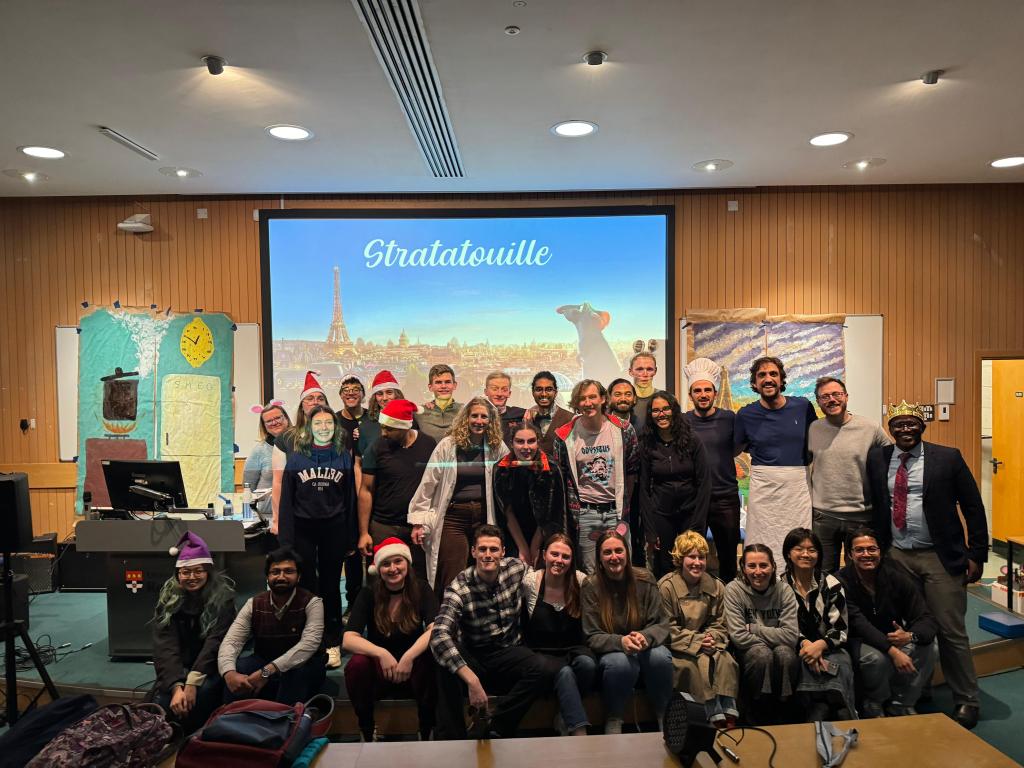
The amazing cast and crew who made STRATATOUILLE happen!

Reflections 

As always, the Panto is months of hard work to organise, and things only ever seem to come together in the eleventh hour. But we had a great team and cast and band that really made it come together beautifully. Acting on stage, playing in a live band, organising a production, generally being a thesp isn’t the kind of thing you expect to hear from a large majority of the PhD students of the world’s leading Meteorology department. But it is these experiences, very far outside most of our comfort zones that builds strong and adaptable characters. And I think this experience has probably given us, as organisers and performers alike, more useful skills than we might have realised. This will, however, probably be these director-producers’ debut and final production. 

A huge thank you to everyone who attended and contributed to the panto in any way, no matter how small. Your participation is what makes this a great bonding experience for the department, and you are all greatly appreciated! 

One last time, 

Your Panto Organisers 
Elliot and Niamh 
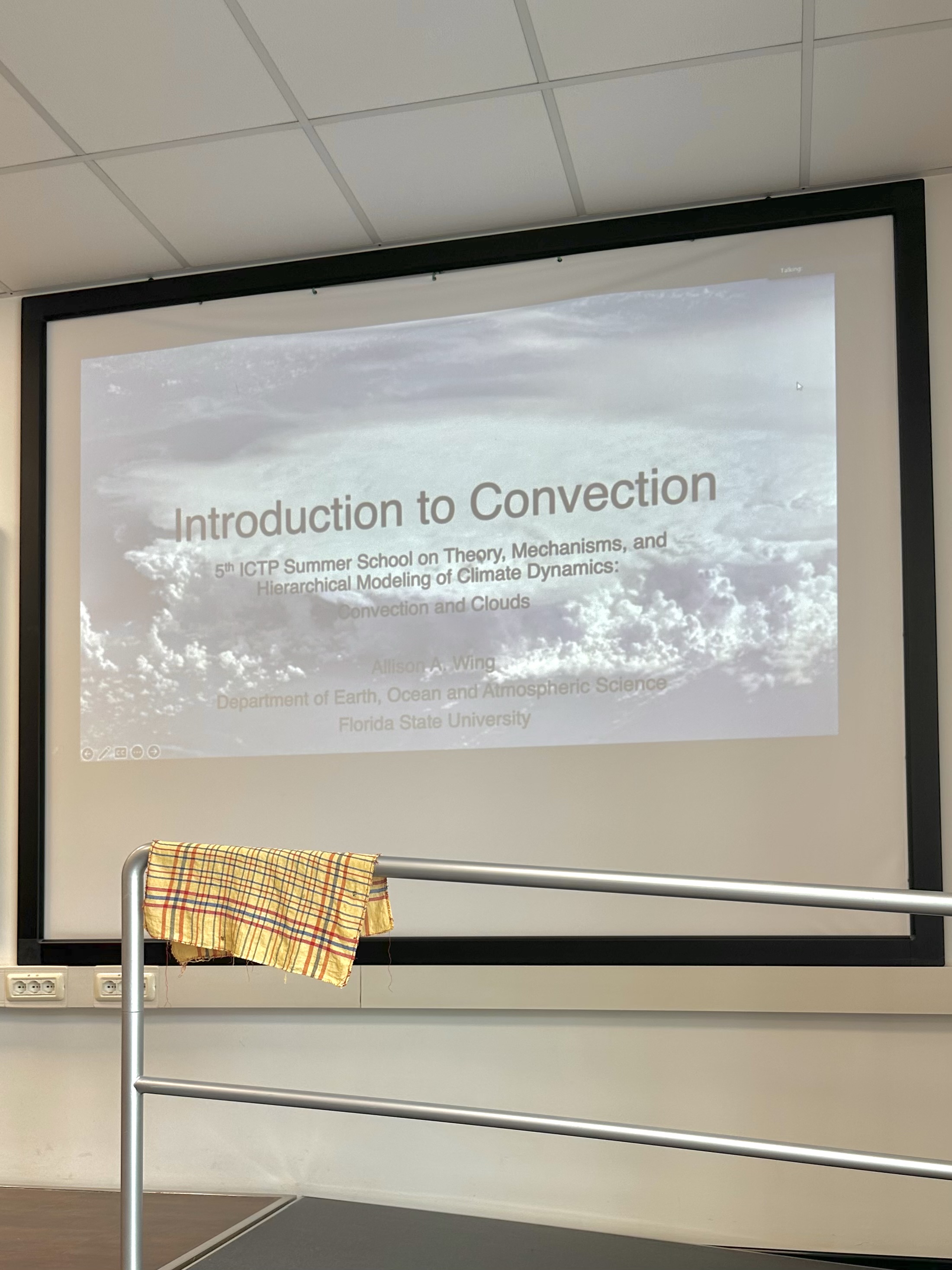
The 5th ICTP Summer School on Modelling of Climate Dynamics: Convection and Clouds, and Conference on Convective Organisation (WCO4)

By Juan Garcia Valencia

In the tropics, organised convective systems provide the majority of precipitation and are often responsible for extreme events. To understand these systems, researchers now use kilometre-resolution (k-scale) global and regional convection-permitting models, along with the latest satellite observations. Machine learning tools have also emerged as important supplements to our dynamical and thermodynamic understanding.

It’s crucial to understand these tools to address key questions such as:

  • How do deep and shallow convection organise in k-scale models?
  • Can energy budgets help explain their precipitation biases?
  • What are the recent advances in convective parameterisation?

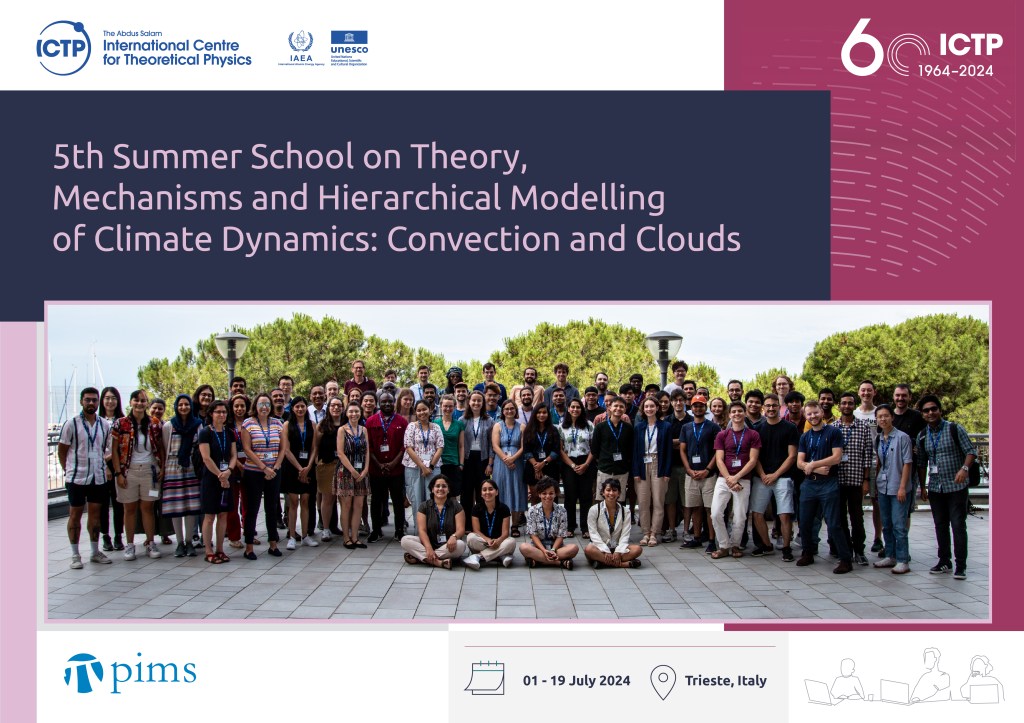
These questions were the focus of the “5th Summer School on Theory, Mechanisms and Hierarchical Modelling of Climate Dynamics: Convection and Clouds,” which I had the privilege of attending from the 1st–19th of July 2024 at the International Centre for Theoretical Physics (ICTP) in Trieste, Italy.

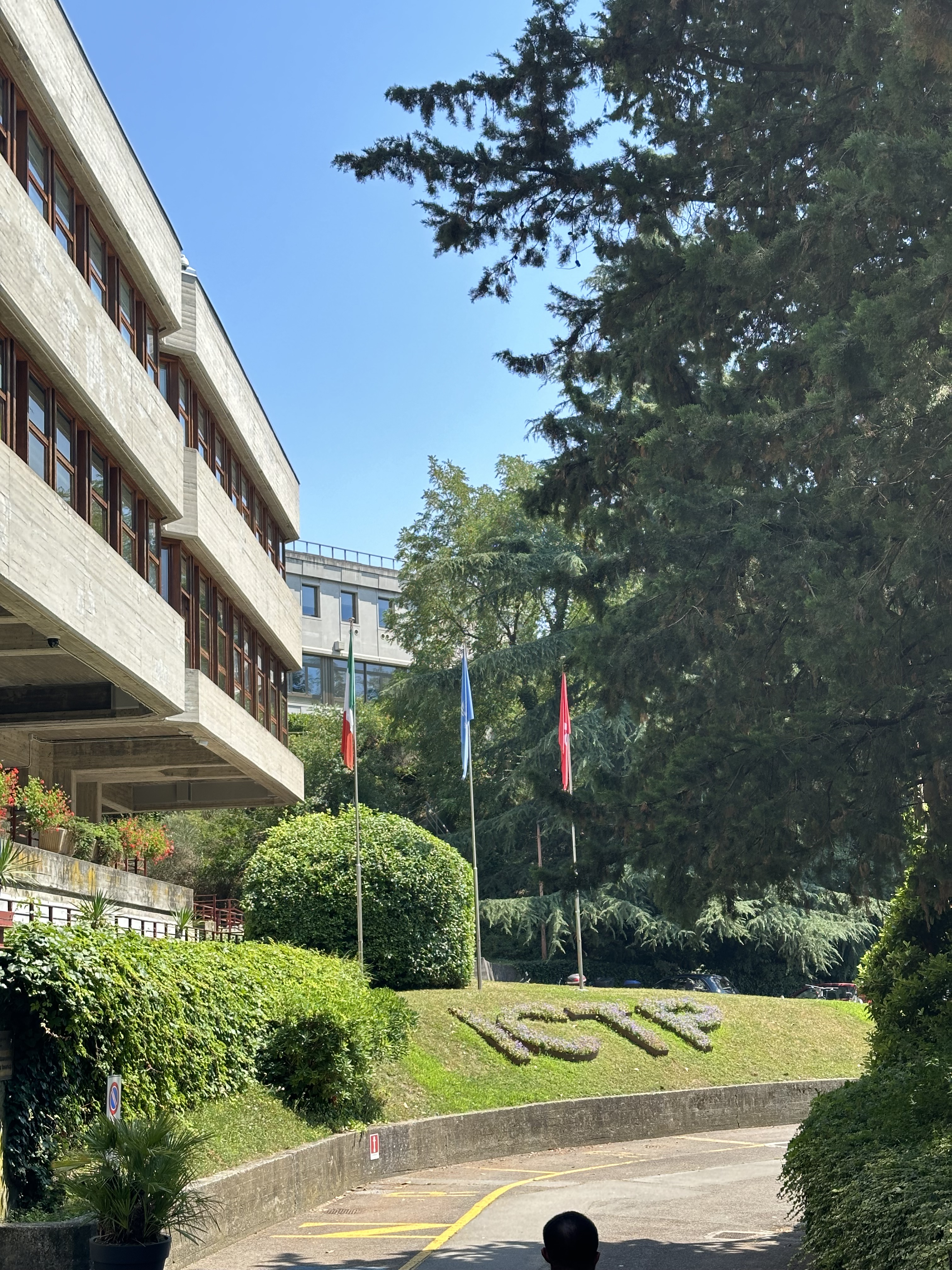
Picture 1 and 2. First lecture and campus. 

The program offered a mix of introductory and advanced lectures, hands-on data analysis through participant projects, and the chance to get involved in the “4th Workshop on Convective Organisation and Precipitation Extremes (WCO4).” The opportunity to attend arose because two of my supervisors, Chris Holloway and Lorenzo Tomassini, presented their work at the conference and taught some of the lectures in the course. As a PhD student researching monsoons using kilometre-scale simulations, I also felt like I had to attend! 

The three-week schedule was intense, with most days running from 9 AM to 6 PM (thankfully with plenty of coffee breaks and a long lunch). A typical day began with lectures from leading experts like Simona Bordoni, Robert Pincus, and Courtney Schumacher. Topics ranged from convection and radiation to RCE, stochastic parameterisation, and observations. Afternoons were usually dedicated to computer lab sessions or group project work.

Picture 3. Attendees of the summer school. 

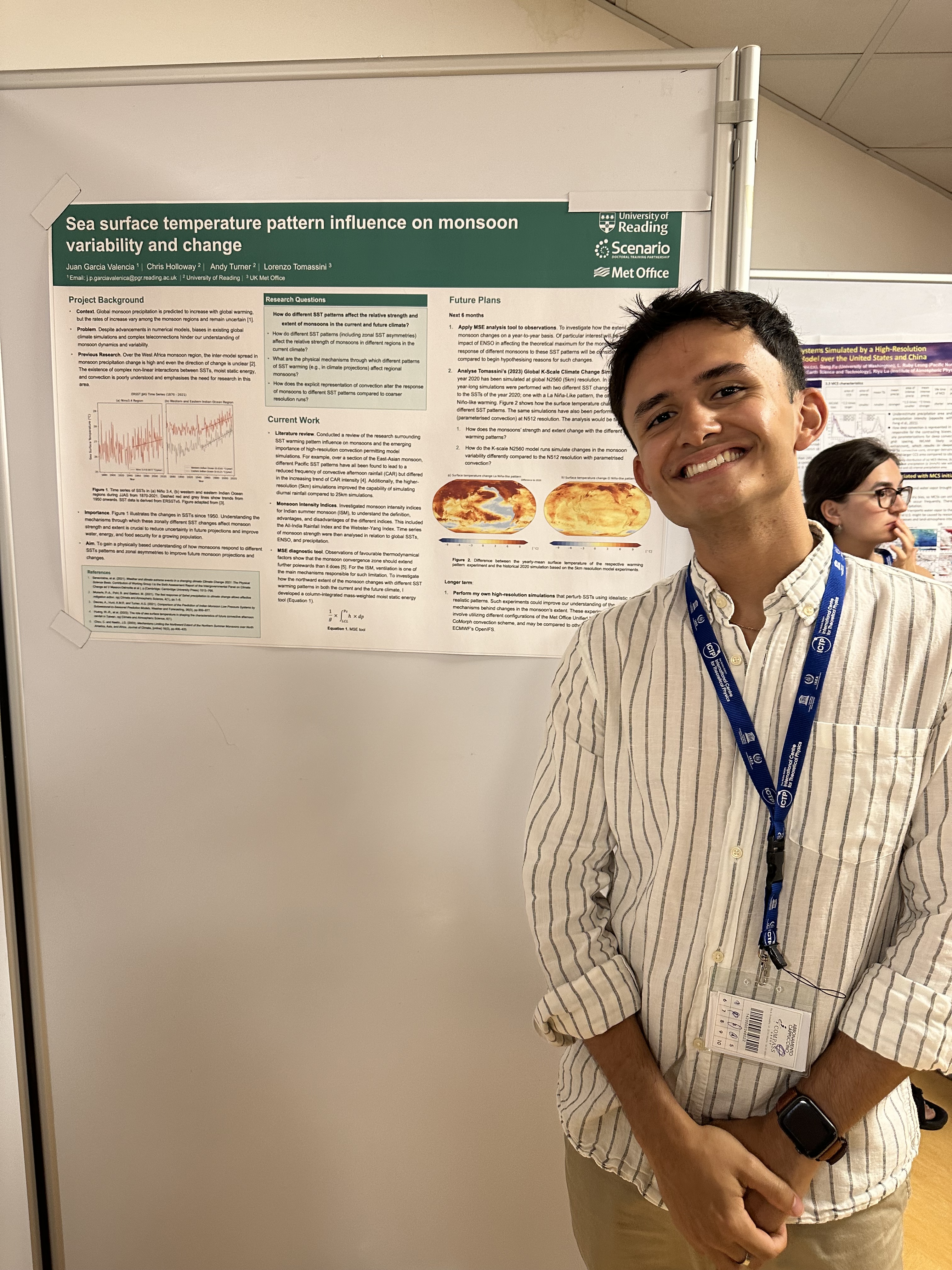
The second week centred on the WCO4 conference, covering topics from convective self-aggregation in idealized experiments to precipitation extremes associated with organized convection and optimizing our use of observational data. Students had the opportunity to present posters on their research—an incredibly valuable experience for me as I received loads of useful feedback about my ideas and goals. This was also my first time presenting research at an international event, so it was great to show what I’ve been working on in front of all the attendees and meet so many people genuinely interested in my work.

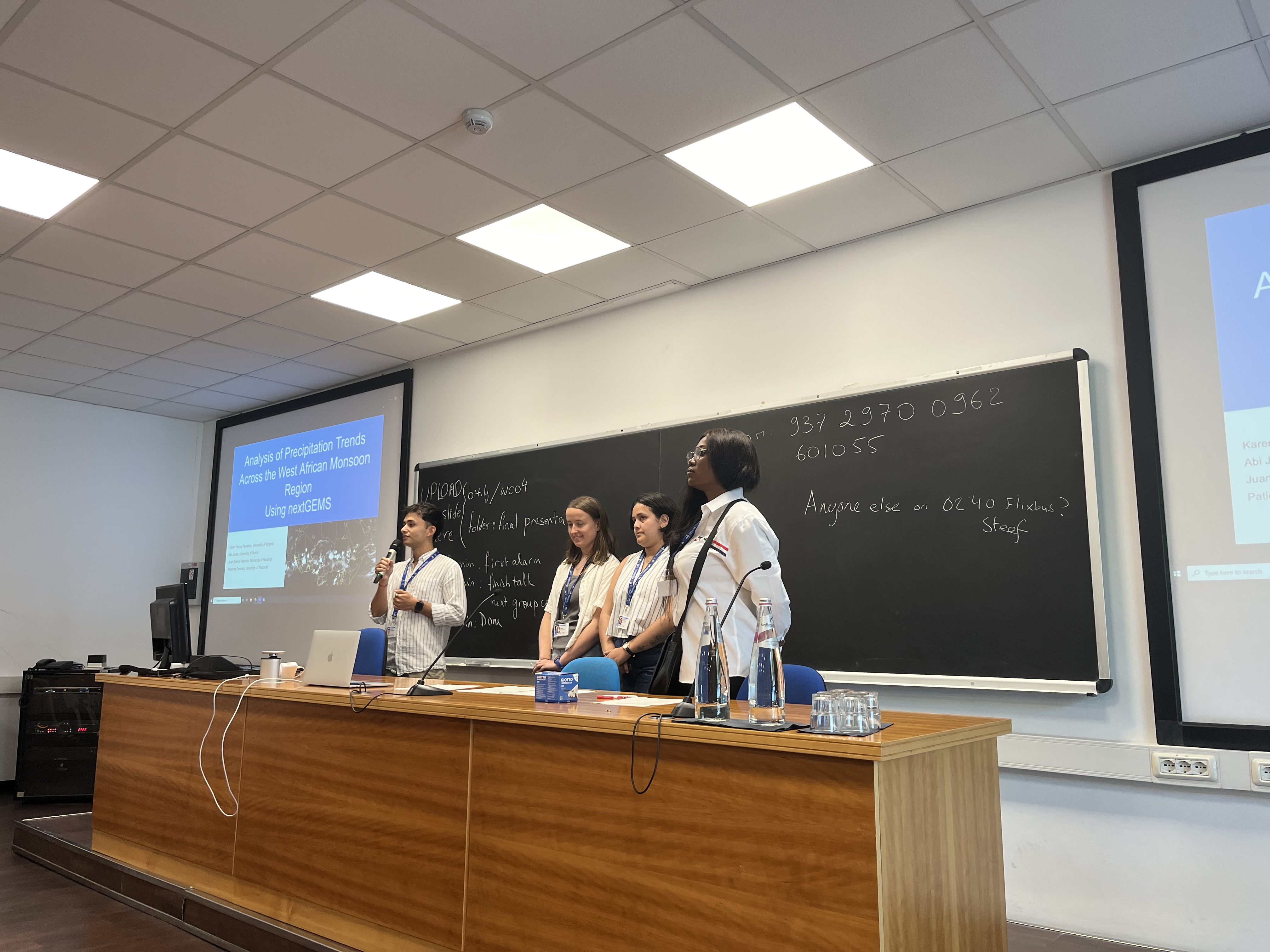
The final week focused on hands-on projects. In groups of 4–5, we analysed numerical model data and presented our results to everyone. My group examined how precipitation extremes change in a warming world using NextGEMS data, but every group had different topics that they had chosen according to their interest and expertise. Many of the tasks and analyses we did were similar to my first-year work, so I left with a plenty of new ideas for my research!

Picture 4. End of group project presentation and poster presentation. 

Being an international centre, the school and conference brought together staff and students from all corners of the globe—one of my favourite aspects of the course. Despite knowing no one beforehand, I quickly got to know other PhDs and post-docs from various institutions, all working on projects similar to mine. I felt at ease in this new environment, making friends and meeting potential future colleagues!

Another fantastic aspect of this summer school was its stunning location on Italy’s sunny, warm northern Adriatic coast. After each day’s activities, we were free to spend our evenings as we pleased. This was the perfect opportunity to relax by the sea, swim, and explore Trieste’s picturesque town centre. More often than not, we’d venture into town for pizza and, of course, gelato!

Starting Your PhD Journey: Tips for Success

So, you’ve officially embarked on the exciting journey that is a PhD—congrats! You’ve reached a major milestone, and whether you’re feeling excited, overwhelmed, or a mix of both, just know you’ve signed up for an adventure like no other. A PhD is an incredible opportunity to dive headfirst into a subject you’re passionate about, build a toolkit of valuable skills, and—who knows?—maybe even make history in your field.

But let’s be real: it’s not all rainbows and groundbreaking discoveries. The PhD life can be challenging, sometimes feeling like a marathon through an obstacle course. You’ll have moments that test your patience, confidence, and sometimes, your sanity. That’s why here at Social Metwork, we’ve gathered some golden advice from seasoned PhD students to help you navigate these waters. Our goal? To make this transition into PhD life a little smoother, maybe even a little fun.

We’ll break these tips down into three areas: navigating day-to-day life as a PhD student, getting organized like a pro, and growing into the great scholar you’re destined to be. Ready? Let’s dive in!

1. Navigating Day-to-day Life as a PhD Student

Work-life balance

The first year of your PhD can feel overwhelming as you try to juggle research, coursework, and life. One key piece of advice? Don’t overwork yourself. As Laura Risley puts it, “Sometimes if you’re struggling with work, an afternoon off is more useful than staying up late and not taking a break.” It’s easy to get absorbed in your work, but stepping away to recharge can actually help you return with fresh perspectives.

Getting involved in activities outside your PhD is another great way to maintain balance (L. Risley, 2024). Whether it’s exploring more of Reading, participating in a hobby, or just getting outside for some fresh air, your brain will thank you for the break. Remember, “Your PhD is important, but so is your health,” so make sure to take care of yourself and make time for things that bring you joy: exercise, good food, and sleep!

Lastly, don’t underestimate the power of routine. Building a consistent schedule can help bring some stability to PhD life. Most importantly, be kind to yourself. The weight of expectations can be heavy so give yourself permission to not have it all figured out yet. You won’t understand everything right away, and that’s completely normal!

Socialising and Building a Support System

Your cohort is your lifeline. The people you start with are going through the same experiences, and they will be your greatest support system. Whether you’re attending department events, organizing a BBQ, or just grabbing a coffee, socializing with your peers is a great way to get through everything. At the end of the day, we are all in this together! As Rhiannon Biddiscombe wisely says, “Go for coffee with people, go to Sappo, enjoy the pub crawls, waste a night out at PT, take part in the panto, spend time in the department in-person” — so make sure you get involved!

If what you want is to meet new people, you could even help organise social events, like research groups or casual hangouts – feeling connected within your department can make all the difference when you’re having a tough week. And hey, if you’re looking for a fun group activity, “Market House in town has darts boards, ping pong tables, and shuffleboard (you slide little discs to the end of the board, it’s good fun!)”.  

2. Getting Organised Like a Pro

Writing and Coding

Staying organised is critical for both your mental health and your research. Adam Gainford recommends you start by setting up a reference manager early on—trust us, you’ll thank yourself later. And if your research involves coding, learn version control tools like GitHub to keep your projects neat and manageable. As a fellow PhD student says “Keeping organised will help keep your future self sane (and it’s a good skill that will help you with employability and future group projects)”.

A golden rule for writing: write as you go. Don’t wait until the last minute to start putting your thoughts on paper. Whether it’s jotting down a few ideas, outlining a chapter, or even starting a draft, regular writing will save you from stress later on. Remember what Laura always says, “It’s never too early to start writing.”

Time Management

Managing your time as a PhD student is a balancing act. Plans will shift, deadlines will change, and real life will get in the way—it’s all part of the process. Instead of stressing over every slipped deadline, try to “go with the flow”. Your real deadlines are far down the road, and as long as you’re progressing steadily, you’re doing fine.

Being organised also doesn’t have to be complicated. Some find it helpful to create daily, weekly, or even monthly plans. Rhiannon recommends keeping a calendar is a great way to track meetings, seminars, and research group sessions – I myself could not agree more and find time-blocking is a great way to make sure everything gets done. Regarding your inbox, make sure you “stay on top of your emails but don’t look at them constantly. Set aside a few minutes a day to look at emails and sort them into folders, but don’t let them interrupt your work too much!”. Most importantly though, don’t forget to schedule breaks—even just five minutes of stepping away can help you reset (and of course, make sure you have some valuable holiday time off!).

3. Growing into the Scholar You’re Meant to Be

Asking for Help

This journey isn’t something you’re expected to do alone. Don’t be afraid to reach out for help from your friends, supervisors, or other PhD students. Asking questions is a sign of strength, not weakness. What’s great is that everyone has different backgrounds, and more often than not, someone will be able to help you navigate whatever you’re facing (trust me, as a geography graduate my office mates saved my life with atmospheric physics!). Whether you’re stuck on a tricky equation or need clarification on a concept, ask ask ask! 

“You’ve got a whole year to milk the ‘I’m a first year’ excuse, but in all seriousness, its never too late to ask when you’re unsure!” – a fellow PhD student.

Navigating Supervisor Meetings

Your supervisors are there to guide you, but communication is key. Be honest with them, especially when you’re struggling or need more support. If something doesn’t make sense, speak up—don’t nod along and hope for the best, “they should always have your back” (it will also be very embarrassing if you go along with it and are caught out with questions…). 

Also, “If you know some things you want to get out of your PhD, communicate that with your supervisors”. Open communication will help you build a stronger working relationship and ensure you get what you need from the process.

Dealing with Imposter Syndrome

Imposter syndrome can hit hard during a PhD, especially when you’re surrounded by brilliant people doing impressive work. But here’s the thing: don’t compare yourself to others. Everyone’s PhD is different—some projects lend themselves to quick results, while others take longer. Just because someone publishes early doesn’t mean your research is less valuable or that you’re behind – we are all on our own journeys. 

And remember, no one expects you to know everything right away. “There might be a pressure, knowing that you’ve been ‘handpicked’ for a project, that you should know things already; be able to learn things more quickly than you’re managing; be able to immediately understand what your supervisor is talking about when they bring up XYZ concept that they’ve been working on for 20+ years. In reality, no reasonable person expects you to know everything or even much at all yet. You were hand-picked for the project because of your potential to eventually become an independent researcher in your field – A PhD is simply training you for that, so you need to finish the PhD to finish that training.”

If you’d struggling with imposter syndrome, or want to learn about ways to deal with it, I highly recommend attending the imposter syndrome RRDP. 

A Few Final Words of Wisdom

The PhD rollercoaster is full of ups and downs, but remember, you’re doing fine. “If you’re supervisors are happy, then don’t worry! Everything works out in the end, even when it seems to not be working for a while! “– Laura Risley

It’s also super important to enjoy the process. You’ve chosen a topic you’re passionate about, and this is a rare opportunity to fully immerse yourself in it. Take advantage of that! Don’t shy away from opportunities to share your work. Whether it’s giving a talk, presenting a poster (or writing for the Social Metwork blog!!), practice makes perfect when it comes to communicating your research.

Embarking on a PhD is no small feat, but hopefully with these tips, you’ll have the tools to manage the challenges and enjoy the ride. And if all else fails, remember the most important advice of all: “Vote in the Big Biscuit Bracket—it’s the most important part of being a PhD student!”. 

From the department’s PhDs students to you! 

Written by Juan Garcia Valencia 

Good morning Baltimore! AMS 2024

Isabel Smithi.h.smith@pgr.reading.ac.uk

Hannah Croadh.croad@pgr.reading.ac.uk

In January 2024, Isabel Smith and Hannah Croad attended the 104th American Meteorological Society (AMS) annual meeting in Baltimore, Maryland. As fourth-year PhD students this was something of a “last hurrah” of our PhDs (with the remainder of our project monies and carbon budgets being used up), representing a fantastic opportunity to see the latest research happening in meteorology, meet other scientists working in our respective fields, and present our own work to a large audience at this late stage in our projects.

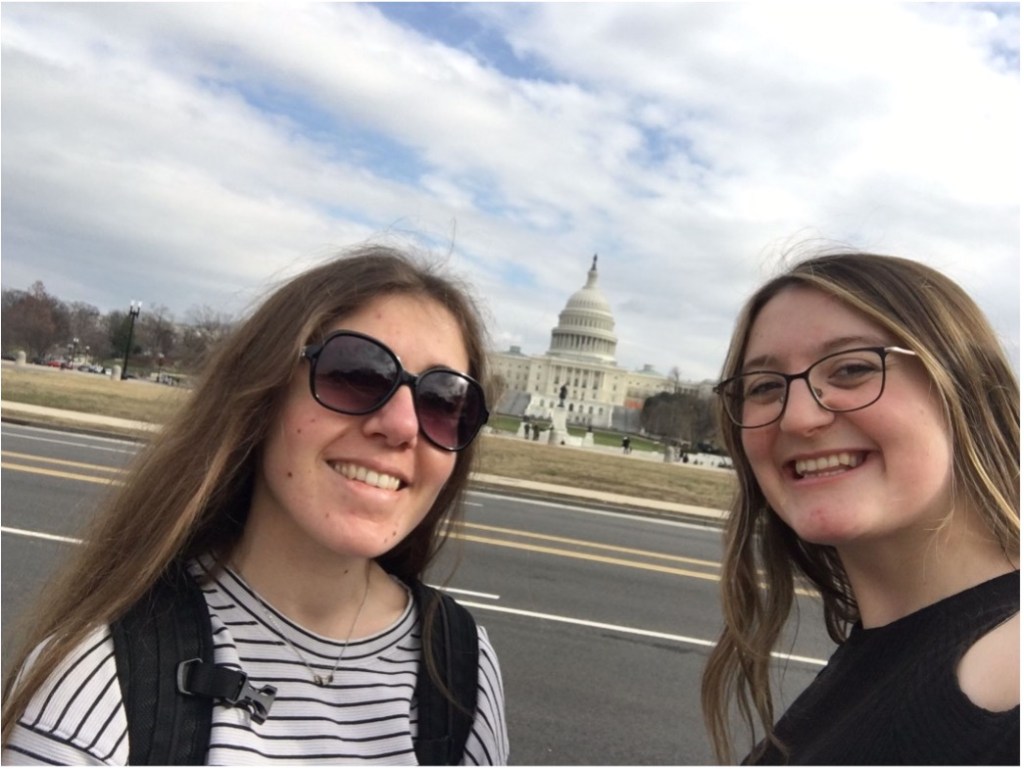
We arrived in Baltimore on the Friday before the conference started, navigating the busy streets near the Inner Harbour in a thick fog to find our hotel. The many plumes of steam coming from vents in the street were somewhat disconcerting, but it turns out this is the result of an underground steam pipe system and is completely safe. As exciting as this was, Baltimore is slightly lacking in terms of other tourist attractions, so on the Saturday we chose to visit Washington DC, only a 1-hour train ride away. We had a great day wandering about the capital city, visiting the Smithsonian’s National Air and Space Museum, and seeing all the iconic monuments including the Capitol building and the White House. Back in Baltimore on the Sunday, there was a buzz about the city as Baltimore’s NFL Ravens team were hosting the Kansas City Chiefs. Although we did not attend the game, and the Ravens lost, it was a great honour to be within a mile radius of Taylor Swift.

Figure 1: Posing for a selfie in front of the Capitol building in Washington DC whilst the sun made a brief appearance.

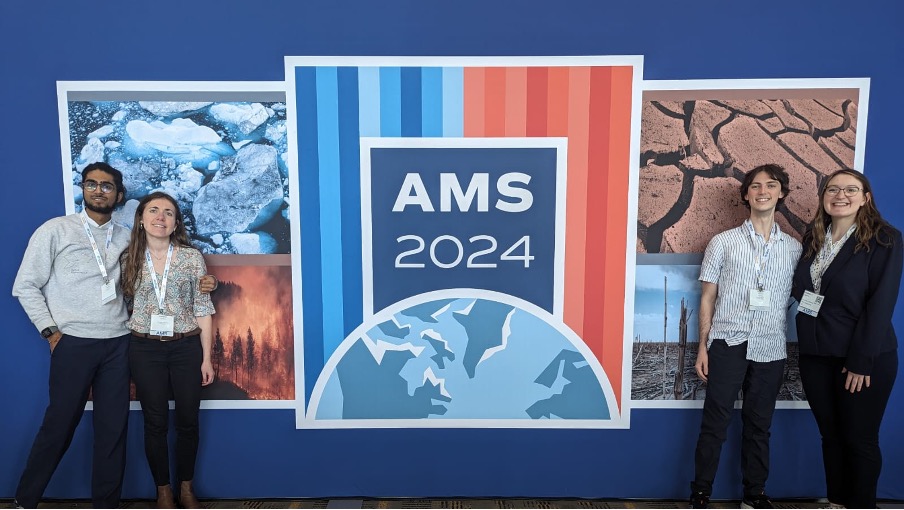
The conference started on Sunday, with registration (where we picked up some cool lanyards), speeches from outgoing and incoming AMS presidents, student posters, and an interesting panel discussion about how the two sides of American politics must come together in the fight against climate change. It was also great to meet up with two first-year PhD students from the department, Karan Ruparell and Robby Marks, for who this was the first international conference of their PhD.  

Figure 2: PhD students (from left to right: Karan, Hannah, Robby, Isabel) from the University of Reading at the AMS 2024 annual meeting with the climate-striped-inspired logo.

The main conference programme was scheduled from Monday to Thursday. The size of the conference was overwhelming, with up to 40 parallel sessions at any one time amongst the many different mini- conferences and symposia. Hence, it was important to research which sessions you wanted to go to in advance.  We did this using the AMS app, although it was rather slow and buggy (AMS if you’re reading this, please improve for next year). Isabel attended the 4-day symposium on Aviation, Range and Aerospace meteorology (ARAM), being held in the same room of the conference center each day. In contrast, Hannah attended many different sessions and so was continuously moving between different rooms, with the highlights being the Daniel Keyser symposium on synoptic-dynamic meteorology on Monday and the Polar symposium on Thursday. 

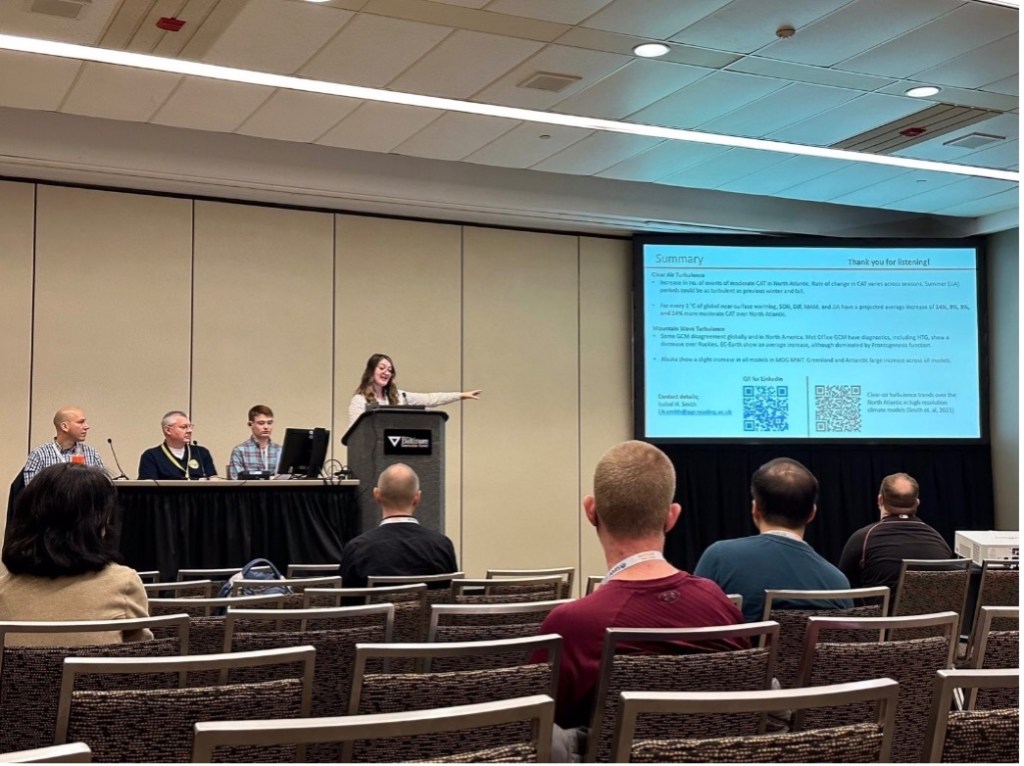
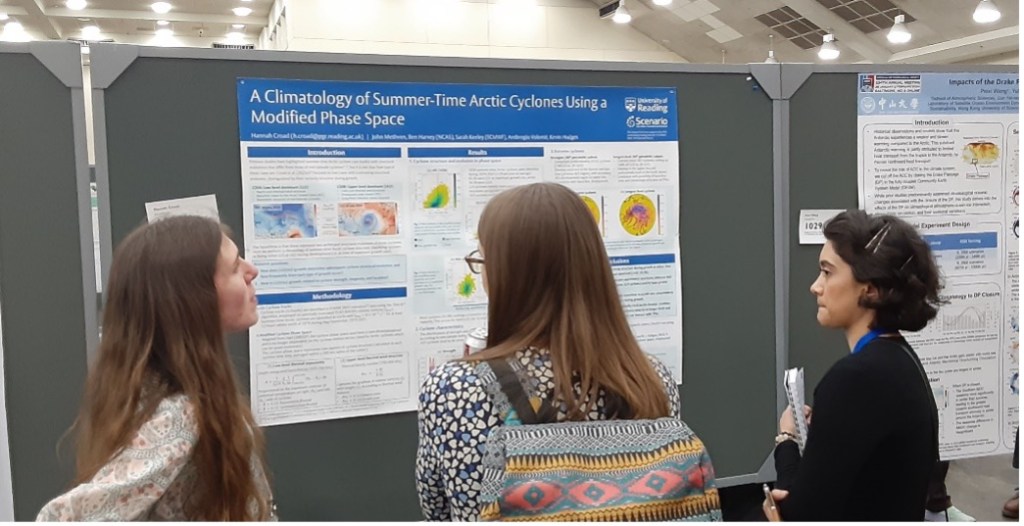
The biggest day of the conference for us was Thursday, as we were both going to be presenting our work. Starting bright and early, Isabel gave an oral presentation in the ARAM symposium, talking about her work on trends in aviation scale turbulence. In the afternoon, Hannah presented a poster in the Polar symposium, talking about her climatology of summer-time Arctic cyclones. We found it interesting to compare the two different presentation formats. For oral presentations your research is likely to reach more people as you have a captive audience for 12 minutes, but the format is more nerve-wracking and there is only limited time for questions and discussion. Less people are likely to visit a poster, but the 1.5 hour format allows for longer and more in-depth discussion with those who do approach you (assuming your poster survives the flight in your suitcase of course). Regardless of the format, we both really enjoyed sharing and discussing our work with other scientists and found the day to be thoroughly rewarding. 

Figure 3: Isabel giving her presentation in the ARAM symposium.
Figure 4: Hannah (left) presenting her poster at the Polar symposium. 

In summary, we both had a fantastic time at the AMS 2024 annual meeting. Not only did we enjoy and learn a lot from the conference talks and posters, it was also great to catch up with current and ex-students from the department, old friends and lecturers from our time at the University of Oklahoma as undergraduate students, and to make new contacts in our respective fields. Although large conferences like AMS can be daunting, attending gives you an appreciation of the wide variety of research happening all over the world, conducive to a stimulating and inspiring atmosphere. They also provide fantastic opportunities to network and to learn new things outside of your immediate research topic. Hence, we would both recommend attending a big conference like AMS if you get the chance to do so in your PhD! 

sshRACC: The Making Of

Once upon a time, in the first week of term, last year’s panto organisers Jen Stout and Caleb Miller came to HP180 to ask if we (Catherine Toolan, Rosie Mammatt, and Hette Houtman) wanted to organise this year’s panto. Duty called, and we answered. We swiftly set out to start the preparations for this prestigious event.  

We set week 3 as the deadline to decide what story we would parody (2 weeks behind schedule). Luckily, some brainstorming on the (slightly hungover) morning after last year’s panto afterparty had already produced a strong candidate: Shrek. We agreed that the plot would be hard to adapt, but the potential for great songs would more than make up for it. During a general assembly of PhD students, it was decided almost unanimously that Shrek was the best we could come up with (sorry Rhiannon, maybe you can do Stratatouille next year). And so it was that Thorwald Stein came to be portrayed as an ogre. 

Plot

By week 8 (5 weeks behind schedule) the plot was finally ironed out. 

Thorwald Stein, a happy and eco-friendly researcher, is having a meeting with PhD student DonkeyBrian Lo, when a horde of fairytale characters barge into his swam-, err office. They bring the news that head of department, Lord Charquaad-Perez, has turned off the heating in most of the building to cut down on carbon emissions! When Thorwald demands an end to this nonsense, Lord Charquaad-Perez tells Thorwald he can have the heating back on if he brings down the dreaded FAAM-dragon, which is breathing out loads of carbon and taking up most of their carbon budget.  

Thus, Thorwald and his trusty companion DonkeyBrian set out on this quest to bring back peace to the department. They are joined by Lord Charquaad’s minion, Chris in Westboots, who keeps an eye on things for his master. When they finally reach the far, far away land of Wessex and spot the FAAM-dragon, they discover that world-renowned climate scientist FionEd Hawkins is trapped on it! As is panto tradition, Maarten Ambaum (portrayed as Prince Charming) tells our heroes that his textbook on thermal physics contains the secrets they need to bring down the plane. But alas, all its copies have been stolen from the library! Luckily, in an ode to the retiring SCENARIO DTP coordinator Wendy Neale and her seemingly magical powers in keeping this department running, Fairy Wendymother comes to the rescue. She waves her magic wand and down comes the dreaded FAAM-dragon. 

After a long journey (made even longer because their newly set travel carbon budget ran out on the way back), the crew return to the department. Thorwald and FionEd set out to cut down the department’s carbon emissions even further, but are thwarted by Lord Charquaad-Perez, who promises FionEd 3TB of storage on the sshRACC if she works on a paper with him instead of attempting to reduce the department’s carbon emissions. 

A fight ensues, and in the chaos Lord Charquaad-Perez is taken prisoner by the FAAM dragon. Thorwald and FionEd sneak into Lord Charquaad’s office and discover that it wasn’t FAAM but he himself who had been using up 80% of the budget – on Virgin Galactic tourist flights to the stratosphere! “That man must really love the stratosphere”, FionEd rightly says. 

With Lord Charquaad’s silly emissions no longer an issue, and the implementation of some ingenious emission-reducing measures from FionEd and Thorwald (like reusable coffee cups), the department becomes truly green, and can finally live la vida eco.  

Songs 

Live la vida eco? What’s that?”, we hear you ask. Livin’ la vida eco was an adaptation of the absolute banger of a song by Ricky Martin, on which we ended the panto. And it wasn’t the only bop to be played by the band that night: All-Star by Smash Mouth (‘Ed Hawkins once told me the world is gonna warm up’), Funkytown by Lipps Inc. (‘Won’t you get me some heating now?’), Holding out for a hero by Bonnie Tyler (‘I need you Wendy’), I’m a believer by Smash Mouth (‘Donkey made me change, now I’m a lot cleaner’), and finally Sk8er Boi by Avril Lavigne (‘Working on papers she’s all alone’ – we will admit this one didn’t make a lot of sense, but we just wanted to play the song). All killer, no filler. 

Once again, Flynn Ames and his protege Nathaniel Edward-Inatimi did a superb job of organising the band. Their incredible talent and months of practise meant that by the time the song rehearsals came around (just two weeks before the show), they sounded amazing. The singers, however, did not. But after a few rehearsals, we’d come out of our shells and were able to put out a (hopefully) respectable performance!  

A special thanks must also go to Beth Saunders for her many years of panto knowledge, insane drumming skills and helping us get back into the swing of live pantos after the covid years. You’ll be missed next year! 

Casting  

The job of casting the roles this year seemed to be too easy. First year Robby Marks’ fatal “I don’t mind” remark led to him becoming the title character. Similar mistakes from Niamh O’Callaghan, who u-turned from “absolutely not” to “oh go on then” in a matter of seconds, led to her becoming the esteemed climate scientist FionEd Hawkins.  

As many of the other parts had relatively few lines, it was great to have so many students wanting to get involved. This led to a great atmosphere both on and off stage – we’re hoping this enthusiasm is still there when we start looking for next year’s organisers… 

The Night of the Panto  

Tickets had been sold (about 150 of them!). Props had been made, songs had been practised. The backstage cupboard was full, Robby’s face had been painted green. The cast were assembled and waiting at 5pm sharp. But wait – who was this in the Madejski lecture theatre? Surprise! An unexpected law lecture until 6pm!  

With the doors due to open at 7pm, we were feeling the pressure. Thankfully, due to a fair amount of preparation earlier in the day between lectures, many of the time- consuming tasks like setting the band up had already been done. With all hands- on deck and some tactical delaying of the audience (by keeping them by the buffet for longer) we were ready to go by 7.15.  

The first act was underway and the performance was going well. Nobody had forgotten their lines (yet). At the end of the first act, a quick glance at the watch relieved that we’d whistled through it in under half an hour… eek! 

Fortunately, we had three fantastic interval acts to keep us entertained in the break. Blair McGinness revealed the results of the Big Biscuit Bracket 2023 – why did more than half of you vote for bourbons over chocolate leibniz? Next came the latest episode of Jon Shonk’s much-anticipated Mr Mets series, which was as fantastic as ever. And finally, Chris Scott serenaded us with a handwritten ditty about the fake panto poster on the second floor window, supported by his dancer/backing singer(?) Matt Owens. 

It was time for the second act to get underway. The end of many months of (behind schedule and therefore slightly panicked) writing and rehearsing was in sight, and the performance was wrapped up with a rousing version of Ricky Martin’s famous Livin’ la Vida Eco. Applause was demanded by our cupboard signs, the audience delivered! 

Afterwards, it was time for the swiftest take down you’ve ever seen and a night on the tiles, I mean in the coffee room, with DJ Shonk! 

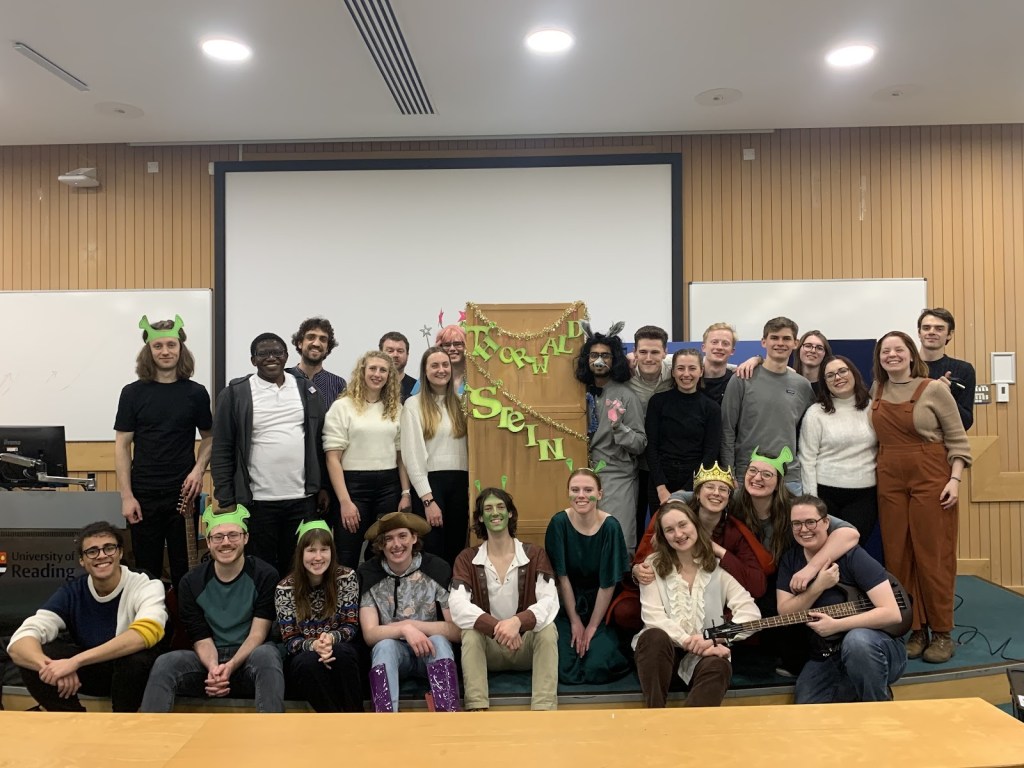
Some of the phenomenal cast and crew that brought sshRACC to the stage

Reflections  

After lots of hard work, many to-do lists, and more than a few days of PhD research missed, it was very rewarding to see everyone’s efforts come together on the night and to contribute to a long-standing department tradition. Once again, we were reminded that our department is full of people with talents that lie well outside of the field meteorology! We are also proud to say that we delivered (probably) the cheapest evening out in Reading – we believe the panto has remained at the same bargain price of £5 per adult since its beginning in 1992… 

Did we enjoy the experience? Yes, we did. Do we want jobs as directors or producers on the West End? No thank you! 

We would like to thank everyone who attended, contributed to, performed in or supported the panto in any way, shape or form. There are too many of you to list here, so just know that your efforts are appreciated! 

Describe your research using the ten-hundred most common words…

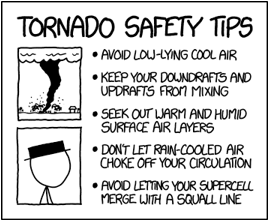
Online comic “xkcd” set a trend for explaining complicated things using only the 1000 most common words when they created this schematic of Saturn-V.  They have subsequently published more on how microwaves, plate tectonics and your computer work, using the same style.

tornado safety
Useful safety advice from xkcd

So we thought we’d jump on the bandwagon in a recent PhD group meeting, and have a go at explaining our research topics using the ten-hundred most common words. You can have a go yourselves, and tweet us with it @SocialMetwork on Twitter. Enjoy!

The Role of the Asian Summer Monsoon in European Summer Climate Variability – Jonathan Beverley

I look at how heavy rain in in-dear in summer makes rain, sun, wind and other things happen in your-up. This happens by big waves high up in the sky moving around the world. We might be able to use this to make a long know-before better and to help people live longer and not lose money.

Contribution of near-infrared bands of greenhouse gases to radiative forcing – Rachael Byrom

I study how the sun’s light warms the sky. This happens when these really tiny things in the air that we can’t see eat the sun’s light which then makes the sky warmer. I use computers to look into how this happens, especially how exactly the really tiny things eat the sun’s light and how this leads to warming. By this I mean, if I add lots of the tiny things to a pretend computer sky, all over the world, then will the sky also warm over all of the world too and by how much will it warm? This might be interesting for people who lead the world so that they can see how much of the really tiny things we should be allowed to put into the sky.

Wind profile effects on gravity wave drag and their impact on the global atmospheric circulation – Holly Turner

I look at waves in the air over high places and how they slow down the wind. When the wind gets faster the higher up you go, it changes how it slows down. I want to use this to make computer wind pictures better.

The pulsatory nature of Bagana volcano, Papua New Guinea – Rebecca Couchman-Crook

To be a doctor, I look at a fire-breathing ground thing with smoke and rocks on a hot place surrounded by water. I look at space pictures to understand the relationships between the air that smells and fire-rock bits in the air, and other stuff. It’s a very angry fire-breathing ground thing and might kill the near-by humans

Surface fluxes, temperatures and boundary layer evolutions in the building grey zone in London – Beth Saunders

I work on numbers which come out of the Met Office’s computer world. These numbers are different to what is seen and felt in real life for cities. True numbers, seen in real life, help to say how hot cities are, and how different the hot city is to areas that aren’t cities, with trees and fields, because of the city’s people, cars and houses. Numbers saying how fast the wind goes, and the wind’s direction, change in cities because of all the areas with tall houses. Finding times where the computer world numbers are bad for cities will help to make the Met Office’s computer give numbers more like the true numbers.

Cloud electrification and lightning in the evolution of convective storms – Ben Courtier

To be a doctor, I look at sudden light shocks from angry water air that happens with noise in the sky and how the angry water air changes before the light shock happens. I do this in order to better guess when the sudden light shock happens.


4th ICOS Summer School

Email: R.Braghiere@pgr.reading.ac.uk

The 4th ICOS Summer School on challenges in greenhouse gases measurements and modelling was held at Hyytiälä field station in Finland from 24th May to 2nd June, 2017. It was an amazing week of ecosystem fluxes and measurements, atmospheric composition with in situ and remote sensing measurements, global climate modelling and carbon cycle, atmospheric transport and chemistry, and data management and cloud (‘big data’) methods. We also spent some time in the extremely hot Finnish sauna followed by jumps into a very cold lake, and many highly enjoyable evenings by the fire with sunsets that seemed to never come.

sunset_Martijn Pallandt
Figure 1. Sunset in Hyytiälä, Finland at 22:49 local time. Credits: Martijn Pallandt

Our journey started in Helsinki, where a group of about 35 PhD students, with a number of postdocs and master students took a 3 hours coach trip to Hyytiälä.  The group was very diverse and international with people from different backgrounds; from plant physiologists to meteorologists. The school started with Prof. Dr. Martin Heimann  introducing us to the climate system and the global carbon cycle, and Dr. Alex Vermeulen highlighted the importance of good metadata practices and showed us more about ICOS research infrastructure. Dr. Christoph Gerbig joined us via Skype from Germany and talked about how atmospheric measurements methods with aircrafts (including how private air companies) can help scientists.

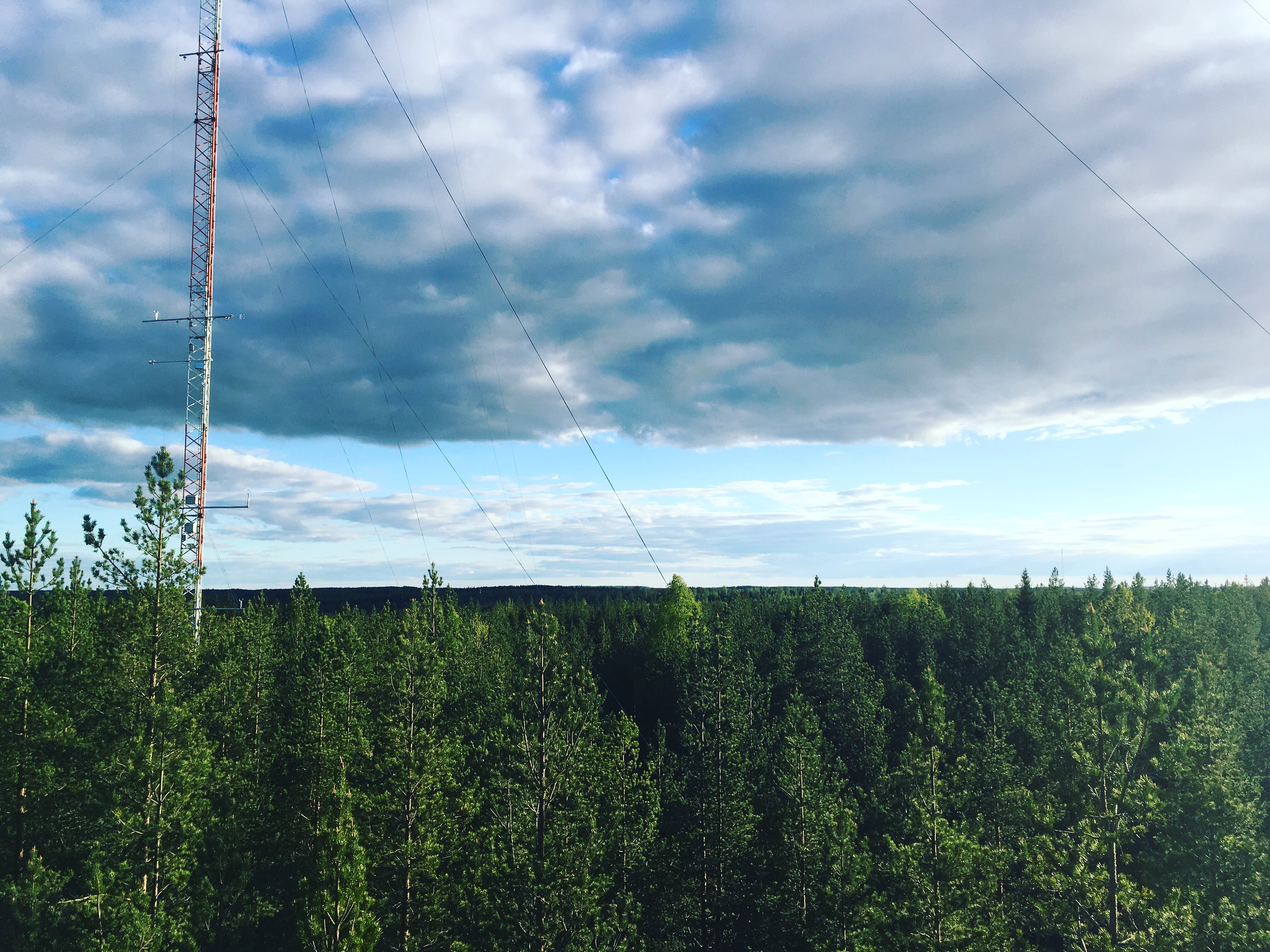
Hyytiala_main_tower_truls_Andersen_2
Figure 2. Hyytiälä flux tower site, Finland. Credits: Truls Andersen

On Saturday we visited the Hyytiälä flux tower site, as well as a peatland field station nearby, where we learned more about all the flux data they collect and the importance of peatlands globally. Peatlands store significant amounts of carbon that have been accumulating for millennia and they might have a strong response to climate change in the future. On Sunday, we were divided in two groups to collect data on temperature gradients from the lake to the Hyytiälä main flux tower, as well as on carbon fluxes with dark (respiration only) and transparent (photosynthesis + respiration) CO2 chambers.

chamber_measurements_renato
Figure 3: Dark chamber for CO2 measurements being used by a group of students in the Boreal forest. Credits: Renato Braghiere

On the following day it was time to play with some atmospheric modelling with Dr. Maarten Krol and Dr. Wouter Peters. We prepared presentations with our observation and modelling results and shared our findings and experiences with the new data sets.

The last two days have focused on learning how to measure ecosystem fluxes with Prof. Dr. Timo Vesala, and insights on COS measurements and applications with Dr. Kadmiel Maseyk. Timo also shared with us his passion for cinema with a brilliant talk entitled “From Vertigo to Blue Velvet: Connotations between Movies and Climate change” and we watched a really nice Finnish movie “The Happiest Day in the Life of Olli Mäki“.

4th_icos_summer_school_group_photo
Figure 4: 4th ICOS Summer School on Challenges in greenhouse gases measurements and modelling group photo. Credits: Wouter Peters

Lastly, it was a fantastic week where we were introduced to several topics and methods related to the global carbon budget and how it might impact the future climate. No doubt all information gained in this Summer School will be highly valuable for our careers and how we do science. A massive ‘cheers’ to Olli Peltola, Alex Vermeulen, Martin Heimann, Christoph Gerbig, Greet Maenhout, Wouter Peters, Maarten Krol, Anders Lindroth , Kadmiel Maseyk, Timo Vesala, and all the staff at the Hyytiälä field station.

This post only scratches the surface of all of the incredible material we were able to cover in the 4th ICOS Summer School, not to mention the amazing group of scientists that we met in Finland, who I really look forward to keeping in touch over the course of the years!


Managing your supervisor

Written by: h.l.gough@pgr.reading.ac.uk

You’re going to be working with them for a while. Supervisors, like projects, are all unique and have their own ways of working. Lots of us have banded together to give tips and advice on how to ‘manage your supervisor’ and by that we mean make the road towards a PhD a little bit easier.

For those of you looking to start a PhD, getting the right match between you and a supervisor is key. PhDs are already stressful enough without a strained supervisor-student relationship.

Know how they work

Supervisors all work differently. Some will leave you to wander for a bit before drawing you back to the point, and others will provide a map of where you’re going. There’s no right or wrong but sometimes their methods can get frustrating when you start comparing supervisors.

Find out the best way to contact them. Some never reply to email and others are never in the office or dislike being disturbed. Figure out between you and your supervisor the best way of getting in contact.

Personal and work balance

Some supervisors are happy to talk about personal problems. Others aren’t. Again, neither option is right or wrong, but it’s something you have to be aware of.

Ask for things

A PhD is intended as a personal development training programme and not just for writing a thesis and publishing papers. Don’t be afraid to ask to do something different, such as environment-Yes, internships, field work and summer schools to name a few.

If you don’t ask, you don’t get.

Manage expectations

Saying yes to all the work they give you is only going to lead to disappointment for them and you. Be honest with the amount of work you can do, and say when you’re having a bad week. They’ll understand. Say when you’ve got enough on your plate already.

Know how long they take to read things, otherwise you’ll end up disappointed when the feedback you expected on a certain day doesn’t arrive.

Don’t expect them to be on email 24/7. Likewise, let them know that you’re not going to be checking emails at 3am either.

Know their style and expertise

Some come across more critical than others, some highlight the good as well as the bad. Their subject may make them biased on certain topics. Knowing their expertise allows you to tailor questions for them.

This is a lot more relevant to people with multiple supervisors, as often you can get two conflicting opinions and have no idea which one to accept. This happens, and it does teach you some diplomacy skills, but don’t go picking sides.

Get advice from other students

Chances are, other students will be supervised by your supervisor. Ask them for hints and tips of how they work. Ask about pitfalls to avoid and helpful tips. They might even have a manual on how to deal with them! There is a camaraderie between people who share the same supervisor!

If you’re still stuck and doing a PhD at Reading University, there’s an RRDP course by the graduate school called managing your supervisor. Definitely worth going to.