EnvironmentYes

Email: luke.storer@pgr.reading.ac.uk

What happens when you ask a bunch of PhD meteorologists (and a space physicist) to come up with an innovative business idea and pitch it to leading experts in business development?

If we’re honest, a bunch of crazy ideas that happened to land us with something believable and attainable. Some of our brainstorming ideas included:

  • Cow Power: Using Pizoelectric sheets to generate electricity from the movement of cows in turnstables.
  • Pick Me Cup: A brand new portable cup created from biodegradable products as part of a reusable scheme.
  • PVC Insulate: Encouraging PVC recycling (i.e. plastics found in food wrap) and use the products for loft insulation.
  • Satellite Design Detection: Using satellite data and weather forecast models to predict the movement of crop diseases.

As scientists we tried to develop ideas that we thought would be plausible, effective and reduce the environmental impact of humans. Therefore the idea we settled on before the start of the workshop was Pick Me Cup. We aimed to use biodegradable materials that are waste products from the agriculture industry such as straw to make a durable and reusable coffee cup. We developed a strategy that would allow consumers to use the cup, deposit it in a recycle type bin, and get a new clean one next time they buy a drink. The scheme’s aim was to reduce waste in an easy manner for customers.

When we arrived at the workshop it quickly became evident that our idea wasn’t interesting enough, and our idea had to be plausible… but importantly not real. So we developed our idea adding in what we called ‘fake science’, which we found difficult as scientists. After talks outlining important things to remember when creating a business plan, we were set loose to work on our idea, with time spent with mentors helping us with the business strategy and intellectual property.

We wrestled with our idea trying to think of something interesting that we could incorporate, then patent and sell the license for. This finally led us to ‘ThermoPaper’. The idea was adding a chemical to the paper, increasing its thermal properties without compromising its recyclability, weight or increasing the costs significantly. This way fewer paper cups would be used as people don’t have to ‘double cup’. It also removes the need for a protective sleeve.

slide1

The workshop was an interesting insight into the world of business and entrepreneurship, informing us of patenting, licensing and the most important part of any small business… the exit strategy. By combining all these elements we forged a business plan that we thought was ambitious, asking for £200 000 investment, and an estimated sale price of £14 million in 5 years. So we gave our Dragons Den style pitch and they loved our idea, but apparently we were not ambitious enough! We aimed to start small and build our way up, developing new uses for ThermoPaper, but they said we should have just gone straight for the top. As a result we didn’t win, but it was an interesting few days.

A big thanks to NERC, Syngenta and all the other organisations that made the workshop possible, and also to the speakers and mentors that helped shape our idea and business plan throughout!

NAWDEX Campaign – Experiencing the Jet Stream

Email:  j.maddison@pgr.reading.ac.uk

NAWDEX (North Atlantic Wave and Downstream impact Experiment) was an International field campaign led by Ludwig-Maximilians-Universität (LMU) Munich and the Deutsches Zentrum für Luft- und Raumfahrt (DLR) Oberpfaffenhofen in cooperation with the Eidgenössische Technische Hochschule (ETH) Zurich and the Office of Naval Research in the USA, with many other international collaborators. Multiple aircraft were deployed from Iceland (the HALO aircraft and the DLR and Safire Falcons) and the UK (the FAAM aircraft) to take meteorological measurments with the aim of providing knowledge of mid-latitude dynamics and predictability. There was involvement from across the UK, including the University of Reading, the University of Manchester, and the Met Office as well as from the FAAM.

The NAWDEX operations centre was based in Keflavik, Iceland (number 27 in Figure 1), which I visited for a week to join the campaign as one of the representatives from the University of Reading, UK. I was tasked with being the ground-based observation coordinator.

radiosonde_locs

Figure 1: Radiosonde launch locations for the campaign.

A Europe-wide network of radiosonde launch locations (Figure 1) had been readied for additional launches during the NAWDEX period. Our role was to choose sites to launch sondes from that would complement measurements taken by the aircraft and/or support one of the NAWDEX objectives. Of particular interest was downstream high impact weather events over Europe. It was great to be given real responsibility and be able to actually contribute to the NAWDEX project.

Below is a typical daily schedule I would have in Iceland:

Daily schedule:

UK call: 8:30am Icelandic. Conference call between UK parties discussing plans for the coming days and any updates from Iceland or the UK.

General meeting: 12pm Icelandic. Go over brief weather summary, instrument status reports, flight plans for the coming days and reports of previous flights.

Weather meeting: 4pm Icelandic. Detailed look at the weather situation for the short and medium-ranges, highlighting key features that would be of interest to fly into, e.g. extratropical transitions of tropical cyclones (which we were fortunate to observe more than once). Radiosonde launch updates.

In between: assessing forecasts and flight plans for the coming days and meeting with scientists for their input to decide where we want to launch radiosondes from. Along with preparing slides to present to the group proposed launch locations and emailing various meteorological services to request the launches (the most time consuming).

My time in Iceland was a great learning experience. Working with some of the pre-eminent scientists in the fields of dynamics and predictability (and spending most of the day discussing the weather!) really helped improve my understanding of the development of mid-latitude weather systems and better understand their predictability.

img_5638

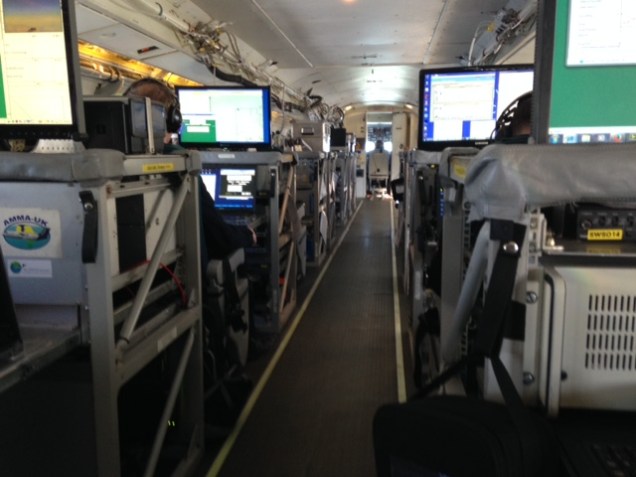
Figure 2: On-board the FAAM aircraft.

After returning from Iceland I got the opportunity to fly on the FAAM aircraft (Figure 2) whilst it was on a mission for another project. The flight aim was to perform a radiometer inter-comparison by taking coordinated measurements of deep-frontal cloud to the north of Scotland with the HALO and Safire aircraft. The flight was remarkably turbulent free (I‘d been hoping for more of a roller coaster ride), although we did perform a profile right through the cloud to an altitude of less than 50 ft, which was pretty fun! Whilst on the aircraft we were also able to plot measurements being taken in real time on an on-board computer.

thumbnail_img_5644

Figure 3: Flying at an altitude of 35 ft.

NAWDEX was a great opportunity to get first-hand experience of a major international field campaign (and see some of Iceland).

img_5508

What will make the public and politicians take climate change seriously?

slide1

Email: j.f.talib@pgr.reading.ac.uk

Imagine you’re creating a problem that we don’t understand. A problem where the majority of people just go, “meh, not important, I don’t really get it”.

What would it look like?

It would be complex, uncertain, something in the future and possibly an issue that was geographically distant.

Now those factors should you remind of climate change, and on 5th October 2016 the South-East Royal Meteorological Society local centre hosted a meeting where a panel of experts were presented with the question, “What will make the public and politicians take climate change seriously?”

The panel included professionals from a range of backgrounds including Professor Sir Brian Hoskins, leading expert in meteorology and climate, and first director of the Grantham Institute for Climate Change, Imperial College London. Dr Rachel McCloy a well-respected figure in behavioural science with experience in policy making in the former Department of Energy and Climate Change and the Treasury. Finally, Paul Simons a prominent journalist for the Times known for the depth of scientific understanding in his articles.

Images taken during the RMetS South East local centre meeting (06/10/16). Left image: Panelists (from left to right) including Dr Rachel McCloy, Sir Brian Hoskins and Paul Simons.

Sir Brian Hoskins opened the discussion with the challenge that we have a responsibility to “encourage” rather than “make” the public take climate change seriously, and recognised the progress in politics including targets announced in COP21, Paris and the UK Climate Change Act 2008. However, it was also recognised that climate change may not be prioritised high enough in political agendas, and the question was raised on whether governments take their environmental global responsibility seriously enough?

Discussion then moved onto personal actions each one of us can take to increase the public response. Repeating the “doom and gloom” message over climate change can become boring and repetitive, and we need to bring a positive message to tackling this global issue. We also need to recognise the responsibility of the individual in a global context and introduce small steps that can be taken to reduce our environmental impact.

One key message from Brian’s talk, and the meeting as whole, was that it’s currently hard for a member of the public to understand what climate change actually means to their daily lives. What impact will a 2°C global temperature rise actually cause? Researchers, the media and policymakers need to relate the science of global warming to our everyday lives, whether that’s through health, nutrition, the working environment, or air quality to name a few.

Our second speaker, Dr Rachel McCloy, introduced psychological behavioural frameworks that are introduced by climate change and how they impact the progression towards successful mitigation. For example, emotional reactions towards climate change can include dread and injustice, and this combined with typical adjectives used to describe the environmental changes including “natural” and “uncontrollable”, can lead to an increased likelihood of no effort being taken at all against climate change.

A component of Rachel’s talk I found particularly interesting was the impact of over-congratulating individuals and societies for taking “baby steps”. When we congratulate or applaud an action too much it reduces the likelihood of an even better action taking place. Therefore, as a society, we need to keep looking at the next step to mitigating against climate change. If we think about this in the present day, could we agree that we congratulated the agreements met in COP21 Paris too much, and as a result the likelihood of ratification and progress being made has been dropped. We as a community need to hold each other to account even when those “baby steps” have been made.

And finally, Paul, a leading science journalist for The Times, brought to the discussion how the media can be used to encourage climate change to be taken seriously. Everything in the media is a story and when a phenomena such climate change impacts health, water or even transportation it can gain a public interest. To increase the media’s attention to climate change, greater emphasis is needed on how environmental changes will impact our daily lives. Paul also reminded us that the public have begun to associate extreme weather events to climate change, whether proven to be a result of anthropogenic action or not. A recent example that comes to my mind is the recent European thunderstorms that occurred last summer. The media should be used to successfully “shape opinions” and it is up to us to grasp the opportunities that they have to offer.

After an intriguing set of three short talks to answer the question “What will make the public and politicians take climate change seriously?”, discussion was opened to the audience. Questions included: What is the importance of education to solving climate change? How much advocacy work should a climate scientist get involved in? The meeting as a whole stimulated a continued discussion on how climate change can be communicated effectively to “encourage” the public and politicians to take climate change seriously.

I would like to thank all three panellists for a set of thought-provoking and challenging talks. Thank you to the Royal Meteorological Society for supporting the local centre event, and to find out more about meetings taking place in your region check out https://www.rmets.org/events/forthcoming-meetings.

Macmillan coffee morning

Email: h.l.gough@pgr.reading.ac.uk

If there are two things that keep the Met department running it’s cake and coffee. This year the department got involved in the Macmillan coffee morning on the 30th September and raised a whopping £282 within three hours.

There was a bake off, a general cake sale and a guess the number of spots on a cake game, which got very scientific! The bake off had four categories, each with a prize: Savoury, bake your research, green theme and free-from, ensuring that there was something for everybody. As always the competition was good-natured but fierce and the judges (2 members of staff, 1 post-doc and 1 PhD student) had a sugar crash at around 3pm.

Here are some of the creations from the event:

First up (left) a chocolate cake carved into the shape of Africa, complete with wildlife, sprinkles and clouds. The judges didn’t want to cut this one, choosing to eat Madagascar first!

The next bake (top middle) went on to win the Best in Bake-off award, vanishing within minutes of being put on the sale table! Each slice was a decadent mixture of chocolate and lime.

The marvellous creations in the bottom middle image were free from everything except nuts. Using vegan marshmallows and chocolate alongside gluten free biscuits created a wickedly dark rocky road with plenty of crunch and just the right amount of marshmallows.

These gluten free wind turbines (right) were entered into all four categories of the bake off. Making gluten free pastry is no mean feat and unless told, no-one was aware that these moreish snacks were gluten free!

Finally, a shot of the table before it got too full of goodies! There are the edges of vegan pretzels (front left), a shop brought Victoria sponge (front middle), a supreme chocolate cake with Malteaser decorations (right) and a hazelnut and pear chocolate brownie which really captured the autumnal flavours and was the first to be completely sold!

20160930_103227

Fortunately the department has its own running group to help counteract some of the cake eating.

That’s it from me for now, hopefully they’ll be more foodie posts soon!

The impact of Climate Variability on the GB power system.

Email: h.bloomfield@pgr.reading.ac.uk

Bloomfield et al., 2016. Quantifying the increasing sensitivity of power systems to climate variability. View published paper.

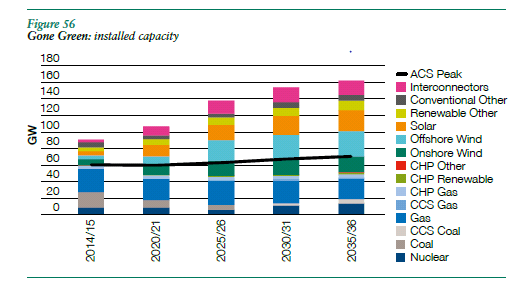
Within the power system of Great Britain (GB), there is a rapidly increasing amount of generation from renewables, such as wind and solar power which are weather-dependent. An increased proportion of weather-dependent generation will require increased understanding of the impact of climate variability on the power system.

blog1

Figure 1: Predicted installed capacity from the National Grid Gone Green Scenario. Source: National Grid Future Energy Scenarios (2015).

Current research on the impact of climate variability on the GB power system is ongoing by climate scientists and power system modellers. The focus of the climate research is on the weather-driven components of the power system, such as the impact of climate variability on wind power generation. These studies tend to include limited knowledge of the whole system impacts of climate variability. The research by power system modellers focuses on the accurate representation of the GB power system. A limited amount of weather data may be used in this type of study (usually 1-10 years) due to the complexity of the power system models.

The aim of this project is to bridge the gap between these two groups of research, by understanding the impact of climate variability on the whole GB power system.In this project, multi-decadal records from the MERRA reanalysis* are combined with a simple representation of the GB power system, of which the weather-dependent components are electricity demand and wind power production. Multiple scenarios are analysed for GB power systems, including 0GW, 15GW, 30GW, and 45GW of installed wind power capacity in the system.

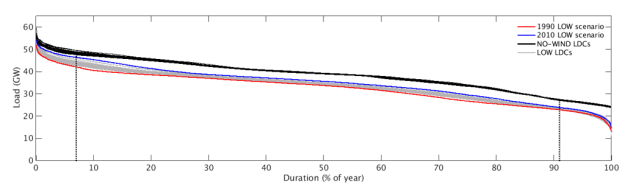
This study characterises the impact of inter-annual climate variability on multiple aspects of the GB power system (including coal, gas and nuclear generation) using a load duration curve framework. A load duration curve can be thought of as a cumulative frequency distribution of power system load. Load can be either power system demand (i.e. the NO-WIND scenario) or demand minus wind power (ie. the LOW, MED and HIGH scenarios).

The introduction of additional wind-power capacity greatly increases the year-year variability in operating opportunity for conventional generators, this is particularly evident for baseload plant (i.e. nuclear power plants). The impact of inter-annual climate variations across the power system due to present-day level of wind-farm installation has approximately doubled the exposure of the GB power sector to inter-annual climate variability. This is shown in Figure 2 as the spread between the red and blue curves (from the LOW scenario) is double that of the black curves (the NO-WIND scenario).

blog2

Figure 2: Load duration curves for the NO-WIND and LOW scenario in black and grey respectively. The two most extreme years from the LOW scenario are 1990 and 2010, plotted in red and blue respectively. Vertical dashed lines show the percentage of time that baseload-plant (91%) and peaking plant (7%) are required to operate

This work has shown that as the amount of installed wind power capacity on the power system is increased, the total amount of energy required from other generators (coal, gas, nuclear) is reduced. Wind therefore contributes to decarbonising the power system, however the reduction is particularly pronounced for plants which are operating as baseload rather than peaking plant (i.e. oil fired generation) where an increase in required production is seen.

This study adds to the literature which suggests that the power system modelling community should begin to take a more robust approach to its treatment of weather and climate data by incorporating a wider range of climate variability.

For more information contact the author for a copy of the paper with details of this work: Quantifying the increasing sensitivity of power system to climate variability (submitted to ERL).

* A reanalysis data set is a scientific method for developing a record of how weather and climate are changing over time. In it, observations are combined with a numerical model to generate a synthesised estimate of the state of the climate system.