Email: l.p.blunn@pgr.reading.ac.uk
Between 6th-10th January 2019 I was fortunate enough to attend the 99th American Meteorological Society (AMS) Annual Meeting in their centennial year. It was hosted in the Phoenix, Arizona Convention Center – its vast size was a necessity, seeing as there were 2300 oral presentations and 1100 poster presentations given in 460 sessions! The conferences and symposia covered a wide range of topics such as space weather, hydrology, atmospheric chemistry, climate, meteorological observations and instrumentation, tropical cyclones, monsoons and mesoscale meteorology.

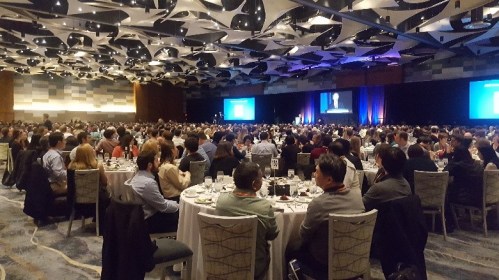
The theme of this year’s meeting was “Understanding and Building Resilience to Extreme Events by Being Interdisciplinary, International, and Inclusive”. The cost of extreme events has been shown by reinsurance companies to have increased monotonically, with estimated costs for 2017 of $306 billion and 350 lives in the US. Marcia McNutt, President of the National Academy of Science (NAS), gave a town hall talk on the continued importance of evidence-based science in society (view recording). She says that NAS must become more agile at giving advice since the timescales of, for example, hurricanes and poor air quality episodes are very short, but the problems are very complex. There is reason for optimism though, as the new director of the White House Office of Science and Technology Policy is Kelvin Droegemeier, a meteorologist who formerly served as Vice President for Research at the University of Oklahoma.
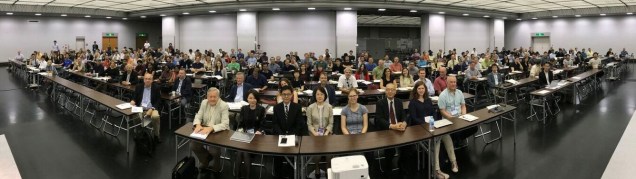
“Building Resilience to Extreme Events” took on another meaning with the federal shutdown and proved to be the main talking point of this year’s annual meeting. Over 500 people from federally funded organisations such as NOAA could not attend. David Goldston, director of the MIT Washington Office, gave a talk at the presidential forum entitled “Building Resilience to Extreme Political Weather: Advice for Unpredictable Times” (view recording). He made the analogy of both current US political attitude towards climate change and the federal shutdown as being ‘weather’, and thought that politics would return to long-term ‘climate’. He advised scientists to present their facts in a way understandable to public and government, prepare policy proposals, and be clear on why they are not biased. He reassured scientists by saying they have outstanding public support with 76% of the public thinking scientists act in their best interest. During the talk questions were sourced from the audience and could be voted on. The frustration of US scientists with the government was evidently large.
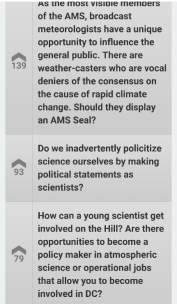

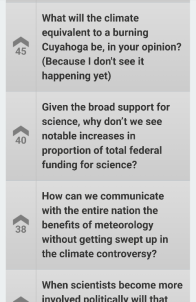
Questions put forward by the audience and associated votes during Goldston’s talk.

A growing area of research is artificial and computational intelligence which had its own dedicated conference. As an early career researcher in urban and boundary layer meteorology I was interested to see a talk on “Surface Layer Flux Machine Learning Parametrisations”. By obtaining training data from observational towers it may be possible to improve upon Monin-Obukhov similarity theory in heterogeneous conditions. At the atmospheric chemistry and aerosol keynote talk by Zhanqing Li I learnt that anthropogenic emissions of aerosol can cause a feedback leading to elevated concentration of pollutants. Aerosol reduces solar radiation reaching the surface leading to less turbulence and therefore lower boundary layer height. It also causes warming at the top of the boundary layer creating a stronger capping inversion which inhibits ventilation. Anthropogenic aerosols are not just important for air quality. They affect global warming via their influence on the radiation budget and can lead to more extreme weather through enhancing deep convection.
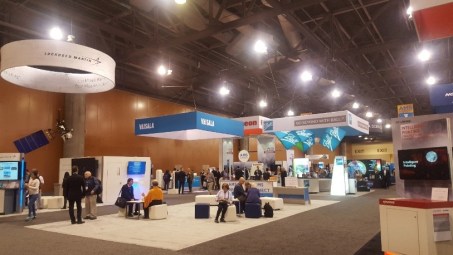
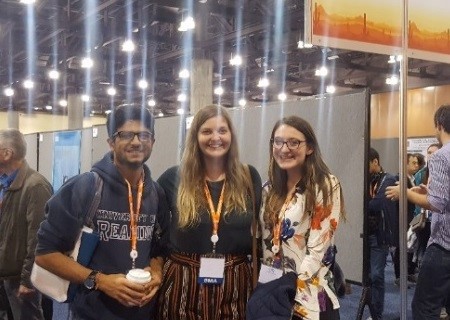
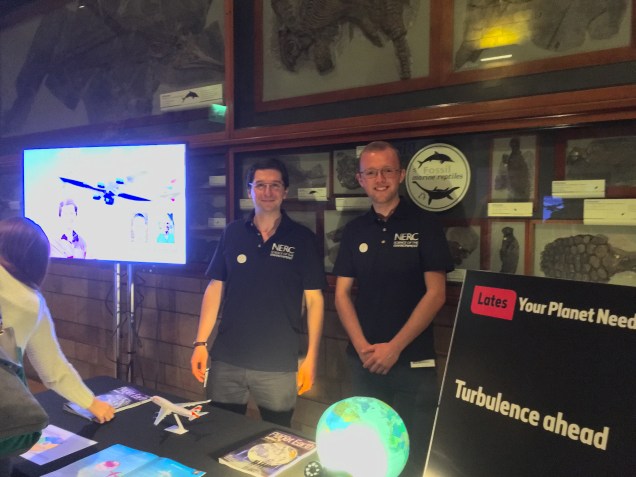
I particularly enjoyed the poster sessions since they enabled networking with many scientists working in my area. On the first day I bumped into several Reading meteorology undergraduates on their year long exchange at the University of Oklahoma. Like me, I think they were amazed by the scale of the conference and the number of opportunities available as a meteorologist. The exhibition had over 100 organisations showcasing a wide range of products, publications and services. Anemoment (producers of lightweight, compact 3D ultrasonic anemometers) and the University of Oklahoma had stalls showing how instruments attached to drones can be used to profile the boundary layer. This has numerous possible applications such as air quality monitoring and analysing boundary layer dynamics.
Overall, I found the conference very motivating since it reinforced the sense that I have a fantastic opportunity to contribute to an exciting and important area of science. Next year’s annual meeting is the hundredth and will be held in Boston.



 A true revolutionary in the field of theoretical physics and abstract algebra, Amelie Emmy Noether was a German-born inspiration thanks to her perseverance and passion for research. Instead of teaching French and English to schoolgirls, Emmy pursued the study of mathematics at the University of Erlangen. She then taught under a man’s name and without pay because she was a women. During her exploration of the mathematics behind Einstein’s general relativity alongside renowned scientists like Hilbert and Klein, she discovered the fundamentals of conserved quantities such as energy and momentum under symmetric invariance of their respective quantities: time and homogeneity of space. She built the bridge between conservation and symmetry in nature, and although Noether’s Theorem is fundamental to our understanding of nature’s conservation laws, Emmy has received undeservedly small recognition throughout the last century.
 Claudine Hermann is a French physicist and Emeritus Professor at the École Polytechnique in Paris. Her work, on physics of solids (mainly on photo-emission of polarized electrons and near-field optics), led to her becoming the first female professor at this prestigious school. Aside from her work in Physics, Claudine studied and wrote about female scientists’ situation in Europe and the influence of both parents’ works on their daughter’s professional choices. Claudine wishes to give girls “other examples than the unreachable Marie Curie”. She is the founder of the Women and Sciences association and represented it at the European Commission to promote gender equality in Science and to help women accessing scientific knowledge. Claudine is also the president of the European Platform of Women Scientists which represents hundreds of associations and more than 12,000 female scientists.
 For most people being handpicked to be one of three students to integrate West Virginia’s graduate schools would probably be the most notable life achievements. However for Katherine Johnson’s this was just the start of a remarkable list of accomplishments. In 1952 Johnson joined the all-black West Area Computing section at NACA (to become NASA in 1958). Acting as a computer, Johnson analysed flight test data, provided maths for engineering lectures and worked on the trajectory for America’s first human space flight.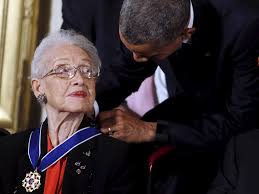
 Women however were not allowed on such ships, thus Marie Tharp was stationed in the lab, checking and plotting the data. Her drawings showed the presence of the North Atlantic Ridge, with a deep V-shaped notch that ran the length of the mountain range, indicating the presence of a rift valley, where magma emerges to form new crust. At this time the theory of plate tectonics was seen as ridiculous. Her supervisor initially dismissed her results as ‘girl talk’ and forced her to redo them. The same results were found. Her work led to the acceptance of the theory of plate tectonics and continental drift.
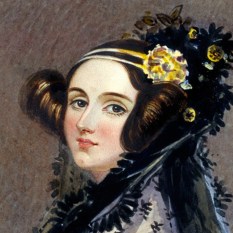 Ada Lovelace was a 19th century Mathematician popularly referred to as the “first computer programmer”. She was the translator of “Sketch of the Analytical Engine, with Notes from the Translator”, (said “notes” tripling the length of the document and comprising its most striking insights) one of the documents critical to the development of modern computer programming. She was one of the few people to understand and even fewer who were able to develop for the machine. That she had such incredible insight into a machine which didn’t even exist yet, but which would go on to become so ubiquitous is amazing!

 As a student, being an RMetS member can lead to conversations that could develop your career and bring unexpected opportunities. This has been greatly enhanced with the RMetS mentoring scheme.
 For a student, the highlight in the RMetS calendar is the annual student conference. Every year, sixty to eighty students come together to present their work and develop professional relationships that continue for years to come. This year’s conference is hosted at the University of York on the 5th and 6th July 2018 (
 Other benefits to becoming an RMetS student member include eligibility to the
  The Social Metwork