Email: j.f.talib@pgr.reading.ac.uk
, 2018: The Role of the Cloud Radiative Effect in the Sensitivity of the Intertropical Convergence Zone to Convective Mixing. J. Climate, 31, 6821–6838, https://doi.org/10.1175/JCLI-D-17-0794.1
Rainfall in the tropics is commonly associated with the Intertropical Convergence Zone (ITCZ), a discontinuous line of convergence collocated at the ascending branch of the Hadley circulation, where strong moist convection leads to high rainfall. What controls the location and intensity of the ITCZ remains a fundamental question in climate science.
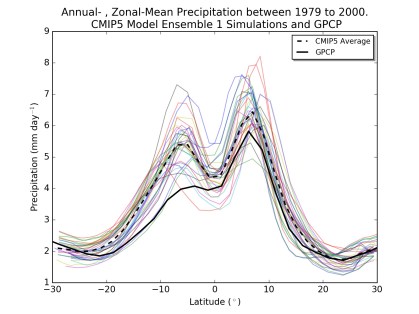
In current and previous generations of climate models, the ITCZ is too intense in the Southern Hemisphere, resulting in two annual-mean, zonal-mean tropical precipitation maxima, one in each hemisphere (Figure 1). Even if we take the same atmospheric models and couple them to a world with only an ocean surface (aquaplanets) with prescribed sea surface temperatues (SSTs), different models simulate different ITCZs (Blackburn et al., 2013).
Within a climate model parameterisations are used to replace processes that are too small-scale or complex to be physically represented in the model. Parameterisation schemes are used to simulate a variety of processes including processes within the boundary layer, radiative fluxes and atmospheric chemistry. However my work, along with a plethora of others, shows that the representation of the ITCZ is sensitive to the convective parameterisation scheme (Figure 2a). The convective parameterisation scheme simulates the life cycle of clouds within a model grid-box.
Our method of showing that the simulated ITCZ is sensitive to the convective parameterisation scheme is by altering the convective mixing rate in prescribed-SST aquaplanet simulations. The convective mixing rate determines the amount of mixing a convective parcel has with the environmental air, therefore the greater the convective mixing rate, the quicker a convective parcel will become similar to the environmental air, given fixed convective parcel properties.

In our study, the structure of the simulated ITCZ is sensitive to the convective mixing rate. Low convective mixing rates simulate a double ITCZ (two precipitation maxima, orange and red lines in Figure 2a), and high convective mixing rates simulate a single ITCZ (blue and black lines).
We then associate these ITCZ structures to the atmospheric energy input (AEI). The AEI is the amount of energy left in the atmosphere once considering the top of the atmosphere and surface energy budgets. We conclude, similar to Bischoff and Schneider, 2016, that when the AEI is positive (negative) at the equator, a single (double) ITCZ is simulated (Figure 2b). When the AEI is negative at the equator, energy is needed to be transported towards the equator for equilibrium. From a mean circulation perspective, this take place in a double ITCZ scenario (Figure 3). A positive AEI at the equator, is associated with poleward energy transport and a single ITCZ.

In our paper, we use this association between the AEI and ITCZ to hypothesize that without the cloud radiative effect (CRE), atmospheric heating due to cloud-radiation interactions, a double ITCZ will be simulated. We also hypothesize that prescribing the CRE will reduce the sensitivity of the ITCZ to convective mixing, as simulated AEI changes are predominately due to CRE changes.
In the rest of the paper we perform simulations with the CRE removed and prescribed to explore further the role of the CRE in the sensitivity of the ITCZ. We conclude that when removing the CRE a double ITCZ becomes more favourable and in both sets of simulations the ITCZ is less sensitive to convective mixing. The remaining sensitivity is associated with latent heat flux alterations.
My future work following this publication explores the role of coupling in the sensitivity of the ITCZ to the convective parameterisation scheme. Prescribing the SSTs implies an arbitary ocean heat transport, however in the real world the ocean heat transport is sensitive to the atmospheric circulation. Does this sensitivity between the ocean heat transport and atmospheric circulation affect the sensitivity of the ITCZ to convective mixing?
Thanks to my funders, SCENARIO NERC DTP, and supervisors for their support for this project.
References:
Blackburn, M. et al., (2013). The Aqua-planet Experiment (APE): Control SST simulation. J. Meteo. Soc. Japan. Ser. II, 91, 17–56.
Bischoff, T. and Schneider, T. (2016). The Equatorial Energy Balance, ITCZ Position, and Double-ITCZ Bifurcations. J. Climate., 29(8), 2997–3013, and Corrigendum, 29(19), 7167–7167.


 A true revolutionary in the field of theoretical physics and abstract algebra, Amelie Emmy Noether was a German-born inspiration thanks to her perseverance and passion for research. Instead of teaching French and English to schoolgirls, Emmy pursued the study of mathematics at the University of Erlangen. She then taught under a man’s name and without pay because she was a women. During her exploration of the mathematics behind Einstein’s general relativity alongside renowned scientists like Hilbert and Klein, she discovered the fundamentals of conserved quantities such as energy and momentum under symmetric invariance of their respective quantities: time and homogeneity of space. She built the bridge between conservation and symmetry in nature, and although Noether’s Theorem is fundamental to our understanding of nature’s conservation laws, Emmy has received undeservedly small recognition throughout the last century.
 Claudine Hermann is a French physicist and Emeritus Professor at the École Polytechnique in Paris. Her work, on physics of solids (mainly on photo-emission of polarized electrons and near-field optics), led to her becoming the first female professor at this prestigious school. Aside from her work in Physics, Claudine studied and wrote about female scientists’ situation in Europe and the influence of both parents’ works on their daughter’s professional choices. Claudine wishes to give girls “other examples than the unreachable Marie Curie”. She is the founder of the Women and Sciences association and represented it at the European Commission to promote gender equality in Science and to help women accessing scientific knowledge. Claudine is also the president of the European Platform of Women Scientists which represents hundreds of associations and more than 12,000 female scientists.
 For most people being handpicked to be one of three students to integrate West Virginia’s graduate schools would probably be the most notable life achievements. However for Katherine Johnson’s this was just the start of a remarkable list of accomplishments. In 1952 Johnson joined the all-black West Area Computing section at NACA (to become NASA in 1958). Acting as a computer, Johnson analysed flight test data, provided maths for engineering lectures and worked on the trajectory for America’s first human space flight.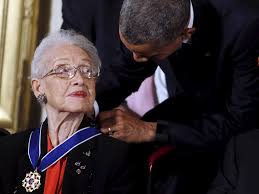
 Women however were not allowed on such ships, thus Marie Tharp was stationed in the lab, checking and plotting the data. Her drawings showed the presence of the North Atlantic Ridge, with a deep V-shaped notch that ran the length of the mountain range, indicating the presence of a rift valley, where magma emerges to form new crust. At this time the theory of plate tectonics was seen as ridiculous. Her supervisor initially dismissed her results as ‘girl talk’ and forced her to redo them. The same results were found. Her work led to the acceptance of the theory of plate tectonics and continental drift.
 Ada Lovelace was a 19th century Mathematician popularly referred to as the “first computer programmer”. She was the translator of “Sketch of the Analytical Engine, with Notes from the Translator”, (said “notes” tripling the length of the document and comprising its most striking insights) one of the documents critical to the development of modern computer programming. She was one of the few people to understand and even fewer who were able to develop for the machine. That she had such incredible insight into a machine which didn’t even exist yet, but which would go on to become so ubiquitous is amazing!

 As a student, being an RMetS member can lead to conversations that could develop your career and bring unexpected opportunities. This has been greatly enhanced with the RMetS mentoring scheme.
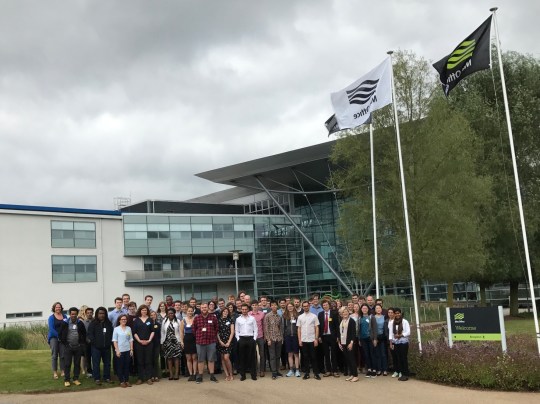
 For a student, the highlight in the RMetS calendar is the annual student conference. Every year, sixty to eighty students come together to present their work and develop professional relationships that continue for years to come. This year’s conference is hosted at the University of York on the 5th and 6th July 2018 (
 Other benefits to becoming an RMetS student member include eligibility to the






 The Social Metwork