On Friday November 30th, Prof. Paul Williams and I ran a ‘pop-up science’ station at the Natural History Museum’s “Lates” event (these are held on the last Friday of each month; the museum is open for all until 10pm, with additional events and activities). Our station was entitled “Turbulence Ahead”, and focused on communicating research under two themes:
- Improving the predictability of clear-air turbulence (CAT) for aviation
- The impact of climate change on aviation, particularly in terms of increasing CAT
There were several other stations, all run by NERC-funded researchers. Our stall went ‘live’ at 6 PM, and from that point on we were speaking almost constantly for the next 3.5 hours – with hundreds (not an exaggeration!) of people coming to our stall to find out more. Neither of us were able to take much of a break, and I’ve never had quite such a sore voice!
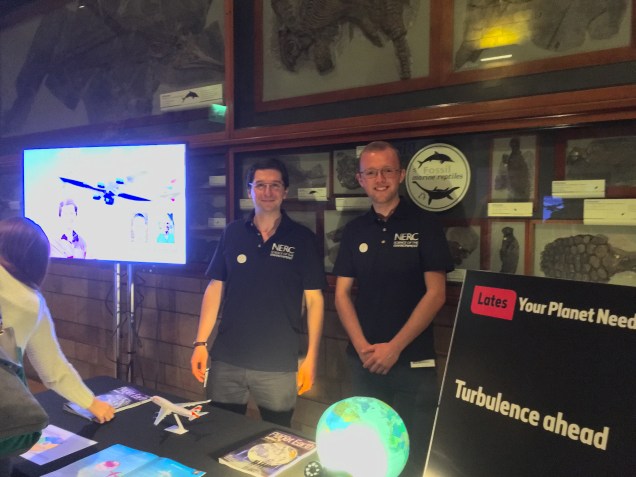
Our discussions covered:
- What is clear-air turbulence (CAT) and why is it hazardous to aviation?
- How do we predict CAT? How has Paul’s work improved this?
- How is CAT predicted to change in the future? Why?
- What other ways does climate change affect aviation?
Those who came to our stall asked some very intelligent questions, and neither of us encountered a ‘climate denier’ – since we were speaking about a very applied impact of climate change, this was heartening. This impact of climate change is not often considered – it’s not as obvious as heatwaves or melting ice, but is a very real threat as shown in recent studies (e.g. Storer et al. 2017). It was a challenge to explain some of these concepts to the general public – some had heard of the jet stream, others had not, whilst some were physicists… and even the director of the British Geological Survey, John Ludden, turned up! It was interesting to hear from so many people who were self-titled “nervous flyers” and deeply concerned about the future potential for more unpleasant journeys.
I found the evening very rewarding; it was interesting to gauge a perspective of how the public perceive a scientist and their work, and it was amazing to see so many curious minds wanting to find out more about subjects with which they are not so familiar.
#NERCImpact Awards 2018 finalist @DrPaulDWilliams is talking about clear air turbulence at #NHMLates tonight @NHM_London pic.twitter.com/Mctdil11c9
— NERC (@NERCscience) November 30, 2018
My involvement with this event stems from my MMet dissertation work with Paul and Tom Frame looking at the North Atlantic jet stream. Changes in the jet stream have large impacts on transatlantic flights (Williams 2016) and the frequency and intensity of CAT. Meanwhile, Paul was a finalist for the 2018 NERC Impact Awards in the Societal Impact category for his work on improving turbulence forecasts – he finished as runner-up in the ceremony which was held on Monday December 3rd.
I am very excited to have won a prize of £5,000 in the #NERCImpact Awards, for making flights smoother and safer through our turbulence research.
Congratulations to all the finalists — what a fantastic array of NERC-funded projects making a real difference to people’s lives! pic.twitter.com/N1guMSys3k
— Paul Williams (@DrPaulDWilliams) December 4, 2018
So, yes, there may indeed be turbulent times ahead – but this Friday evening certainly went smoothly!
Email: s.h.lee@pgr.reading.ac.uk
Twitter: @SimonLeeWx
References
Storer, L. N., P. D. Williams, and M. M. Joshi, 2017: Global Response of Clear-Air Turbulence to Climate Change. Geophys. Res. Lett., 44, 9979-9984, https://doi.org/10.1002/2017GL074618
Williams, P. D., 2016: Transatlantic flight times and climate change. Environ. Res. Lett., 11, 024008, https://doi.org/10.1088/1748-9326/11/2/024008.


 A true revolutionary in the field of theoretical physics and abstract algebra, Amelie Emmy Noether was a German-born inspiration thanks to her perseverance and passion for research. Instead of teaching French and English to schoolgirls, Emmy pursued the study of mathematics at the University of Erlangen. She then taught under a man’s name and without pay because she was a women. During her exploration of the mathematics behind Einstein’s general relativity alongside renowned scientists like Hilbert and Klein, she discovered the fundamentals of conserved quantities such as energy and momentum under symmetric invariance of their respective quantities: time and homogeneity of space. She built the bridge between conservation and symmetry in nature, and although Noether’s Theorem is fundamental to our understanding of nature’s conservation laws, Emmy has received undeservedly small recognition throughout the last century.
 Claudine Hermann is a French physicist and Emeritus Professor at the École Polytechnique in Paris. Her work, on physics of solids (mainly on photo-emission of polarized electrons and near-field optics), led to her becoming the first female professor at this prestigious school. Aside from her work in Physics, Claudine studied and wrote about female scientists’ situation in Europe and the influence of both parents’ works on their daughter’s professional choices. Claudine wishes to give girls “other examples than the unreachable Marie Curie”. She is the founder of the Women and Sciences association and represented it at the European Commission to promote gender equality in Science and to help women accessing scientific knowledge. Claudine is also the president of the European Platform of Women Scientists which represents hundreds of associations and more than 12,000 female scientists.
 For most people being handpicked to be one of three students to integrate West Virginia’s graduate schools would probably be the most notable life achievements. However for Katherine Johnson’s this was just the start of a remarkable list of accomplishments. In 1952 Johnson joined the all-black West Area Computing section at NACA (to become NASA in 1958). Acting as a computer, Johnson analysed flight test data, provided maths for engineering lectures and worked on the trajectory for America’s first human space flight.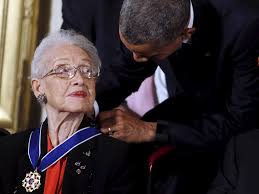
 Women however were not allowed on such ships, thus Marie Tharp was stationed in the lab, checking and plotting the data. Her drawings showed the presence of the North Atlantic Ridge, with a deep V-shaped notch that ran the length of the mountain range, indicating the presence of a rift valley, where magma emerges to form new crust. At this time the theory of plate tectonics was seen as ridiculous. Her supervisor initially dismissed her results as ‘girl talk’ and forced her to redo them. The same results were found. Her work led to the acceptance of the theory of plate tectonics and continental drift.
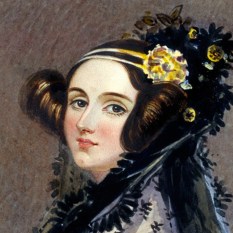 Ada Lovelace was a 19th century Mathematician popularly referred to as the “first computer programmer”. She was the translator of “Sketch of the Analytical Engine, with Notes from the Translator”, (said “notes” tripling the length of the document and comprising its most striking insights) one of the documents critical to the development of modern computer programming. She was one of the few people to understand and even fewer who were able to develop for the machine. That she had such incredible insight into a machine which didn’t even exist yet, but which would go on to become so ubiquitous is amazing!


 The Social Metwork