The impact of Climate Variability on the GB power system.

Email: h.bloomfield@pgr.reading.ac.uk

Bloomfield et al., 2016. Quantifying the increasing sensitivity of power systems to climate variability. View published paper.

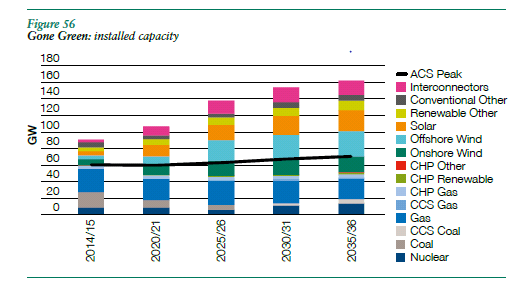
Within the power system of Great Britain (GB), there is a rapidly increasing amount of generation from renewables, such as wind and solar power which are weather-dependent. An increased proportion of weather-dependent generation will require increased understanding of the impact of climate variability on the power system.

blog1

Figure 1: Predicted installed capacity from the National Grid Gone Green Scenario. Source: National Grid Future Energy Scenarios (2015).

Current research on the impact of climate variability on the GB power system is ongoing by climate scientists and power system modellers. The focus of the climate research is on the weather-driven components of the power system, such as the impact of climate variability on wind power generation. These studies tend to include limited knowledge of the whole system impacts of climate variability. The research by power system modellers focuses on the accurate representation of the GB power system. A limited amount of weather data may be used in this type of study (usually 1-10 years) due to the complexity of the power system models.

The aim of this project is to bridge the gap between these two groups of research, by understanding the impact of climate variability on the whole GB power system.In this project, multi-decadal records from the MERRA reanalysis* are combined with a simple representation of the GB power system, of which the weather-dependent components are electricity demand and wind power production. Multiple scenarios are analysed for GB power systems, including 0GW, 15GW, 30GW, and 45GW of installed wind power capacity in the system.

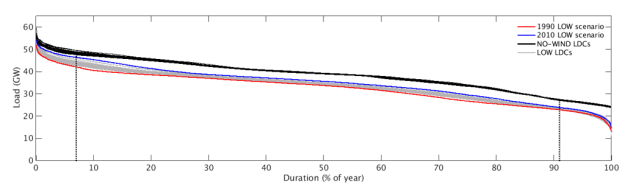
This study characterises the impact of inter-annual climate variability on multiple aspects of the GB power system (including coal, gas and nuclear generation) using a load duration curve framework. A load duration curve can be thought of as a cumulative frequency distribution of power system load. Load can be either power system demand (i.e. the NO-WIND scenario) or demand minus wind power (ie. the LOW, MED and HIGH scenarios).

The introduction of additional wind-power capacity greatly increases the year-year variability in operating opportunity for conventional generators, this is particularly evident for baseload plant (i.e. nuclear power plants). The impact of inter-annual climate variations across the power system due to present-day level of wind-farm installation has approximately doubled the exposure of the GB power sector to inter-annual climate variability. This is shown in Figure 2 as the spread between the red and blue curves (from the LOW scenario) is double that of the black curves (the NO-WIND scenario).

blog2

Figure 2: Load duration curves for the NO-WIND and LOW scenario in black and grey respectively. The two most extreme years from the LOW scenario are 1990 and 2010, plotted in red and blue respectively. Vertical dashed lines show the percentage of time that baseload-plant (91%) and peaking plant (7%) are required to operate

This work has shown that as the amount of installed wind power capacity on the power system is increased, the total amount of energy required from other generators (coal, gas, nuclear) is reduced. Wind therefore contributes to decarbonising the power system, however the reduction is particularly pronounced for plants which are operating as baseload rather than peaking plant (i.e. oil fired generation) where an increase in required production is seen.

This study adds to the literature which suggests that the power system modelling community should begin to take a more robust approach to its treatment of weather and climate data by incorporating a wider range of climate variability.

For more information contact the author for a copy of the paper with details of this work: Quantifying the increasing sensitivity of power system to climate variability (submitted to ERL).

* A reanalysis data set is a scientific method for developing a record of how weather and climate are changing over time. In it, observations are combined with a numerical model to generate a synthesised estimate of the state of the climate system.

NERC Course on Polar Fieldwork Skills

Email: r.frew@pgr.reading.ac.uk

The aims of the NERC funded BAS run course, “A skills framework for delivering safe and effective fieldwork in the polar regions”, were to learn how to safely and effectively plan and carry out fieldwork at the poles. And in doing so, to give 16 early career polar scientists across a range of disciplines the opportunity to go to the Arctic and learn practical fieldwork skills that we don’t pick up from our day to day office work.

The first part took place at Madingley Hall in Cambridge where we were briefed as an entire cohort on planning, logistics, instrumentation, risk assessment, GPS mapping, health and safety, and were exceedingly well fed as part of the process….

The sunny early morning views that greeted us into Ny Ålesund.

Next we set off to put what we had learnt into practice in Ny Ålesund, on the Island of Spitzbergen (translates as ‘pointy mountains’) in Svalbard. Ny Ålesund is a small international village predominantly inhabited by scientists, with a peak population in summer of around 150, and a hardy winter population of 35 toughing out the minimal daylight hours and chilling temperatures, which reach minimums of around -20°C! Our journey began with three flights, and a stopover in Longyearbyen, also known as Santa Claus town, although it looks a lot more industrial than the name implies. We then had a 3.30am start which was aided by the 24 hour daylight to get the boat to Ny Ålesund. After 4 hours of queasiness we arrived at the NERC UK Arctic research station in Ny Ålesund.

groupphoto
The group all kitted out in front of the NERC UK Arctic Research Station. Photos courtesy of Simon Morley.

The first task we had to do after arrival was the rifle training course. This felt like a dangerous activity to be doing at 2pm in the afternoon after a 3.30am start. However it is safe to say we were all sufficiently awake after the first gun shot… We never left the NERC Arctic base without a massive rucksack full of layers, food, water, flask etc and most importantly a rifle and flare gun in case of running into a polar bears. As we are essentially trespassing on the bears’ territory, it is up to us to avoid disturbing them and to use rifles for self-defence as a last resort.

Terrestrial wildlife around Ny Ålesund. The greatest wildlife threat we faced was the cheeky Arctic fox stealing our sandwiches!

In Ny Ålesund you are very far removed from civilisation, even via digital means as there is no wifi (due to a large experiment detecting quasars) or phone signal. Therefore life in Ny Ålesund feels timeless, as outside events that rampage on social media feel far removed and irrelevant. However signatures of global warming are evident, with the extent of glaciers noticeably retreating each year, and sea ice becoming a rarer and rarer occurrence in the fjord within the living memory of residents of Ny Ålesund.

From left to right: View of Ny Ålesund, the closest we came to a polar bear in the doorway of the mess building, old hut from the mining industry.

The past mining infrastructure is evident everywhere, and classified as ‘heritage’, meaning that despite thinking of them as eyesores, in the otherwise immaculate views the run down infrastructure is actually protected as part of Ny Ålesund’s history. The NERC UK Arctic base was very cosy, we definitely weren’t roughing it like all those early polar explorers! The base is run by station manager Nick Cox, who was full of stories about everything and anything. Most evenings ended with everyone staying at the base gathering together for storytime with Nick in the living room of the UK Arctic base. Everyone in Ny Ålesund went to the mess building (best view I’ve ever had whilst eating breakfast!) in the centre of Ny Ålesund for meals, and on Saturdays everyone makes more of an effort to change out of work clothes and enjoy good food and wine together before heading to the small pub which opens on Saturday nights for people to gather to drink, chatter and dance.

Every time we left the UK station we had to take an enormous rucksack filled with food (packed lunch and lots of snacks, Mars bars disappeared like gold dust), waterproofs, spare layers, emergency blanket, first aid kit, temporary shelters, spare batteries for any equipment needed, flare gun, rifle, bullets, a satellite phone (one between the group), radio (at least one for each separate group). Keeping in contact via radio is very important, even if our group was going to be just 15 mins late we had to radio in and let the people at the station now so they can amend the signing out book. There was also a radio line for all of the stations in Ny Ålesund, so everybody would know if somebody was in trouble or extra help was needed. All the extra layers were essential. In just the five days we were there, we saw sun, rain, snow, sometimes all in one day! Preparing for all eventualities and all of the `what ifs’ is essential for polar fieldwork.

We had two main projects that required fieldwork planning and execution. The first was a two day marine biology project (led by Simon Morley from BAS) which was undertaken in two boats followed up by lab work. We took sediment grabs, plankton nets, CTD profiles (measurements of salinity, temperature and density), put down traps overnight. The aim was to investigate the difference between near rivers and near glaciers, and build up a picture of the food web there. Understanding the small marine creatures at the base of the food web and their temperature tolerance has important implications for larger marine and terrestrial creatures higher up the chain.

Left to right, getting our hands dirty sieving the sediment samples on the boat, putting on the immersion suits before getting onto the smaller boat in case of falling in! Photos courtesy of Simon Morley and Ed King.

The second two day task (led by Ed king from BAS) was to investigate the retreat of a glacier about 4-5km from Ny Ålesund called Midtre Lovénbreen. We carried out was to do a ground penetrating radar survey along and across the nearest glacier to Ny Ålesund to measure the ice thickness. Also, we mapped out the snout of the glacier and took photos to compare the glacier to previous years. A 15-20m retreat of the snout of the glacier relative to last year was measured!

Clockwise from left: Setting up the geophysics kit for a transect on the glacier, Midtre Lovénbreen in 1999, Midtre Lovénbreen September 2016. Glacier photos courtesy of Ed King.

The five or so days we had in Ny Ålesund flew by and before we knew it, it was time for us all to take the (very choppy) boat journey back to Longyearbyen before heading back to the UK. I really, really enjoyed the course, and I would highly recommend to any PhDs or Postdocs who study the poles to consider applying for the course in 2017!

Thanks to everyone at BAS involved in organising the course, in particular Alistair Crane, Blair Fyffe, Simon Morley, Ed King, Nick cox, and of course Ali Teague for organising all of the logistics and ensuring we all got there and back as smoothly as possible!


The effect of local topography on severe tropical convective rainfall development.

Email: m.f.f.b.mohdnor@pgr.reading.ac.uk

The occurrence of severe convective rainfall is common over the tropical rainforest region. While the basic mechanism of the development of severe convective rainfall over the tropics is well understood in previous studies, the effect of local topography may yield a unique development process.

One part of my PhD project is to look at how local topography modifies severe rainfall events over the western Peninsular Malaysia. This was examined via a case study of severe rainfall that took place on 2nd May 2012. On that day, heavy rainfall caused flash floods and landslides over Klang Valley (red box in Fig. 1). Although the total rainfall on the 2nd May was above the Apr-May average, it was not extremely high.

fig1_geography_malaysia

Fig. 1. The study area, specifically over the western Peninsular Malaysia. The red box is Klang valley area.

Looking at observational data was not enough to understand the processes involved in the development of severe rainfall event on 2nd May 2012 and therefore a simulation study was conducted using the UK Met Office Unified Model (1.5km horizontal resolution).

One theory which could explain  the rainfall event on 2nd May 2012 is the influence of a series of rainfall events that developed earlier. There were rainfall events over the Peninsular Malaysia and Sumatra Island in the early evening of 1st May 2012 along the Titiwangsa mountains (Peninsular Malaysia) and Barisan Mountains (Sumatra Island). These rainfall events influenced the development of rainfall over the Malacca Strait overnight. The rainfall event over the strait strengthened by the morning of 2nd May. In the afternoon of 2nd May, the western peninsula had the right atmospheric conditions to develop convective rainfall, and the rainfall over the strait influenced the intensification of rainfall over the western peninsula. Thus, we believe that the local topography has a large impact on the development of the 2nd May rainfall event.

So, how do we test the hypothesis? One way is to perform sensitivity experiments. Four sensitivity experiments were conducted, modifying the orography of both the peninsula and Sumatra, and removing Sumatra altogether (Fig. 2).

fig2_experiments_all

Fig. 2. Sensitivity experiments on the local orography and Sumatra Island. Control run on the first panel, flatPM (flat peninsula to sea level), flatSI (flat Sumatra), flatALL(both peninsula and Sumatra are flat), and noSI (Sumatra is removed)

The results show that orography influenced and modified the development of late evening rainfall over both landmasses on both days. On 2nd May, total rainfall in the experiments are as follows:
1. flatPM : Klang valley received less rainfall than control,
2. flatSI : Klang valley received less rainfall than control but more than flatPM,
3. flatALL : Klang valley received more rainfall than control, flatPM and flatSI experiments,
4. noSI : Klang valley received triple the amount of rainfall of the control and other experiments.
These results hint the complex relationship between local topography and rainfall. Moreover, both the peninsula and Sumatra are important for the development of the morning rainfall over the Malacca Strait, regardless of the orographic variability.

Whilst looking at one case study is not enough to draw a general conclusion, this will definitely be a step forward on broadening the information that we already have. A more robust conclusion would require further studies to be taken.

(This PhD project is supervised by Pete Inness and Christopher Holloway, and funded by MARA Malaysia).