Air Pollution – The Cleaner Side of Climate Change?

Email: c.p.webber@pgr.reading.ac.uk

Air pollution is a major global problem, with the World Health Organisation recently linking 1 in 8 global deaths to this invisible problem. I say invisible, what air pollution may seem is an almost invisible problem. My PhD looks at some of the largest air pollutants, particulate matter PM10, which is still only 1/5th the width of a human hair in diameter!

My project looks at whether winter (December – February) UK PM10 concentration ([PM10]) exceedance events will change in frequency or composition in a future climate. To answer this question, a state of the art climate model is required. This model simulates the atmosphere only and is an iteration of the Met-Office HADGEM3 model. The climate simulation models a future 2050 under the RCP8.5 emissions scenario, the highest greenhouse-gas emission scenario considered in IPCC-AR5 (Riahi et al., 2011).

In an attempt to model PM10 in the climate model (a complex feat, currently tasked to the coupled UKCA model), we have idealised the problem, making the results much easier to understand. We have emitted chemically inert tracers in the model, which represent the key sources of PM10 throughout mainland Europe and the UK. The source regions identified were: West Poland, Po Valley, BENELUX and the UK. While the modelled tracers were shown to replicate observed PM10 well, albeit with inevitable sources of lost variability, they were primarily used to identify synoptic flow regimes influencing the UK. The motivation of this work is to determine whether the flow regimes that influence the UK during UK PM10 episodes, change in a future climate.

As we are unable to accurately replicate observed UK [PM10] within the model, we need to generate a proxy for UK [PM10] episodes. We chose to identify the synoptic meteorological conditions (synoptic scale ~ 1000 km) that result in UK air pollution episodes. We find that the phenomenon of atmospheric blocking in the winter months, in the Northeast Atlantic/ European region, provide the perfect conditions for PM10 accumulation in the UK. In the Northern Hemisphere winter, Rossby Wave Breaking (RWB) is the predominant precursor to atmospheric blocking (Woollings et al., 2008). RWB is the meridional overturning of air masses in the upper troposphere, so that warm/cold air is advected towards the pole/equator. The diagnostic chosen to detect RWB on is potential temperature (θ) on the potential vorticity = 2 Potential vorticity units surface, otherwise termed the dynamical tropopause. The advantages of using this diagnostic for detecting RWB have been outlined in this study’s first publication; Webber et al., (2016). Figure 1 illustrates this mechanism and the metric used to diagnose RWB, BI, introduced by Pelly and Hoskins (2003).

thumbnail_blog_post_fig1
Fig. 1 – A schematic of Rossby Wave Breaking, breaking in a clockwise (anticyclonic) direction. The black contour represents a θ contour on the 2PVU surface, otherwise termed the dynamical tropopause. The colour shading represents θ anomalies, with red/ blue being warm/cold θ anomalies. The metric used to identify RWB is shown as the BI metric and is the mean θ in the 15 degrees latitude to the north subtracted by that to the south of the centre of overturning (black dot).

In Fig. 1 warm air is transported to the north of cold air to the south. This mechanism generates an anticyclone to the north of the centre of overturning (black circle in Fig 1) and a cyclone to the south. If the anticyclone to north becomes quasi-stationary, a blocking anticyclone is formed, which has been shown to generate conditions favourable for the accumulation of PM10.

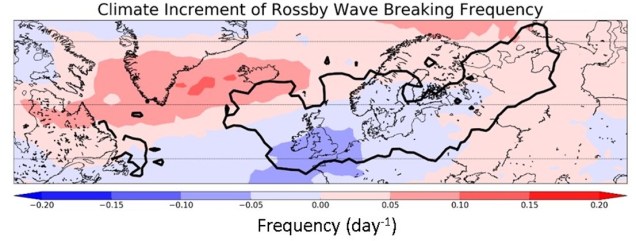
To determine whether there exists a change in RWB frequency, due to climate change (a climate increment), the difference in RWB frequency between two simulations must be taken. The first of these is a free-running present day simulation, which provides us with the models representation of a present day atmosphere. The second is a future time-slice simulation, representative of the year 2050. Figure 2 shows the difference between the two simulations, with positive values representing an increase in RWB frequency in a future climate. The black contoured region corresponds to the region where the occurrence of RWB significantly increases UK [PM10].

picture1
Fig 2. Climate increment in RWB frequency, with red/blue shading representing an increase/ decrease in RWB frequency in a future climate. The thick black contour represents the region where the occurrence of RWB significantly raises mean UK [PM10].
RWB frequency anomalies within the black contoured region are of most importance within this study. Predominantly the RWB frequency anomaly, within the black contour, can be described as a negative frequency anomaly. However, there also exist heterogeneous RWB frequency anomalies within the contoured region. What is shown is that there is a tendency for RWB to occur further north and eastward in a future climate. These shifts in the regions of RWB occurrence influence a shift in the resulting flow regimes that influence the UK.

Climate shifts in flow regimes were analysed, however only for the most prominent subset of RWB events. RWB can be subset into cyclonic and anti-cyclonic RWB (CRWB and ACRWB respectively) and both have quite different impacts on UK [PM10] (Webber et al., 2016).  ACRWB events are the most prominent RWB subset within the Northeast Atlantic/ European region (Weijenborg et al., 2012). Figure 1 represents ACRWB, with overturning occurring in a clockwise direction about the centre of overturning and these events were analysed for climate shifts in resultant flow regimes.

The analysis of climate flow regime shifts, provides the most interesting result of this study. We find that there exists a significant (p<0.05) increase in near European BENELUX tracer transport into the UK and a significant reduction of UK tracer accumulation, following ACRWB events. What we therefore see is that while in the future we see a reduction in the number of RWB and ACRWB events in a region most influential to UK [PM10], there also exists a robust shift in the resulting flow regime. Following ACRWB, there exists an increased tendency for the transport of European PM10 and decreased locally sourced [PM10] in the UK. Increased European transport may result in increased long-range transport of smaller and potentially more toxic (Gehring et al., 2013) PM2.5 particles from Europe.

References

Gehring, U., Gruzieva, O., Agius, R. M., Beelen, R., Custovic, A., Cyrys, J., Eeftens, M., Flexeder, C., Fuertes, E., Heinrich, J., Hoffmann, B., deJongste, J. C., Kerkhof, M., Klümper, C., Korek, M., Mölter, A., Schultz, E. S., Simpson, A.,Sugiri, D., Svartengren, M., von Berg, A., Wijga, A. H., Pershagen, G. and Brunekreef B.: Air Pollution Exposure and Lung Function in Children: The ESCAPE Project. Children’s Health Prespect, 121,
1357-1364, doi:10.1289/ehp.1306770 , 2013.

Pelly, J. L and Hoskins, B. J.: A New Perspective on Blocking. J. Atmos. Sci, 50, 743-755, doi: http://dx.doi.org/10.1175/1520- 0469(2003)060<0743:ANPOB>2.0.CO;2, 2003.

Riahi, K., Rao S., Krey, V., Cho, C., Chirkov, V., Fischer, G., Kindermann, G., Nakicenovic, N. and Rafaj, P.: RCP 8.5—A scenario of comparatively high greenhouse gas emissions. Climatic Change, 109, no. 1-2, 33-57, doi: 10.1007/s10584-011-0149-y, 2011.

Webber, C. P., Dacre, H. F., Collins, W. J., and Masato, G.: The Dynamical Impact of Rossby Wave Breaking upon UK PM10 Concentration. Atmos. Chem. and Phys. Discuss, doi; 10.5194/acp-2016-571, 2016.

Weijenborg, C., de Vries, H. and Haarsma, R. J.: On the direction of Rossby wave breaking in blocking. Climate Dynamics, 39, 2823- 2831, doi: 10.1007/s00382-012-1332-1, 2012.

Woollings, T. J., Hoskins, B. J., Blackburn, M. and Berrisford, P.: A new Rossby wave-breaking interpretation of the North Atlantic Oscillation. J. Atmos. Sci, 65, 609-626, doi: http://dx.doi.org/10.1175/2007JAS2347.1, 2008.


Understanding the urban environment and its effect on indoor air.

Email: h.l.gough@pgr.reading.ac.uk

Recent estimates by the United Nations (2009) state that 50 to 70 % of the world’s population now live in urban areas with over 70 % of our time being spent indoors, whether that’s at work, at home or commuting.

We’ve all experienced a poor indoor environment, whether it’s the stuffy office that makes you sleepy, or the air conditioning unit that causes the one person under it to freeze. Poor environments make you unproductive and research is beginning to suggest that they can make you ill. The thing is, the microclimate around one person is complex enough, but then you have to consider the air flow of the room, the ventilation of the building and the effect of the urban environment on the building.

So what tends to happen is that buildings and urban areas are simplified down into basic shapes with all the fine details neglected and this is either modelled at a smaller scale in a wind tunnel or by using CFD (computer fluid dynamics). However, how do we know whether these models are representative of the real-world?

blogimage1

This is Straw city, which was built in Silsoe U.K during 2014. You can just see the car behind the array (purple circle), these cubes of straw are 6 m tall, or roughly the height of an average house. Straw city is the stepping stone between the scale models and the real world, and was an urban experiment in a rural environment. We measured inside the array, outside of the array and within the blue building so we could see the link between internal and external flow: which meant the use of drones and smoke machines! The focus of the experiment was on the link between ventilation and the external conditions.

blogphoto2
Smoke releases, drone flying, thermal imaging and tracer gas release: some of the more fun aspects of the fieldwork

After 6 months of data collection, we took the straw cubes away and just monitored the blue cube on its own and the effect of the array can clearly be seen in this plot, where pink is the array, and blue is the isolated cube. So this is showing the pressure coefficient (Cp),  and can be thought of as a way of comparing one building to another in completely different conditions. You can see that the wind direction has an effect and that the array reduces the pressure felt by the cube by 60-90 %. Pressure is linked to the natural ventilation of a building: less pressure means less flow through the opening.


Alongside the big straw city, we also went to the Enflo lab at the University of Surrey to run some wind tunnel experiments of our own, which allowed us to expand the array.

blogimage3
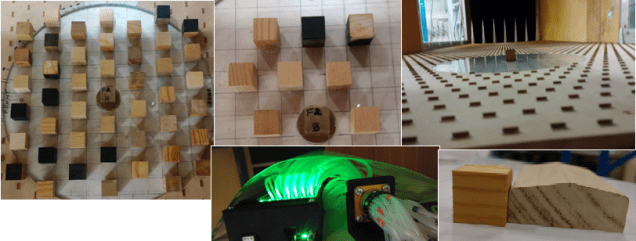
Photos of the wind tunnel arrays. Left is the biggest array modelled, centre is the Silsoe array, top right is the wind tunnel and roughness elements. Bottom right is the model of the storage shed at the full-scale site and centre is the logging system used.

So we have a data set that encompasses all wind directions and speeds, all atmospheric stabilities, different temperature differences and different weather conditions. It’s a big data set and will take a while to work through, especially with comparisons to the wind tunnel model and CFD model created by the University of Leeds. We will also compare the results to the existing guidelines out there and to other similar data sets.

I could ramble on for hours about the work, having spent far too long in a muddy field in all weathers but for more information please email me or come along to my departmental seminar on the 8th November.

This PhD project is jointly funded by the University of Reading and the EPSRC and is part of the Refresh project: www.refresh-project.org.uk

Robots and COP?

Email: c.m.dunning@pgr.reading.ac.uk

Robots aren’t a frequent topic of conversation amongst PhD students in the Met department, but currently everyone seems to be talking about a robot, virtual reality and COP. What’s going on?

COP stands for the Conference of the Parties, and forms the decision making body of the United Nations Framework Convention on Climate Change (UNFCCC). This is the UN body with the responsibility of “stabilizing greenhouse gas concentrations in the atmosphere at a level that would prevent dangerous anthropogenic interference with the climate system”. They meet once a year to review and assess the implementation of the UNFCCC and associated agreements and protocols. The 22nd COP will be held in Morocco next week.

So what is significant about this year’s COP? Well 2015 was a landmark year in terms of creation of UN agreements. Firstly, the Sendai Framework for Disaster Risk Reduction aims to substantially reduce disaster risk and losses in lives, livelihoods and health. Secondly, the Sustainable Development Goals, call for action to end poverty, protect the planet and encourage peace and prosperity. Thirdly, and finally the Paris Agreement, when all nations agreed to limit the global temperature rise this century to below 2 degrees Celsius and to try to limit the temperature increase to 1.5 degrees Celsius. Additionally, the agreement aims to strengthen the ability of countries to deal with the impacts of climate change.

We, as PhD students studying meteorology understand that robust evidence underpins the three major global agreements of 2015. The first priority for action under the Sendai Framework is ‘understanding disaster risk’, where science is one of the major contributors. Many of the Sustainable Development Goals, which link strongly with both the Paris Agreement and Sendai Framework , require a strong scientific basis. As early career scientists, appreciating the role of research and importance of our science is crucial.

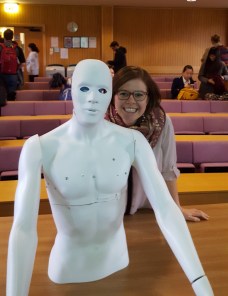
So where does the robot come into this? Next week, Josh Talib and Caroline Dunning will be attending COP22 in Morocco on behalf of the Walker Institute. Accompanying us will be a robot avatar, which will enable remote participation in COP. Back in Reading, other PhD students will be running a Climate Action Studio, operating the robot and using virtual reality to interact with the COP and conduct interviews with participants. The hope is that, with the help of the robot avatar, we will all be able to engage with the discussions in Marrakech, and gain a greater understanding of climate governance.

20161104_1302220


If you are interested in hearing more, or intrigued about how we are using a robot to conduct interviews, we will be posting updates on this blog under the COP22 link (https://thesocialmetwork.wordpress.com/cop22/). We will also be tweeting using the hashtag #COPbot on @SocialMetwork. Thank you to NERC, SCENARIO DTP and the Walker Institute for this incredible opportunity.

nerc-logo-largescenario_logowalker_rgb

NERC Into the Blue – the Science We Live and Breathe

Email: d.l.a.flack@pgr.reading.ac.uk

One of the key aspects of science is communicating our work, not only to other scientists but also to the public. As part of the Manchester Science Festival the Natural Environment Research Council (NERC) have been holding a number of events and last week (25 – 29 Oct) Into the Blue (a science showcase) was held at the Runway Visitor Centre underneath the wings of a Concorde. Along with a fellow PhD student from Reading (Kieran Hunt, who helped out on a stand about the monsoon) I was privileged to help man a stand (on flash flooding).

The event was used to showcase all the science that NERC funds from the atmosphere through to ecology. There were 40 exhibits and the chance to take tours of Concorde and the FAAM aircraft.

Concorde (left) and FAAM aircraft (right)

Exhibits involved a variety of interactive activities from making clouds in a bottle, using Infra-red cameras, making rivers in sand boxes, meeting Boaty McBoatface and a virtual reality flash flood!

During the quieter moments at their stands the exhibitors were allowed to wander around the rest of the event (including getting tours on the planes). In doing this we were able to talk to a number of different scientists about their work and engage in all the activities.

Personal highlights for me were touring both the Concorde and the FAAM aircraft. Although the best bit was the interaction with the public and being able to give everyone (no matter the age, from kids to adults) a “wow moment”.

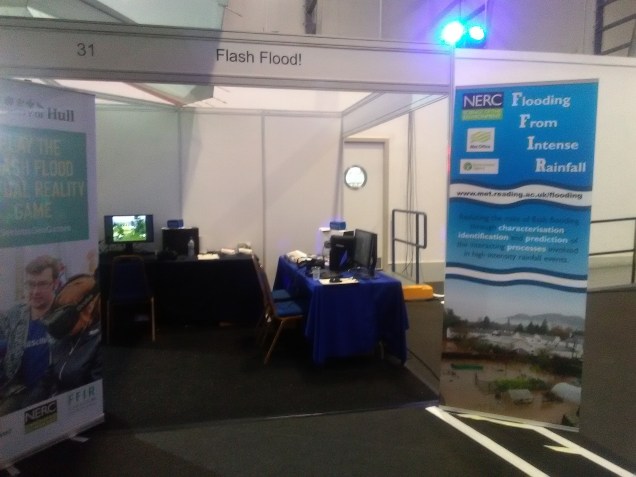
The stand I was helping run was called FlashFlood! This stall was run predominantly by the University of Hull on behalf of the Flooding From Intense Rainfall (FFIR) project. They had created a virtual reality flash flood that was based on a real event (Thinhope Burn, 17 July 2007) which enabled us to place the stand’s visitor into a river valley and take them through the process of flooding from intense rainfall and how floods can change the characteristics of the rivers. It also gave us the ability (because of the case we had chosen) to show people that just because its not raining heavily at your location does not mean you won’t get flooded.

img_20161029_0915221

Having virtual reality was a massive draw for people to come to our stand so we were always fairly busy, but the feedback we had was very positive with the most frequent comments being,

  • “It felt like I was really there”
  • “It really helps me to visualise the science”
  • “Wow, this is really amazing”.

Comments like this really make events such as Into the Blue worth while for us as scientists as we then realise we are getting our messages through to people, and it shows the usefulness of scientific research to the public.

Events like this can be exhausting, but they are definitely worth the effort as you get to see the delight of the public as they learn about different science and have fun at the same time.

A big thank you must be said to NERC and Manchester Runway Visitor Centre for organizing and hosting the event and to all the exhibitors who did a great job in communicating science to the public.

EnvironmentYes

Email: luke.storer@pgr.reading.ac.uk

What happens when you ask a bunch of PhD meteorologists (and a space physicist) to come up with an innovative business idea and pitch it to leading experts in business development?

If we’re honest, a bunch of crazy ideas that happened to land us with something believable and attainable. Some of our brainstorming ideas included:

  • Cow Power: Using Pizoelectric sheets to generate electricity from the movement of cows in turnstables.
  • Pick Me Cup: A brand new portable cup created from biodegradable products as part of a reusable scheme.
  • PVC Insulate: Encouraging PVC recycling (i.e. plastics found in food wrap) and use the products for loft insulation.
  • Satellite Design Detection: Using satellite data and weather forecast models to predict the movement of crop diseases.

As scientists we tried to develop ideas that we thought would be plausible, effective and reduce the environmental impact of humans. Therefore the idea we settled on before the start of the workshop was Pick Me Cup. We aimed to use biodegradable materials that are waste products from the agriculture industry such as straw to make a durable and reusable coffee cup. We developed a strategy that would allow consumers to use the cup, deposit it in a recycle type bin, and get a new clean one next time they buy a drink. The scheme’s aim was to reduce waste in an easy manner for customers.

When we arrived at the workshop it quickly became evident that our idea wasn’t interesting enough, and our idea had to be plausible… but importantly not real. So we developed our idea adding in what we called ‘fake science’, which we found difficult as scientists. After talks outlining important things to remember when creating a business plan, we were set loose to work on our idea, with time spent with mentors helping us with the business strategy and intellectual property.

We wrestled with our idea trying to think of something interesting that we could incorporate, then patent and sell the license for. This finally led us to ‘ThermoPaper’. The idea was adding a chemical to the paper, increasing its thermal properties without compromising its recyclability, weight or increasing the costs significantly. This way fewer paper cups would be used as people don’t have to ‘double cup’. It also removes the need for a protective sleeve.

slide1

The workshop was an interesting insight into the world of business and entrepreneurship, informing us of patenting, licensing and the most important part of any small business… the exit strategy. By combining all these elements we forged a business plan that we thought was ambitious, asking for £200 000 investment, and an estimated sale price of £14 million in 5 years. So we gave our Dragons Den style pitch and they loved our idea, but apparently we were not ambitious enough! We aimed to start small and build our way up, developing new uses for ThermoPaper, but they said we should have just gone straight for the top. As a result we didn’t win, but it was an interesting few days.

A big thanks to NERC, Syngenta and all the other organisations that made the workshop possible, and also to the speakers and mentors that helped shape our idea and business plan throughout!

NAWDEX Campaign – Experiencing the Jet Stream

Email:  j.maddison@pgr.reading.ac.uk

NAWDEX (North Atlantic Wave and Downstream impact Experiment) was an International field campaign led by Ludwig-Maximilians-Universität (LMU) Munich and the Deutsches Zentrum für Luft- und Raumfahrt (DLR) Oberpfaffenhofen in cooperation with the Eidgenössische Technische Hochschule (ETH) Zurich and the Office of Naval Research in the USA, with many other international collaborators. Multiple aircraft were deployed from Iceland (the HALO aircraft and the DLR and Safire Falcons) and the UK (the FAAM aircraft) to take meteorological measurments with the aim of providing knowledge of mid-latitude dynamics and predictability. There was involvement from across the UK, including the University of Reading, the University of Manchester, and the Met Office as well as from the FAAM.

The NAWDEX operations centre was based in Keflavik, Iceland (number 27 in Figure 1), which I visited for a week to join the campaign as one of the representatives from the University of Reading, UK. I was tasked with being the ground-based observation coordinator.

radiosonde_locs

Figure 1: Radiosonde launch locations for the campaign.

A Europe-wide network of radiosonde launch locations (Figure 1) had been readied for additional launches during the NAWDEX period. Our role was to choose sites to launch sondes from that would complement measurements taken by the aircraft and/or support one of the NAWDEX objectives. Of particular interest was downstream high impact weather events over Europe. It was great to be given real responsibility and be able to actually contribute to the NAWDEX project.

Below is a typical daily schedule I would have in Iceland:

Daily schedule:

UK call: 8:30am Icelandic. Conference call between UK parties discussing plans for the coming days and any updates from Iceland or the UK.

General meeting: 12pm Icelandic. Go over brief weather summary, instrument status reports, flight plans for the coming days and reports of previous flights.

Weather meeting: 4pm Icelandic. Detailed look at the weather situation for the short and medium-ranges, highlighting key features that would be of interest to fly into, e.g. extratropical transitions of tropical cyclones (which we were fortunate to observe more than once). Radiosonde launch updates.

In between: assessing forecasts and flight plans for the coming days and meeting with scientists for their input to decide where we want to launch radiosondes from. Along with preparing slides to present to the group proposed launch locations and emailing various meteorological services to request the launches (the most time consuming).

My time in Iceland was a great learning experience. Working with some of the pre-eminent scientists in the fields of dynamics and predictability (and spending most of the day discussing the weather!) really helped improve my understanding of the development of mid-latitude weather systems and better understand their predictability.

img_5638

Figure 2: On-board the FAAM aircraft.

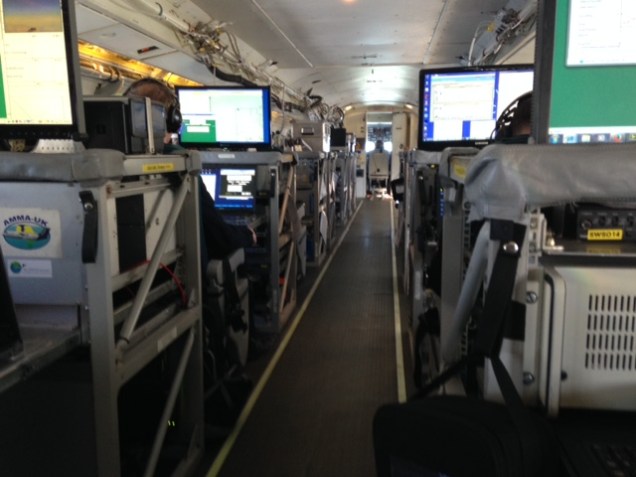
After returning from Iceland I got the opportunity to fly on the FAAM aircraft (Figure 2) whilst it was on a mission for another project. The flight aim was to perform a radiometer inter-comparison by taking coordinated measurements of deep-frontal cloud to the north of Scotland with the HALO and Safire aircraft. The flight was remarkably turbulent free (I‘d been hoping for more of a roller coaster ride), although we did perform a profile right through the cloud to an altitude of less than 50 ft, which was pretty fun! Whilst on the aircraft we were also able to plot measurements being taken in real time on an on-board computer.

thumbnail_img_5644

Figure 3: Flying at an altitude of 35 ft.

NAWDEX was a great opportunity to get first-hand experience of a major international field campaign (and see some of Iceland).

img_5508

What will make the public and politicians take climate change seriously?

slide1

Email: j.f.talib@pgr.reading.ac.uk

Imagine you’re creating a problem that we don’t understand. A problem where the majority of people just go, “meh, not important, I don’t really get it”.

What would it look like?

It would be complex, uncertain, something in the future and possibly an issue that was geographically distant.

Now those factors should you remind of climate change, and on 5th October 2016 the South-East Royal Meteorological Society local centre hosted a meeting where a panel of experts were presented with the question, “What will make the public and politicians take climate change seriously?”

The panel included professionals from a range of backgrounds including Professor Sir Brian Hoskins, leading expert in meteorology and climate, and first director of the Grantham Institute for Climate Change, Imperial College London. Dr Rachel McCloy a well-respected figure in behavioural science with experience in policy making in the former Department of Energy and Climate Change and the Treasury. Finally, Paul Simons a prominent journalist for the Times known for the depth of scientific understanding in his articles.

Images taken during the RMetS South East local centre meeting (06/10/16). Left image: Panelists (from left to right) including Dr Rachel McCloy, Sir Brian Hoskins and Paul Simons.

Sir Brian Hoskins opened the discussion with the challenge that we have a responsibility to “encourage” rather than “make” the public take climate change seriously, and recognised the progress in politics including targets announced in COP21, Paris and the UK Climate Change Act 2008. However, it was also recognised that climate change may not be prioritised high enough in political agendas, and the question was raised on whether governments take their environmental global responsibility seriously enough?

Discussion then moved onto personal actions each one of us can take to increase the public response. Repeating the “doom and gloom” message over climate change can become boring and repetitive, and we need to bring a positive message to tackling this global issue. We also need to recognise the responsibility of the individual in a global context and introduce small steps that can be taken to reduce our environmental impact.

One key message from Brian’s talk, and the meeting as whole, was that it’s currently hard for a member of the public to understand what climate change actually means to their daily lives. What impact will a 2°C global temperature rise actually cause? Researchers, the media and policymakers need to relate the science of global warming to our everyday lives, whether that’s through health, nutrition, the working environment, or air quality to name a few.

Our second speaker, Dr Rachel McCloy, introduced psychological behavioural frameworks that are introduced by climate change and how they impact the progression towards successful mitigation. For example, emotional reactions towards climate change can include dread and injustice, and this combined with typical adjectives used to describe the environmental changes including “natural” and “uncontrollable”, can lead to an increased likelihood of no effort being taken at all against climate change.

A component of Rachel’s talk I found particularly interesting was the impact of over-congratulating individuals and societies for taking “baby steps”. When we congratulate or applaud an action too much it reduces the likelihood of an even better action taking place. Therefore, as a society, we need to keep looking at the next step to mitigating against climate change. If we think about this in the present day, could we agree that we congratulated the agreements met in COP21 Paris too much, and as a result the likelihood of ratification and progress being made has been dropped. We as a community need to hold each other to account even when those “baby steps” have been made.

And finally, Paul, a leading science journalist for The Times, brought to the discussion how the media can be used to encourage climate change to be taken seriously. Everything in the media is a story and when a phenomena such climate change impacts health, water or even transportation it can gain a public interest. To increase the media’s attention to climate change, greater emphasis is needed on how environmental changes will impact our daily lives. Paul also reminded us that the public have begun to associate extreme weather events to climate change, whether proven to be a result of anthropogenic action or not. A recent example that comes to my mind is the recent European thunderstorms that occurred last summer. The media should be used to successfully “shape opinions” and it is up to us to grasp the opportunities that they have to offer.

After an intriguing set of three short talks to answer the question “What will make the public and politicians take climate change seriously?”, discussion was opened to the audience. Questions included: What is the importance of education to solving climate change? How much advocacy work should a climate scientist get involved in? The meeting as a whole stimulated a continued discussion on how climate change can be communicated effectively to “encourage” the public and politicians to take climate change seriously.

I would like to thank all three panellists for a set of thought-provoking and challenging talks. Thank you to the Royal Meteorological Society for supporting the local centre event, and to find out more about meetings taking place in your region check out https://www.rmets.org/events/forthcoming-meetings.

Macmillan coffee morning

Email: h.l.gough@pgr.reading.ac.uk

If there are two things that keep the Met department running it’s cake and coffee. This year the department got involved in the Macmillan coffee morning on the 30th September and raised a whopping £282 within three hours.

There was a bake off, a general cake sale and a guess the number of spots on a cake game, which got very scientific! The bake off had four categories, each with a prize: Savoury, bake your research, green theme and free-from, ensuring that there was something for everybody. As always the competition was good-natured but fierce and the judges (2 members of staff, 1 post-doc and 1 PhD student) had a sugar crash at around 3pm.

Here are some of the creations from the event:

First up (left) a chocolate cake carved into the shape of Africa, complete with wildlife, sprinkles and clouds. The judges didn’t want to cut this one, choosing to eat Madagascar first!

The next bake (top middle) went on to win the Best in Bake-off award, vanishing within minutes of being put on the sale table! Each slice was a decadent mixture of chocolate and lime.

The marvellous creations in the bottom middle image were free from everything except nuts. Using vegan marshmallows and chocolate alongside gluten free biscuits created a wickedly dark rocky road with plenty of crunch and just the right amount of marshmallows.

These gluten free wind turbines (right) were entered into all four categories of the bake off. Making gluten free pastry is no mean feat and unless told, no-one was aware that these moreish snacks were gluten free!

Finally, a shot of the table before it got too full of goodies! There are the edges of vegan pretzels (front left), a shop brought Victoria sponge (front middle), a supreme chocolate cake with Malteaser decorations (right) and a hazelnut and pear chocolate brownie which really captured the autumnal flavours and was the first to be completely sold!

20160930_103227

Fortunately the department has its own running group to help counteract some of the cake eating.

That’s it from me for now, hopefully they’ll be more foodie posts soon!