From 3rd-6th July 2018 the Royal Meteorological Society (RMetS) held two national conferences at the University of York. The Atmospheric Science Conference, joint with NCAS, started off the week and brought together scientists to present and discuss the latest research findings in weather, climate and atmospheric chemistry. The following two days brought the RMetS Student Conference. Both events were well attended by PhD students from Reading and provided a great opportunity to share our work with the wider scientific community.
For a summary of the work presented by Reading students, stick around until the end of the blog!
Atmospheric Science Conference 2018
Weather, Climate and Air Quality
Many of the presentations focused on seasonal forecasting with Adam Scaife (Met Office) giving a keynote address on “Skilful Long Range Forecasts for Europe”. He presented an interesting analysis on the current progress of predicting the North Atlantic Oscillation showing that there is skill in current predictions which could be improved even further by increasing ensemble size. Adam was also awarded the prestigious Copernicus Medal at the conference dinner. Another notable talk was by Reading’s own Ed Hawkins, who presented the benefits of using citizen scientists to rescue weather records. A summary of Ed’s presentation can be accessed below, and you can read more about research involving Citizen Science in Shannon Jones’ blog.
The poster sessions at the conference also gave a great opportunity to look at the breadth of work going on in institutions around the UK. It was also a great time to catch up with colleagues and forge new academic connections.
One of the highlights of the conference was having the conference dinner in the National Railway Museum. This was a fantastic yet surreal location with dining tables set up in the station hall overlooking a suite of old steam trains . The event was made even better by watching England‘s quarter-final world cup game!

Evolution of Science: Past, Present and Future
Students & Early Career Scientist Conference
The student conference is open to all students with an interest in meteorology, from undergraduate to PhD and early career scientists. The conference aimed to give students the opportunity to meet each other and present their work at an early stage in their career before attending other academic conferences. For many of those attending from Reading this was their first time presenting research at an event outside of the department and provided a great experience to communicate their work with others. Work presented varied from radiative forcing to normal empirical modes (summaries of talks are below). There were also a number of keynote speakers and workshops aimed at addressing the current challenges in atmospheric sciences and skills that are important for researchers.

https://twitter.com/jominicdones/status/1015191296334548993
Of course there was also time for socialising with an ice-breaker dinner and pub quiz and a formal Conference dinner on the Thursday. This was the second student conference I have attended and it was a really great place to discuss my work and meet other students from around the country. I have also attended other academic events with several people that I met at the conference last year, it’s always great to see a friendly face!
The student conference is organised by a committee of students from around the UK. Being on the committee was a great opportunity to learn more about how conferences work and to practice skills such as chairing sessions. It has also been great to get to know lots of different people working within meteorology. If you’re interested in helping organise next year’s conference please do get in touch with Victoria Dickinson at RMetS (Victoria.Dickinson@rmets.org) or if you’re thinking about attending then you can start by joining the society where you’ll hear about all the other great events they host.
Highlights of the work presented by Reading students:
Godwin Ayesiga presented work on the convective activity that connects Western and Eastern equatorial Africa. Investigating how intraseasonal modes of variability influence intense rainfall.
Matt Priestley presented an assessment of the importance of windstorm clustering on European wintertime insurance losses. More details of this work can be found here.
Lewis Blunn presented his work looking into the ‘grey zone’ of turbulence at model grid scale lengths of 100 m – 1 km. At these scales turbulence is partially resolved by the grid but still needs to be partially parameterised. Lewis finds that spurious grid scale features emerge at scales where turbulence is partially resolved. Model results are poorer in this ‘grey zone’ than when turbulence is fully resolved or fully parameterised.
Alec Vessey presented his work evaluating the representation of Arctic storms in different reanalysis products. He found that there is a difference between different reanlysis and so care should be taken when using these products to analyse Arctic storms.
Dominic Jones presented a technique for extracting modes of variability from atmospheric data, and a test dataset that has been developed to use this technique to examine the relationship of modes of variability associated with the jet-latitude.
Rachael Byrom presented a motivation for quantifying methane’s shortwave radiative forcing. Her work demonstrated a need to use a high resolution narrow-band radiation model to accurately calculate forcings in atmospheric models.
Andrea Marcheggiani presented a poster on the role of resolution in predicting the North Atlantic storm track. An energy budget of the winter climatology (DJF 1979-2018) was presented.
Sally Woodhouse presented her work on the impact of resolution on energy transports into the Arctic. She has found that increasing atmospheric resolution increases the energy transport in the ocean to better agree with observations.
Kaja Milczewska presented work on evaluating the inaccuracies of predicting air quality in the UK.
Having recently passed her viva, Caroline Dunning’s presentation was on precipitation seasonality over Africa under present and future climates. Caroline has developed a new methodology for determining the beginning and end of the wet season across Africa. This has been applied to CMIP5 model output to look at future changes in wet seasons across Africa under climate change.


 A true revolutionary in the field of theoretical physics and abstract algebra, Amelie Emmy Noether was a German-born inspiration thanks to her perseverance and passion for research. Instead of teaching French and English to schoolgirls, Emmy pursued the study of mathematics at the University of Erlangen. She then taught under a man’s name and without pay because she was a women. During her exploration of the mathematics behind Einstein’s general relativity alongside renowned scientists like Hilbert and Klein, she discovered the fundamentals of conserved quantities such as energy and momentum under symmetric invariance of their respective quantities: time and homogeneity of space. She built the bridge between conservation and symmetry in nature, and although Noether’s Theorem is fundamental to our understanding of nature’s conservation laws, Emmy has received undeservedly small recognition throughout the last century.
 Claudine Hermann is a French physicist and Emeritus Professor at the École Polytechnique in Paris. Her work, on physics of solids (mainly on photo-emission of polarized electrons and near-field optics), led to her becoming the first female professor at this prestigious school. Aside from her work in Physics, Claudine studied and wrote about female scientists’ situation in Europe and the influence of both parents’ works on their daughter’s professional choices. Claudine wishes to give girls “other examples than the unreachable Marie Curie”. She is the founder of the Women and Sciences association and represented it at the European Commission to promote gender equality in Science and to help women accessing scientific knowledge. Claudine is also the president of the European Platform of Women Scientists which represents hundreds of associations and more than 12,000 female scientists.
 For most people being handpicked to be one of three students to integrate West Virginia’s graduate schools would probably be the most notable life achievements. However for Katherine Johnson’s this was just the start of a remarkable list of accomplishments. In 1952 Johnson joined the all-black West Area Computing section at NACA (to become NASA in 1958). Acting as a computer, Johnson analysed flight test data, provided maths for engineering lectures and worked on the trajectory for America’s first human space flight.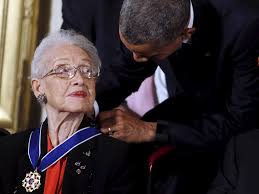
 Women however were not allowed on such ships, thus Marie Tharp was stationed in the lab, checking and plotting the data. Her drawings showed the presence of the North Atlantic Ridge, with a deep V-shaped notch that ran the length of the mountain range, indicating the presence of a rift valley, where magma emerges to form new crust. At this time the theory of plate tectonics was seen as ridiculous. Her supervisor initially dismissed her results as ‘girl talk’ and forced her to redo them. The same results were found. Her work led to the acceptance of the theory of plate tectonics and continental drift.
 Ada Lovelace was a 19th century Mathematician popularly referred to as the “first computer programmer”. She was the translator of “Sketch of the Analytical Engine, with Notes from the Translator”, (said “notes” tripling the length of the document and comprising its most striking insights) one of the documents critical to the development of modern computer programming. She was one of the few people to understand and even fewer who were able to develop for the machine. That she had such incredible insight into a machine which didn’t even exist yet, but which would go on to become so ubiquitous is amazing!

 As a student, being an RMetS member can lead to conversations that could develop your career and bring unexpected opportunities. This has been greatly enhanced with the RMetS mentoring scheme.
 For a student, the highlight in the RMetS calendar is the annual student conference. Every year, sixty to eighty students come together to present their work and develop professional relationships that continue for years to come. This year’s conference is hosted at the University of York on the 5th and 6th July 2018 (
 Other benefits to becoming an RMetS student member include eligibility to the



 Schematic showing some dynamic features of sea ice 3.


