When the Lakes Remember: Unravelling the Sudd Floods of 2022

By Douglas Mulangwa – d.mulangwa@pgr.reading.ac.uk

Between 2019 and 2024, East Africa experienced one of the most persistent high-water periods in modern history: a flood that simply would not recede. Lakes Victoria, Kyoga, and Albert all rose to exceptional levels, and the Sudd Wetland in South Sudan expanded to an unprecedented 163,000 square kilometres in 2022. More than two million people were affected across Uganda and South Sudan as settlements, roads, and farmland remained inundated for months.

At first, 2022 puzzled stakeholders, observers and scientists alike. Rainfall across much of the region was below average that year, yet flooding in the Sudd intensified. This prompted a closer look at the wider hydrological system. Conventional explanations based on local rainfall failed to account for why the water would not recede. The answer, it turned out, lay far upstream and more than a year earlier, hidden within the White Nile’s connected lakes and wetlands.
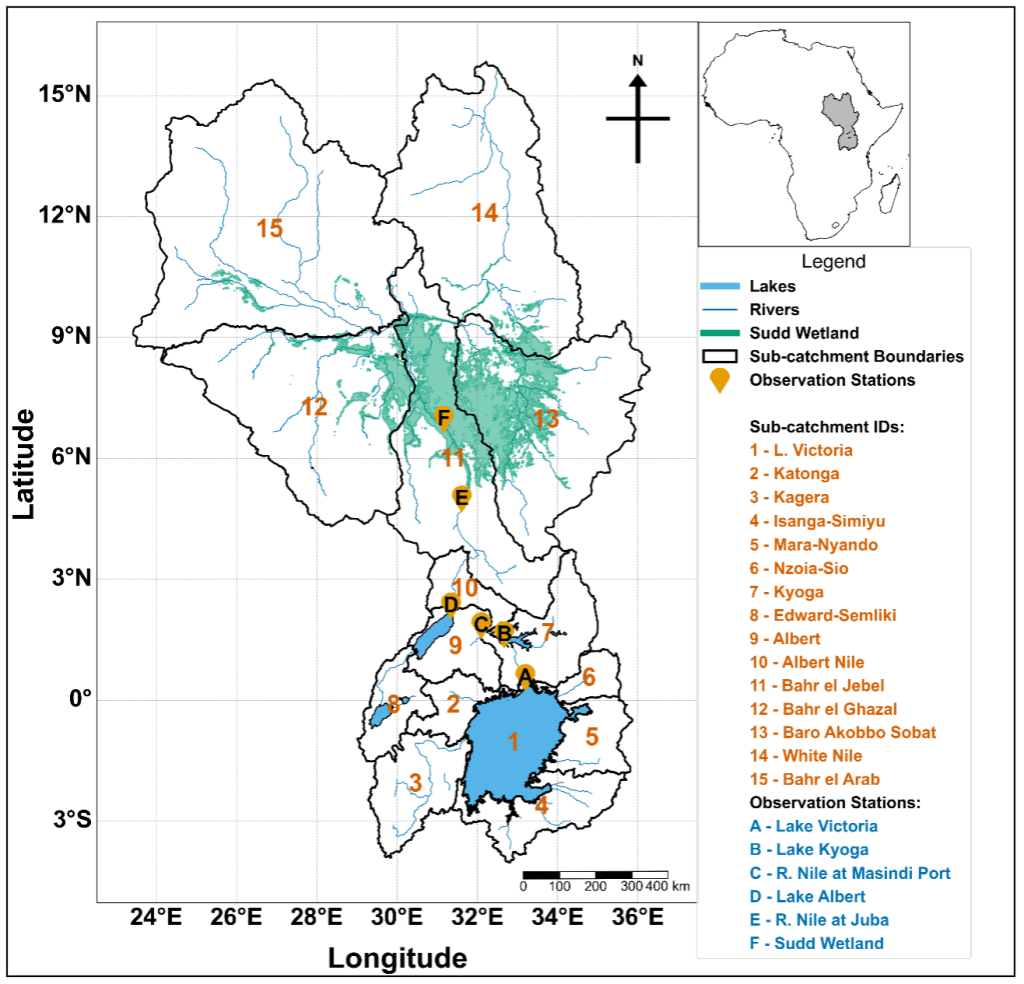
Figure 1: Map of the White Nile Basin showing delineated sub-catchments, lakes, major  rivers, and the Sudd Wetland extent. Sub-catchments are labelled numerically (1–15) with names listed in the legend. Observation stations (A–F) mark key hydrological data collection  locations used in this study: Lake Victoria (A), Lake Kyoga (B), River Nile at Masindi Port (C), Lake Albert (D), River Nile at Juba (E), and the Sudd Wetland (F). Background river networks and sub-catchment boundaries are derived from the HydroSHED dataset, and wetland extent is based on MODIS flood mask composites. The map is projected in geographic coordinates (EPSG:4326) with a graduated scale bar for accurate distance representation using UTM Zone 36N.

The White Nile: A Basin with Memory

The White Nile forms one of the world’s most complex lake, river, and wetland systems, extending from Lake Victoria through Lakes Kyoga and Albert into the Sudd. Hydrologically, it is a system of connected reservoirs that store, delay, and gradually release floodwaters downstream.

For decades, operational planning assumed that floodwaters take roughly five months to travel from Lake Victoria to the Sudd. That estimate was never actually tested with data; it originated as a rule of thumb based on Lake Victoria annual maxima in May and peak flooding in South Sudan in September/October.

Our recent study challenged that assumption. By combining daily lake-level and discharge data (1950–2024) with CHIRPS rainfall and MODIS flood-extent records (2002–2024), we tracked how flood peaks propagated through the system, segment by segment. Using an automated peak-matching algorithm, we quantified the lag between successive annual maxima peaks in Lake Victoria, Lake Kyoga, Lake Albert, and the Sudd Wetland.

The unprecedented high-water regime of 2019-2024
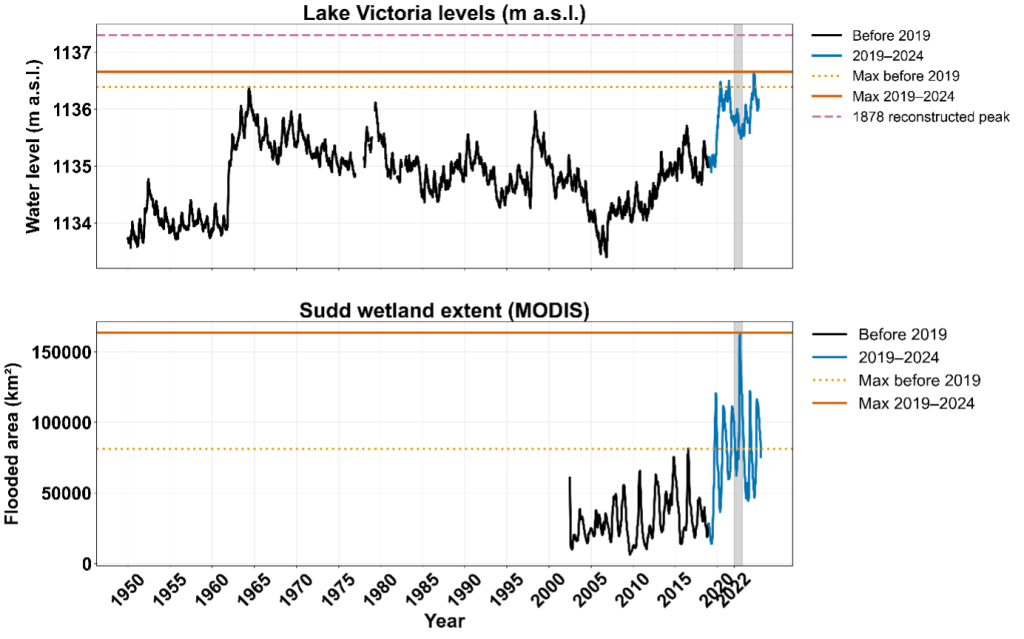
Figure 2: Lake Victoria water levels (1950–2024) and Sudd Wetland extents (2002–2024), with the 2019–2024 anomalous period shown in dark blue and earlier observations in black. The orange dotted line marks the pre-2019 maximum, while the solid vermillion line denotes the highest peak observed during 2019–2024. The dashed magenta line represents the reconstructed 1878 Lake Victoria peak (1137.3 m a.s.l.) from Nicholson & Yin (2001). The shaded grey band highlights the 2022 flood year, when the Sudd reached its largest extent in the MODIS record.

Between 2019 and 2024, both Lake Victoria and the Sudd reached record levels. Lake Victoria exceeded its historic 1964 peak in 2020, 2021, and 2024, while the Sudd expanded to more than twice its previous maximum extent. Each year from 2019 to 2024 stayed above any pre-2019 record, revealing that this was not a single flood season but a sustained multi-year regime.

The persistence of the 2019–2024 high-water regime mirrors earlier basin-wide episodes, including the 1961–64 and 1870s floods, when elevated lake levels and wetland extents were sustained across multiple years rather than confined to a single rainy season.  However, the 2020s stand out as the most extensive amongst all the episodes since the start of the 20th century. These data confirm that both the headwaters and terminal floodplain remained at record levels for several consecutive years during 2019–2024, highlighting the unprecedented nature of this sustained high-water phase in the modern observational era.

2019–2024: How Multi-Year Rainfall Triggers Propagated a Basin-Wide Flood

The sequence of flood events began with the exceptionally strong positive Indian Ocean Dipole of 2019, which brought extreme rainfall across the Lake Victoria basin. This marked the first in a series of four consecutive anomalous rainfall seasons that sustained elevated inflows into the lake system. The October–December 2019 short rains were among the wettest on record, followed by above-normal rainfall in the March–May 2020 long rains, another wet short-rains season in late 2020, and continued high rainfall through early 2021. Together, these back-to-back wet seasons kept catchments saturated and prevented any significant drawdown of lake levels between seasons. Lake Victoria rose by more than 1.4 metres between September 2019 and May 2020, the highest increase since the 1960s, and remained near the 1960s historical maximum for consecutive years. As that excess water propagated downstream, Lakes Kyoga and Albert filled and stayed high through 2021. Even when regional rainfall weakened in 2022, these upstream lakes continued releasing stored water into the White Nile. The flood peak that reached the Sudd in 2022 corresponded closely to the 2021 Lake Victoria high-water phase.

This sequence shows that the 2022 disaster was not driven by a single rainfall event but by cumulative wetness over multiple seasons. Each lake acted as a slow reservoir that buffered and then released the 2019 to 2021 excess water, resulting in multi-year flooding that persisted long after rainfall had returned to near-normal levels.

Transit Time and Floodwave Propagation

Quantitative tracking showed that it takes an average of 16.8 months for a floodwave to travel from Lake Victoria to the Sudd. The fastest transmission occurs between Victoria and Kyoga (around 4 months), while the slowest and most attenuated segment lies between Albert and the Sudd (around 9 months).

This overturns the long-held assumption of a five-month travel time and reveals a system dominated by floodplain storage and delayed release. The 2019–2021 period showed relatively faster propagation because of high upstream storage, while 2022 exhibited the longest lag as the Sudd absorbed and held vast volumes of water. By establishing this timing empirically, the study offers a more realistic foundation for early-warning systems.
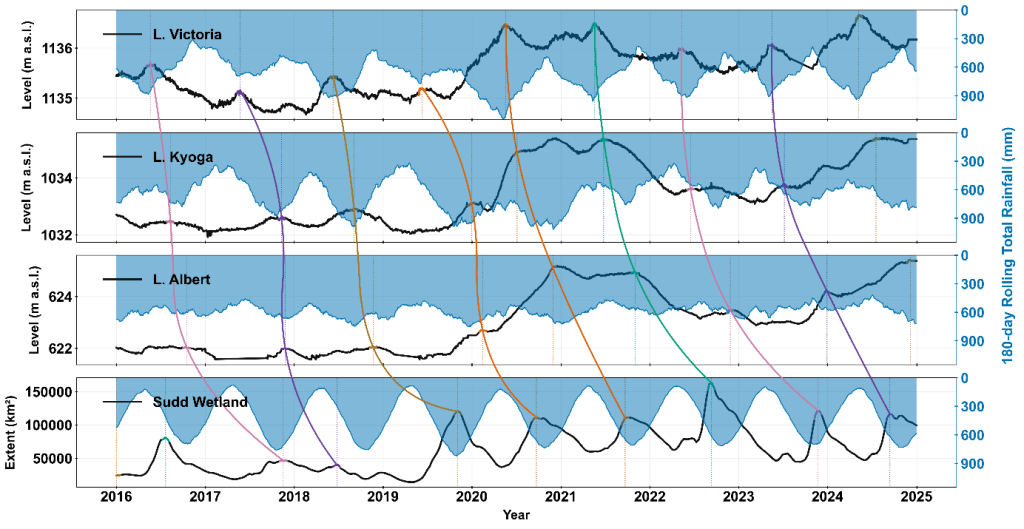
Figure 3: Lake Victoria, Lake Kyoga, and Lake Albert water levels, and Sudd Wetland inundated extent, from 2016 to 2024. Coloured spline curves indicate annual flood-wave trajectories traced from the timing of Lake Victoria annual maxima through the downstream of the White Nile system. Blue shading on the secondary (right) axis shows 180-day rolling rainfall totals over each basin. The panel sequence (Victoria–Kyoga, Kyoga–Albert, Albert–Sudd) highlights the progressive translation of flood waves through the connected lake–river–wetland network.

Wetland Activation and Flood Persistence

Satellite flood-extent maps reveal how the Sudd responded once the inflow arrived. The wetland expanded through multiple activation arms that progressively connected different sub-catchments:

  • 2019: rainfall-fed expansion on the east (Baro–Akobo–Sobat and White Nile sub-basins)
  • 2020–2021: a central-western arm from Bahr el Jebel extending into Bahr el Ghazal and a north-western connection from Bahr el Jebel to Bahr el Arab connected around Bentiu in Unity State.
  • 2022: The two activated arms persisted so the JJAS seasonal rainfall in South Sudan and the inflow from the upstream lakes just compounded the activation leading to the massive flooding in Bentiu, turning the town into an island surrounded by water.

This geometry confirms that the Sudd functions not as a single floodplain but as a network of hydraulically linked basins. Once activated, these wetlands store and recycle water through backwater effects, evaporation, and lateral flow between channels. That internal connectivity explains why flooding persisted long after rainfall declined.

The Bigger Picture

Understanding these long lags is vital for effective flood forecasting and anticipatory humanitarian action. Current early-warning systems in South Sudan and Uganda mainly rely on short-term rainfall forecasts, which cannot capture the multi-season cumulative storage and delayed release that drive multi-year flooding.

By the time floodwaters reach the Sudd Wetland, the hydrological signature of releases from Lake Victoria has been substantially transformed by storage, delay, and attenuation within the intermediate lakes and wetlands. This means that downstream flood conditions are not a direct reflection of upstream releases but the result of cumulative interactions across the basin’s interconnected reservoirs.

The results suggest that antecedent storage conditions in Lakes Victoria, Kyoga, and Albert should be incorporated into regional flood outlooks. When upstream lake levels are exceptionally high, downstream alerts should remain elevated even if rainfall forecasts appear moderate. This approach aligns with impact-based forecasting, where decisions are informed not only by rainfall predictions but also by hydrological memory, system connectivity and potential impact of the floods.

The 2019–2024 high-water regime joins earlier basin-wide flood episodes in the 1870s, 1910s, and 1960s, each linked to multi-year wet phases across the equatorial lakes. The 1961–64 event raised Lake Victoria by about 2.5 metres and reshaped the Nile’s flow for several years. The 1870s flood appears even more extensive, showing that compound, persistent flooding is part of the White Nile’s natural variability.

Climate-change attribution studies indicate that the 2019–2020 rainfall anomaly was intensified by anthropogenic warming, increasing both its magnitude and probability. If such events become more frequent, the basin’s long-memory behaviour could convert short bursts of rainfall into multi-year high-water regimes.

This work reframes how we view the White Nile. It is not a fast, responsive river system but a slow-moving memory corridor in which floodwaves propagate, store, and echo over many months. Recognising this behaviour opens practical opportunities: it enables longer forecast lead times based on upstream indicators, supports coordinated management of lake releases, and strengthens early-action planning for humanitarian agencies across the basin.

It also highlights the need for continued monitoring and data sharing across national borders. Sparse observations remain a major limitation: station gaps, satellite blind spots, and non-public lake-release data all reduce our ability to model the system in real time. Improving this observational backbone is essential if we are to translate scientific insight into effective flood preparedness.

By Douglas Mulangwa (PhD researcher, Department of Meteorology, University of Reading), with contributions from Evet Naturinda, Charles Koboji, Benon T. Zaake, Emily Black, Hannah Cloke, and Elisabeth M. Stephens.

Acknowledgements

This research was conducted under the INFLOW project, funded through the CLARE programme (FCDO and IDRC), with collaboration from the Uganda Ministry of Water and Environment, the South Sudan Ministry of Water Resources and Irrigation, the World Food Programme(WFP), IGAD Climate Prediction and Application Centre  (ICPAC), Médecins Sans Frontières (MSF), the Red Cross Red Crescent Climate Centre, Uganda Red Cross Society (URCS), the South Sudan Red Cross Red Crescent Society (SSRCS) and the Red Cross Red Crescent Climate Centre (RCCC).
Nature vs Nurture in Convective-Scale Ensemble Spread

By Adam Gainford

Quantifying the uncertainty of upcoming weather is now a common procedure thanks to the widespread use of ensemble forecasting. Unlike deterministic forecasts, which show only a single realisation of the upcoming weather, ensemble forecasts predict a range of possible scenarios given the current knowledge of the atmospheric state. This approach allows forecasters to estimate the likelihood of upcoming weather events by simply looking at the frequency of event occurrence within all ensemble members. Additionally, by sampling a greater range of events, this approach highlights plausible worst-case scenarios, which is of particular interest for forecasts of extreme weather. Understanding the realistic range of outcomes is crucial for forecasters to provide informed guidance, and helps us avoid the kind of costly and embarrassing mistakes that are commonly associated with the forecast of “The Great Storm of 1987”*.

To have trust that our ensembles are providing an appropriate range of outputs, we need some method of verifying ensemble spread. We do this by calculating the spread-skill relationship, which essentially just compares the difference between member values to the skill of the ensemble as a whole. If the spread-skill relationship is appropriate, spread and skill scores should be comparable when averaged over many forecasts. If the ensemble shows a tendency to produce larger spread scores than skill scores, there is too much spread and not enough confidence in the ensemble given its accuracy: i.e., the ensemble is overspread. Conversely, if spread scores are smaller than skill scores, the ensemble is too confident and is underspread. 

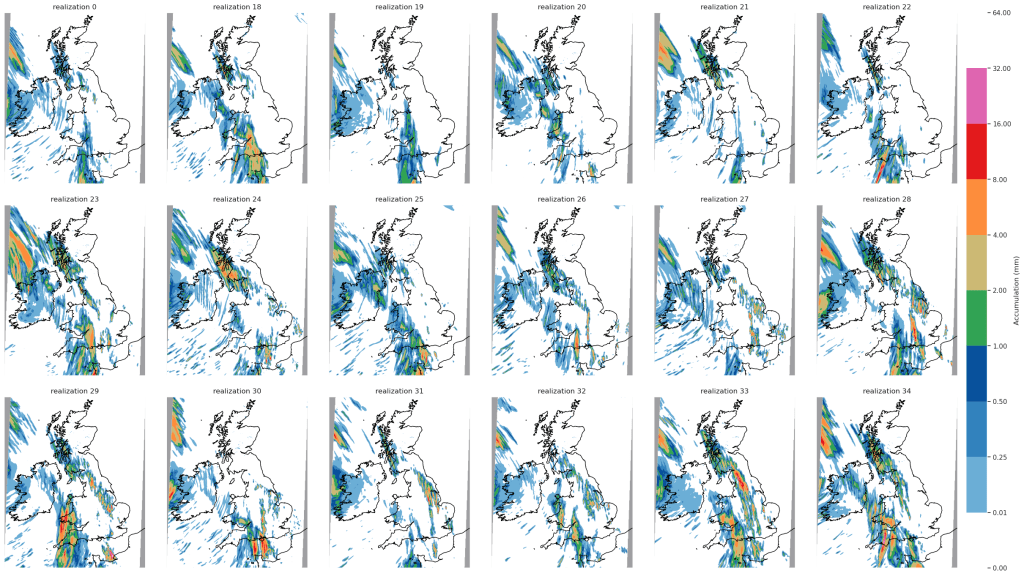
Figure 1: Postage stamp plots showing three-hourly precipitation accumulation valid for 2023-07-08 09Z at leadtime T+15 h. There is reasonable spread within both the frontal rain band effecting areas of SW England and Wales, and the convective features ahead of this front.

My PhD work has focussed on understanding the spread-skill relationship in convective-scale ensembles. Unlike medium range ensembles that are used to estimate the uncertainty of synoptic-scale weather at daily-to-weekly leadtimes, convective-scale ensembles quantify the uncertainty of smaller-scale weather at hourly-to-daily leadtimes. To do this, convective-scale ensembles must be run at higher resolutions than medium-range ensembles, with grid spacings smaller than 4 km. These higher resolutions allows the ensemble to explicitly represent convective storms, which has been repeatedly shown to produce more accurate forecasts compared coarser-resolution forecasts that must instead rely on convective parametrizations. However, running models at such high resolutions is too computationally expensive to be done over the entire Earth, so they are typically nested inside a lower-resolution “parent” ensemble which provides initial and boundary conditions. Despite this, researchers often report that convective-scale ensembles are underspread, and the range of outputs is too narrow given the ensemble skill. This is corroborated by operational forecasters, who report that the ensemble members often stay too close to the unperturbed control member. 

To provide the necessary context for understanding the underspread problem, many studies have examined the different sources and behaviours of spread within convective-scale ensembles. In general, spread can be produced through three different mechanisms: firstly, through differences in each member’s initial conditions; secondly, through differences in the lateral boundary conditions provided to each member; and thirdly, through the different internal processes used to evolve the state. This last source is really the combination of many different model-specific factors (e.g., stochastic physics schemes, random parameter schemes etc.), but for our purposes this represents the ways in which the convective-scale ensemble produces its own spread. This contrasts with the other two sources of spread, which are directly linked to the spread of the parent ensemble.  

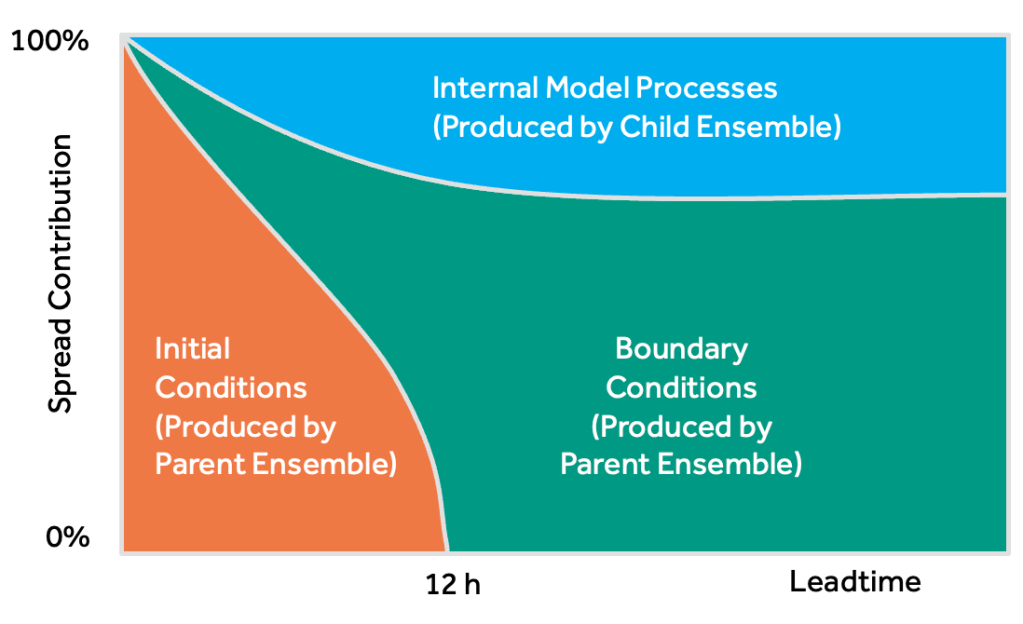
The evolution of each of these three spread sources is shown in Fig. 2. At the start of a forecast, the ensemble spread is entirely dictated by differences in the initial conditions provided to each ensemble member. As we integrate forward in time, though, this initial information is removed from the domain by the prevailing winds and replaced by information arriving through the boundaries. At the same time, internal model processes start spinning up additional detail within each ensemble member. For a UK-sized domain, it takes roughly 12 hours for the initial information to have fully left the domain, though this is of course highly dependent on the strength of the prevailing winds. After this time, spread in the ensemble is partitioned between internal processes and boundary condition differences.  

Figure 2: Attribution of spread within a convective-scale ensemble by leadtime. 

While the exact partitioning in this schematic shouldn’t be taken too literally, it does highlight the important role that the parent ensemble plays in determining spread in the child ensemble. Most studies which try to improve spread target the child ensemble itself, but this schematic shows that these improvements may have quite a limited impact. After all, if the spread of information arriving from the parent ensemble is not sufficient, this may mask or even overwhelm any improvements introduced to the child ensemble.  

However, there are situations where we might expect internal processes to show a more dominant spread contribution. Forecasts of convective storms, for instance, typically show larger spread than forecasts of other types of weather, and are driven more by local processes than larger-scale, external factors.

This is where our “nature” and “nurture” analogy becomes relevant. Given the similarities of this relationship to the common parent-child theory in behavioural psychology, we thought it would be a fun and useful gimmick to also use this terminology here. So, in the “nature” scenario, each child member shows large similarity to the corresponding parent member, which is due to the dominating influence of genetics (initial and boundary conditions). Conversely, in the “nurture” scenario, spread in the child ensemble is produced more by its response to the environment (internal processes), and as such, we see larger differences between each parent-child pair.  

While the nature and nurture attribution is well understood for most variables, few studies have examined the parent-child relationship for precipitation patterns, which are an important output for guidance production and require the use of neighbourhood-based metrics for robust evaluation. Given that this is already quite a long post, I won’t go into too much detail of our results looking at nature vs nurture for precipitation patterns. Instead, I will give a quick summary of what we found: 

  • Nurture provides a larger than average influence on the spread in two situations: during short leadtimes**, and when forecasting convective events driven by continental plume setups. 
  • In the nurture scenarios, spread is consistently larger in the child ensemble than the parent ensemble. 
  • In contrast to the nurture scenarios, nature provides larger than average spread at medium-to-long leadtimes and under mobile regimes, which is consistent with the boundary arguments mentioned previously. 
  • Spread is very similar between the child and parent ensembles in the nurture scenarios.  

If you would like to read more about this work, we will be submitting a draft to QJRMS very soon.  

To conclude, if we want to improve the spread of precipitation patterns in convective-scale ensembles, we should direct more attention to the role of the driving ensemble. It is clear that the exact nesting configuration used has a strong impact on the quality of the spread. This factor is especially important to consider given recent experiments with hectometric-scale ensembles which are themselves nested within convective-scale ensembles. With multiple layers of nesting, the coupling between each ensemble layer is likely to be complex. Our study provides the foundation for investigating these complex interactions in more detail. 

* This storm was actually well forecast by the Met Office. The infamous Michael Fish weather update in which he said there was no hurricane on the way was referring to a different system which indeed did not impact the UK. Nevertheless, this remains a good example of the importance of accurately predicting (and communicating) extreme weather events.  

** While this appears to be inconsistent with Fig. 2, the ensemble we used does not solely take initial conditions from the driving ensemble. Instead, the ensemble uses a separate, high-resolution data assimilation scheme to the parent ensemble. Each ensemble is produced in a way which makes the influence of the data assimilation more influential to the spread than the initial condition perturbations. 

Cloud-Radiation Interactions and Their Contributions to Convective Self-Aggregation 

Kieran Pope – k.n.pope@pgr.reading.ac.uk

Convective self-aggregation is the process by which initially randomly scattered convection becomes spontaneously clustered in space despite uniform initial conditions. This process was first identified in numerical models, however it is relevant to real world convection (Holloway et al., 2017). Tropical weather is dominated by convection, and the degree of convective aggregation has important consequences for weather and climate. A more organised regime is associated with reduced cloudiness, increased longwave emission to space (Bretherton et al., 2005), and a higher frequency of long-lasting extreme precipitation events (Bao and Sherwood, 2019).

Because of its relevance to weather and climate, self-aggregation has been the focus of many recent studies. However, there is still much debate as to the processes that cause aggregation. There is great variability in the rate and degree of aggregation between models, and there remains uncertainty as to how aggregation is affected by climate change (Wing et al., 2020). Previous studies have shown that feedbacks between convection and shortwave & longwave radiation are key drivers and maintainers of aggregation (e.g. Wing & Cronin 2016), and that interactive radiation in models is essential for aggregation to occur (Muller & Bony 2015).

This blog summarises results from the first paper from my PhD (Pope et al., 2021), where we develop and use a framework to analyse how radiative interactions with different cloud types contribute to aggregation. We analyse self-aggregation within a set of three idealised simulations of the UK Met Office Unified Model (UM). The simulations are configured in radiative-convective equilibrium over three fixed sea surface temperatures (SSTs) of 295, 300 and 305 K. They are convection permitting models that are 432 × 6048 km2 in size with a 3 km horizontal grid spacing. The simulations neglect the earth’s rotation, so they approximately represent convection over tropical oceans within a warming climate.

Our analysis framework is based on that used in Wing and Emanuel (2014) which uses the variance of vertically-integrated frozen moist static energy (FMSE) as a measure of aggregation. FMSE is a measure of the total energy an air parcel has if all the water (vapour and frozen) was converted to liquid, neglecting its velocity. Variations in vertically-integrated FMSE come from perturbations in temperature and humidity. As aggregation increases, moist regions get moister and dry regions get drier, so the variance of vertically-integrated FMSE increases.

The problem with using FMSE variance as an aggregation metric is that it is highly sensitive to SST. A warmer atmosphere can hold more water vapour via the Clausius-Clapeyron relationship. This means there is a greater difference in FMSE between the moist and dry regions for higher-SST simulations, so the variance of FMSE is typically much greater for higher SSTs. To account for this problem, we normalise FMSE between hypothetical upper and lower limits which are functions of SST. This gives a value of normalised FMSE between 0 and 1.

Wing and Emanuel (2014) derive a budget equation for the rate of change of FMSE variance which shows how different processes contribute to aggregation. By rederiving their equation for normalised FMSE , we get:

\displaystyle \frac{1}{2}\frac{\partial\widehat{h'}_n^2}{\partial t} = \widehat{h'}_nLW'_n + \widehat{h'}_nSW'_n + \widehat{h'}_nSEF'_n - \widehat{h'}_n\nabla_h\cdot\widehat{\textbf{u}h_n}

where \widehat{h} is vertically-integrated FMSE, LW and SW are the net atmospheric column longwave and shortwave heating rates, SEF is the surface enthalpy flux, made up of the surface latent and sensible heat fluxes, and \nabla h \cdot \widehat{\textbf{u}h} is the horizontal divergence of the \widehat{h} flux. Primes (') indicate local anomalies from the instantaneous domain mean. The subscript (_n) denotes a normalised variable which is the original variable divided by the difference between the hypothetical upper and lower limits of \widehat{h}. The equation shows that the rate of change of \widehat{h'}_n variance (left hand side term) is driven by interactions between \widehat{h}_n anomalies and anomalies in normalised net longwave heating, shortwave heating, surface fluxes and advection.

We use the variance of \widehat{h}_n as our aggregation metric. Hovmöller plots of \widehat{h}_n are shown in Figure 1 for each of our SSTs. In these plots, \widehat{h}_n is averaged along the short axis of our domains. The plots show how initially randomly-distributed convection organises into bands which expand until the point where there are 4 to 5 quasi-stationary bands of moist convective regions separated by dry subsiding regions. This demonstrates that once our domains become fully-aggregated, the degree of aggregation appears similar. Figure 2a shows time series of each of the variance of \widehat{h}_n, and shows that the variance of non-normalised \widehat{h}_n is ~4 times greater for our 305 K simulations compared to our 295 K simulation. Figure 2b shows time series of the variance of \widehat{h}_n. From this, we can see the convection aggregates faster as SST increases, yet the degree of aggregation remains similar via this metric once the convection is fully aggregated. Values of \widehat{h}_n variance around 10-4 or lower correspond to randomly scattered convection, whereas values greater that 10-3 are associated with strongly aggregated convection.

Figure 3: Maps of (a) cloud condensed water path, (b) vertically-integrated FMSE anomaly, (c) longwave heating anomaly, (d) shortwave heating anomaly. Snapshots at day 100 of the 300 K simulation.

To understand the processes contributing to aggregation, we have to look to Equation 1. We mainly focus on the two radiative terms on the right hand side. The terms show that regions in which the radiative anomalies and the \widehat{h}_n anomalies have the same sign contribute to aggregation. We can start to get an intuitive understanding of this concept by looking at maps of these variables. Figure 3b-d show maps of \widehat{h'}_n, LW' and SW'. We can see SW' and \widehat{h'} are closely correlated since SW' is mainly determined by the shortwave absorption by water vapour. Clouds have little effect on the shortwave heating rates, with ~90% of the shortwave heating rate in cloudy regions being due to absorption by water vapour. LW' is closely linked to cloud condensed water path (Figure 3a). This is because the majority of our clouds are high-topped clouds which, due to their cold cloud tops, are able to prevent longwave radiation escaping to space, so they are associated with positive longwave heating anomalies.

The sensitivity of the budget terms to both aggregation and SST can be seen in Figure 4. This figure is made by creating 50 bins of \widehat{h}_n variance and then averaging the budget terms in space and time for each bin and for each SST. Where the terms are positive, they are helping to increase aggregation. Where they are negative, the terms are opposing aggregation. The terms tend to increase in magnitude since every term has \widehat{h'}_n as a factor, which increases with aggregation by definition.

Figure 4: Terms in Equation 1 vs normalised FMSE variance for each SST

In general, we find the longwave term is the dominant driver of aggregation, being insensitive to SST during the growth phase of aggregation. Once the aggregation is mature, the longwave term remains the dominant maintainer of aggregation, however its contribution to aggregation maintenance decreases with SST. The shortwave term is initially small at early times but becomes a key maintainer of aggregation within highly-aggregated environments. This is because humidity variations are initially small, so there is little variation in shortwave heating. Once the convection is aggregated, moist regions are very moist and dry regions are very dry, so there is a large difference in shortwave heating between moist and dry regions. The variations in shortwave heating remain very similar with SST, meaning shortwave heating anomalies contribute the same amount to non-normalised \widehat{h} variance. Therefore, shortwave heating contributes less to aggregation at higher SSTs because they contribute to a smaller fraction of \widehat{h} anomalies. The radiative terms are balanced by the surface flux term (negative because there is greater evaporation in dry regions) and the advection term (negative because circulations tend to smooth out \widehat{h'}_n gradients). The decrease in the magnitude of the radiative terms with SST is balanced by the surface flux and advection terms becoming more positive with SST.

To understand the behaviour of the longwave term, we define different cloud types based on the vertical profile of cloud, assigning one cloud type per grid box in a similar way to Hill et al. (2018). We define a lower and upper level pressure threshold, assigning cloud below the lower threshold to a “Low” category, cloud above the upper threshold to a “High” category, and cloud in between to a “Mid” category. If cloud occurs in more than one of these layers, then it is assigned to a combined category. In total, there are eight cloud types: Clear, Low, Mid, Mid & Low, High, High & Low, High & Mid, and Deep. We can then find each cloud type’s contribution to the longwave term by multiplying the cloud’s mean [Equation] covariance by its domain fraction.

To see how the cloud type contributions change with aggregation, we define a Growth phase and Mature phase of aggregation. The Growth phase has \widehat{h}_n variance between 3\times10^{-4} and 4\times10^{-4} and the Mature phase has \widehat{h} variance between 1.5\times10^{-3} and 2\times 10^{-3}. The contribution of longwave interactions with each cloud type to aggregation during these two phases is shown in Figure 5a, with their mean LW'\times\widehat{h'} covariance and fraction shown in Figures 5b & c.

Figure 5: Mean (a) contribution to the longwave term in Equation 1, (b) normalised longwave-FMSE covariance, (c) cloud fraction for the Growth phase (dots) and Mature phase (open circles). Data points for each category are in order of SST increasing to the right.

We find that longwave interactions with high-topped clouds and clear regions drive aggregation during the Growth phase (Figure 5a). This is because high clouds are abundant, have positive longwave heating anomalies and occur in moist, high \widehat{h} environments. The clear regions are the most abundant category, have typically negative longwave heating anomalies and tend to occur in low \widehat{h} regions, so their LW'\times\widehat{h'} covariance is positive. During the Growth phase, there is little SST sensitivity within each category. During the Mature phase, longwave interactions with high-topped cloud remain the main maintainer of aggregation however their contribution decreases with SST. This sensitivity is mainly because there is a greater decrease in high-topped cloud fraction with aggregation as SST increases. This also has consequences for the LW'\times\widehat{h'} covariance of the clear regions. As high-topped cloud fraction reduces, the domain-mean longwave cooling increases. This makes the radiative cooling of the clear regions less anomalous, resulting in an increasingly negative LW'\times\widehat{h'} covariance during the Mature phase as SST increases.

There is great variability in the degrees of aggregation within numerical models, which has important consequences for weather and climate modelling (Wing et al. 2020). With cloud-radiation interactions being crucial for aggregation, understanding how these interactions vary between models may help to explain the differences in aggregation. This study provides a framework by which a comparison of cloud-radiation interactions and their contributions to convective self-aggregation between models and SSTs can be achieved.

Page Break 

REFERENCES 

Bao, J., & Sherwood, S. C. (2019). The role of convective self-aggregation in extreme instantaneous versus daily precipitation. Journal of Advances in Modeling Earth Systems11(1), 19– 33. https://doi.org/10.1029/2018MS001503 

Bretherton, C. S., Blossey, P. N., & Khairoutdinov, M. (2005). An energy-balance analysis of deep convective self-aggregation above uniform SST. Journal of the Atmospheric Sciences62(12), 4273– 4292. https://doi.org/10.1175/JAS3614.1 

Hill, P. G., Allan, R. P., Chiu, J. C., Bodas-Salcedo, A., & Knippertz, P. (2018). Quantifying the contribution of different cloud types to the radiation budget in Southern West Africa. Journal of Climate31(13), 5273– 5291. https://doi.org/10.1175/JCLI-D-17-0586.1 

Holloway, C. E., Wing, A. A., Bony, S., Muller, C., Masunaga, H., L’Ecuyer, T. S., & Zuidema, P. (2017). Observing convective aggregation. Surveys in Geophysics38(6), 1199– 1236. https://doi.org/10.1007/s10712-017-9419-1 

Muller, C., & Bony, S. (2015). What favors convective aggregation and why? Geophysical Research Letters42(13), 5626– 5634. https://doi.org/10.1002/2015GL064260 

Pope, K. N., Holloway, C. E., Jones, T. R., & Stein, T. H. M. (2021). Cloud-radiation interactions and their contributions to convective self-aggregation. Journal of Advances in Modeling Earth Systems13, e2021MS002535. https://doi.org/10.1029/2021MS002535 

Wing, A. A., & Cronin, T. W. (2016). Self-aggregation of convection in long channel geometry. Quarterly Journal of the Royal Meteorological Society142(694), 1– 15. https://doi.org/10.1002/qj.2628 

Wing, A. A., & Emanuel, K. A. (2014). Physical mechanisms controlling self-aggregation of convection in idealized numerical modeling simulations. Journal of Advances in Modeling Earth Systems6(1), 59– 74. https://doi.org/10.1002/2013MS000269 

Wing, A. A., Stauffer, C. L., Becker, T., Reed, K. A., Ahn, M.-S., Arnold, N., & Silvers, L. (2020). Clouds and convective self-aggregation in a multi-model ensemble of radiative-convective equilibrium simulations. Journal of Advances in Modeling Earth Systems12(9), e2020MS0021380. https://doi.org/10.1029/2020MS0021380 

Do local or non-local sources of moisture contribute to extratropical cyclone precipitation?

Sophie Cuckow – s.cuckow@pgr.reading.ac.uk 

Introduction 

Transient corridors of strong horizontal water vapour transport, called atmospheric rivers have been linked to flooding over Europe and the US (Ralph et al. 2004, Lavers et al. (2011), Corringham et al. (2019)). Despite this, the relationship between atmospheric rivers and the precipitation associated with extratropical cyclones is debated in literature. It is often thought that atmospheric rivers feed moisture from the tropics directly to the cyclone where it rises to form precipitation (Ralph et al. (2004), Neiman et al. 2008)). However, this would only be the case if the cyclone propagation velocity is slower than the vapour transport, which might not occur when a cyclone is developing. Thus, arises the question, where does the moisture that produces the precipitation come from? The tropics via atmospheric rivers or from another location via a different mechanism? Understanding which moisture sources contribute to extratropical precipitation would help to improve forecasts and mitigate the risk of damage from flooding events. 

Case Study – Storm Bronagh

To investigate different moisture sources, we examined our case study, storm Bronagh, in an Earth relative and system relative framework. Storm Bronagh tracked over the UK during the 20th and 21st September 2018 and bought over 50mm of rainfall in 24 hours to parts of Wales and England. This led to flooding in mid-Wales and Sheffield (Met Office). The Earth relative framework allows us to investigate whether the storm has an associated atmospheric river. The cyclone relative framework allows us to investigate airstreams called conveyor belts, which are moving faster than the cyclone propagation velocity. To transition to this framework, we calculated the propagation velocity of the cyclone using the tracks produced by the tracking algorithm of Hodges (1995). We then subtracted the velocity from the Earth relative wind fields (European Centre for Mid-range Weather Forecasts Re-analysis 5, ERA5) to give the cyclone relative wind fields (Carlson (1980)).

Figure 1: The 300K isentropic surface on 21st September 2018 00:00UTC with the center of the storm (red cross, the isobars (white contours) and masked areas depicting where the surface intersects the ground are shown. Left hand side: The Earth relative moisture flux (streamlines) and the magnitude of the Earth relative moisture flux (filled contours). Right hand side: The system relative moisture flux (streamlines) and the magnitude of the system relative moisture flux (filled contours).

The Earth relative and system relative moisture flux (q\overline{U}) on the 300K isentropic surface for storm Bronagh on 21st September 2018 00:00UTC are shown in figure 1. In the Earth relative framework on the left-hand side of this figure, there is an atmospheric river approaching from the West as shown by the blue arrow. This suggests that the source of moisture for this storm was the tropics. However, the cyclone relative framework suggests there is in fact a local source of moisture. This can be seen on the right-hand side of figure 1 where three important airstreams can be seen: the warm conveyor belt (red), the dry intrusion (blue) and the feeder airstream (green). 

The warm conveyor belt is responsible for most of the cloud and precipitation associated with the cyclone. As shown in figure 1, it ascends ahead of the cold front and turns cyclonically to form the upper part of the cloud head, resulting in the iconic comma shape. Also shown in figure 1 is the dry intrusion which descends from behind the cold front into the centre of the cyclone. As this is a dry airflow, it creates a cloud free area between the cold frontal cloud band and the cloud head.

The feeder airstream is a low-level moist airflow that supplies moisture to the base of the warm conveyor belt where it rises. This can be seen in figure 1 where an airstream approaches from the East and splits into two branches, one of which joins the base of the warm conveyor belt. Therefore, in the cyclone relative framework, the moisture originates in the environment ahead of the cyclone rather than the tropics. Furthermore, the other branch of the feeder airstream indicates that the atmospheric river is a result of the moisture being left behind by the cyclone as it propagates. This supports the findings of Dacre et al. (2019) where the feeder airstream was identified by examining 200 of the most intense winter storms over 20 years. 

Therefore, the question arises, which cyclones have a local moisture source? Is it just the intense cyclones or do weaker ones have one too? In order to answer these questions, a diagnostic that identifies the feeder airstream has been developed thus, determining whether there is a local or non-local source of moisture.  

Identification Diagnostic

As seen in figure 1, the feeder airstream is synonymous with a saddle point where it splits into two branches. Therefore, the basis of the feeder airstream’s identification is a saddle point in the system relative moisture flux on an isentropic surface. Utilising theory from non-linear dynamics, the flow around a minimum or fixed point can be identified. Taking the Jacobian matrix of a field and Taylor expanding around a fixed-point, results in a quadratic equation which includes the determinant and trace of the field. By solving this equation and plotting the trace and determinant of the field gives insight into how each flow can be characterised (Drazin (1992)). This is shown in figure 2 where positive values of determinant of the field characterises spiral sources and sinks, whereas the negative values of determinant of the field characterises a saddle point. The determinant of a field is calculated using an equation which calculates the gradient of the field around the fixed point. Therefore, the feeder airstream can be identified by a minimum in the system relative moisture flux field coinciding with an area of negative determinant of the system relative moisture flux field.  Applying this theory to the case study, the feeder air stream for storm Bronagh was successfully identified for 21st September 2018 at 00:00UTC.

Figure 2: Poincare diagram based on Hundley (2012). This diagram describes how the flow around a fixed point in field A can be characterised using the determinant and trace of the field.

Conclusion and Future Work

In conclusion, the moisture source for the precipitation associated with storm Bronagh on 21st September 2018 00:00UTC is ahead of the environment rather than the tropics. This moisture is transported to the base of the warm conveyor belt via one branch of a low-level moist airflow called the feeder airstream. The second branch forms the atmospheric river which is a result of moisture being left behind by the cyclone as it propagates. To determine the source of moisture associated with Bronagh in an objective manner, an identification diagnostic has successfully been developed using the determinant of the system relative moisture flux field on an isentropic surface.

In order to develop the identification diagnostic further, it will be adapted to identify the feeder airstream in different stages of storm Bronagh’s evolution. This would verify whether the diagnostic is successfully identifying the feeder airstream and will give us more insight into the relative sources of moisture as the storm evolves. Future work would involve applying the identification diagnostic to a climatology of cyclones with varying intensity, genesis location and durations so that we can ascertain the dependance of the moisture sources on these parameters.

References

Carlson, T. N. (1980), ‘Airflow Through Midlatitude Cyclones and the Comma Cloud Pattern’, Monthly Weather Review

Corringham, T. W., Martin Ralph, F., Gershunov, A., Cayan, D. R., & Talbot, C. A. (2019).

Atmospheric rivers drive flood damages in the western United States. Science Advances, 5(12). https://doi.org/10.1126/sciadv.aax4631

Dacre, H. F., Martınez-Alvarado, O. & Mbengue, C. O. (2019), ‘Linking Atmospheric Rivers and Warm Conveyor Belt Airflows’, Journal of Hydrometeorology

Douglas R. Hundley. “Poincare Diagram: Classification of phase portraits in (detA, TrA) – plane.” Whitman College, WA, Fall 2012. http://people.whitman.edu/~hundledr/ courses/M244F12/M244/PoincareDiagram.jpg

Drazin, P. G. (1992), Nonlinear Systems, Cambridge Texts in Applied Mathematics, Cambridge University Press

Hodges, K. I. (1995), ‘Feature Tracking on the Unit Sphere’, Monthly Weather Review 123(12)

Lavers, D. A., Villarini, G., Allan, R. P., Wood, E. F. & Wade, A. J. (2012), ‘The detection of atmospheric rivers in atmospheric reanalyses and their links to British winter floods and the large-scale climatic circulation’, Journal of Geophysical Research Atmospheres

Neiman, P. J., Ralph, F. M., Wick, G. A., Lundquist, J. D. & Dettinger, M. D. (2008), ‘Meteorological Characteristics and Overland Precipitation Impacts of Atmospheric Rivers Affecting the West Coast of North America Based on Eight Years of SSM/I Satellite Observations’, Journal of Hydrometeorology

Met Office – “Strong Winds and Heavy Rain from Storms Ali and Bronagh” https://www.metoffice.gov.uk/binaries/content/assets/metofficegovuk/pdf/weather/learn-about/uk-past-events/interesting/2018/strong-winds-and-heavy-rain-from-storms-ali-and-bronagh—met-office.pdf

Ralph, F. M., Neiman, P. J. & Wick, G. A. (2004), ‘Satellite and CALJET Aircraft Observations of Atmospheric Rivers over the Eastern North Pacific Ocean during the Winter of 1997/98’, Monthly Weather Review

Trouble in paradise: Climate change, extreme weather and wildlife conservation on a tropical island.

Joseph Taylor, NERC SCEARNIO DTP student. Zoological Society of London.

Email: J.Taylor5@pgr.reading.ac.uk

Projecting the impacts of climate change on biodiversity is important for informing

Mauritius Kestrel by Joe Taylor
Male Mauritius kestrel (Falco punctatus) in the Bambous Mountains, eastern Mauritius. Photo by Joe Taylor.

mitigation and adaptation strategies. There are many studies that project climate change impacts on biodiversity; however, changes in the occurrence of extreme weather events are often omitted, usually because of insufficient understanding of their ecological impacts. Yet, changes in the frequency and intensity of extreme weather events may pose a greater threat to ecosystems than changes in average weather regimes (Jentsch and Beierkuhnlein 2008). Island species are expected to be particularly vulnerable to climate change pressures, owing to their inherently limited distribution, population size and genetic diversity, and because of existing impacts from human activities, including habitat destruction and the introduction of non-native species (e.g. Fordham and Brook 2010).

Mauritius is an icon both of species extinction and the successful recovery of threatened species. However, the achievements made through dedicated conservation work and the investment of substantial resources may be jeopardised by future climate change. Conservation programmes in Mauritius have involved the collection of extensive data on individual animals, creating detailed longitudinal datasets. These provide the opportunity to conduct in-depth analyses into the factors that drive population trends.

My study focuses on the demographic impacts of weather conditions, including extreme events, on three globally threatened bird species that are endemic to Mauritius. I extended previous research into weather impacts on the Mauritius kestrel (Falco punctatus), and applied similar methods to the echo parakeet (Psittacula eques) and Mauritius fody (Foudia rubra). The kestrel and parakeet were both nearly lost entirely in the 1970s and 1980s respectively, having suffered severe population bottlenecks, but all three species have benefitted from successful recovery programmes. I analysed breeding success using generalised linear mixed models and analysed survival probability using capture-mark-recapture models. Established weather indices were adapted for use in this study, including indices to quantify extreme rainfall, droughts and tropical cyclone activity. Trends in weather indices at key conservation sites were also analysed.

The results for the Mauritius kestrel add to a body of evidence showing that precipitation is an important limiting factor in its demography and population dynamics. The focal population in the Bambous Mountains of eastern Mauritius occupies an area in which rainfall is increasing. This trend could have implications for the population, as my analyses provide evidence that heavy rainfall during the brood phase of nests reduces breeding success, and that prolonged spells of rain in the cyclone season negatively impact the survival of juveniles. This probably occurs through reductions in hunting efficiency, time available for hunting and prey availability, so that kestrels are unable to capture enough prey to sustain themselves and feed their young (Nicoll et al. 2003, Senapathi et al. 2011). Exposure to heavy and prolonged rainfall could also be a direct cause of mortality through hypothermia, especially for chicks if nests are flooded (Senapathi et al. 2011). Future management of this species may need to incorporate strategies to mitigate the impacts of increasing rainfall.

References:

Fordham, D. A. and Brook, B. W. (2010) Why tropical island endemics are acutely susceptible to global change. Biodiversity and Conservation 19(2): 329‒342.

Jentsch, A. and Beierkuhnlein, C. (2008) Research frontiers in climate change: Effects of extreme meteorological events on ecosystems. Comptes Rendus Geoscience 340: 621‒628.

Nicoll, M. A. C., Jones, C. G. and Norris, K. (2003) Declining survival rates in a reintroduced population of the Mauritius kestrel: evidence for non-linear density dependence and environmental stochasticity. Journal of Animal Ecology 72: 917‒926.

Senapathi, D., Nicoll, M. A. C., Teplitsky, C., Jones, C. G. and Norris, K. (2011) Climate change and the risks associated with delayed breeding in a tropical wild bird population. Proceedings of the Royal Society B 278: 3184‒3190.

Future of Cumulus Parametrization conference, Delft, July 10-14, 2017

Email: m.muetzelfeldt@pgr.reading.ac.uk

For a small city, Delft punches above its weight. It is famous for many things, including its celebrated Delftware (Figure 1). It was also the birthplace of one of the Dutch masters, Johannes Vermeer, who coincidentally painted some fine cityscapes with cumulus clouds in them (Figure 2). There is a university of technology with some impressive architecture (Figure 3). It holds the dubious honour of being the location of the first assassination using a pistol (or so we were told by our tour guide), when William of Orange was shot in 1584. To this list, it can now add hosting a one-week conference on the future of cumulus parametrization, and hopefully bringing about more of these conferences in the future.

Delftware_display

Figure 1: Delftware.

Vermeer-view-of-delft

Figure 2: Delft with canopy of cumulus clouds. By Johannes Vermeer, 1661.

Delft_AULA

Figure 3: AULA conference centre at Delft University of Technology – where we were based for the duration of the conference.

So what is a cumulus parametrization scheme? The key idea is as follows. Numerical weather and climate models work by splitting the atmosphere into a grid, with a corresponding grid length representing the length of each of the grid cells. By solving equations that govern how the wind, pressure and heating interact, models can then be used to predict what the weather will be like days in advance in the case of weather modelling. Or a model can predict how the climate will react to any forcings over longer timescales. However, any phenomena that are substantially smaller than this grid scale will not be “seen” by the models. For example, a large cumulonimbus cloud may have a horizontal extent of around 2km, whereas individual grid cells could be 50km in the case of a climate model. A cumulonimbus cloud will therefore not be explicitly modelled, but it will still have an effect on the grid cell in which it is located – in terms of how much heating and moistening it produces at different levels. To capture this effect, the clouds are parametrized, that is, the vertical profile of the heating and moistening due to the clouds are calculated based on the conditions in the grid cell, and this then affects the grid-scale values of these variables. A similar idea applies for shallow cumulus clouds, such as the cumulus humilis in Vermeer’s painting (Figure 2), or present-day Delft (Figure 3).

These cumulus parametrization schemes are a large source of uncertainty in current weather and climate models. The conference was aimed at bringing together the community of modellers working on these schemes, and working out which might be the best directions to go in to improve these schemes, and consequently weather and climate models.

Each day was a mixture of listening to presentations, looking at posters and breakout discussion groups in the afternoon, as well as plenty of time for coffee and meeting new people. The presentations covered a lot of ground: from presenting work on state-of-the-art parametrization schemes, to looking at how the schemes perform in operational models, to focusing on one small aspect of a scheme and modelling how that behaves in a high resolution model (50m resolution) that can explicitly model individual clouds. The posters were a great chance to see the in-depth work that had been done, and to talk to and exchange ideas with other scientists.

Certain ideas for improving the parametrization schemes resurfaced repeatedly. The need for scale-awareness, where the response of the parametrization scheme takes into account the model resolution, was discussed. One idea for doing this was the use of stochastic schemes to represent the uncertainty of the number of clouds in a given grid cell. The concept of memory also cropped up – where the scheme remembers if it had been active at a given grid cell in a previous point in time. This also ties into the idea of transitions between cloud regimes, e.g. when a stratocumulus layer splits up into individual cumulus clouds. Many other, sometimes esoteric, concepts were discussed, such as the role of cold pools, how much tuning of climate models is desirable and acceptable, how we should test our schemes, and what the process of developing the schemes should look like.

In the breakout groups, everyone was encouraged to contribute, which made for an inclusive atmosphere in which all points of view were taken on board. Some of the key points of agreement from these were that it was a good idea to have these conferences, and we should do it more often! Hopefully, in two years’ time, another PhD student will write a post on how the next meeting has gone. We also agreed that it would be beneficial to be able to share data from our different high resolution runs, as well as to be able to compare code for the different schemes.

The conference provided a picture of what the current thinking on cumulus parametrization is, as well as which directions people think are promising for the future. It also provided a means for the community to come together and discuss ideas for how to improve these schemes, and how to collaborate more closely with future projects such as ParaCon and HD(CP)2.

Sting Jet: the poisonous (and windy) tail of some of the most intense UK storms

Email: a.volonte@pgr.reading.ac.uk

IDL TIFF file
Figure 1: Windstorm Tini (12 Feb 2014) passes over the British Isles bringing extreme winds. A Sting Jet has been identified in the storm. Image courtesy of NASA Earth Observatory

It was the morning of 16th October when South East England got battered by the Great Storm of 1987. Extreme winds occurred, with gusts of 70 knots or more recorded continually for three or four consecutive hours and maximum gusts up to 100 knots. The damage was huge across the country with 15 million trees blown down and 18 fatalities.

case_study_great_storm_fig011
Figure 2: Surface wind gusts in the Great Storm of 1987. Image courtesy of UK Met Office.

The forecast issued on the evening of 15th October failed to identify the incoming hazard but forecasters were not to blame as the strongest winds were actually due to a phenomenon that had yet to be discovered at the time: the Sting Jet. A new topic of weather-related research had started: what was the cause of the exceptionally strong winds in the Great Storm?

It was in Reading at the beginning of 21st century that scientists came up with the first formal description of those winds, using observations and model simulations. Following the intuitions of Norwegian forecasters they used the term Sting Jet, the ‘sting at the end of the tail’. Using some imagination we can see the resemblance of the bent-back cloud head with a scorpion’s tail: strong winds coming out from its tip and descending towards the surface can then be seen as the poisonous sting at the end of the tail.

Conceptual+model+of+storm+development
Figure 3: Conceptual model of a sting-jet extratropical cyclone, from Clark et al, 2005. As the cloud head bends back and the cold front moves ahead we can see the Sting Jet exiting from the cloud tip and descending into the opening frontal fracture.  WJ: Warm conveyor belt. CJ: Cold conveyor belt. SJ: Sting jet.

In the last decade sting-jet research progressed steadily with observational, modelling and climatological studies confirming that the strong winds can occur relatively often, that they form in intense extratropical cyclones with a particular shape and are caused by an additional airstream that is neither related to the Cold nor to the Warm Conveyor Belt. The key questions are currently focused on the dynamics of Sting Jets: how do they form and accelerate?

Works recently published (and others about to come out, stay tuned!) claim that although the Sting Jet occurs in an area in which fairly strong winds would already be expected given the morphology of the storm, a further mechanism of acceleration is needed to take into account its full strength. In fact, it is the onset of mesoscale instabilities and the occurrence of evaporative cooling on the airstream that enhances its descent and acceleration, generating a focused intense jet (see references for more details). It is thus necessary a synergy between the general dynamics of the storm and the local processes in the cloud head in order to produce what we call the Sting Jet .

plot_3D_sj ccb_short
Figure 4: Sting Jet (green) and Cold Conveyor Belt (blue) in the simulations of Windstorm Tini. The animation shows how the onset of the strongest winds is related to the descent of the Sting Jet. For further details on this animation and on the analysis of Windstorm Tini see here.

References:

http://www.metoffice.gov.uk/learning/learn-about-the-weather/weather-phenomena/case-studies/great-storm

Browning, K. A. (2004), The sting at the end of the tail: Damaging winds associated with extratropical cyclones. Q.J.R. Meteorol. Soc., 130: 375–399. doi:10.1256/qj.02.143

Clark, P. A., K. A. Browning, and C. Wang (2005), The sting at the end of the tail: Model diagnostics of fine-scale three-dimensional structure of the cloud head. Q.J.R. Meteorol. Soc., 131: 2263–2292. doi:10.1256/qj.04.36

Martínez-Alvarado, O., L.H. Baker, S.L. Gray, J. Methven, and R.S. Plant (2014), Distinguishing the Cold Conveyor Belt and Sting Jet Airstreams in an Intense Extratropical Cyclone. Mon. Wea. Rev., 142, 2571–2595, doi: 10.1175/MWR-D-13-00348.1.

Hart, N.G., S.L. Gray, and P.A. Clark, 0: Sting-jet windstorms over the North Atlantic: Climatology and contribution to extreme wind risk. J. Climate, 0, doi: 10.1175/JCLI-D-16-0791.1.

Volonté, A., P.A. Clark, S.L. Gray. The role of Mesoscale Instabilities in the Sting-Jet dynamics in Windstorm Tini. Poster presented at European Geosciences Union – General Assembly 2017, Dynamical Meteorology (General session)

The onset and end of wet seasons over Africa

Email: c.m.dunning@pgr.reading.ac.uk

For many Africans, the timing of the wet season is of crucial importance, especially for those reliant upon subsistence agriculture, who depend on the seasonal rains for crop irrigation. In addition, the wet season recharges lakes, rivers and water storage tanks which constitute the domestic water supply in some areas. The timing of the wet season also affects the availability of energy from hydroelectric schemes, and has impacts upon the prevalence of certain disease carrying vectors, such as mosquitoes.

Climate change is already threatening many vulnerable populations, and changes in the timing or intensity of the wet season, or increasing uncertainty in the timing of the onset, may lead to significant socio-economic impacts. But before we consider future projections or past changes in the seasonality, we need to go back a few steps.

The first step is to find a method for determining when the wet season starts and ends (its ‘onset’ and ‘cessation’). In order to look at large-scale shifts in the timing of the wet season and relate this to wider-scale drivers, this method needs to be applicable across the entirety of continental Africa. Most previous methods for determining the onset focus on the national to regional scale, and are dependent on the exceedance of a certain threshold e.g. the first week with at least 20mm of rainfall, with one rainfall event of more than 10mm, and no dry spell of more than 10 days after the rain event for the next month. While such definitions work well at a national scale they are not applicable at a continental scale where rainfall amounts vary substantially. A threshold suitable for the dry countries at the fringes of the Sahara would not be suitable in the wetter East African highlands.

In addition to a vast range of rainfall amounts, the African continent also spans multiple climatic regimes. The seasonal cycle of precipitation over continental Africa is largely driven by the seasonal progression of the ITCZ and associated rain belts, which follows the maximum incoming solar radiation. In the boreal summer, when the thermal equator sits between the equator and the Tropic of Cancer, the ITCZ sits north of the equator and West Africa and the Sahel experience a wet season. During the boreal autumn the ITCZ moves south, and southern Africa experiences a wet season during the austral summer, followed by the northward return of the ITCZ during the boreal spring. As a consequence of this, central African regions and the Horn of Africa experience two wet seasons per year – one as the ITCZ travels north, and a second as the ITCZ travels south. A method for determining the onset and cessation at the continental scale thus needs to account for regions with multiple wet seasons per year.

In our paper (available here) we propose such a method, based on the method of Liebmann et al (2012). The method has three steps:

  • Firstly, determine the number of seasons experienced per year at the location (or grid point) of interest. This is achieved using harmonic analysis – the amplitude of the first and second harmonic were computed, using the entire timeseries and their ratio compared. If the ratio was greater than 1.0, i.e. the amplitude of the second harmonic was greater than the amplitude of the first harmonic then the grid point was defined as having two wet seasons per year (biannual), if the ratio was less than one then it was defined as having an annual regime. Figure 1 shows the ratio for one African rainfall dataset (TARCATv2). Three regions are identified as biannual regions; the Horn of Africa, an equatorial strip extending from Gabon to Uganda and a small region on the southern West African coastline.

    blog_fig1
    Figure 1: Location of regions with one and two seasons per year, determined using harmonic analysis. Yellow indicates two seasons per year, while pink/purple indicates one season per year. Computed from TARCATv2 data.
  • Secondly the period of the year when the wet season occurs was determined. This was achieved by looking for minima and maxima in the climatological cumulative daily rainfall anomaly to identify one or two seasons.
  • The third and final stage is to calculate the onset and cessation dates for each year. This is done by looking for the minima and maxima in the cumulative daily rainfall anomaly, calculated for each season.

Figure 2 shows the seasonal progression of the onset and cessation, with the patterns observed in agreement with those expected from the driving physical mechanisms, and continuous progression across the annual/biannual boundaries. Over West Africa and the Sahel, Figure 2a-b shows zonally-contiguous progression patterns with onset following the onset of the long rains and moving north, and cessation moving southward, preceding the end of the short rains. Over southern Africa Figure 2c-d shows the onset over southern Africa starting in the north-west and south-east, following the onset of the short rains, reaching the East African coast last, and cessation starting at the Zimbabwe, Mozambique, South Africa border and spreading out radially into the cessation of the long rains.

As well as testing the method for compatibility with known physical drivers of African rainfall, agreement across multiple satellite-based rainfall estimates was also examined. In general, good agreement was found across the datasets, particularly for regions with an annual regime and over the biannual region of East Africa.

blog_fig2
Figure 2: Southward and northward progression of the onset and cessation across the annual/biannual boundaries, computed using GPCP daily rainfall data 1998-2013.

The advantage of having a method that works at the continental scale is the ability to look at the impact of large-scale oscillations on wider-scale variability. One application of this method was to investigate the impact of El Niño upon both the annual rains and short rains (Figure 3). In Figure 3 we see the well-documented dipole in rainfall anomaly, with higher rainfall totals over 0–15°S and the Horn of Africa in El Niño years and the opposite between 15°S and 30°S.  This anomaly is stronger when we use this method compared with using standard meteorological seasons. We can also see that while the lower rainfall to the south is colocated with later onset dates and a consequentially shorter season, the higher rainfall over the Horn of Africa is associated with later cessation of the short rains, with only small differences in onset date.

blog_fig3
Figure 3: a-c) Composite of onset, cessation and wet season rainfall in El Niño years for annual rains and short rains, minus the mean over 1982-2013, computed using CHIRPS data d) Oct-Feb rainfall anomaly in  years (CHIRPS).

In addition to using this method for research purposes, its application within an operational setting is also being explored. Hopefully, the method will be included within the Rainwatch platform, which will be able to provide users with a probabilistic estimate of whether or not the season has started, based on the rainfall experienced so far that year, and historical rainfall data.

For more details, please see the paper detailing this work:

Dunning, C.M., E Black, and R.P. Allan (2016) The onset and cessation of seasonal rainfall over Africa, Journal of Geophysical Research: Atmospheres, 121 11,405-11,424, doi: 10.1002/2016JD025428

References:

Liebmann, B., I. Bladé, G. N. Kiladis, L. M. Carvalho, G. B. Senay, D. Allured, S. Leroux, and C. Funk (2012), Seasonality of African precipitation from 1996 to 2009, J. Clim.25(12), 4304–4322.
