Organising a virtual conference

Gwyneth Matthews – g.r.matthews@pgr.reading.ac.uk

A Doctoral Training Programme (DTP) provides funding, training, and opportunities for many PhD students in our department. Every year three environmentally focused DTPs: the SCENARIO NERC DTP, the London NERC DTP, and the Science and Solutions for a Changing Planet (SSCP) DTP, combine forces to hold a conference bringing together hundreds of PhD students to present their work and to network. As for many conferences in 2020, COVID19 disrupted our plans for the Joint DTP conference.  Usually the conference is hosted at one of the universities involved with a DTP however, this year it was held virtually using a mixture of Zoom and Slack. 

The decision to go virtual was difficult. We had to decide early in the pandemic when we didn’t know how long the lockdown would last nor what restrictions would be in place in September. If possible, we wanted to keep the conference in-person so that attendees got the full experience as it’s often the first time the new cohort meet and one of the few chances for the DTPs to mingle. However, as meeting and mingling was, and is, very much discouraged, making the decision to go virtual early on meant we had time to re-organise.  

Figure 1 – It was initially planned to hold the conference at the University of Surrey campus, which is located in Guildford, Surrey and hosts some students from the SCENARIO NERC DTP. The conference was instead held on Slack, an online communication platform that allows content to be divided into channels, and presentation sessions were hosted on Zoom.

When we thought we were organising a conference to be held at the University of Surrey, the main theme was “Engaging Sustainability” with the aim of making the conference as sustainable as possible. Since one of the often-made criticisms of conferences, especially those within the environmental fields, is the impact of large numbers of people travelling to one place, a virtual conference has obvious environmental benefits. An additional benefit was that we could invite guest speakers, such as Mya-Rose Craig (aka Bird Girl @birdgirluk), who may not have been able to attend if the event was held in person. It was also easier for some participants who had other commitments, such as childcare, to attend, although poor internet connection was an issue for others. 

The pandemic exposed, and often enhanced, many issues within academia and society in general. A questionnaire sent out before the event showed that most attendees were finding working from home and all other pandemic induced changes exhausting and mentally challenging. The recent Black Lives Matter protests around the world and the disproportionate impact of COVID on ethnic minority communities highlighted both the overt and systemic racism that is still prevalent in society. The UK Research and Innovation COVID funding controversy, and an increased focus on the challenges faced by the LGBTQ+ researchers emphasised the inequalities and poor representation specifically experienced in academia. Scientists working at the forefront of the pandemic response faced the challenge of providing clear information to enable people and policy makers to take life-disrupting actions before they are directly impacted; a challenge familiar to climate and environmental scientists. These issues gave us our topics for the external sessions which focused on wellbeing, inclusivity and diversity in academia, and communicating research.  

Barring technical difficulties, oral presentations are easy to replicate online, however, virtual conferences held earlier this year often had issues with recreating the poster sessions. Attempting to learn from these snags, instead of replicating an in-person poster session and possibly producing a poor-quality knock-off, participants were asked to create an animated “Twitter poster”. These were required to describe the key points of their research in a simple format that could be shared on social media and that was accessible to a non-expert. The posters were available for comments and questions throughout the two days in one easy-to-find location. Many of the participants shared their posters on Twitter after the conference using the conference hashtag #JointDTPCon.  

Another issue we faced was how to run a social and networking event. We kept the social event simple. A quiz. A pandemic classic with a fantastic double act as hosts. Randomly assigned teams meant that new connections could be made. However, the quiz was held online and after a full day of video calls most people didn’t want to spend their evenings also starring at a screen.  

Fig 2 – Jo Herschan and Lucinda King, members of the SCENARIO DTP and on the conference organising committee, hosted an entertaining quiz on the first night of the conference. An ethical objects photo round linked the quiz to the conference’s main theme.

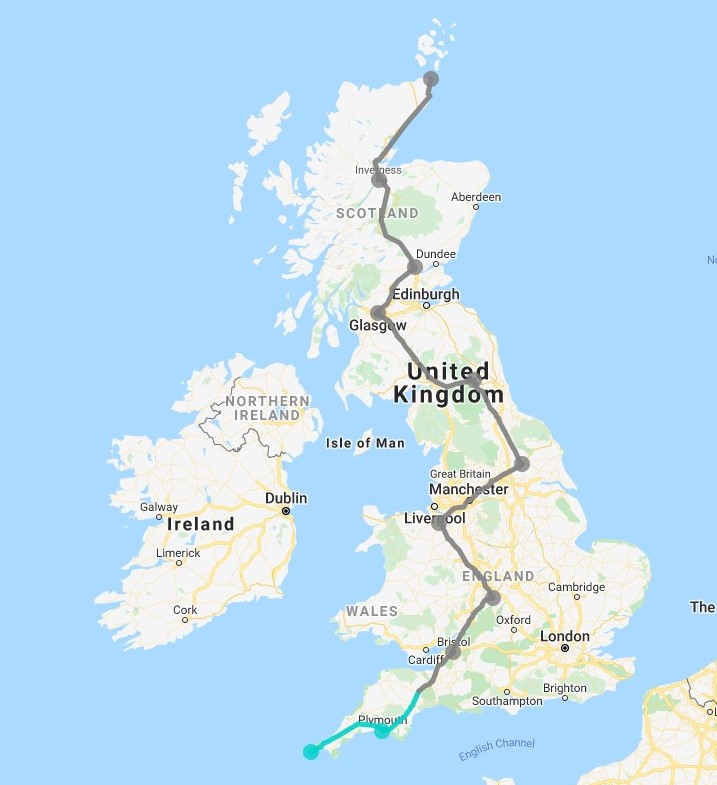
With everyone having stayed at home and everything being conducted virtually for a few months by the time of our conference, Zoom fatigue was an issue we were aware could occur and tried to counter as much as possible during the day without losing any of the exciting new research being presented. In the weeks running up to the conference we had several discussions about how to encourage people to move throughout the two days without missing any of the sessions they wanted to attend. We decided on two ideas: a yoga session and a walking challenge. The yoga session was a success and not only gave participants an opportunity to stretch in the middle of the day but also linked strongly to our theme of researcher wellbeing. The walking challenge was not as successful. The aim was that collectively the conference participants would walk the distance from Land’s End to John O’Groats. We did not make it that far; but we did make it out of Cornwall. 

Fig 3 – Using World Walking to track the distance, we intended to collectively walk the 1576km (or 2,299,172 steps) from Land’s End to John O’Groats. This may have been an optimistic endeavour as we only achieved 235km (343, 311 steps).  

Helping to organise a virtual conference as part of an enthusiastic committee was a lot of fun and attending the conference and learning about the research being undertaken (from fungi in Kew Gardens to tigers in North Korea) was even more fun. There is still enormous room for improvement in virtual conferences, but since they aren’t as well established as traditional in-person conferences there’s also a lot of flexibility for each conference to be designed differently. Once we’re through the pandemic and in-person conferences return it’d be nice for some of these benefits to be maintained as hybrid conferences are designed.   

The visual complexity of coronal mass ejections follows the solar cycle

Shannon Jones – s.jones2@pgr.reading.ac.uk

Coronal Mass Ejections (CMEs), or solar storms, are huge eruptions of particles and magnetic field from the Sun. With the help of 4,028 citizen scientists, my supervisors and I have just published a paper, showing that the appearance of CMEs changes over the solar cycle, with CMEs appearing more visually complex towards solar maximum.

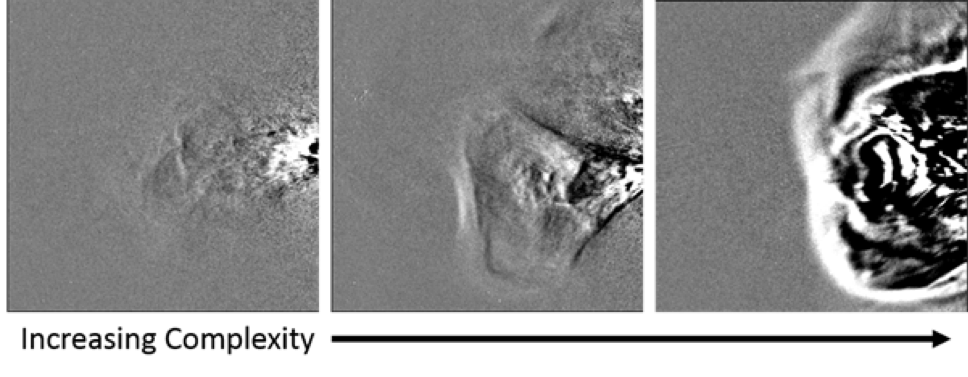
We created a Zooniverse citizen science project in collaboration with the UK Science Museum called ‘Protect our planet from solar storms’, where we showed pairs of images of CMEs from the Heliospheric (wide-angle white-light) Imagers on board the twin STEREO spacecraft, and asked participants to decide whether the left or right CME looked most complicated, or complex (Jones et al. 2020)  We used these data to rank 1,110 CMEs in order of their relative visual complexity, by fitting a Bradley-Terry model. This is a statistical model widely used by psychologists to rank items by human preference. Figure 1 shows three example storms from across the ranking (see figshare for an animation with all CMEs). When we asked the citizen scientists how they chose the most complex CME, they described complex CMEs as “big”, “messy” and “bright” with complicated “waves”, “patterns” and “shading”.

Figure 1. Example images showing three example CMEs in ranked order of subjective complexity increasing from low (left-hand image) through to high (right-hand image).

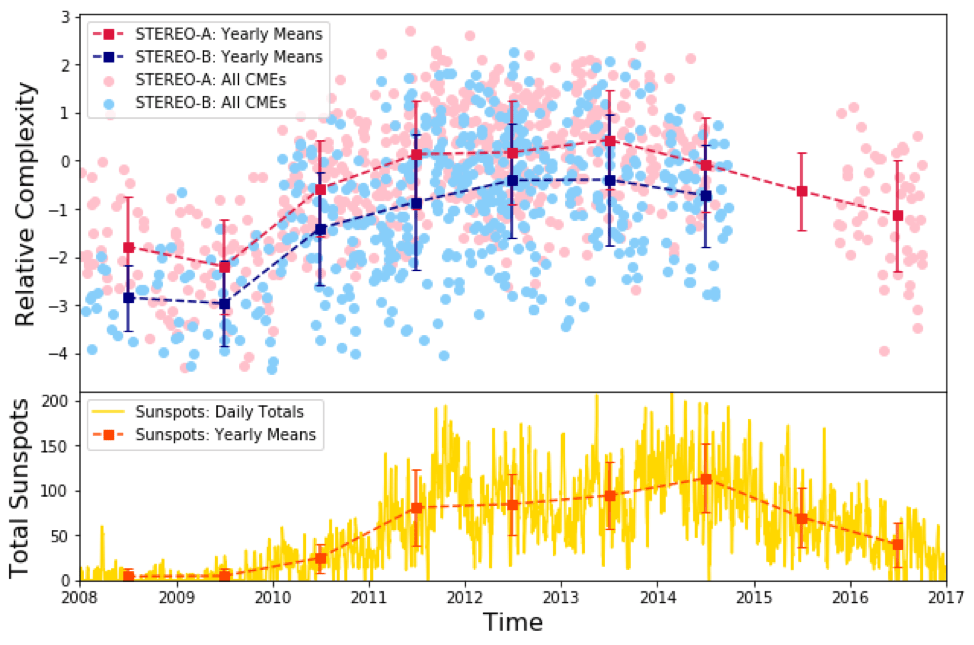
Figure 2 shows the relative complexity of all 1,110 CMEs, with CMEs observed by STEREO-A shown by pink dots, and CMEs observed by STEREO-B shown by blue dots. The lower panel shows the daily sunspot number over the same time period, using data from SILSO World Data Center. This shows that the annual average complexity values follow the solar cycle, and that the average complexity of CMEs observed by STEREO-B is consistently lower that the complexity of CMEs observed by STEREO-A. This might be due to slight differences between the imagers: STEREO-B is affected by pointing errors, which might blur smaller-scale features within the images.

Figure 2. Top panel: relative complexity of every CME in the ranking plotted against time. Pink points represent STEREO-A images, while blue points represent STEREO-B images. Annual means and standard deviations are over plotted for STEREO-A (red dashed line) and STEREO-B (blue dashed line) CMEs. Bottom panel: Daily total sunspot number from SILSO shown in yellow, with annual means over plotted (orange dashed line).

If a huge CME were to hit Earth, there could be serious consequences such as long-term power cuts and satellite damage. Many of these impacts could be reduced if we had adequate warning that a CME was going to hit. Our results suggest that there is some predictability in the structure of CMEs, which may help to improve future space weather forecasts.

We plan to continue our research and quantitatively determine which CME characteristics are associated with visual complexity. We also intend to investigate what is causing the CMEs to appear differently. Possible causes include: the complexity of the magnetic field at the CME source region on the Sun; the structure of the solar wind the CME passes through; or multiple CMEs merging, causing a CME to look more complex.

Please see the paper for more details, or email me at s.jones2@pgr.reading.ac.uk if you have any questions!

Jones, S. R., C. J. Scott, L. A. Barnard, R. Highfield, C. J. Lintott and E. Baeten (2020): The visual complexity of coronal mass ejections follows the solar cycle. Space Weather, https://doi.org/10.1029/2020SW002556.

My journey to Reading: Going from application to newly minted SCENARIO PhD student

George Gunn – g.f.gunn@pgr.reading.ac.uk 

Have you been thinking ‘I’ll never be good enough for a PhD’? Or perhaps you’ve been set on the idea of joining those who push the bounds of knowledge for quite some time, but are feeling daunted by the process? Well, keep reading. 

I started university with the hopes of stretching myself academically and gaining an undergraduate degree. As the degree progressed, I found myself increasingly improving in my marks and abilities. I enjoyed the coursework – researching a topic and the sense of discovery brought about by it. I became deeply interested in climate change and the impact humans have on the environment and was able to begin my dissertation research a year early because I was so motivated within my subject. 

In my final year of undergraduate studies, much of my time was pre-occupied with my role as Student President. Attending social events, board meetings, and lots of other things that didn’t involve a darkened room and a pile of books. I was very much a student who turned up, put the effort in, and then spent the rest of my time as I wished.  

Giving a speech at the Global Youth Strike for Climate, Inverness, as Student President. Extracurricular activities are a worthwhile addition to your application and were considered a lot during the interview! 

I began to look for opportunities for research degrees online, as well as asking almost anyone and everyone I knew academically if they had any ideas. Nothing came to fruition. That was until I received a Twitter notification from my lecturer drawing my attention to what looked to be an ideal PhD studentship. The snag? Applications were due to close within 3 hours of me checking the notification. 

By the time I had read the project particulars, accessed the cited literature and paced around my living room more than a few times, I had around 2 hours to submit an application. Due to my prior unsuccessful searches, I hadn’t previously submitted a PhD application and so had nothing to refer to – but proceed I did.  

Thankfully, the application was relatively straightforward. Standard job application information, details of the grades I had achieved and was predicted to achieve, and two academic references (for me, my personal academic tutor and climate change lecturer). What took time (I would advise anyone considering an application to prepare these earlier than I did!) was the statement of research interest and academic CV. My university careers service had excellent advice and resources to assist in that regard. 

Within minutes of the deadline, my application was in. I had almost forgotten about it by the time a week-or-so later I received an e-mail inviting me to Reading for an interview day. Shocked and excited were the emotions – little old me from the Highlands of Scotland, who hadn’t yet finished his undergraduate degree, was somehow being invited to one of the best Meteorology departments in the world to interview for a PhD studentship.  

No time to spare, my travel to and from Reading was booked. For the next couple of weeks, all I now had to worry about was how to do a PhD interview – though as will become clear, I need not have worried. I sought the advice of academic friends and colleagues (a calming influence for sure) and countless websites and forums (generally a source of unnecessary worry). 

Given the level of conflicting advice on PhD interviews, on arrival at Reading I wasn’t sure what to expect. At the front door I was provided with all the information that I needed for the day. I then made my way to a room with all the other candidates for a welcome talk and the opportunity to learn more about other projects on offer over lunch. 

The interview itself was very relaxed. No ‘stock’ PhD interview questions here – it was very much an opportunity to discuss my previous work and abilities, and how that might fit with the project. Importantly, it was an opportunity to meet my potential supervisors and ‘interview’ them too. If you’re going to spend 3-4 years working together, the connection needs to work well both ways. So, whilst the 30-minute interview slot seemed daunting on paper, the time flew by and it was soon time to leave. 

Fast forward a week or so and I was very surprised to receive an e-mail offering me the studentship that I had applied for: Developing an urban canopy model for improved weather forecasts in cities. And the rest, as they say, is history. 

At my desk in the Department of Meteorology, University of Reading. 

I hope that this blog post has helped you to feel less daunted to begin your PhD journey. Please feel free to get in touch with me by e-mail if you would like to chat further about beginning a PhD, or indeed to let me know how your own interview goes. Good luck! 

The Scandinavia-Greenland Pattern: something to look out for this winter

Simon Lee, s.h.lee@pgr.reading.ac.uk

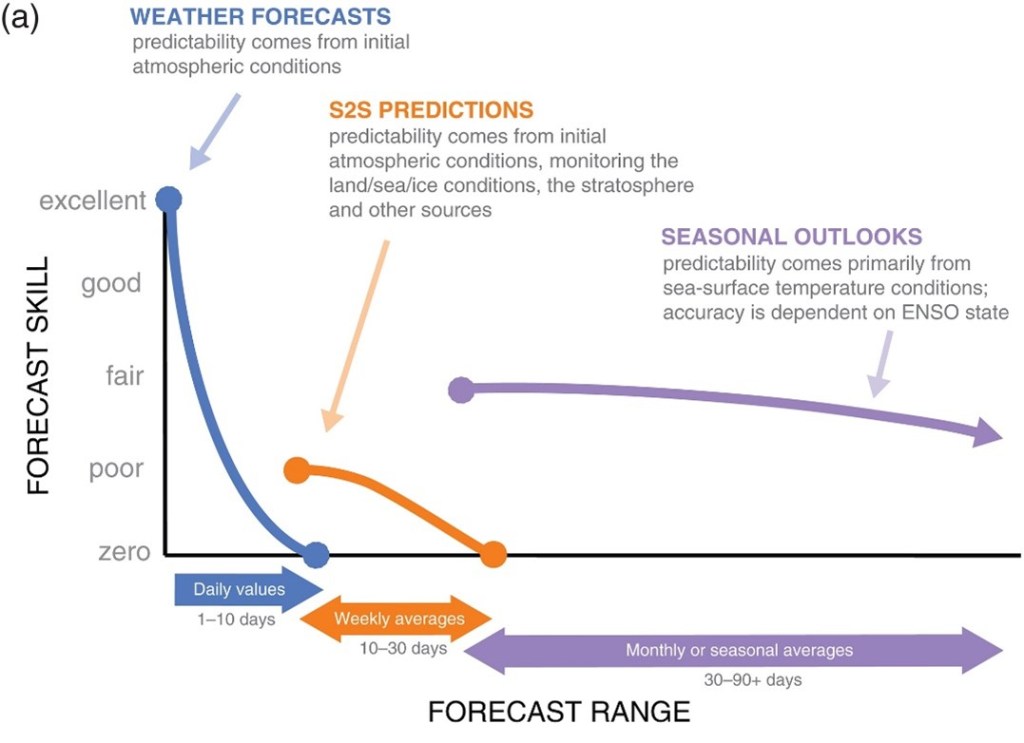
The February-March 2018 European cold-wave, known widely as “The Beast from the East” occurred around 2 weeks after a major sudden stratospheric warming (SSW) event on February 12th. Major SSWs typically occur once every other winter, involving significant disruption to the stratospheric polar vortex (a planetary-scale cyclone which resides over the pole in winter). SSWs are important because their occurrence can influence the type and predictability of surface weather on longer timescales of between 2 weeks to 2 months. This is known as subseasonal-to-seasonal (S2S) predictability, and “bridges the gap” between typical weather forecasts and seasonal forecasts (Figure 1).  

Figure 1: Schematic of medium-range, S2S and seasonal forecasts and their relative skill. [Figure 1 in White et al. (2017)] 

In general, S2S forecasts suffer from relatively low skill. While medium-range forecasts are an initial value problem (depending largely on the initial conditions of the forecast) and seasonal forecasts are a boundary value problem (depending on slowly-varying constraints to the predictions, such as the El Niño-Southern Oscillation), S2S forecasts lie somewhere between the two. However, certain “windows of opportunity” can occur that have the potential to increase S2S skill – and a major SSW is one of them. Skilful S2S forecasts can be of particular benefit to public health planners, the transport sector, and energy demand management, among many others.  

Following an SSW, the eddy-driven jet stream tends to weaken and shift equatorward. This is characteristic of the negative North Atlantic Oscillation (NAO) and negative Arctic Oscillation (AO), and during these patterns the risk of cold air outbreaks significantly increases in places like northwest Europe. So, by knowing this, S2S forecasts issued during the major SSW were able to highlight the increased risk of severely cold weather.  

Given that we know that following an SSW certain weather types are more likely for several weeks, and forecasts may be more skilful, it might seem advantageous to know an SSW was coming at a long lead-time in order to really push the boundaries of S2S prediction. So, what about in 2018?  

In the first paper from my PhD, published in July 2019 in JGR-Atmospheres, we explored the onset of predictions of the February 2018 SSW. We found that, until about 12 days beforehand, extended-range forecasts that contribute to the S2S database (an international collaboration of extended-range forecast data) did not accurately predict the event; in fact, most predictions indicated the vortex would remain unusually strong! 

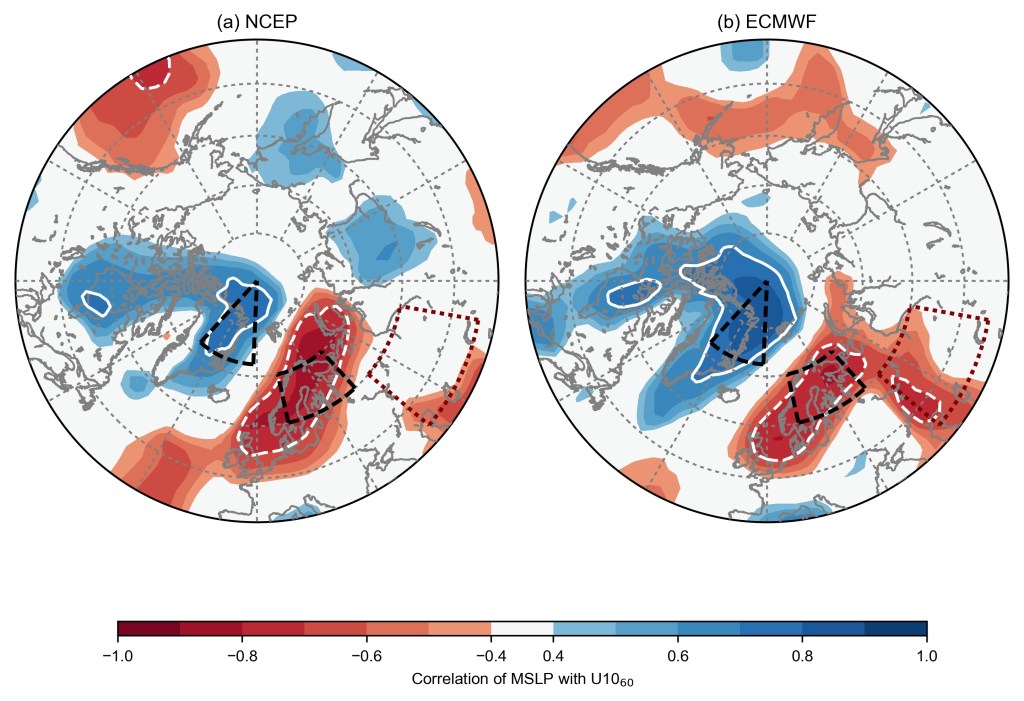
We diagnosed that anticyclonic wave breaking in the North Atlantic was a crucial synoptic-scale “trigger” event for perturbing the stratospheric vortex, by enhancing vertically propagating Rossby waves (which weaken the vortex when they break in the stratosphere). Forecasts struggled to predict this event far in advance, and thus struggled to predict the SSW. We called the pattern the “Scandinavia-Greenland (S-G) dipole” – characterised by an anticyclone over Scandinavia and a low over Greenland (Figure 2), and we found it was present before 35% of previous SSWs (1979-2018). The result agrees with several previous studies highlighting the role of blocking in the Scandinavia-Urals region, but was the first to suggest such a significant impact of a single tropospheric event.  

Figure 2: Correlation between mean sea level pressure forecasts over 3-5 February 2018 and subsequent forecasts of 10 hPa 60°N zonal-mean zonal wind on 9-11 February, in (a) NCEP and (b) ECMWF ensembles launched between 29 January and 1 February 2018. White lines (dashed negative) indicate correlations exceeding +/- 0.7, while the black dashed lines indicate the nodes of the S-G dipole. [Figure 3 in Lee et al. (2019)] 

So, we had established the S-G dipole was important in the predictability onset in 2018, and important in previous cases – but how well do S2S models generally capture the pattern?  

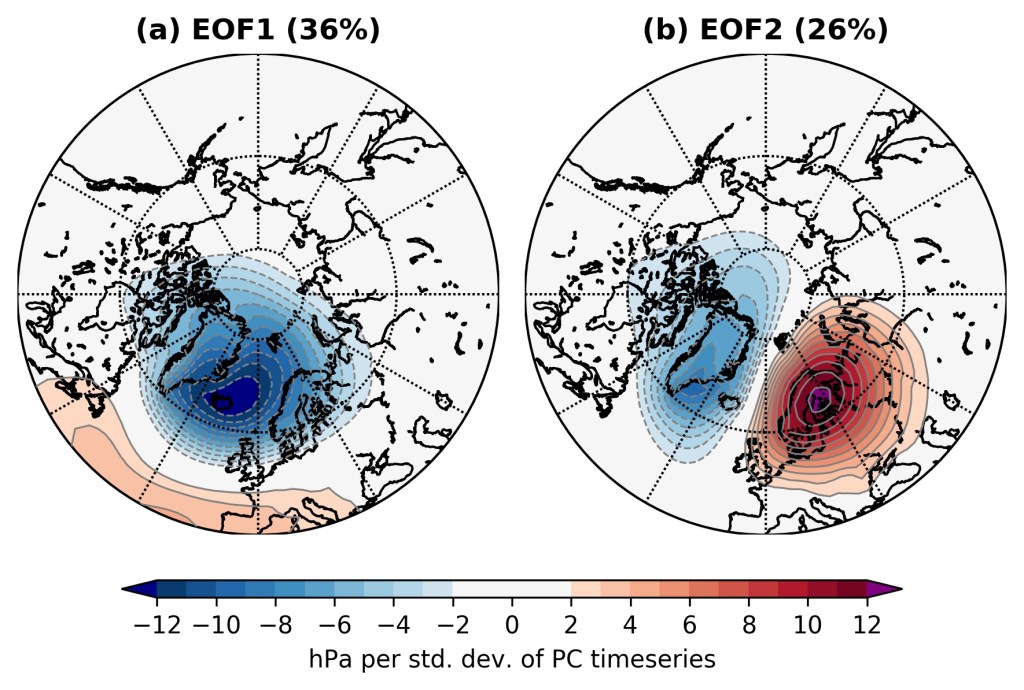
That was the subject of our recent (open-access) paper, published in August in QJRMS. We define a more generalised pattern by performing empirical orthogonal function (EOF) analysis on mean sea-level pressure anomalies in a region of the northeast Atlantic during November-March in ERA5 reanalysis (Figure 3).  While the leading EOF (the “zonal pattern”) resembles the NAO, the 2nd EOF resembles the S-G dipole from our previous paper – so we call it the “S-G pattern”.  

Figure 3: The first two leading EOFs of MSLP anomalies in the northeast Atlantic during November-March in ERA5, expressed as hPa per standard deviation of the principal component timeseries. The percentage of variance explained by the EOF is also shown. [Figure 1 in Lee et al. (2020) 

We then establish, through lagged linear regression analysis, that the S-G pattern is associated with enhanced vertically propagating wave activity (measured by zonal-mean eddy heat flux) into the stratosphere, and a subsequently weakened stratospheric vortex for the next 2 months. Thus, it supports our earlier work, and motivates considering how the pattern is represented in S2S models. To do this, we look at hindcasts – forecasts initialised for dates in the past – from 10 different prediction systems from around the world.  

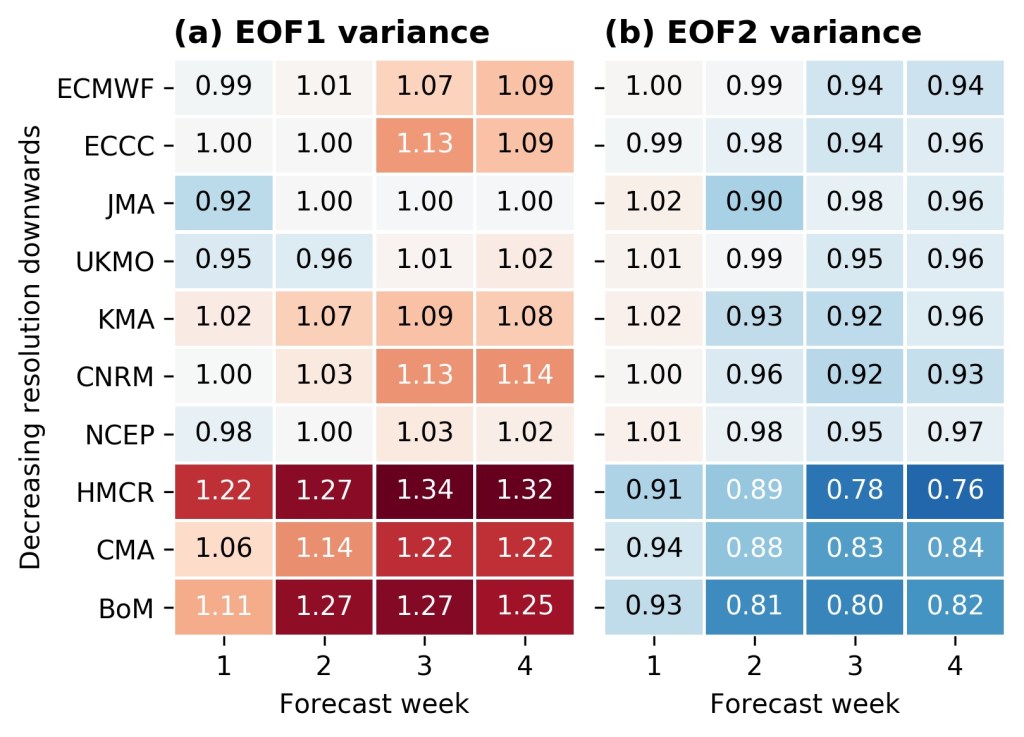
We find that while all the S2S models represent the spatial pattern of these two EOFs very well, some have biases in the variance explained by the EOFs, particularly at weeks 3 and 4 (Figure 4). Broadly, all the models have more variance explained by their first EOF compared with ERA5, and less by the second EOF – but this bias is particularly large for the three models with the lowest horizontal resolution (BoM, CMA, and HMCR).  

Figure 4: Weekly-mean ratio between the variance explained by the EOFs in each model and the ERA5 EOF. [Figure 6 in Lee et al. (2020)] 

Additionally, we find that the deterministic prediction skill in the S-G pattern (measured by the ensemble-mean correlation) can be as small as 5-6 days for the BoM model – and only as high as 11 days in the higher resolution models. Extending this to probabilistic skill in weeks 3 and 4, we find models have only limited (if any) skill above climatology in weeks 3 and 4 (and much less than the skill in the leading EOF, the NAO-like pattern).  

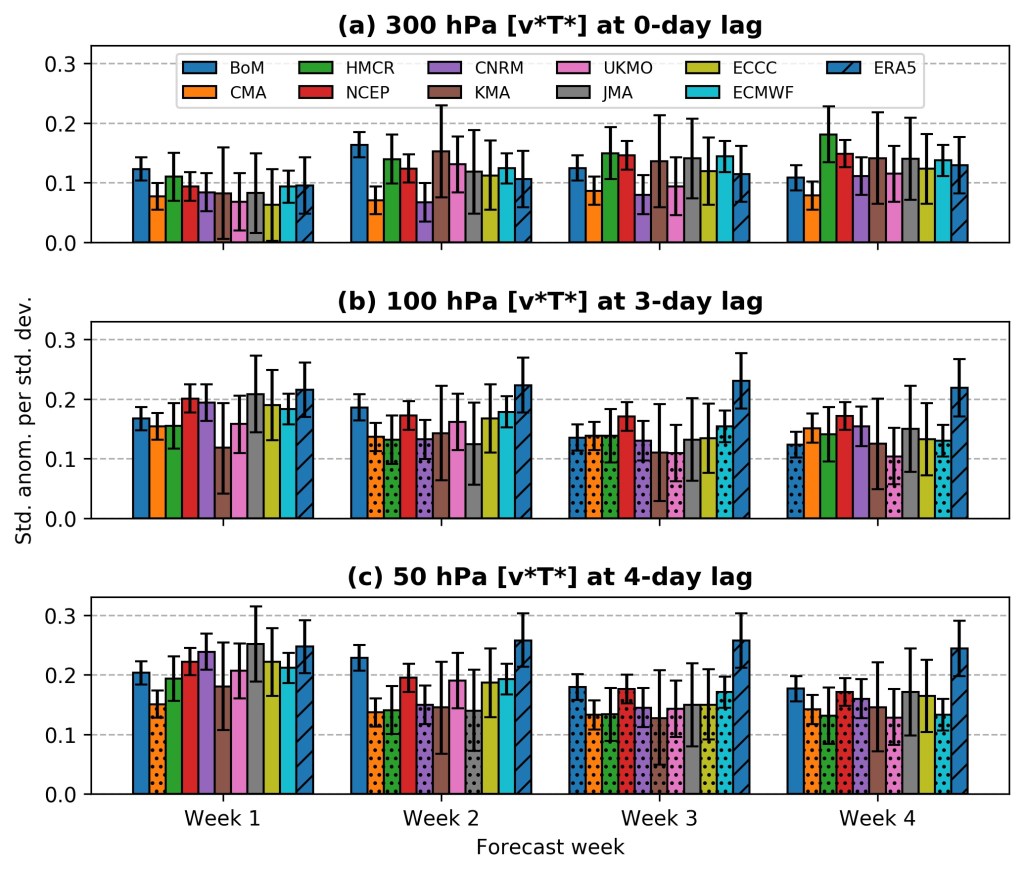
Furthermore, we find that the relationship between the S-G pattern and the enhanced heat flux in the stratosphere decays with lead-time in most S2S models, even in the higher-resolution models (Figure 5). Thus, this suggests that the dynamical link between the troposphere and stratosphere weakens with lead time in these models – so even a correct tropospheric prediction may not, in these cases, have a subsequently accurate extended-range stratospheric forecast. 

Figure 5: Weekly mean regression coefficients between the S–G index and the corresponding eddy heat flux anomalies at (a) 300 hPa on the same day, (b) 100 hPa three days later, and (c) 50 hPa four days later. The lags correspond to days with maximum correlation in ERA5. Stippled bars indicate a significant difference from ERA5 at the 95% confidence level. [Figure 11 in Lee et al. (2020)] 

So, when taking this all together, we have: 

  • The S-G pattern is the second-leading mode of MSLP variability in the northeast Atlantic during winter. 
  • It is associated with enhanced vertically propagating wave activity into the stratosphere and a weakened polar vortex in the following weeks to months. 
  • S2S models represent the spatial patterns of the two leading EOFs well. 
  • Most S2S models have a zonal variability bias, with relatively more variance explained by the leading EOF and correspondingly less in the second EOF.  
  • This bias is largest in the lowest-resolution models in weeks 3 and 4.  
  • Extended range skill in the S-G pattern is low, and lower than for the NAO-like zonal pattern. 
  • The linear relationship between the S-G pattern and eddy heat flux in the stratosphere decays with lead-time in most S2S models.  

The zonal variance bias is consistent with S2S model biases in Rossby wave breaking and blocking, while these biases have been widely found to be largest in the lowest resolution models. The results suggest that the poor prediction of the S-G event in February 2018 is not unique to that case, but a more generic issue. Overall, the combination of the variability biases, the poor extended-range predictability, and the poor representation of its impact on the stratospheric vortex at longer lead-times likely contributes to limiting skill at predicting major SSWs on S2S timescales – which remains low, despite the stratosphere’s much longer timescales. Correcting the biases outlined here will likely contribute to improving this skill, and subsequently increasing how far we are able to predict real-world weather.   

How Important are Post-Tropical Cyclones to European Windstorm Risk?

Elliott Sainsbury, e.sainsbury@pgr.reading.ac.uk

To date, the 2020 North Atlantic hurricane season has been the most active on record, producing 20 named storms, 7 hurricanes, and a major hurricane which caused $9 billion in damages across the southern United States. With the potential for such destructive storms, it is understandable that a large amount of attention is paid to the North Atlantic basin at this time of year. Whilst hurricanes have been known to cause devastation in the tropics for centuries, until recently there was little appreciation for the destructive potential of these systems across Europe.

As tropical cyclones such as hurricanes move poleward – away from the tropics and into regions of lower sea surface temperatures and higher vertical wind shear, they undergo a process called extratropical transition (Klein et al., 2000): Over a period of time, the cyclones change from symmetric, warm cored systems into asymmetric cold core systems fuelled by horizontal temperature gradients, as opposed to latent heat fluxes (Evans et al., 2017). These systems, so-called post-tropical cyclones (PTCs), often reintensify in the mid-latitude Atlantic with consequences for land masses downstream – often Europe. This was highlighted in 2017, when ex-hurricane Ophelia impacted Ireland, bringing with it the strongest winds Ireland had seen in 50 years (Stewart, 2018). 3 people were killed, and 360,000 homes were without power.

In a recent paper, we quantify the risk associated with PTCs across Europe relative to mid-latitude cyclones (MLCs) for the first time – in terms of both the absolute risk (i.e. what fraction of high impact wind events across Europe are caused by PTCs?) and also the relative risk (for a given PTC, how likely is it to be associated with high-impact winds, and how does this compare to a given MLC?). By tracking all cyclones impacting a European domain (36-70N, 10W-30E) in the ERA5 reanalysis (1979-2017) using a feature tracking algorithm (Hodges, 1994, 1995, 1999), we identify the post-tropical cyclones using spatiotemporal matching (Hodges et al., 2017) with the observational record, IBTrACS (Knapp et al., 2010).

Figure 1: Distributions of the maximum intensity (maximum wind speed, minimum MSLP) attained by each PTC and MLC inside (a-c) the whole European domain (36-70N, 10W-30E), (d-f) the Northern Europe domain (48-70N, 10W-30E) and (g-i) the Southern Europe domain (36-48N, 10W-30E), using cyclones tracked through the ERA5 reanalysis all year round, 1979-2017. [Figure 2 in Sainsbury et al. 2020].

Figure 1 shows the distributions of maximum intensity for PTCs and MLCs across the entire European domain (top), Northern Europe (48-70°N, 10°W-30°E; middle) and Southern Europe (36-48°N, 10°W-30°E; bottom), using all cyclone tracks all year round. The distribution of PTC maximum intensities is higher (in terms of both wind speed and MSLP) than MLCs, particularly across Northern Europe. The difference between the maximum intensity distributions of PTCs and MLCs across Northern Europe is statistically significant (99%). PTCs are also present in the highest of intensity bins, indicating that the strongest PTCs have intensities comparable to strong wintertime MLCs.

Whilst Figure 1 shows that PTCs are stronger than MLCs even when considering MLCs forming all year round (including the often much stronger wintertime MLCs), it is also useful to compare the risks posed by PTCs relative to MLCs forming at the same time of the year – during the North Atlantic hurricane season (June 1st-November 30th).

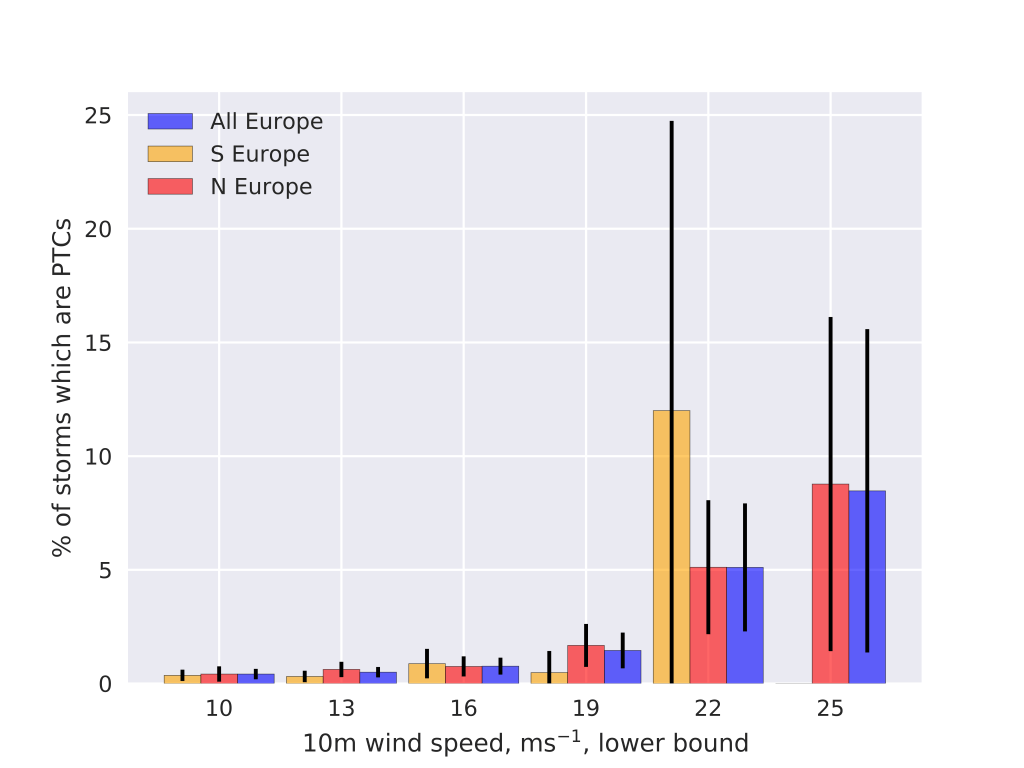
Figure 2 shows the fraction of all storms, binned by their maximum intensity in their respective domains, which are PTCs. For storms with weak-moderate maximum winds (first three bins in the figure), <1% of such events are caused by PTCs (with the remaining 99% caused by MLCs). For stronger storms, particularly those of storm force (>25 ms-1 on the Beaufort scale), this percentage is much higher. Despite less than 1% of all storms impacting Northern Europe during hurricane season being PTCs, almost 9% of all storms with storm-force winds which impact the region are PTCs, suggesting that a disproportionate fraction of high-impact windstorms are PTCs. 8.2% of all Northern Europe impacting PTCs which form during hurricane season impact the region with storm-force winds. This fraction is only 0.8% for MLCs, suggesting that the fraction of PTCs impacting Northern Europe with storm-force winds is approximately 10 times greater than MLCs.

Figure 2: The fraction of cyclones impacting Europe which are PTCs as a function of their maximum 10m wind speed in their respective domain. Lower bound of wind speed is shown on the x axis, bin width = 3. Error bars show the 95% confidence interval. All cyclone tracks forming during the North Atlantic hurricane season are used. [Figure 4 in Sainsbury et al. 2020].

Here we have shown that PTCs, at their maximum intensity over Northern Europe, are stronger than MLCs. However, the question still remains as to why this is the case. Warm-seclusion storms post-extratropical transition have been shown to have the fastest rates of reintensification (Kofron et al., 2010) and typically have the lowest pressures upon impacting Europe (Dekker et al., 2018). Given the climatological track that PTCs often take over the warm waters of the Gulf stream, along with the contribution of both baroclinic instability and latent heat release for warm-seclusion development (Baatsen et al., 2015), one hypothesis may be that PTCs are more likely to develop into warm seclusion storms than the broader class of mid-latitude cyclones, potentially explaining the disproportionate impacts they cause across Europe. This will be the topic of future work.

Despite PTCs disproportionately impacting Europe with high intensities, they are a relatively small component of the total cyclone risk in the current climate. However, only small changes are expected in MLC number and intensity under RCP 4.5 (Zappa et al., 2013). Conversely, the number of hurricane-force (>32.6 ms-1) storms impacting Norway, the North Sea and the Gulf of Biscay has been projected to increases by a factor of 6.5, virtually all of which originate in the tropics (Haarsma et al., 2013). Whilst the absolute contribution of PTCs to hurricane season windstorm risk is currently low, PTCs may make an increasingly significant contribution to European windstorm risk in a future climate.

Interested to read more? Read our paper, published in Geophysical Research Letters.

Sainsbury, E. M., R. K. H. Schiemann, K. I. Hodges, L. C. Shaffrey, A. J. Baker, K. T. Bhatia, 2020: How Important Are Post‐Tropical Cyclones for European Windstorm Risk? Geophysical Research Letters, 47(18), e2020GL089853, https://doi.org/10.1029/2020GL089853

References

Baatsen, M., Haarsma, R. J., Van Delden, A. J., & de Vries, H. (2015). Severe Autumn storms in future Western Europe with a warmer Atlantic Ocean. Climate Dynamics, 45, 949–964. https://doi.org/10.1007/s00382-014-2329-8

Dekker, M. M., Haarsma, R. J., Vries, H. de, Baatsen, M., & Delden, A. J. va. (2018). Characteristics and development of European cyclones with tropical origin in reanalysis data. Climate Dynamics, 50(1), 445–455. https://doi.org/10.1007/s00382-017-3619-8

Evans, C., Wood, K. M., Aberson, S. D., Archambault, H. M., Milrad, S. M., Bosart, L. F., et al. (2017). The extratropical transition of tropical cyclones. Part I: Cyclone evolution and direct impacts. Monthly Weather Review, 145(11), 4317–4344. https://doi.org/10.1175/MWR-D-17-0027.1

Haarsma, R. J., Hazeleger, W., Severijns, C., De Vries, H., Sterl, A., Bintanja, R., et al. (2013). More hurricanes to hit western Europe due to global warming. Geophysical Research Letters, 40(9), 1783–1788. https://doi.org/10.1002/grl.50360

Hodges, K., Cobb, A., & Vidale, P. L. (2017). How well are tropical cyclones represented in reanalysis datasets? Journal of Climate, 30(14), 5243–5264. https://doi.org/10.1175/JCLI-D-16-0557.1

Hodges, K. I. (1994). A general method for tracking analysis and its application to meteorological data. Monthly Weather Review, 122(11), 2573–2586. https://doi.org/10.1175/1520-0493(1994)122<2573:AGMFTA>2.0.CO;2

Hodges, K. I. (1995). Feature Tracking on the Unit Sphere. Monthly Weather Review, 123(12), 3458–3465. https://doi.org/10.1175/1520-0493(1995)123<3458:ftotus>2.0.co;2

Hodges, K. I. (1999). Adaptive constraints for feature tracking. Monthly Weather Review, 127(6), 1362–1373. https://doi.org/10.1175/1520-0493(1999)127<1362:acfft>2.0.co;2

Klein, P. M., Harr, P. A., & Elsberry, R. L. (2000). Extratropical transition of western North Pacific tropical cyclones: An overview and conceptual model of the transformation stage. Weather and Forecasting, 15(4), 373–395. https://doi.org/10.1175/1520-0434(2000)015<0373:ETOWNP>2.0.CO;2

Knapp, K. R., Kruk, M. C., Levinson, D. H., Diamond, H. J., & Neumann, C. J. (2010). The international best track archive for climate stewardship (IBTrACS). Bulletin of the American Meteorological Society, 91(3), 363–376. https://doi.org/10.1175/2009BAMS2755.1

Kofron, D. E., Ritchie, E. A., & Tyo, J. S. (2010). Determination of a consistent time for the extratropical transition of tropical cyclones. Part I: Examination of existing methods for finding “ET Time.” Monthly Weather Review, 138(12), 4328–4343. https://doi.org/10.1175/2010MWR3180.1

Stewart, S. R. (2018). Tropical Cyclone Report: Hurricane Ophelia. National Hurricane Center, (February), 1–32. https://doi.org/AL142016

Zappa, G., Shaffrey, L. C., Hodges, K. I., Sansom, P. G., & Stephenson, D. B. (2013). A multimodel assessment of future projections of North Atlantic and European extratropical cyclones in the CMIP5 climate models. Journal of Climate, 26(16), 5846–5862. https://doi.org/10.1175/JCLI-D-12-00573.1

Exploring the impact of variable floe size on the Arctic sea ice

Email: a.w.bateson@pgr.reading.ac.uk

The Arctic sea ice cover is made up of discrete units of sea ice area called floes. The size of these floes has an impact on several sea ice processes including the volume of melt produced at floe edges, the momentum exchange between the sea ice, ocean, and atmosphere, and the mechanical response of the sea ice to stress. Models of the sea ice have traditionally assumed that floes adopt a uniform size, if floe size is explicitly represented at all in the model. Observations of floes show that floe size can span a huge range, from scales of metres to tens of kilometres. Generally, observations of the floe size distribution (FSD) are fitted to a power law or a combination of power laws (Stern et al., 2018a).

The Los Alamos sea ice model, hereafter referred to as CICE, usually assumes a fixed floe size of 300 m. We can impose a simple FSD model into CICE derived from a power law to explore the impact of variable floe size on the sea ice cover. Figure 1 is a diagram of the WIPoFSD model (Waves-in-Ice module and Power law Floe Size Distribution model), which assumes a power law with a fixed exponent, \alpha, between a lower floe size cut-off, d_{min}, and an upper floe size cut-off, d_{max}. The model also incorporates a floe size variable, l_{var}, to capture the effects of processes that can influence floe size. The processes represented are wave break-up of floes, melting at the floe edge, winter floe growth, and advection. The model includes a wave advection and attenuation scheme so that wave properties can be determined within the sea ice field to enable the identification of wave break-up events. Full details of the WIPoFSD model and its implementation into CICE are available in Bateson et al. (2020). For the WIPoFSD model setup considered here, we explore the impact of the FSD on the lateral melt rate, which is the melt rate at the edge surfaces of floes. It is useful to define a new FSD metric that can be used to characterise the impact of the FSD on lateral melt. To do this we note that the lateral melt volume produced by a floe is proportional to the perimeter of the floe. The effective floe size, l_{eff}, is defined as a fixed floe size that would produce the same lateral melt rate as a given FSD, for a fixed total sea ice area.
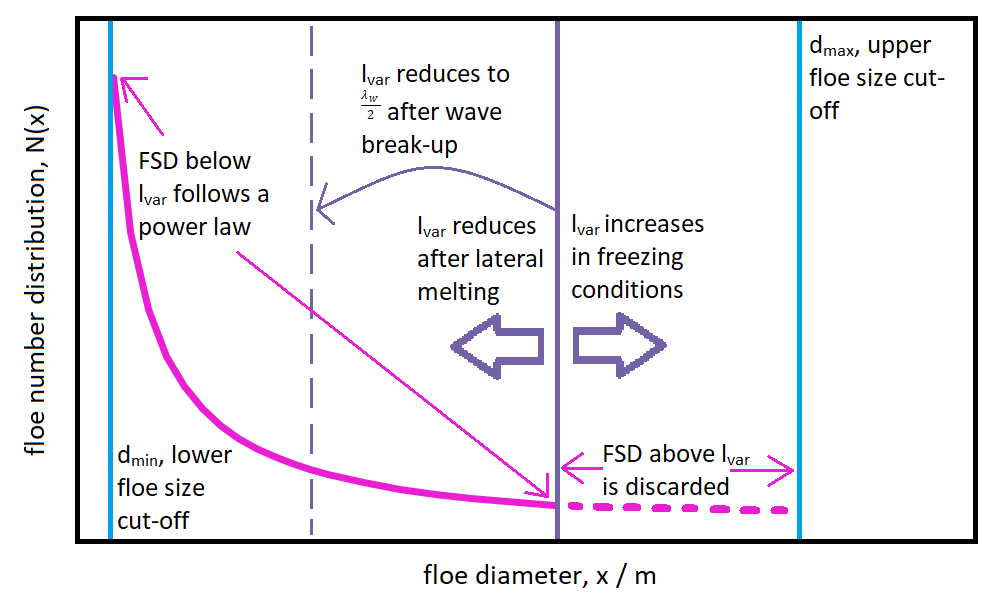
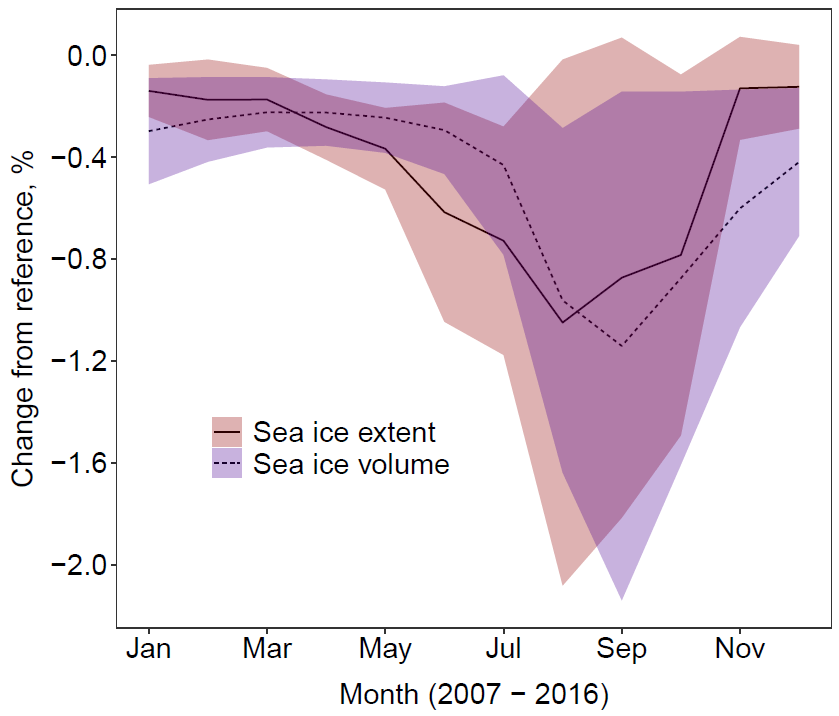
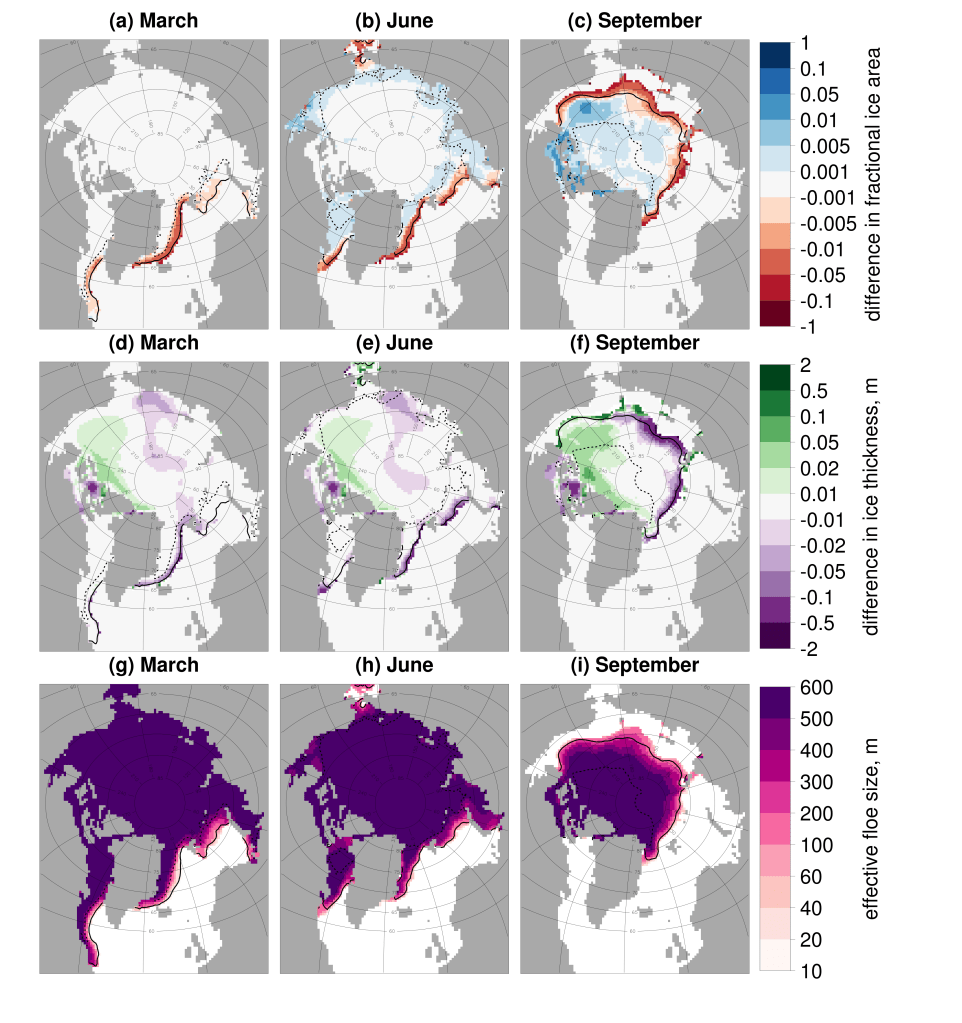
Figure 1: A schematic of the imposed FSD model. This model is initiated by prescribing a power law with an exponent, \alpha, and between the limits d_{min} and d_{max}. Within individual grid cells the variable FSD tracer, l_{var}, varies between these two limits. l_{var} evolves through lateral melting, wave break-up events, freezing, and advection.

Here we will compare a CICE simulation incorporating the WIPoFSD model, hereafter referred to as stan-fsd, to a reference case, ref, using the CICE standard fixed floe size of 300 m. For the WIPoFSD model, d_{min} = 10 m, d_{max} = 30 km, and \alpha = -2.5. These values have been selected as representative values from observations. The reference setup is initiated in 1990 and spun-up until 2005, when either continued as ref or the WIPoFSD model imposed for stan-fsd before being evaluated from 2006 – 2016. All figures in this post are given as a mean over 2007 – 2016, such that 2005 – 2006 is a period of spin-up for the incorporated WIPoFSD model.

In Figure 2, we show the percentage reduction in the Arctic sea ice extent and volume of stan-fsd relative to ref. The differences in both extent and volume over the pan-Arctic scale evolve over an annual cycle, with maximum differences of -1.0 % in August and -1.1 % in September respectively. The annual cycle corresponds to periods of melting and freeze-up and is a product of the nature of the imposed FSD. Lateral melt rates are a function of floe size, but freeze-up rates are not, hence model differences only increase during periods of melting and not during periods of freeze-up. The difference in sea ice extent reduces rapidly during freeze-up because this freeze-up is predominantly driven by ocean surface properties, which are strongly coupled to atmospheric conditions in areas of low sea ice extent. In comparison, whilst atmospheric conditions initiate the vertical sea ice growth, this atmosphere-ocean coupling is rapidly lost due to insulation of the warmer ocean from the cooler atmosphere once sea ice extends across the horizontal plane. Hence a residual difference in sea ice thickness and therefore volume propagates throughout the winter season. The interannual variability shows that the impact of the WIPoFSD model with standard parameters varies significantly depending on the year.

Figure 2: Difference in sea ice extent (solid, red ribbon) and volume (dashed, blue ribbon) between stan-fsd relative to ref averaged over 2007–2016. The ribbon shows the region spanned by the mean value plus or minus 2 times the standard deviation for each simulation. This gives a measure of the interannual variability over the 10-year period.

Although the pan-Arctic differences in extent and volume shown in Figure 2 are marginal, differences are larger when considering smaller spatial scales. Figure 3 shows the spatial distribution in the changes in sea ice concentration and thickness in March, June, and September for stan-fsd relative to ref in addition to the spatial distribution in l_{eff} for stan-fsd for the same months. Reductions in the sea ice concentration and thickness of up to 0.1 and 50 cm observed respectively in the September marginal ice zone (MIZ). Within the pack ice, increases in the sea ice concentration of up to 0.05 and ice thickness of up to 10 cm can be seen. To understand the non-uniform spatial impacts of the FSD, it is useful to look at the behaviour of l_{eff}. Regions with an l_{eff} greater than 300 m will experience less lateral melt than the equivalent location in ref (all other things being equal) whereas locations with an l_{eff} below 300 m will experience more lateral melt. In Figure 3 we see the transition to values of l_{eff} smaller than 300 m in the MIZ, hence most of the sea ice cover experiences less lateral melting for stan-fsd compared to ref.

Figure 3: Difference in the sea ice concentration (top row, a-c) and thickness (middle row, d-f) between stan-fsd and ref and l_{eff} (bottom row, g-i) for stan-fsd averaged over 2007 – 2016. Results are presented for March (left column, a, d, g), June (middle column, b, e, h) and September (right column, c, f, i). Values are shown only in locations where the sea ice concentration exceeds 5 %.

For Figures 2-3, the parameters used to define the FSD have been set to fixed, standard values. However, these parameters vary significantly between different observed FSDs. It is therefore useful to explore the model sensitivity to these parameters. For α values of -2, -2.5, -3 and -3.5 have been selected to span the general range of values reported in observations (Stern et al., 2018a). For d_{min} values of 1 m, 20 m and 50 m are selected to reflect the different behaviours reported in studies, with some showing power law behaviour extending to 1 m (Toyota et al., 2006) and others showing a tailing off at an order of 10 s of metres (Stern et al., 2018b). For the upper cut-off, d_{max}, values of 1000 m, 10,000 m, 30,000 m and 50,000 m are selected, again to represent the distributions reported in different studies. 50 km is taken as the largest value for d_{max} as this serves as an upper limit to what can be resolved within an individual grid cell on a CICE 1^{\circ} grid. A total of 19 sensitivity studies have been completed used different permutations of the stated values for the FSD model parameters. Figure 4 shows the change in mean September sea ice extent and volume relative to ref plotted against mean annual l_{eff}, averaged over the sea ice extent, for each of these sensitivity studies. The impacts range from a small increase in extent and volume to large reductions of -22 % and -55 % respectively, even within the parameter space defined by observations. Furthermore, there is almost a one-to-one mapping between mean l_{eff} and extent and volume reduction. This suggests l_{eff} is a useful diagnostic tool to predict the impact of a given set of floe size parameters. The system varies most in response to the changes in the α, but it is also particularly sensitive to d_{min}.
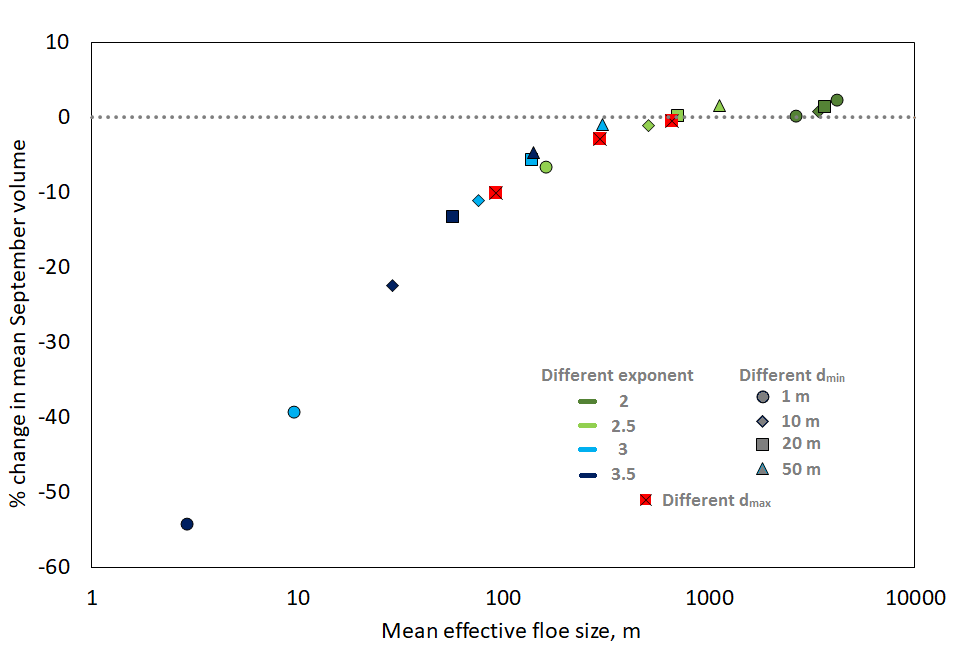
Figure 4: Relative change (%) in mean September sea ice volume from 2007 – 2016 respectively, plotted against mean l_{eff} for simulations with different selections of parameters relative to ref. The mean l_{eff} is taken as the equally weighted average across all grid cells where the sea ice concentration exceeds 15%. The colour of the marker indicates the value of the \alpha, the shape indicates the value of d_{min}, and the three experiments using standard parameters but different d_{max} (1000 m, 10000 m and 50000 m) are indicated by a crossed red square. The parameters are selected to be representative of a parameter space for the WIPoFSD model that has been constrained by observations.

There are several advantages to the assumption of a fixed power law in modelling the sea ice floe size distribution. It provides a simple framework to explore the potential impact of an observed FSD on the sea ice mass balance, given observations of the FSD are generally fitted to a power law. In addition, the use of a simple model makes it easier to constrain the mechanism of how the model changes the sea ice cover. However, there are also significant disadvantages including the high model sensitivity to poorly constrained parameters, as shown in Figure 4. In addition, there is evidence both that the exponent evolves over an annual cycle and is not a fixed value (Stern et al., 2018b) and that the power law is not a statistically valid description of the FSD over all floe sizes (Horvat et al., 2019). An alternative approach to modelling the FSD is the prognostic model of Roach et al. (2018, 2019). The prognostic model avoids any assumptions about the shape of the distribution and instead assigns sea ice area to a set of adjacent floe size categories, with individual processes parameterised at floe scale. This approach carries its own set of challenges. If important physical processes are missing from the model it will not be possible to simulate a physically realistic distribution. In addition, the prognostic model has a significant computational cost. In practice, the choice of FSD modelling approach will depend on the application.

Further reading
Bateson, A. W., Feltham, D. L., Schröder, D., Hosekova, L., Ridley, J. K. and Aksenov, Y.: Impact of sea ice floe size distribution on seasonal fragmentation and melt of Arctic sea ice, Cryosphere, 14, 403–428, https://doi.org/10.5194/tc-14-403-2020, 2020.

Horvat, C., Roach, L. A., Tilling, R., Bitz, C. M., Fox-Kemper, B., Guider, C., Hill, K., Ridout, A., and Shepherd, A.: Estimating the sea ice floe size distribution using satellite altimetry: theory, climatology, and model comparison, The Cryosphere, 13, 2869–2885, https://doi.org/10.5194/tc-13-2869-2019, 2019. 

Stern, H. L., Schweiger, A. J., Zhang, J., and Steele, M.: On reconciling disparate studies of the sea-ice floe size distribution, Elem. Sci. Anth., 6, p. 49, https://doi.org/10.1525/elementa.304, 2018a. 

Stern, H. L., Schweiger, A. J., Stark, M., Zhang, J., Steele, M., and Hwang, B.: Seasonal evolution of the sea-ice floe size distribution in the Beaufort and Chukchi seas, Elem. Sci. Anth., 6, p. 48, https://doi.org/10.1525/elementa.305, 2018b. 

Roach, L. A., Horvat, C., Dean, S. M., and Bitz, C. M.: An Emergent Sea Ice Floe Size Distribution in a Global Coupled Ocean-Sea Ice Model, J. Geophys. Res.-Oceans, 123, 4322–4337, https://doi.org/10.1029/2017JC013692, 2018. 

Roach, L. A., Bitz, C. M., Horvat, C. and Dean, S. M.: Advances in Modeling Interactions Between Sea Ice and Ocean Surface Waves, J. Adv. Model. Earth Syst., 11, 4167–4181, https://doi.org/10.1029/2019MS001836, 2019.

Toyota, T., Takatsuji, S., and Nakayama, M.: Characteristics of sea ice floe size distribution in the seasonal ice zone, Geophys. Res. Lett., 33, 2–5, https://doi.org/10.1029/2005GL024556, 2006. 

A Journey through Hot British Summers

Email: s.h.lee@pgr.reading.ac.uk

The phrase “British summer” tends to evoke images of disorganised family barbecues being interrupted by heavy rain, or the covers coming on at Wimbledon, or the saying “three fine days and a thunderstorm”. Yet in recent years, hot weather has become an increasingly regular occurrence. Let me take you on a brief tour of notably hot summers in the UK. I’ll largely draw on the Met Office HadUK-Grid dataset, shown in Figure 1.

Figure 1: Nationally-averaged daily maximum temperatures for June-July-August from HadUK-Grid. In red is a 30-year centred running mean, which has risen by 1°C since the mid-20th century.

HadUK-Grid begins in 1884, but thanks to the Central England Temperature dataset (which extends back to 1659), we do have records of earlier heatwaves.  These include the hot summer of 1666, which set the scene for the Great Fire of London in September. The summers of 1781, 1826 and 1868 were also particularly hot. The first hot summer in the HadUK-Grid series is 1899, which was the warmest summer by average maxima in that series until 1976!

But our journey properly begins in 1911, when the temperature reached 36.7°C on August 9th. At the time, this was the highest reliably recorded temperature measured in the UK. It is hard to imagine how this summer must have felt at the time – not least in the cooler average climate, but also with the less developed infrastructure and clothing customs of the time. As with any heatwave, its impacts were large with increased death, drought, and agricultural impacts. The summer of 1911 was followed by the summer of 1912, which was the 2nd wettest on record for the UK. Such a turnaround must have been equally hard to believe and does highlight that extreme swings in the British weather are not, in themselves, new. In a series from 1884, the summer of 1911 is the 8th warmest in terms of the UK average maximum temperature (at the time, it would have been 2nd, with only 1899 warmer).

Stopping briefly in 1933 (which eclipsed 1911, but pales in comparison with the dustbowl conditions being experienced in the US at the time) and then again in August 1947 (which remains 2nd warmest for UK average maxima and the nation’s driest, and was in huge contrast to the tremendously snowy and cold February), our next destination is 1975.

1975 currently ranks as the 11th warmest for UK average maxima but is also the 19th driest. This, when combined with the dry winter that followed, set the scene for the infamous summer of 1976. Both these summers followed a spell of very cool summers, with no particularly remarkable summers in the 1960s, while the UK did not see a temperature above 28°C in 1974 (almost unthinkable nowadays). I won’t go into huge detail about the 1976 summer, but it is engrained in the minds of a generation thanks not only to its remarkable June heatwave (which has never been matched) but also the cool climate in which it occurred. It ranks as the 2nd driest summer for the UK and remains the warmest on record in terms of average maxima – though no individual month holds the number 1 spot.

Let us next whizz off to July 1983, which at the time had the warmest nationally averaged maxima for the month (it now ranks 3rd). Oddly enough, while the UK baked in heat, the temperature at Vostok, Antarctica dropped to -89.2°C on the 21st – the lowest surface-based temperature ever recorded. I am keeping the topic of this blog to hot summers, but I want to give 1985 a special mention – the most recent summer when the UK-average maxima were less than 17°C, a formerly frequent occurrence.

As we hot-foot it toward the end of the 20th century (pun intended), we arrive at 1990. Liverpool had just won the First Division (sound familiar?) and on August 3rd the temperature at Cheltenham, Gloucestershire reached 37.1°C – beating the record set in 1911 after 79 years. That night, the temperature fell to only 23.9°C in Brighton – the warmest night on record. However, the heatwave was rather brief but intense (3 consecutive days exceeded 35°C, the only other occurrences were in 1976). For a prolonged heatwave, we jump to August 1995. With a UK average maximum of 22.8°C, it remains the UK’s warmest August by that metric, and the 2nd driest. The summer ranks 2nd warmest by maxima. Soon after, the August of 1997 (4th warmest) added to growing evidence of a change to the British climate.

But it was in the August of 2003 when things really kicked off. In the earliest heatwave I remember, the temperature hit 38.5°C on the 10th at Faversham, Kent (satellite image in Figure 2) – the first time the UK had surpassed 37.8°C (100°F) and breaking the record from 1990 after only 23 years. 30°C was exceeded somewhere for 10 consecutive days. The summer of 2003 ranks nowadays as 6th warmest by average maxima; across Europe conditions were more extreme with a huge estimated death toll.

Figure 2: Terra-MODIS imagery from 10 August 2003, when the UK first surpassed 100°F and most of Europe was experiencing an intense heatwave (via https://worldview.earthdata.nasa.gov/)

Only 3 years later, July 2006 set the record for the hottest month for the UK-average maxima (23.3°C), and set – at the time – a record for the highest-recorded July temperature (36.5°C at Wisley on the 19th). Ranking 4th warmest by average maxima, the summer was even more extreme across mainland Europe.

What followed from 2007 through 2012 was a spell of wet summers, but we shrug off all that Glastonbury mud to arrive at July 2013, which currently ranks as 4th warmest by average maxima and saw the longest spell of >28°C weather since 1997.

Skipping through in increasingly short steps, we arrive for a brief blast on July 1st, 2015 – when the July record from 2006 fell, with 36.7°C at Heathrow in an otherwise cool month. We hop over now to 2018…

The summer of 2018, memorable for England’s performance in the World Cup, saw very warm temperatures in June and July. By nationally averaged maxima, June 2018 ranks 2nd behind 1940, and July sits 2nd behind 2006. The summer ranks 3rd, but by mean temperature is the warmest. Though not reaching the dizzying highs of 2003 (“only” 35.3°C was reached on July 26th), the prolonged dry conditions which began in May across England led to parched grasses (Figure 3), wildfires, and low river levels. I may have also had a viral tweet.

Figure 3: Brown grass during summer 2018 at the University of Reading, as seen in Google Earth.

With the present day in sight, our journey is not yet over. Stepping into 2019, an otherwise unremarkable summer was characterised with huge bursts of heat – setting records across Europe – which on July 25th saw the temperature reach 38.7°C at Cambridge Botanic Gardens. This eclipsed the 2003 record and became only the 2nd day – at the time – when 100°F or more had been reached in the UK.

But that is still not the end of the story! After a record-setting sunny spring followed by a mixed first half of summer, on July 31st 2020 the temperature at Heathrow hit 37.8°C – becoming the UK’s third warmest day on record and the third time 100°F had been recorded. The following Friday, 36.4°C was reached at Heathrow and Kew – the UK’s 9th warmest day on record, and highest temperature in August since 2003. Figure 4 shows the view at the University atmospheric observatory shortly after 34.8°C was reached, Reading’s 4th highest in August since records began in 1908.

Figure 4: The University of Reading Atmospheric Observatory on the afternoon of August 7th, shortly after 34.8°C had been recorded by the automatic sensor.

Forecasts suggest a continuation of hot weather through the next week or so, with many records up for grabs. However, we should be mindful that heatwaves cause suffering and excess deaths, too. And, with the evidently increasing frequency with which these hot extremes are occurring (note how so many of the stops on my tour were clustered in the last 30 years), they are not good news, but another sign that our climate is changing.

Now that we have blasted through the 100°F barrier, our attention turns to 40°C. Research suggests this is already becoming much more likely thanks to climate change and will continue to do so. Reaching such extremes in the UK requires a unique combination of factors – but when these do come together, expect yet more records to fall.

Thanks to Stephen Burt for useful discussions.

Further Reading:

McCarthy, M., et al. 2019: Drivers of the UK summer heatwave of 2018. Weather, https://doi.org/10.1002/wea.3628.

Black, E., et al. 2006: Factors contributing to the summer 2003 European heatwave. Weather, https://doi.org/10.1256/wea.74.04

Burt, 2006: The August 2003 heatwave in the United Kingdom: Part 1 – Maximum temperatures and historical precedents. Weather, https://doi.org/10.1256/wea.10.04A

Burt and Eden, 2007: The August 2003 heatwave in the United Kingdom: Part 2 – The hottest sites. Weather, https://doi.org/10.1256/wea.10.04B

Brugge, 1991: The record-breaking heatwave of 1-4 August 1990 over England and Wales. Weather, https://doi.org/10.1002/j.1477-8696.1991.tb05667.x

How do ocean and atmospheric heat transports affect sea-ice extent?

Email: j.r.aylmer@pgr.reading.ac.uk

Downward trends in Arctic sea-ice extent in recent decades are a striking signal of our warming planet. Loss of sea ice has major implications for future climate because it strongly influences the Earth’s energy budget and plays a dynamic role in the atmosphere and ocean circulation.

Comprehensive numerical models are used to make long-term projections of the future climate state under different greenhouse gas emission scenarios. They estimate that the Arctic ocean will become seasonally ice free by the end of the 21st century, but there is a large uncertainty on the timing due to the spread of estimates across models (Fig. 1).

Figure 1: Projections of Arctic sea-ice extent under ‘moderate’ emissions in 20 recent-generation climate models. Model data: CMIP6 multi-model ensemble; observational data: National Snow & Ice Data Center.

What causes this spread, and how might it be reduced to better constrain future projections? There are various factors (Notz et al. 2016), but of interest to our work is the large-scale forcing of the atmosphere and ocean. The mean atmospheric circulation transports about 3 PW of heat from lower latitudes into the Arctic, and the oceans transport about a tenth of that (e.g. Trenberth and Fasullo, 2017; 1 PW = 1015 W). Our goal is to understand the relative roles of Ocean and Atmospheric Heat Transports (OHT, AHT) on long timescales. Specifically, how sensitive is the sea-ice cover to deviations in OHT and AHT, and what underlying mechanisms determine the sensitivities?

We developed a highly simplified Energy-Balance Model (EBM) of the climate system (Fig. 2)—it has only latitudinal variations and is described by a few simple equations relating energy transfer between the atmosphere, ocean, and sea ice (Aylmer et al. 2020). The latitude of the sea-ice edge is an analogue for ice extent in the real world. The simplicity of the EBM allows us to isolate the basic physics of the problem, which would not be possible going directly with the complex output of a full climate model.

Figure 2: Simplified schematic of our Energy-Balance Model (EBM; see Aylmer et al. 2020 for technical details). Arrows represent energy fluxes, each varying with latitude, between the atmosphere, ocean, and sea ice.

We generated a set of simulations in which OHT varies and checked the response of the ice edge. This is a measure of the effective sensitivity of the ice cover to OHT (Fig. 3a)—it is not the actual sensitivity because AHT decreases (Fig. 3b), and we are really seeing in Fig. 3a the net response of the ice edge to changes in both OHT and AHT.

Figure 3: (a) Effective sensitivity of the (annual-mean) sea-ice edge to varying OHT (expressed as the mean convergence over the ice pack). (b) AHT convergence reduces at the same time, which partially cancels the true impact of increasing OHT on sea ice.

This reduction in AHT with increasing OHT is called Bjerknes compensation, and it occurs in full climate models too (Outten et al. 2018). Here, it has a moderating effect on the true impact of increasing OHT. With further analysis, we determined the actual sensitivity to be about 1.5 times the effective sensitivity. The actual sensitivity of the ice edge to AHT turns out to be about half that to the OHT.

What sets the difference in OHT and AHT sensitivities? This is easily answered within the EBM framework. We derived a general expression for the ratio of (actual) ice-edge sensitivities to OHT (so) and AHT (sa):

A higher-order term has been neglected for simplicity here, but the basic point remains: the ratio of sensitivities mainly depends on the parameters BOLR and Bdown. These are bulk representations of atmospheric feedbacks and determine the efficiency of outgoing and downwelling longwave radiation, respectively. They are always positive, so the ice edge is always more sensitive to OHT than AHT.

The interpretation of this equation is simple. AHT converging over the ice pack can either be transferred to the underlying sea ice, or radiated to space, having no impact on the ice, and the partitioning is controlled by Bdown and BOLR. The same amount of OHT converging under the ice pack can only go through the ice and is thus the more efficient driver.

Climate models with larger OHTs tend to have less sea ice (Mahlstein and Knutti, 2011). We have also found strong correlations between OHT and the sea-ice edge in several of the models listed in Fig. 1 individually. Ice-edge sensitivities and B values can be determined per model, and our equation predicts how these should be related. Our work thus provides a way to investigate how much physical biases in OHT and AHT contribute to sea-ice-projection uncertainties.