Tropical Circulation viewed as a heat engine

Climate scientists have a lot of insight into the factors driving weather systems in the mid-latitudes, where the rotation of the earth is an important influence. The tropics are less well served, and this can be a problem for global climate models which don’t capture many of the phenomena observed in the tropics that well.

What we do know about the tropics however is that despite significant contrasts in sea surface temperatures (Fig. 1) there is very little horizontal temperature variation in the atmosphere (Fig. 2) – because the Coriolis force (due to the Earth’s rotation) that enables this gradient in more temperate climates is not present. We believe that the large-scale circulation acts to minimise the effect these surface contrasts have higher up. This suggests a model for vertical wind which cools the air over warmer surfaces and warms it where the surface is cool, called the Weak Temperature Gradient (WTG) Approximation, that is frequently used in studying the climate in the tropics.

GrSEMtest1_SST_map2-page-001
Fig.1 Sea surface temperatures (K) at 0Z on 1/1/2000 (ERA-Interim)
GrSEMtest1_T_map2-page-001
Fig.2 Temperatures at 500 hPa (K) at 0Z on 1/1/2000 (ERA-Interim)


Thermodynamic ideas have been around for some 200 years. Carnot, a Frenchman worried about Britain’s industrial might underpinning its military potential(!), studied the efficiency of heat engines and showed that the maximum mechanical work generated by an engine is determined by the ratio of the temperatures at which energy enters and leaves the system. It is possible to treat climate systems as heat engines – for example Kerry Emanuel has used Carnot’s idea to estimate the pressure in the eye of a hurricane. I have been building on a recent development of these ideas by Olivier Pauluis at New York University who shows how to divide up the maximum work output of a climate heat engine into the generation of wind, the lifting of moisture and a lost component, which he calls the Gibbs penalty, which is the energetic cost of keeping the atmosphere moist. Typically, 50% of the maximum work output is gobbled up by the Gibbs penalty, 30% is the moisture lifting term and only 20% is used to generate wind.

For my PhD, I have been applying Pauluis’ ideas to a modelled system consisting of two connected tropical regions (one over a cooler surface than the other), which are connected by a circulation given by the weak temperature gradient approximation. I look at how this circulation affects the components of work done by the system. Overall there is no impact – in other words the WTG does not distort the thermodynamics of the underlying system – which is reassuring for those who use it. What is perhaps more interesting however, is that even though the WTG circulation is very weak compared to the winds that we observe in the two columns, it does as much work as is done by the cooler column – in other words its thermodynamic importance is huge. This suggests that further avenues of study may help us better express what drives the climate in the tropics.

New Forecast Model Provides First Global Scale Seasonal River Flow Forecasts

new_web_figure2_rivernetwork

Over the past ~decade, extended-range forecasts of river flow have begun to emerge around the globe, combining meteorological forecasts with hydrological models to provide seasonal hydro-meteorological outlooks. Seasonal forecasts of river flow could be useful in providing early indications of potential floods and droughts; information that could be of benefit for disaster risk reduction, resilience and humanitarian aid, alongside applications in agriculture and water resource management.

While seasonal river flow forecasting systems exist for some regions around the world, such as the U.S., Australia, Africa and Europe, the forecasts are not always accessible, and forecasts in other regions and at the global scale are few and far between.  In order to gain a global overview of the upcoming hydrological situation, other information tends to be used – for example historical probabilities based on past conditions, or seasonal forecasts of precipitation. However, precipitation forecasts may not be the best indicator of floodiness, as the link between precipitation and floodiness is non-linear. A recent paper by Coughlan-de-Perez et al (2017), “should seasonal rainfall forecasts be used for flood preparedness?”, states:

“Ultimately, the most informative forecasts of flood hazard at the seasonal scale are streamflow forecasts using hydrological models calibrated for individual river basins. While this is more computationally and resource intensive, better forecasts of seasonal flood risk could be of immense use to the disaster preparedness community.”

twitter_screenshotOver the past months, researchers in the Water@Reading* research group have been working with the European Centre for Medium-Range Weather Forecasts (ECMWF), to set up a new global scale hydro-meteorological seasonal forecasting system. Last week, on 10th November 2017, the new forecasting system was officially launched as an addition to the Global Flood Awareness System (GloFAS). GloFAS is co-developed by ECMWF and the European Commission’s Joint Research Centre (JRC), as part of the Copernicus Emergency Management Services, and provides flood forecasts for the entire globe up to 30 days in advance. Now, GloFAS also provides seasonal river flow outlooks for the global river network, out to 4 months ahead – meaning that for the first time, operational seasonal river flow forecasts exist at the global scale – providing globally consistent forecasts, and forecasts for countries and regions where no other forecasts are available.
The new seasonal outlook is produced by forcing the Lisflood hydrological river routing model with surface and sub-surface runoff from SEAS5, the latest version of ECMWF’s seasonal forecasting system, (also launched last week), which consists of 51 ensemble members at ~35km horizontal resolution. Lisflood simulates the groundwater and routing processes, producing a probabilistic forecast of river flow at 0.1o horizontal resolution (~10km, the resolution of Lisflood) out to four months, initialised using the latest ERA-5 model reanalysis.

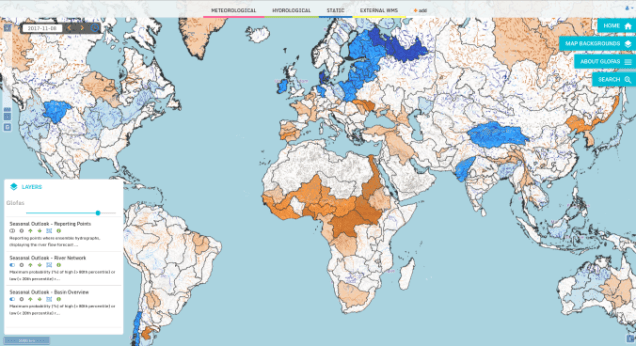
The seasonal outlook is displayed as three new layers in the GloFAS web interface, which is publicly (and freely) available at www.globalfloods.eu. The first of these gives a global overview of the maximum probability of unusually high or low river flow (defined as flow exceeding the 80th or falling below the 20th percentile of the model climatology), during the 4-month forecast horizon, in each of the 306 major world river basins used in GloFAS-Seasonal.

new_web_figure1_basins
The new GloFAS Seasonal Outlook Basin Overview and River Network Layers.

The second layer provides further sub-basin-scale detail, by displaying the global river network (all pixels with an upstream area >1500km2), again coloured according to the maximum probability of unusually high or low river flow during the 4-month forecast horizon. In the third layer, reporting points with global coverage are displayed, where more forecast information is available. At these points, an ensemble hydrograph is provided showing the 4-month forecast of river flow, with thresholds for comparison of the forecast to typical or extreme conditions based on the model climatology. Also displayed is a persistence diagram showing the weekly probability of exceedance for the current and previous three forecasts.

blog_screenshot
The new GloFAS Seasonal Outlook showing the river network and reporting points providing hydrographs and persistence diagrams.

Over the coming months, an evaluation of the system will be completed – for now, users are advised to evaluate the forecasts for their particular application. We welcome any feedback on the forecast visualisations and skill – feel free to contact me at the email address below!

To find out more, you can see the University’s press release here, further information on SEAS5 here, and the user information on the seasonal outlook GloFAS layers here.

*Water@Reading is “a vibrant cross-faculty centre of research excellence at the University of Reading, delivering world class knowledge in water science, policy and societal impacts for the UK and internationally.”

Full list of collaborators: 

Rebecca Emerton1,2, Ervin Zsoter1,2, Louise Arnal1,2, Prof. Hannah Cloke1, Dr. Liz Stephens1, Dr. Florian Pappenberger2, Prof. Christel Prudhomme2, Dr Peter Salamon3, Davide Muraro3, Gabriele Mantovani3

1 University of Reading
2 ECMWF
3 European Commission JRC

Contact: r.e.emerton@pgr.reading.ac.uk

Clear-Air Turbulence and Climate Change

Europe_turbulence_blog
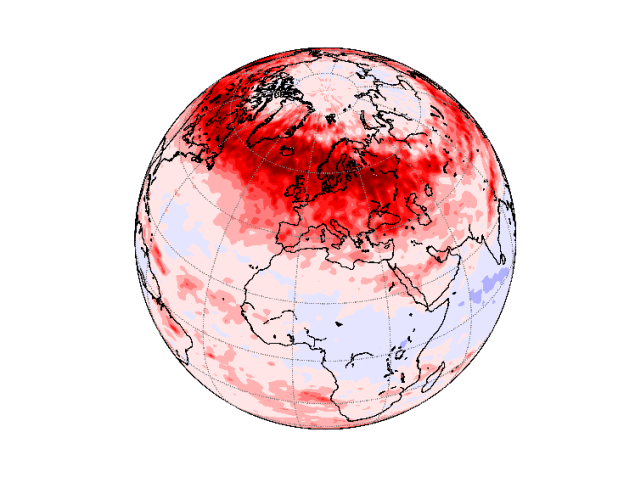
Figure 1: Percentage change of clear-air turbulence over Europe and the North Atlantic

Clear-Air Turbulence (CAT) is a major hazard to the aviation industry. If you have ever been on a plane you have probably heard the pilots warn that clear-air turbulence could occur at any time so always wear your seatbelt. Most people will have experienced it for themselves and wanted to grip their seat. However, severe turbulence capable of causing serious passenger injuries is rare. It is defined as the vertical motion of the aircraft being strong enough to force anyone not seat belted to leave the chair or floor if they are standing. In the United States alone, it costs over 200 million US dollars in compensation for injuries, with people being hospitalised with broken bones and head injuries. Besides passengers suffering serious injuries, the cabin crew are most vulnerable as they spend most of the time on their feet serving customers. This results in an additional cost if they are injured and unable to work.

Clear-air turbulence is defined as high altitude inflight bumpiness away from thunderstorm activity. It can appear out of nowhere at any time and is particularly dangerous because pilots can’t see or detect it using on-board instruments.  Usually the first time a pilot is aware of the turbulence is when they are already flying through it. Because it is a major hazard, we need to know how it might change in the future, so that the industry can prepare if necessary. This could be done by trying to improve forecasts so that pilots can avoid regions likely to contain severe turbulence or making sure the aircraft can withstand more frequent and severe turbulence.

Our new paper published in Geophysical Research Letters named ‘Global Response of Clear-Air Turbulence to Climate Change’ aims at understanding how clear-air turbulence will change in the future around the world and throughout the year. What our study found was that, the busiest flight routes around the world would see the largest increase in turbulence. For example, the North Atlantic, North America, North Pacific and Europe (see Figure 1) will see a significant increase in severe turbulence which could cause more problems in the future. These regions see the largest increase because of the Jet Stream. The Jet Stream is a fast flowing river of air that is found in the mid-latitudes. Clear-air turbulence is predominantly caused by the wind traveling at different speeds around the Jet Stream. Climate change is expected to increase the Jet Stream speed and therefore increase the vertical wind shear, causing more turbulence.

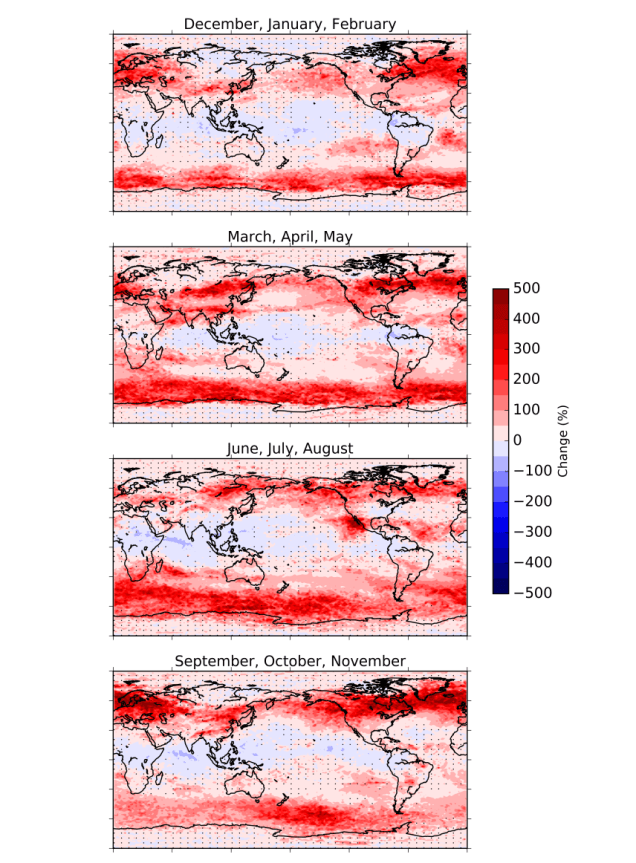
To put these findings in context, severe turbulence in the future will be as frequent as moderate turbulence historically. Anyone who is a frequent flyer will have likely experienced moderate turbulence at some point, but fewer people have experienced severe turbulence. Therefore, this study suggests this will change in the future with most frequent flyers experiencing severe turbulence on some flight routes as well as even more moderate turbulence. Our study also found moderate turbulence will become as frequent in the summer as it has done historically in winter. This is significant because although clear-air turbulence is more likely in winter, it will however now become much more of a year round phenomenon (see Figure 2).

Seasonal_turbulence_blog
Figure 2: Percentage change of clear-air turbulence around the world in all four seasons. No Stipling (stipling) indicates it is (is not) significant at the 90% confidence level.

This increase in clear-air turbulence highlights the importance for improving turbulence forecasting. Current research has shown that using ensemble forecasts (many forecasts of the same event) and also using more turbulence diagnostics than the one we used in this study can improve the forecast skill. By improving the forecasts, we could consistently avoid the areas of severe turbulence or make sure passengers and crew are seat-belted before the turbulence event occurs. Unfortunately, as these improvements are not yet fully operational, you can still reduce your own risk of injury by making sure you wear your seat belt as much as possible so that, if the aircraft does hit unexpected turbulence, you would avoid serious injuries.

Storer, L. N., Williams, P. D., & Joshi, M. M. (2017). Global response of clear-air turbulence to climate change. Geophysical Research Letters, 44, 99769984. https://doi.org/10.1002/2017GL074618

This blog was originaly writen for EGU Blogs

Sea ice is complicated, but do sea ice models need to be?

email: r.frew@pgr.reading.ac.uk

Sea ice is complex…

When sea water freezes it forms sea ice, a composite of ice and brine. Sea ice exhibits varying structural, thermodynamic and mechanical properties across a range of length- and time-scales. It can be subcategorised into numerous different types of sea ice depending on where is grows and how old it is.


ice_formation
Different sea ice growth processes and types 1.

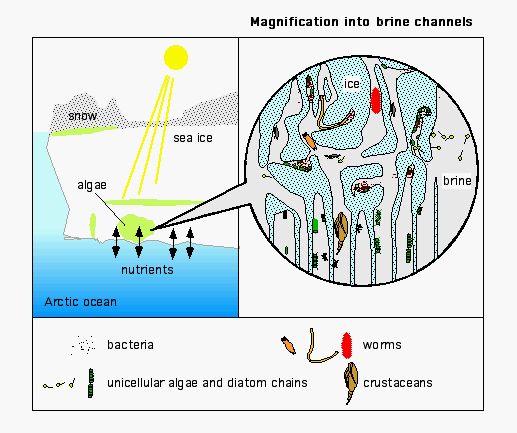
However, climate models do not simulate the evolution of floes (they model floes as cylindrical) or the floe size distribution, which has implications for ice melt rates and exchange of heat with the atmosphere and ocean. Sea ice also hosts algae and small organisms within brine channels in the ice, which can be important for nutrient cycles. This is a developing area of earth system modelling.

sympagic_web
Schematic of life within brine channels in sea ice 2.

How much complexity do global climate models need to sufficiently model the interactions of sea ice with the ocean and atmosphere?
The representation of sea ice in global climate models is actually very simple, with minimal sea ice types and thickness categories. The main important feature of sea ice for global climate models is its albedo, which is much greater than that of open water, making it important for the surface energy balance. So, it is important to get the correct area of sea ice. Global climate models need sea ice:

  • to get the correct heat exchange with the atmosphere and ocean
  • to get a realistic overturning circulation in the ocean.
  • because salt release during sea ice growth is important for the ocean salinity structure, and therefore important to get the correct amount of sea in/near deep water formation sites.
  • sea ice is not important for sea level projections.

So, do the complex features of sea ice matter, or are simple parameterisations sufficient?

Sea_ice_Drawing_General_features.svg Schematic showing some dynamic features of sea ice 3.

Which leads to a lot more questions…

  • Where does the balance between sufficient complexity and computational cost lie?
  • Does adding extra model complexity actually make it harder to understand what the model is doing and therefore to interpret the results?
  • Do climate models need any further improvements to sea ice in order to better simulate global climate? There is still large uncertainty surrounding other climate model components, such as clouds and ocean eddies, which are believed to explain a lot of the discrepancy between models and observations, particularly in the Southern Ocean.

A lot of these questions depend on the scientific question that is being asked. And the question is not necessarily always ‘how is global climate going to change in the future’. Sea ice is fascinating because of its complexity, and there are still many interesting questions to investigate, hopefully before it all melts!

 Images clockwise from top left: grease ice 4, pancake ice 5, surface melt ponds 6, ice floes 7

The Future Developments in Climate Sea Ice Modelling Workshop

This blog stems from a one day workshop I attended on ‘Future developments in climate sea ice modelling’ at the Isaac Newton Centre as part of a four month programme on the ‘Mathematics of Sea Ice Phenomena’. The format of the day was that three different strands of sea ice researchers gave 40 min talks giving their strand’s point of view of current sea ice developments and what the focus should be for sea ice modelers, each followed by 40 mins of open discussion with the audience.

The three (very good!) talks were:

  1. Dirk Notz: What do climate models need sea ice for? A top-down, system level view of what sea ice models should produce from the perspective of a climate modeller.
  2. Cecilia Bitz: What sea ice physics is missing from models? A bottom-up view of what is missing from current sea ice models from the perspective of a sea ice scientist.
  3. Elizabeth Hunke: What modelling approaches can be used to address the complexity of sea ice and the needs of climate models?


  1. https://nsidc.org/cryosphere/seaice/characteristics/formation.html.
  2. https://www.eduplace.com/science/hmxs/ls/mode/cricket/sect7cc.shtml
  3. https://en.wikipedia.org/wiki/Fast_ice
  4. https://www.travelblog.org/Photos/2101807
  5. http://www.antarctica.gov.au/about-antarctica/environment/icebergs-and-ice/sea-ice
  6. https://en.wikipedia.org/wiki/Sea_ice#/
  7. https://www.shutterstock.com/video/clip-15391768-stock-footage-flying-over-arctic-ice-floes.html

Macmillan Coffee Morning / Bake-Off 2017

(Written by Hannah Gough & Kaja Milczewska)

Following on from last year, the Macmillan Coffee Morning 2017 proved to be another storming success in the Met department. Four tables full of cake and other goodies were sold across the morning, raising well over £300 for Macmillan Cancer. We combined this with a ‘Bake Off’, where two tables of bakes were entered into four categories: ‘traditional’, ‘pumpkin’, ‘WCD’ (weather and climate discussion) and the technical challenge: scones. Competition was fierce, with no bake being disliked by our judges: Steve Woolnough, Claire Morris, Rob Thompson and Michael Jonhston.

The goods which did not make it into any category (but definitely into our bellies!) made up two other tables, featuring the likes of rum cake, banana bread, Swiss roll, cookies and cupcakes of various flavours and a very shiny-chocolate topped salted caramel slice.

Those with allergies were well catered for with gluten free chocolate orange iced cupcakes and chocolate fudge cake. Vegan entrants included chocolate muffins and a lemon and chia seed loaf with rain cloud decoration!

Josh Talib won the scone category with butternut squash, thyme and goat’s cheese scones, Rebecca Frew won the traditional cake category with a tasty Bara Brith (speckled bread), a Welsh speciality. The pumpkin category was won by Wendy Neale with some scrumptious pumpkin and ginger cupcakes, whilst the lightning bolt biscuits by Dan Hodson zapping the competition in the WCD category.

A big thanks to all who donated cakes, time and cash to this event. Macmillan Coffee mornings are held frequently all over the country, raising money towards cancer care. We hope this continues in our department in the future! For more information on the work Macmillan do, visit https://www.macmillan.org.uk/


Adventures in Modelling – NCAS Climate Modelling Summer School

At the beginning of September 3 PhD students from Reading, including myself, went to Cambridge to attend the NCAS Climate Modelling Summer School. This is an annual event aimed at PhD students and early career scientists who want to develop their understanding of climate models, with topics covering parameterisations to supercomputers.

IMG_3847
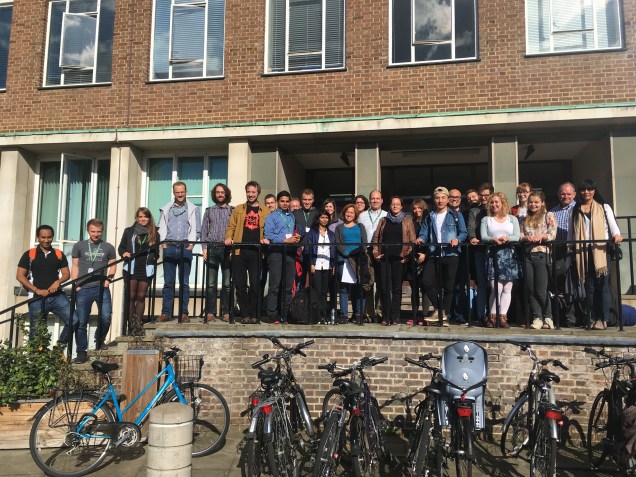
Staff and students of the course pose outside the Chemistry department, which played host to morning lectures

The course ran over two weeks with lectures on the components of climate models in the morning, covering fundamental dynamics and thermodynamics, numerical methods and different parameterisations. This was followed by an afternoon of computer practicals and then more topical lectures in the evening, such as “User engagement in climate science” and “The Sun and Earth’s climate system”. The lectures were very fast paced but this was a great opportunity to cover so many topics in a short space of time and get a grounding in lots of different topics that I will definitely be looking over in future. A poster session on the second evening gave us the chance to learn about other people’s work and make connections with other people starting out their careers in climate science, including a few readers of the blog, that will hopefully last throughout our careers.

One of the highlights of the course was the chance to run some (rather interesting) experiments with an earth system model. This involved breaking into groups with each being given a different project. It was exciting to go  through the whole process of having an idea, developing a hypothesis, thinking of specific experiments to answer the hypothesis and then analysing the results in just a week – something that takes much longer when you’re doing a PhD! My group worked on the Flat Earth experiment, which looked at the effect of removing all of the earth’s orography not, to our dismay, turning the earth into a flat disk. I learned a lot about how to run models, something which I have never done even though I use the output. It also developed my understanding of different climate processes that I don’t work with such as the monsoons, and even dynamical vegetation.

monsoons
Flat earth experiment looking at the change in the monsoon winds

Throughout the course we stayed at St Catharine’s College. Right in the centre of Cambridge it quickly felt like a home from home, keeping us well fed to get through the intense science. Although the weekend was rainy, apparently breaking a run of excellent weather for the school, we still had plenty of time to explore beautiful Cambridge. A few people were even brave enough to go punting!

An interesting, hectic and inspiring two weeks later we may have been glad to head back to Reading for a good sleep but having thoroughly enjoyed the summer school.

Buildings2000-®TimRawle-resized-w680px
The beautiful St Catharine’s College, image from http://www.caths.cam.ac.uk/


Synchronisation: how can this help weather forecasts in the future?

Current numerical modelling and data assimilation methods still face problems in strongly nonlinear cases, like in convective scales. A different, but interesting tool to help overcome these issues can be found in the synchronisation theory.

It all started in 1665, when Christiaan Huygens, a Dutch scientist, discovered that his two pendulum clocks were suddenly oscillating in opposite directions, but in a synchronised way. He tried to desynchronise them, by perturbing randomly one of the clocks, but surprisingly, after some time, both devices were synchronised again. He has attributed the phenomenon to the frame both clocks were sharing and after that, synchronisation field was opened to the world.

figure1

Figure 1: A drawing by Christiaan Huygens of his experiment in 1665.

Nowadays, researchers use these synchronisation concepts to reach a main goal: synchronise a model (any) with the true evolution of a system, using measurements. And even when only a reduced part of this system is observed, synchronisation between models and the true state can still be achieved. This is quite similar to what data assimilation looks for, as it aims to synchronise a model evolution with the truth by using observations, finding the best estimate of the state evolution and its uncertainty.

So why not investigate the benefits of recent synchronisation findings and combine these concepts with a data assimilation methodology?

At the start of this project, the first noticeable step that should be taken was to open up the synchronisation field to higher-dimension systems, as the experiments performed in the area were all focused on low-dimension, non-realistic systems. To this end, a first new idea was proposed:  an ensemble version of a synchronisation scheme, what we are calling EnSynch (Ensemble Synchronisation). Tests with a partly observed 1000-dimension chaotic model show a very efficient correspondence between the model and the true trajectories, both for estimation and prediction periods. Figures 2 and 3 show how our estimates and the truth are on top of each other, i.e. synchronised. Note that we do not have observations for all of the variables in our system. So, it is amazing to obtain the same successful results for the observed and also for the unobserved variables in this system!

figure2

Figure 2: Trajectories of 2 variables (top:observed and bottom: unobserved). Blue lines: truth. Green lines: estimates/predictions. (Predictions start after the red lines, i.e. no data assimilation is used.)

figure3

Figure 3: Zoom in the trajectory of a variable, showing how the model matches with the truth. Blue line: truth. Red line: our model. Yellow dots: observations.

The second and main idea is to test a combination of this successful EnSynch scheme with a data assimilation method called Particle Filter. As a proper data assimilation methodology, a particle filter provides us the best estimation of the state evolution and its uncertainty. Just to illustrate the importance of data assimilation in following the truth, figure 4 compares the case of only counting on an ensemble of models running freely in a chaotic nonlinear system, with the case of a data assimilation method applied to it.

figure4

Figure 4: Trajectories of ensemble members. Blue: with data assimilation. Red: without data assimilation. Truth is in black.

Efficient results are found with the combination between the new EnSynch and the particle filters. An example is shown in figure 5, where particles (ensemble members) of an unobserved variable nicely follow the truth during the assimilation period and also during the forecast stage (after t=100).

figure5

Figure 5: Trajectory for an unobserved variable in a 1000-dimension system. Observations occur at every 10 time steps until t=100. Predictions start after t=100.

These results are motivating and the next and big step is to implement this combined system in a bigger atmospheric model.  This methodology has been shown to be a promising solution for strongly nonlinear problems and potential benefits are expected for numerical weather prediction in the near future.

References:

Rey, D., M. Eldridge, M. Kostuk, H. Abarbanel, J. Schumann-Bischoff, and U. Parlitz, 2014a: Accurate state and parameter estimation in nonlinear systems with sparse observations. Physics Letters A, 378, 869-873, doi:10.1016/j.physleta.2014.01.027.

Zhu, M., P. J. van Leeuwen, and J. Amezcua, 2016: Implicit equal-weights particle filter. Quart. J. Roy. Meteorol. Soc., 142, 1904-1919, doi:10.1002/qj.2784.


The 2017 SCENARIO Conference: Frontiers in Natural Environment Research

Every year students from the SCENARIO (Science of the Environment, Natural and Anthropogenic Processes, Impacts and Opportunities) Doctoral Training Partnership organise an annual conference. Those invited include SCENARIO students, NERC employees and industrial partners. This year, after last year’s successful collaboration with the University of Oklahoma, it was decided that we would run the conference (Frontiers in Natural Environment Research) with the Science and Solutions for a Changing Planet (SSCP) and London NERC DTPs, led by a variety of universities and institutions in London.

A similar conference was organised last year (Perspectives on Environmental Change) between SSCP and the London NERC DTP, which was a rousing success. This year, with the addition of Reading and Surrey, we had almost 200 delegates attending with a healthy proportion of supervisors and industry partners, with over 40 oral presentations and 40 posters from students at the various institutions. The conference was held in the Physics building at Imperial College, a literal stone’s throw away from the Royal Albert Hall.

Organising the conference was a daunting task; there was a lot of work involved between the nine PhD students on the committee! One of the challenges, (but also one of the most exciting parts of the conference), was the sheer variety of research being presented. Many of the attendees were from the Met department, but there were also students from Chemistry and Geography from SCENARIO, and students from the London institutions doing topics as varied as sociology, ecology, biology, materials science and plate tectonics. This made for a really interesting conference since there was so much on offer from such a wide range of fields, but made our lives quite difficult when trying to organise keynote speakers and sort abstracts!

IMG_8983

As well as the student presentations we also ran workshops and panel discussions, and had two invited keynote speakers. The workshops were about communicating science through social media, and also on getting published in one of the Nature journals (similar to the successful workshop ran by SCENARIO here at Reading). The panel discussions were themed around “Science and Development” and “Science in a post-truth world”, looking at ways in which science (particularly that within the NERC remit) can help to solve the UN’s Sustainable Development Goals, and how we communicate science in a time of “fake news”.

IMG_8990

Perhaps my favourite part of the conference were the two keynote speakers. Finding speakers who would appeal to the majority of people attending the conference was no easy task, given the huge range of disciplines!

Opening the conference, Marcus Munafo, Professor in Biological Psychology at Bristol University spoke about the “reproducibility crisis” and how incentive structures affect the scientific process. I can honestly say it was one of the most thought-provoking lectures I’ve ever been to. His main argument was that ultimately science is done by people who have an incentive to do certain things, (e.g. publish in high impact journals), for the benefit of their careers. However, this incentivisation means that often one “big result” can mean more for the career of someone than all the work they’ve done previously, even if that result ended up being retracted or proven false later on, (he went on to demonstrate that happens a lot). One of the statistics he presented was that the higher the impact factor of a journal, the higher the chance of retraction, which I thought was really interesting and certainly made me re-evaluate the way in which I approach my own work.

The other keynote speaker was Lucy Hawkes, Senior Lecturer in Physiological Ecology at Exeter, talking about her work and career, particularly “biologging” of animals and looking at their migratory patterns. Aside from all the great anecdotes and stories (like swimming with sharks in order to plant bio-tags on them), from a meteorologist’s perspective it was interesting listening to her talk about how these migratory patterns change with the climate.

Of course any conference worth its salt has entertainment and things outside work. A BBQ was hosted in the courtyard underneath the Queen’s Tower, and drinks and comedy (the Science Showoff) in the wonderfully titled hBar at Imperial. The Science Showoff in particular was really good, hosted by a professional comedian but with most of the material coming from PhD students at the various institutes (although shamefully no-one from Met volunteered).

IMG_9012

One of the other really useful parts was meeting students from disparate fields at the other institutions. As Joanna Haigh (director of the SSCP DTP) said in her closing speech, the people we meet at these conferences will be our colleagues for our entire careers, so it’s really important to get to know people socially and professionally. In the end I think it went really well, and I’m certainly looking forward to seeing the London students again at next year’s conference!