The advection process: simulating wind on computers

Email: js102@zepler.net   Web: datumedge.co.uk   Twitter: @hertzsprrrung

This article was originally posted on the author’s personal blog.

If we know which way the wind is blowing then we can predict a lot about the weather. We can easily observe the wind moving clouds across the sky, but the wind also moves air pollution and greenhouse gases. This process is called transport or advection. Accurately simulating the advection process is important for forecasting the weather and predicting climate change.

I am interested in simulating the advection process on computers by dividing the world into boxes and calculating the same equation in every box. There are many existing advection methods but many rely on these boxes having the correct shape and size, otherwise these existing methods can produce inaccurate simulations.

During my PhD, I’ve been developing a new advection method that produces accurate simulations regardless of cell shape or size. In this post I’ll explain how advection works and how we can simulate advection on computers. But, before I do, let’s talk about how we observe the weather from the ground.

In meteorology, we generally have an incomplete picture of the weather. For example, a weather station measures the local air temperature, but there are only a few hundred such stations dotted around the UK. The temperature at another location can be approximated by looking at the temperatures reported by nearby stations. In fact, we can approximate the temperature at any location by reconstructing a continuous temperature field using the weather station measurements.

The advection equation

So far we have only talked about temperatures varying geographically, but temperatures also vary over time. One reason that temperatures change over time is because the wind is blowing. For example, a wind blowing from the north transports, or advects, cold air from the arctic southwards over the UK. How fast the temperature changes depends on the wind speed, and the size of the temperature contrast between the arctic air and the air further south. We can write this as an equation. Let’s call the wind speed v and assume that the wind speed and direction are always the same everywhere. We’ll label the temperature T, label time t, and label the south-to-north direction y, then we can write down the advection equation using partial derivative notation,

\frac{\partial T}{\partial t} = - \frac{\partial T}{\partial y} \times v

This equation tells us that the local temperature will vary over time (\frac{\partial T}{\partial t}), depending on the north-south temperature contrast (- \frac{\partial T}{\partial y}) multiplied by the wind speed v.

Solving the advection equation

One way to solve the advection equation on a computer is to divide the world into boxes, called cells. The complete arrangement of cells is called a mesh. At a point at the centre of each cell we store meteorological information such as temperature, water vapour content or pollutant concentration. At the cell faces where two cells touch we store the wind speed and direction. The arrangement looks like this:

britain-cgrid
A mesh of cells with temperatures stored at cell centres and winds stored at cell faces.  For illustration, the temperature and winds are only shown in one cell.  This arrangement of data is known as an Arakawa C-grid.  Figure adapted from WikiMedia Commons, CC BY-SA 3.0.

The above example of a mesh over the UK uses cube-shaped cells stacked in columns above the Earth, and arranged along latitude and longitude lines. But more recently, weather forecasting models are using different types of mesh. These models tesselate the globe with squares, hexagons or triangles.

meshes
The surfaces of some different types of global mesh. The cells are prismatic since they are stacked in columns above the surface.

Weather models must also rearrange cells in order to represent mountains, valleys, cliffs and other terrain. Once again, different models rearrange cells differently. One method, called the terrain-following method, shifts cells up or down to accommodate the terrain. Another method, called the cut-cell method, cuts cells where they intersect the terrain. Here’s what these methods look like when we use them to represent an idealised, wave-shaped mountain:

terrain-meshes
Two different methods for representing terrain in weather forecast models. The terrain-following method is widely used but suffers from large distortions above steep slopes. The cut cell method alleviates this problem but cells may be very much smaller than most others in a cut cell mesh.

Once we’ve chosen a mesh and stored temperature at cell centres and the wind at cell faces, we can start calculating a solution to the advection equation which enables us to forecast how the temperature will vary over time. We can solve the advection equation for every cell separately by discretising the advection equation. Let’s consider a cell with a north face and a south face. We want to know how the temperature stored at the cell centre, T_\mathrm{cell}, will vary over time. We can calculate this by reconstructing a continuous temperature field and using this to approximate temperature values at the north and south faces of the cell, T_\mathrm{north} and T_\mathrm{south},

\frac{\partial T_\mathrm{cell}}{\partial t} = - \frac{T_\mathrm{north} - T_\mathrm{south}}{\Delta y} \times v

where \Delta y is the distance between the north and south cell faces. This is the same reconstruction process that we described earlier, only, instead of approximating temperatures using nearby weather station measurements, we are approximating temperatures using nearby cell centre values.
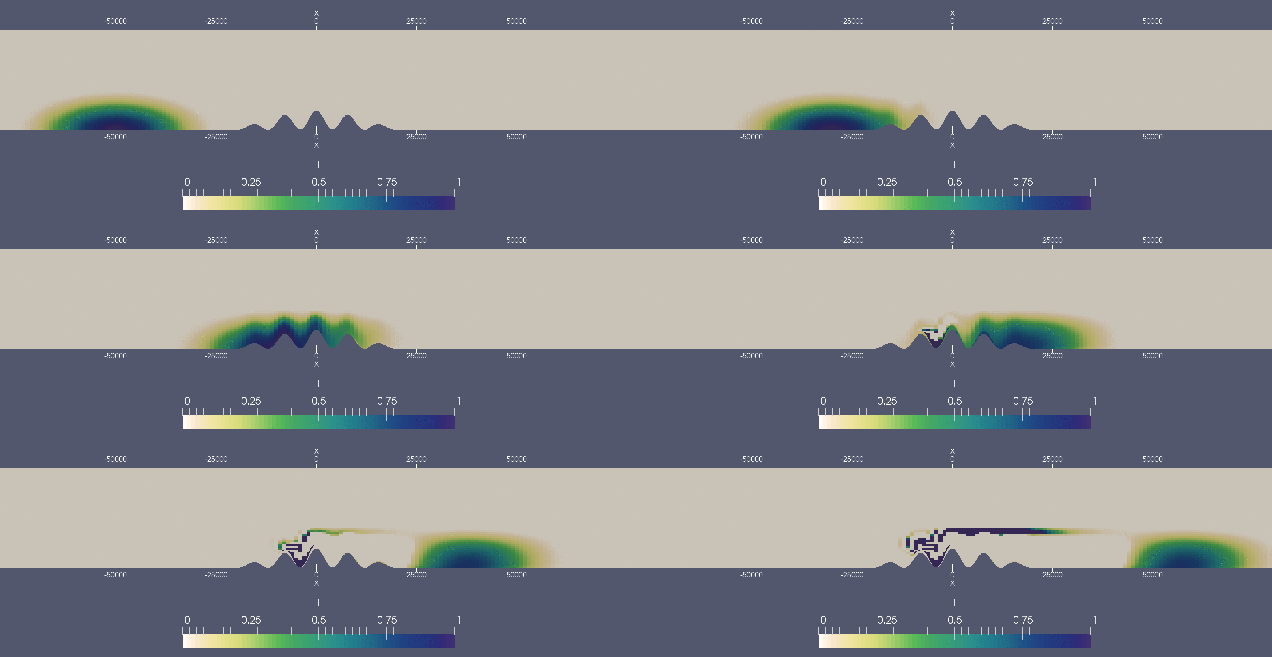
There are many existing numerical methods for solving the advection equation but many do not cope well when meshes are distorted, such as terrain-following meshes, or when cells have very different sizes, such as those cells in cut-cell meshes. Inaccurate solutions to the advection equation lead to inaccuracies in the weather forecast. In extreme cases, very poor solutions can cause the model software to crash, and this is known as a numerical instability.

slug-slantedCells-linearUpwind
An idealised simulation of a blob advected over steep mountains. A numerical instability develops because the cells are so distorted over the mountain.

We can see a numerical instability growing in this idealised example. A blob is being advected from left to right over a range of steep, wave-shaped mountains. This example is using a simple advection method which cannot cope with the distorted cells in this mesh.

We’ve developed a new method for solving the advection equation with almost any type of mesh using cubes or hexagons, terrain-following or cut-cell methods. The advection method works by reconstructing a continuous field from data stored at cell centre points. A separate reconstruction is made for every face of every cell in the mesh using about twelve nearby cell centre values. Given that weather forecast models have millions of cells, this sounds like an awful lot of calculations. But it turns out that we can make most of these calculations just once, store them, and reuse them for all our simulations.

slug-slantedCells-cubicFit
Our new advection method avoids the numerical instability that occurred using the simple method.

Here’s the same idealised simulation using our new advection method. The results are numerically stable and accurate.

Further reading

A preprint of our journal article documenting the new advection method is available on ArXiv. I also have another blog post that talks about how to make the method even more accurate. Or follow me on Twitter for more animations of the numerical methods I’m developing.

Meteorology Ball 2017

Email: K.M.Milczewska@pgr.reading.ac.uk

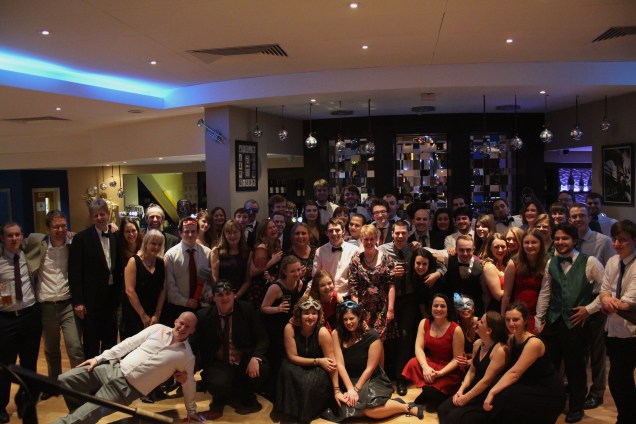
On Friday 17th February, the annual Meteorology Ball provided a great excuse for members of the department and their guests to dress up for the evening. But for all the excitement of this year’s masquerade theme, the Ball is mainly a charity event. Through the sale of raffle tickets and an auction of promises, the event aims to raise money for the David Grimes Trust, administered by the Reading San Francisco Libre Association (RSFLA), in honour of the well-remembered academic from our department who devoted a great deal of his time to the charity.

RSFLA supports environmental and educational projects in the rural Nicaraguan town of San Francisco Libre, which was ‘twinned’ with Reading in 1994 in order to encourage the exchange of culture and knowledge. Over the past few years, the Meteorology department has supported this link through regular cake sales, running the Reading Half Marathon and, of course, the annual ball.

David Grimes was a respected, integral member of the department and there are many among us who reminisce about his goodwill, interactive lectures and Panto appearances. There are also those among us who, despite never having had the chance to meet David, can easily imagine the positive impact he had both in and outside of our department, through our continued support of the charity under his name. The money  raised is mainly spent on educational support in the San Francisco Libre district: helping to fund a scholarship programme, build a library and toilet facilities among various other projects – and the people who benefit directly have a special message for us all!
https://youtu.be/vWsf9TWwWp4

The generosity of over 80 people attending made the event a great success, raising over £1500 through bidding on bizzarre auction items and lessons, as well as purchasing raffle tickets. To add to this, Santander will be chipping in with an extra £1500 to match, bringing the total raised to over £3000 for the charity! Such success would never have happened, had it not been for all the help we received from Santander, local businesses offering prizes for the raffle, and most importantly: all of those who bought a ticket to come! On behalf of all the organisers, I would like to finish this post with a massive bout of thanks for making the evening worth all the effort and continuing the important tradition of fundraising for the David Grimes Trust.

IMG_1534.JPG

Met Office Academic Partnership Poster and Presentation Session

Email: h.v.turner@pgr.reading.ac.uk

All photos courtesy of Carlo Cafaro

On 22nd and 23rd February, a group of students from the University of Reading visited the UK Met Office in Exeter to share our work and listen to talks from academics and Met Office employees. It was a great opportunity to discuss our work with other scientists from outside the university.

We arrived at the Met Office at 12 on the Wednesday. Once we had hung up our posters and had lunch, we listened to our first talk from Dale Barker, who is Deputy Director of Weather Science at the UK Met Office. He gave us an overview of the Met Office Academic Partnership (MOAP) and the variety of work that takes place within the partnership.  The MOAP brings together the UK Met Office with the universities of Exeter, Reading, Leeds, and Oxford to collaborate on projects and share science. It aims to pull together world-class expertise in weather and climate science to tackle key problems in these areas, and to provide an environment to develop the science leaders of tomorrow. The next talk was from Prof. Nadine Unger from the University of Exeter who spoke about aerosol pollution and work she has been involved in with African nations to reduce health problems caused by pollution. Our very own Dr Clare Watt then spoke about space weather, focusing on the magnetosphere and the impact of ‘killer’ electrons. The final talk of the day was from Dr Steven Böing from the University of Leeds. He spoke about semi-Lagrangian cloud modelling and how it can be used to increase forecast accuracy.

The poster session then took place in the Street. A lot of useful discussions were had during this session (and over the whole two days) as we were able to share our work with each other and also with passing members of Met Office staff. I certainly realized some new things about my results and had ideas about future directions for my work.

On the second day we had a presentation on career opportunities within the scientific areas of the Met Office from Mo Mylne, who is Science Project and Planning Manager at the UK Met Office. This really highlighted the breadth of roles that are available at the national meteorological service. This was followed by a talk from Prof. Coralia Cartis from the University of Oxford who spoke about parameter estimation for climate modelling using optimization techniques. After this, we were taken on tours of the Met Office to see some of areas that scientists are involved in. We then had lunch and a final opportunity to discuss our posters before the event finished.

Overall, then, it was a very enjoyable event with a great variety of subjects covered by the talks. I found the use of optimization techniques for parameter estimation particularly interesting and I hope to incorporate some of the ideas into my own research. I feel I have personally learned a lot, both about my own results and new ideas to consider. Thank you to all at the Met Office who organized the event.

Tales from the Alice Holt forest: carbon fluxes, data assimilation and fieldwork

Email: ewan.pinnington@gmail.com

Forests play an important role in the global carbon cycle, removing large amounts of CO2 from the atmosphere and thus helping to mitigate the effect of human-induced climate change. The state of the global carbon cycle in the IPCC AR5 suggests that the land surface is the most uncertain component of the global carbon cycle. The response of ecosystem carbon uptake to land use change and disturbance (e.g. fire, felling, insect outbreak) is a large component of this uncertainty. Additionally, there is much disagreement on whether forests and terrestrial ecosystems will continue to remove the same proportion of CO2 from the atmosphere under future climate regimes. It is therefore important to improve our understanding of ecosystem carbon cycle processes in the context of a changing climate.

Here we focus on the effect on ecosystem carbon dynamics of disturbance from selective felling (thinning) at the Alice Holt research forest in Hampshire, UK. Thinning is a management practice used to improve ecosystem services or the quality of a final tree crop and is globally widespread. At Alice Holt a program of thinning was carried out in 2014 where one side of the forest was thinned and the other side left unmanaged. During thinning approximately 46% of trees were removed from the area of interest.

flux_me
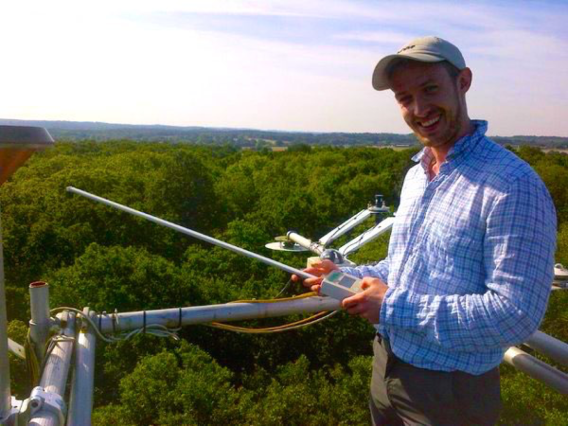
Figure 1: At the top of Alice Holt flux tower.

Using the technique of eddy-covariance at flux tower sites we can produce direct measurements of the carbon fluxes in a forest ecosystem. The flux tower at Alice Holt has been producing measurements since 1999 (Wilkinson et al., 2012), a view from the flux tower is shown in Figure 1. These measurements represent the Net Ecosystem Exchange of CO2 (NEE). The NEE is composed of both photosynthesis and respiration fluxes. The total amount of carbon removed from the atmosphere through photosynthesis is termed the Gross Primary Productivity (GPP). The Total Ecosystem Respiration (TER) is made up of autotrophic respiration (Ra) from plants and heterotrophic respiration (Rh) from soil microbes and other organisms incapable of photosynthesis. We then have, NEE = -GPP + TER, so that a negative NEE value represents removal of carbon from the atmosphere and a positive NEE value represents an input of carbon to the atmosphere. A schematic of these fluxes is shown in Figure 2.

forest_fluxes
Figure 2: Fluxes of carbon around a forest ecosystem.

The flux tower at Alice Holt is on the boundary between the thinned and unthinned forest. This allows us to partition the NEE observations between the two areas of forest using a flux footprint model (Wilkinson et al., 2016). We also conducted an extensive fieldwork campaign in 2015 to estimate the difference in structure between the thinned and unthinned forest. However, these observations are not enough alone to understand the effect of disturbance. We therefore also use mathematical models describing the carbon balance of our ecosystem, here we use the DALEC2 model of ecosystem carbon balance (Bloom and Williams, 2015). In order to find the best estimate for our system we use the mathematical technique of data assimilation in order to combine all our available observations with our prior model predictions. More infomation on the novel data assimilation techniques developed can be found in Pinnington et al., 2016. These techniques allow us to find two distinct parameter sets for the DALEC2 model corresponding to the thinned and unthinned forest. We can then inspect the model output for both areas of forest and attempt to further understand the effect of selective felling on ecosystem carbon dynamics.

fluxes
Figure 3: Model predicted cumulative fluxes for 2015 after data assimilatiom. Solid line: NEE, dotted line: TER, dashed line: GPP. Orange: model prediction for thinned forest, blue: model prediction for unthinned forest. Shaded region: model uncertainty after assimilation (± 1 standard deviation).

In Figure 3 we show the cumulative fluxes for both the thinned and unthinned forest after disturbance in 2015. We would probably assume that removing 46% of the trees from the thinned section would reduce the amount of carbon uptake in comparison to the unthinned section. However, we can see that both forests removed a total of approximately 425 g C m-2 in 2015, despite the thinned forest having 46% of its trees removed in the previous year. From our best modelled predictions this unchanged carbon uptake is possible due to significant reductions in TER. So, even though the thinned forest has lower GPP, its net carbon uptake is similar to the unthinned forest. Our model suggests that GPP is a main driver for TER, therefore removing a large amount of trees has significantly reduced ecosystem respiration. This result is supported by other ecological studies (Heinemeyer et al., 2012, Högberg et al., 2001, Janssens et al., 2001). This has implications for future predictions of land surface carbon uptake and whether forests will continue to sequester atmospheric CO2 at similar rates, or if they will be limited by increased GPP leading to increased respiration.

References

Wilkinson, M. et al., 2012: Inter-annual variation of carbon uptake by a plantation oak woodland in south-eastern England. Biogeosciences, 9 (12), 5373–5389.

Wilkinson, M., et al., 2016: Effects of management thinning on CO2 exchange by a plantation oak woodland in south-eastern England. Biogeosciences, 13 (8), 2367–2378, doi: 10.5194/bg-13-2367-2016.

Bloom, A. A. and M. Williams, 2015: Constraining ecosystem carbon dynamics in a data-limited world: integrating ecological “common sense” in a model data fusion framework. Biogeosciences, 12 (5), 1299–1315, doi: 10.5194/bg-12-1299-2015.

Pinnington, E. M., et al., 2016: Investigating the role of prior and observation error correlations in improving a model forecast of forest carbon balance using four-dimensional variational data assimilation. Agricultural and Forest Meteorology, 228229, 299 – 314, doi: http://dx.doi.org/10.1016/j.agrformet.2016.07.006.

Heinemeyer, A., et al., 2012: Exploring the “overflow tap” theory: linking forest soil co2 fluxes and individual mycorrhizo- sphere components to photosynthesis. Biogeosciences, 9 (1), 79–95.

Högberg, P., et al., 2001: Large-scale forest girdling shows that current photosynthesis drives soil respiration. Nature, 411 (6839), 789–792.

Janssens, I. A., et al., 2001: Productivity overshadows temperature in determining soil and ecosystem respiration across european forests. Global Change Biology, 7 (3), 269–278, doi: 10.1046/j.1365-2486.2001.00412.x.

Continue reading

Understanding our climate with tiny satellites

Gristey, J. J., J. C. Chiu, R. J. Gurney, S.-C. Han, and C. J. Morcrette (2017), Determination of global Earth outgoing radiation at high temporal resolution using a theoretical constellation of satellites, J. Geophys. Res. Atmos., 122, doi:10.1002/2016JD025514.

Email: J.Gristey@pgr.reading.ac.uk          Web: http://www.met.reading.ac.uk/~fn008822/

The surface of our planet has warmed at an unprecedented rate since the mid-19th century and there is no sign that the rate of warming is slowing down. The last three decades have all been successively warmer than any preceding decade since 1850, and 16 of the 17 warmest years on record have all occurred since 2001. The latest science now tells us that it is extremely likely that human influence has been the dominant cause of the observed warming1, mainly due to the release of carbon dioxide and other greenhouse gases into our atmosphere. These greenhouse gases trap heat energy that would otherwise escape to space, which disrupts the balance of energy flows at the top of the atmosphere (Fig. 1). The current value of the resulting energy imbalance is approximately 0.6 W m–2, which is more than 17 times larger than all of the energy consumed by humans2! In fact, observing the changes in these energy flows at the top of the atmosphere can help us to gauge how much the Earth is likely to warm in the future and, perhaps more importantly, observations with sufficient spatial coverage, frequency and accuracy can help us to understand the processes that are causing this warming.

fig1
Figure 1. The Earth’s top-of-atmosphere energy budget. In equilibrium, the incoming sunlight is balanced by the reflected sunlight and emitted heat energy. Greenhouse gases can reduce the emitted heat energy by trapping heat in the Earth system leading to an energy imbalance at the top of the atmosphere.

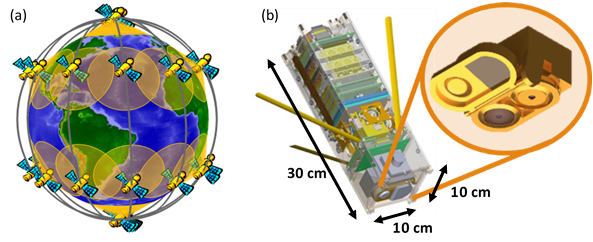
Observations of energy flows at the top of the atmosphere have traditionally been made by large and expensive satellites that may be similar in size to a large car3, making it impractical to launch multiple satellites at once. Although such observations have led to many advancements in climate science, the fundamental sampling restrictions from a limited number of satellites makes it impossible to fully resolve the variability in the energy flows at the top of atmosphere. Only recently, due to advancements in small satellite technology and sensor miniaturisation, has a novel, viable and sustainable sampling strategy from a constellation of satellites become possible. Importantly, a constellation of small satellites (Fig. 2a), each the size of a shoe-box (Fig. 2b), could provide both the spatial coverage and frequency of sampling to properly resolve the top of atmosphere energy flows for the first time. Despite the promise of the constellation approach, its scientific potential for measuring energy flows at the top of the atmosphere has not been fully explored.

fig2
Figure 2. (a) A constellation of 36 small satellites orbiting the Earth. (b) One of the small “CubeSat” satellites hosting a miniaturised radiation sensor that could be used [edited from earthzine article].
To explore this potential, several experiments have been performed that simulate measurements from the theoretical constellation of satellites shown in Fig 2a. The results show that just 1 hour of measurements can be used to reconstruct accurate global maps of reflected sunlight and emitted heat energy (Fig. 3). These maps are reconstructed using a series of mathematical functions known as “spherical harmonics”, which extract the information from overlapping samples to enhance the spatial resolution by around a factor of 6 when compared with individual measurement footprints. After producing these maps every hour during one day, the uncertainty in the global-average hourly energy flows is 0.16 ± 0.45 W m–2 for reflected sunlight and 0.13 ± 0.15 W m–2 for emitted heat energy. Observations with these uncertainties would be capable of determining the sign of the 0.6 W m–2 energy imbalance directly from space4, even at very short timescales.

fig3
Figure 3. (top) “Truth” and (bottom) recovered enhanced-resolution maps of top of atmosphere energy flows for (left) reflected sunlight and (right) emitted heat energy, valid for 00-01 UTC on 29th August 2010.

Also investigated are potential issues that could restrict similar uncertainties being achieved in reality such as instrument calibration and a reduced number of satellites due to limited resources. Not surprisingly, the success of the approach will rely on calibration that ensures low systematic instrument biases, and on a sufficient number of satellites that ensures dense hourly sampling of the globe. Development and demonstration of miniaturised satellites and sensors is currently underway to ensure these criteria are met. Provided good calibration and sufficient satellites, this study demonstrates that the constellation concept would enable an unprecedented sampling capability and has a clear potential for improving observations of Earth’s energy flows.

This work was supported by the NERC SCENARIO DTP grant NE/L002566/1 and co-sponsored by the Met Office.

Notes:

1 This statement is quoted from the latest Intergovernmental Panel on Climate Change assessment report. Note that these reports are produced approximately every 5 years and the statements concerning human influence on the climate have increased in confidence in every report.

2 Total energy consumed by humans in 2014 was 13805 Mtoe = 160552.15 TWh. This is an average power consumption of 160552.15 TWh  / 8760 hours in a year = 18.33 TW

Rate of energy imbalance per square metre at top of atmosphere is = 0.6 W m–2. Surface area of “top of atmosphere” at 80 km is 4 * pi * ((6371+80)*103 m)2 = 5.23*1014 m2. Rate of energy imbalance for entire Earth = 0.6 W m–2 * 5.23*1014 m2 = 3.14*1014 W = 314 TW

Multiples of energy consumed by humans = 314 TW / 18.33 TW = 17

3 The satellites currently carrying instruments that observe the top of atmosphere energy flows (eg. MeteoSat 8, Aqua) will typically also be hosting a suite of other instruments, which adds to the size of the satellite. However, even the individual instruments are still much larger that the satellite shown in Fig. 2b.

4 Currently, the single most accurate way to determine the top-of-atmosphere energy imbalance is to infer it from changes in ocean heat uptake. The reasoning is that the oceans contain over 90% of the heat capacity of the climate system, so it is assumed on multi-year time scales that excess energy accumulating at the top of the atmosphere goes into heating the oceans. The stated value of 0.6 W m–2 is calculated from a combination of ocean heat uptake and satellite observations.

References:

Allan et al. (2014), Changes in global net radiative imbalance 1985–2012, Geophys. Res. Lett., 41, 5588–5597, doi:10.1002/2014GL060962.

Barnhart et al. (2009), Satellite miniaturization techniques for space sensor networks, Journal of Spacecraft and Rockets46(2), 469–472, doi:10.2514/1.41639.

IPCC (2013), Climate Change 2013: The Physical Science Basis, available online at https://www.ipcc.ch/report/ar5/wg1/.

NASA (2016), NASA, NOAA Data Show 2016 Warmest Year on Record Globally, available online at https://www.nasa.gov/press-release/nasa-noaa-data-show-2016-warmest-year-on-record-globally.

Sandau et al. (2010), Small satellites for global coverage: Potential and limits, ISPRS J. Photogramm., 65, 492–504, doi:10.1016/j.isprsjprs.2010.09.003.

Swartz et al. (2013), Measuring Earth’s Radiation Imbalance with RAVAN: A CubeSat Mission to Measure the Driver of Global Climate Change, available online at https://earthzine.org/2013/12/02/measuring-earths-radiation-imbalance-with-ravan-a-cubesat-mission-to-measure-the-driver-of-global-climate-change/.

Swartz et al. (2016), The Radiometer Assessment using Vertically Aligned Nanotubes (RAVAN) CubeSat Mission: A Pathfinder for a New Measurement of Earth’s Radiation Budget. Proceedings of the AIAA/USU Conference on Small Satellites, SSC16-XII-03

Mountains and the Atmospheric Circulation within Models

Email: a.vanniekerk@pgr.reading.ac.uk

Mountains come in many shapes and sizes and as a result their dynamic impact on the atmospheric circulation spans a continuous range of physical and temporal scales. For example, large-scale orographic features, such as the Himalayas and the Rockies, deflect the atmospheric flow and, as a result of the Earth’s rotation, generate waves downstream that can remain fixed in space for long periods of time. These are known as stationary waves (see Nigam and DeWeaver (2002) for overview). They have an impact not only on the regional hydro-climate but also on the location and strength of the mid-latitude westerlies. On smaller physical scales, orography can generate gravity waves that act to transport momentum from the surface to the upper parts of the atmosphere (see Teixeira 2014), playing a role in the mixing of chemical species within the stratosphere.

hims
Figure 1: The model resolved orography at different horizontal resolutions. From a low (climate model) resolution to a high (seasonal forecasting) resolution. Note how smooth the orography is at climate model resolution.

Figure 1 shows an example of the resolved orography at different horizontal resolutions over the Himalayas. The representation of orography within models is complicated by the fact that, unlike other parameterized processes, such as clouds and convection, that are typically totally unresolved by the model, its effects are partly resolved by the dynamics of the model and the rest is accounted for by parameterization schemes.However, many parameters within these schemes are not well constrained by observations, if at all. The World Meteorological Organisation (WMO) Working Group on Numerical Experimentation (WGNE) performed an inter-model comparison focusing on the treatment of unresolved drag processes within models (Zadra et al. 2013). They found that while modelling groups generally had the same total amount of drag from various different processes, their partitioning was vastly different, as a result of the uncertainty in their formulation.

Climate models with typically low horizontal resolutions, resolve less of the Earth’s orography and are therefore more dependent on parameterization schemes. They also have large model biases in their climatological circulations when compared with observations, as well as exhibiting a similarly large spread about these biases. What is more, their projected circulation response to climate change is highly uncertain. It is therefore worth investigating the processes that contribute towards the spread in their climatological circulations and circulation response to climate change. The representation of orographic processes seem vital for the accurate simulation of the atmospheric circulation and yet, as discussed above, we find that there is a lot of uncertainty in their treatment within models that may be contributing to model uncertainty. These uncertainties in the orographic treatment come from two main sources:

  1. Model Resolution: Models with different horizontal resolutions will have different resolved orography.
  2. Parameterization Formulation: Orographic drag parameterization formulation varies between models.

The issue of model resolution was investigated in our recent study, van Niekerk et al. (2016). We showed that, in the Met Office Unified Model (MetUM) at climate model resolutions, the decrease in parameterized orographic drag that occurs with increasing horizontal resolution was not balanced by an increase in resolved orographic drag. The inability of the model to maintain an equivalent total (resolved plus parameterized) orographic drag across resolutions resulted in an increase in systematic model biases at lower resolutions identifiable over short timescales. This shows not only that the modelled circulation is non-robust to changes in resolution but also that the parameterization scheme is not performing in the same way as the resolved orography. We have highlighted the impact of parameterized and resolved orographic drag on model fidelity and demonstrated that there is still a lot of uncertainty in the way we treat unresolved orography within models. This further motivates the need to constrain the theory and parameters within orographic drag parameterization schemes.

References

Nigam, S., and E. DeWeaver, 2002: Stationary Waves (Orographic and Thermally Forced). Academic Press, Elsevier Science, London, 2121–2137 pp., doi:10.1016/B978-0-12-382225-3. 00381-9.

Teixeira MAC, 2014: The physics of orographic gravity wave drag. Front. Phys. 2:43. doi:10.3389/fphy.2014.00043 http://journal.frontiersin.org/article/10.3389/fphy.2014.00043/full

Zadra, A., and Coauthors, 2013: WGNE Drag Project. URL:http://collaboration.cmc.ec.gc.ca/science/rpn/drag_project/

van Niekerk, A., T. G. Shepherd, S. B. Vosper, and S. Webster, 2016: Sensitivity of resolved and parametrized surface drag to changes in resolution and parametrization. Q. J. R. Meteorol. Soc., 142 (699), 2300–2313, doi:10.1002/qj.2821. 


Quo Vadis 2017

“Quo Vadis”, Latin for “where are you going?”, is an annual event held in the Department of Meteorology in which 2nd year PhD students present their work as if they were in an international conference.  In addition to providing the opportunity for students to present their research in a professional yet friendly environment, Quo Vadis has an emphasis on where on-going research is heading (as its name suggests).  Over the years presenters have always walked away with constructive feedback on their presentation style and scientific work, and occasionally, a new collaboration with someone in the audience!

This year’s Quo Vadis was held on 1st February, 2017.  26 excellent talks covering a wide range of meteorology-related topics were delivered by PhD students in their 2nd year in the one-day event.  A full schedule of the event can be found here.  The morning sessions covered topics such as Atmospheric Dynamics, Tropical Meteorology and Space Weather, whereas the afternoon sessions focused on Oceanography, Climate Change, Urban Meteorology and Data Assimilation.

Every year a winning talk is selected based on criteria including knowledge of the subject, methods and innovativeness, results, presentation style and ability to answer questions.  This has always been a tough job for the evaluation committee formed by staff members, as our students tend to be very good at presenting their cutting edge research!

This year’s Quo Vadis winner is Christoph Kent.  He gave an excellent presentation on representing surface roughness in urban areas to determine the vertical wind profile above the surface.  Understanding wind in urban areas is essential to stakeholders in sectors such as renewable energy, construction and many more.  In addition to the winner, 3 honourable mentions were made.  They went to Jonathan Beverley, Thomas Eldridge and Elizabeth Cooper, whose talks were about the influence of Asian summer monsoon on European summer weather, the use of the Temperature Humidity Infrared Radiometer, and the use of data assimilation to improve flood prediction, respectively.

At the end of the event a buffet was served to thank all our speakers and the evaluation committee, congratulate the well-deserved winner and honourable mentions, as well as to celebrate research excellence of the Department of Meteorology.  Quo Vadis 2017 was a huge success, you can find out more about the event on our Twitter account @SocialMetwork, or under the hashtag #QuoVadis2017.

Understanding the dynamics of cyclone clustering

Priestley, M. D. K., J. G. Pinto, H. F. Dacre, and L. C. Shaffrey (2016), Rossby wave breaking, the upper level jet, and serial clustering of extratropical cyclones in western Europe, Geophys. Res. Lett., 43, doi:10.1002/2016GL071277.

Email: m.d.k.priestley@pgr.reading.ac.uk

Extratropical cyclones are the number one natural hazard that affects western Europe (Della-Marta, 2010). These cyclones can cause widespread socio-economic damage through extreme wind gusts that can damage property, and also through intense precipitation, which may result in prolonged flood events. For example the intensely stormy winter of 2013/2014 saw 456mm of rain fall in under 90 days across the UK; this broke records nationwide as 175% of the seasonal average fell (Kendon & McCarthy, 2015). One particular storm in this season was cyclone Tini (figure 1), this was a very deep cyclone (minimum pressure – 952 hPa) which brought peak gusts of over 100 mph to the UK. These gusts caused widespread structural damage that resulted in 20,000 homes losing power. These extremes can be considerably worse when multiple extratropical cyclones affect one specific geographical region in a very short space of time. This is known as cyclone clustering. Some of the most damaging clustering events can result in huge insured losses, for example the storms in the winter of 1999/2000 resulted in €16 billion of losses (Swiss Re, 2016); this being more than 10 times the annual average.

figure-1
Figure 1. A Meteosat visible satellite image at 12 UTC on February 12th 2014 showing cyclone Tini over the UK. Image credit to NEODAAS/University of Dundee.

Up until recently cyclone clustering had been given little attention in terms of scientific research, despite it being a widely accepted phenomenon in the scientific community. With these events being such high risk events it is important to understand the atmospheric dynamics that are associated with these events; and this is exactly what we have been doing recently. In our new study we attempt to characterise cyclone clustering in several different locations and associate each different set of clusters with a different dynamical setup in the upper troposphere. The different locations we focus on are defined by three areas, one encompassing the UK and centred at 55°N. Our other two areas are 10° to the north and south of this (centred at 65°N and 45°N.) The previous study of Pinto et al. (2014) examined several winter seasons and found links between the upper-level jet, Rossby wave breaking (RWB) and the occurrence of clustering. RWB is the meridional overturning of air in the upper troposphere. It is identified using the potential temperature (θ) field on the dynamical tropopause, with a reversal of the normal equator-pole θ gradient representing RWB. This identification method is explained in full in Masato et al. (2013) and also illustrated in figure 2. We have greatly expanded on this analysis to look at all winter clustering events from 1979/1980 to 2014/2015 and their connection with these dynamical features.

schematic_box1
Figure 2. Evolution of Rossby waves on the tropopause. RWB occurs when these waves overturn by a significant amount. H: High potential temperature; L: Low potential temperature (Priestley et al., 2017).

We find that when we get clustering it is accompanied with a much stronger jet at 250 hPa than in the climatology, with average speeds peaking at over 50 ms-1 (figures 3a-c). In all cases there is also a much greater presence of RWB in regions not seen from the climatology (Figure 3d). In figure 3a there is more RWB to the south of the jet, in figure 3b there is an increased presence on both the northern and southern flanks, and finally in figure 3c there is much more RWB to the north. The presence of this anomalous RWB transfers momentum into the jet, which acts to strengthen and extend it toward western Europe.

figure-2
Figure 3. The dynamical setup for clustering occurring at (a) 65°N; (b) 55°N; and (c) 45°N. The climatology is shown in (d). Coloured shading is the average potential temperature on the tropopause, black contours are the average 250 hPa wind speeds and black crosses are where RWB is occurring.

The location of the RWB controls the jet tilt; more RWB to the south of the jet acts to angle it more northwards (figure 3a), there is a southward deflection when there is more RWB to the north of the jet (figure 3c). The presence of RWB on both sides extends it along a more central axis (figure 3b). Therefore the occurrence of RWB in a particular location and the resultant angle of the jet acts to direct cyclones to various parts of western Europe in quick succession.

In our recently published study we go into much more detail regarding the variability associated with these dynamics and also how the jet and RWB interact in time. This can be found at http://dx.doi.org/10.1002/2016GL071277.

This work is funded by NERC via the SCENARIO DTP and is also co-sponsored by Aon Benfield.

References

Della-Marta, P. M., Liniger, M. A., Appenzeller, C., Bresch, D. N., Köllner-Heck, P., & Muccione, V. (2010). Improved estimates of the European winter windstorm climate and the risk of reinsurance loss using climate model data. Journal of Applied Meteorolo

Kendon, M., & McCarthy, M. (2015). The UK’s wet and stormy winter of 2013/2014. Weather, 70(2), 40-47.

Masato, G., Hoskins, B. J., & Woollings, T. (2013). Wave-breaking characteristics of Northern Hemisphere winter blocking: A two-dimensional approach. Journal of Climate, 26(13), 4535-4549.

Pinto, J. G., Gómara, I., Masato, G., Dacre, H. F., Woollings, T., & Caballero, R. (2014). Large‐scale dynamics associated with clustering of extratropical cyclones affecting Western Europe. Journal of Geophysical Research: Atmospheres, 119(24).

Priestley, M. D. K., J. G. Pinto, H. F. Dacre, and L. C. Shaffrey (2017). The role of cyclone clustering during the stormy winter of 2013/2014. Manuscript in preparation.

Swiss Re. (2016). Winter storm clusters in Europe, Swiss Re publishing, Zurich, 16 pp., http://www.swissre.com/library/winter_storm_clusters_in_europe.html. Accessed 24/11/16.